-260719-4-edited.png)
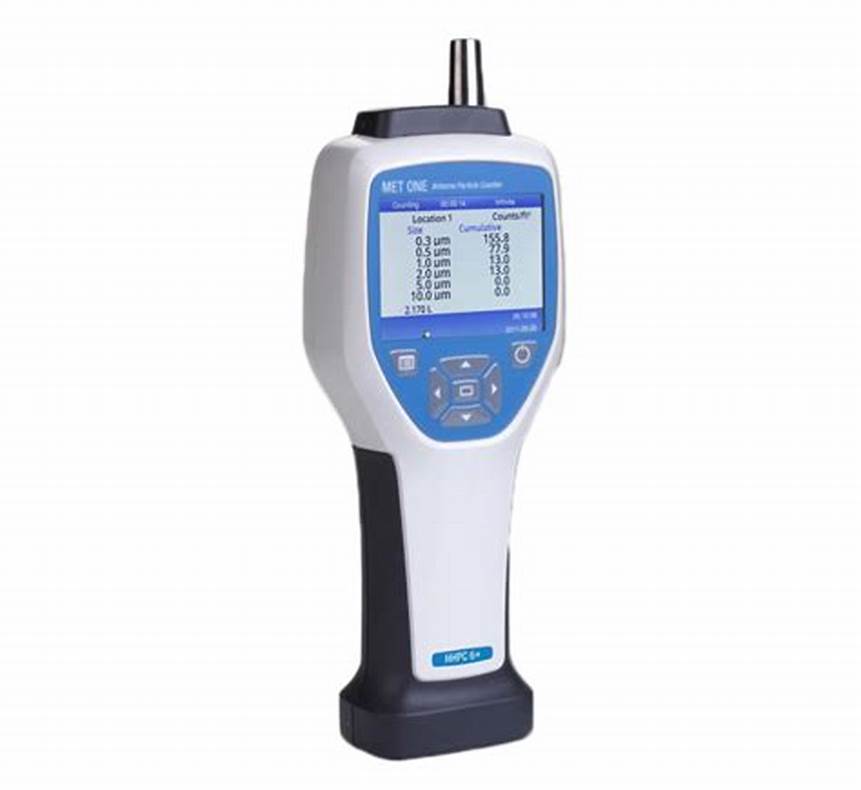
How Particle Counters Work?
Particle counters are used in cleanrooms to count and size airborne particles, ensuring the cleanroom maintains proper functionality and meets critical certification standards.
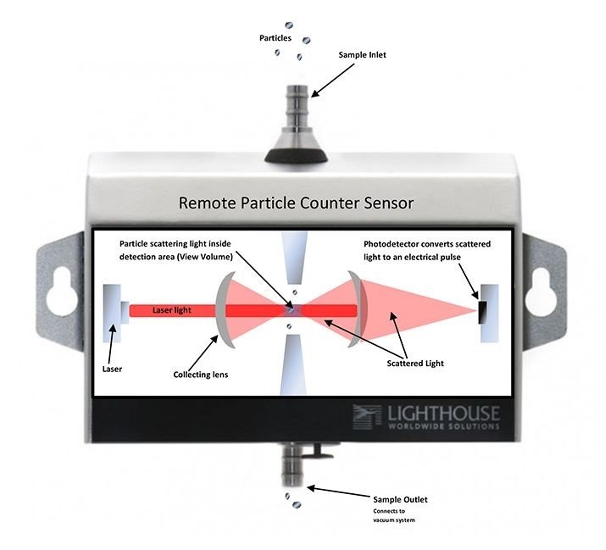
A vacuum is generated using a pump to draw air into the particle counter from outside. This vacuum pulls air through the inlet via a laser diode and expels it through the exhaust port. As air passes through the inlet, it is compressed to achieve the most precise light scattering readings possible.
When air traverses the diode, it reflects light, causing light scattering. Larger particles reflect more light. This is where the photodetector comes into play. The photodetector converts light energy into a voltage signal. Through this process, we can quantify the physical size of particles and present the particle count.
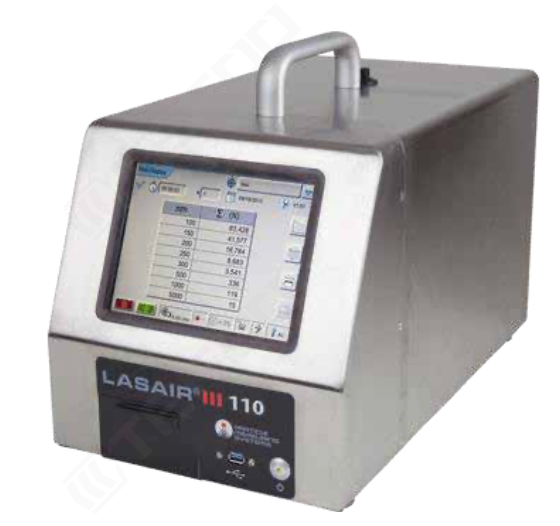
Basic Components of a Light Scattering Particle Counter
Light Source: The light source is a critical component of the particle counter, significantly impacting the instrument’s performance.
Measurement Chamber: The measurement chamber is the space where particles are observed, with sampled air passing through it. These components enable the particle counter to move air through the sensor block and detect particle size via light scattering.
Photodetector: The photodetector is a photoelectric conversion device that transforms scattered light energy into electrical signals.
Flow Monitoring: The instrument is calibrated to 0.1 cfm (cubic feet per minute) or 1 cfm, primarily to facilitate cleanliness calculations compliant with Fed-Std-209E.
Air Pump and Filter: The air pump is located inside the instrument, generating the sampling flow.
Circuit System: Particles of different sizes are converted by the dust particle counter’s photoelectric system into electrical pulse signals of varying amplitudes (voltages). Larger particles produce higher pulse voltages.
These components enable the particle counter to move air through the sensor block and detect particle size via light scattering.
Dust particle counters are generally not inexpensive. Proper use and maintenance of dust particle counters not only reduces damage to the instrument but also extends the service life of the dust particle counter.
Monitoring Particle Size and Its Importance
The only way for particle counters to detect minute particles is through high-precision lasers. For example, here are the sizes of some common particles:
Average human hair: 100 micrometers
Salt grain: 60 micrometers
Pollen: 15 micrometers
Bacteria: 5 micrometers
Viruses: 0.1 micrometers
COVID-19 virus: 0.06 to 0.14 micrometers
ISO 14644-1:2015 defines particles smaller than 0.1 micrometers as ultrafine particles and those larger than 5 micrometers as macroparticles. However, advanced technologies, such as imaging techniques, are driving us to detect even smaller particles, including those at the nanoscale.
Understanding particle size within cleanrooms is critical for both production and certification. Cleanroom certification mandates particle concentration levels below acceptable limits based on cleanroom class, tested particle size, and sample volume derived from cleanroom operations—factors including the number of HEPA filters, filter type, and air changes per hour.
How are batteries customized for dust particle counters?
TEFOO’s standard lithium batteries are recommended. These batteries facilitate indoor and outdoor operations for personnel, providing continuous, efficient, and stable mobile power supply—the primary guarantee for the normal functioning of such equipment.
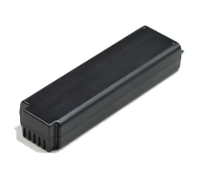
TEFOO’s power solution utilizes Panasonic’s high-performance 18650 cells, enabling the entire battery to deliver high energy density, lightweight construction, compact size, extended cycle life, superior safety, and excellent consistency. The battery is extremely user-friendly and can be directly swapped for original batteries on-site.