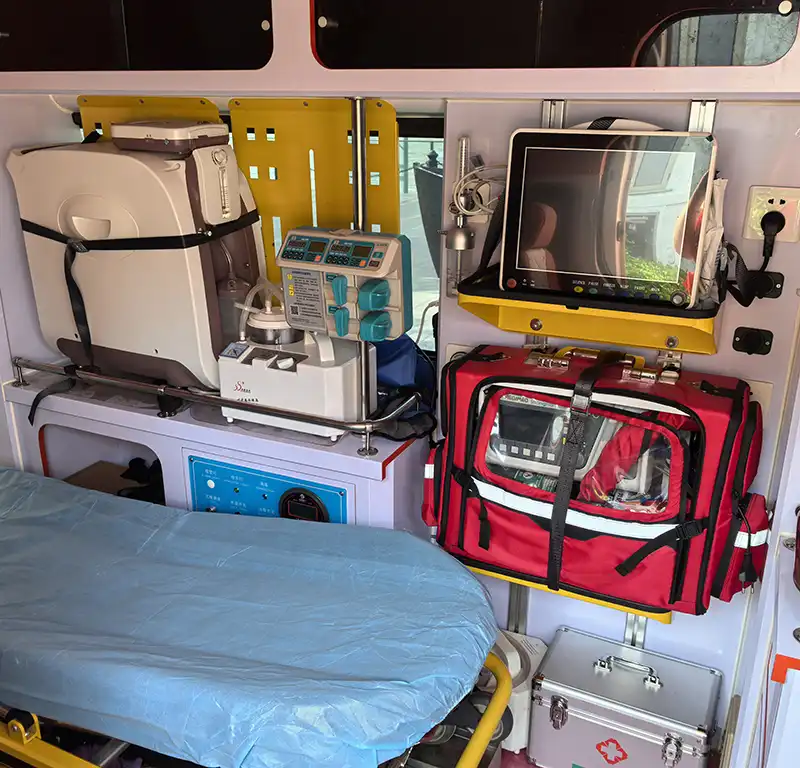
-260719-4-edited.png)

10.8V Infusion Pump Battery: Design, Safety, and SMBus Smart BMS Explained
An infusion pump delivers medication, fluids, or nutrition with dosing accuracy that can be a matter of life and death. Behind that accuracy sits a component clinicians rarely think about: the battery. In the majority of portable and transport infusion pumps on the market, that battery is a 10.8V lithium-ion pack — a 3-series cell configuration that has become the de facto power platform for the device class.
This guide explains what actually goes into a 10.8V infusion pump battery, why it cannot be treated like a consumer power bank, which standards govern it, and what a medical device OEM should verify before qualifying a battery supplier.
Why Infusion Pumps Need a Purpose-Built Battery
Infusion pumps are regulated as Class II medical devices in the United States under 21 CFR 880.5725, and their basic safety and essential performance are governed internationally by IEC 60601-2-24 (IEC Webstore). The battery is not an accessory bolted on afterwards — it is part of the medical electrical system and must support the device’s safety and performance requirements.
Three characteristics separate a pump battery from a consumer pack:
- Dosing continuity under load. A pump draws pulsed, motor-driven currents. The battery must hold stable voltage under these transients so the pumping mechanism never stalls mid-dose.
- Predictable run-time intelligence. Clinical staff need accurate state-of-charge (SOC) and remaining run-time data. A dumb pack cannot provide this; a smart pack with SMBus communication can.
- Fail-safe behavior. In a hospital, a battery failure is not an inconvenience — it can interrupt therapy. The pack must degrade predictably, report its own faults, and never present a fire or toxicity risk to patients or staff.
The 10.8V platform (three 3.6V lithium-ion cells in series) offers the right balance of power headroom, motor compatibility, and pack volume for mid-size pumps — which is why it dominates the category.
The 10.8V Architecture: What “3S” Actually Means
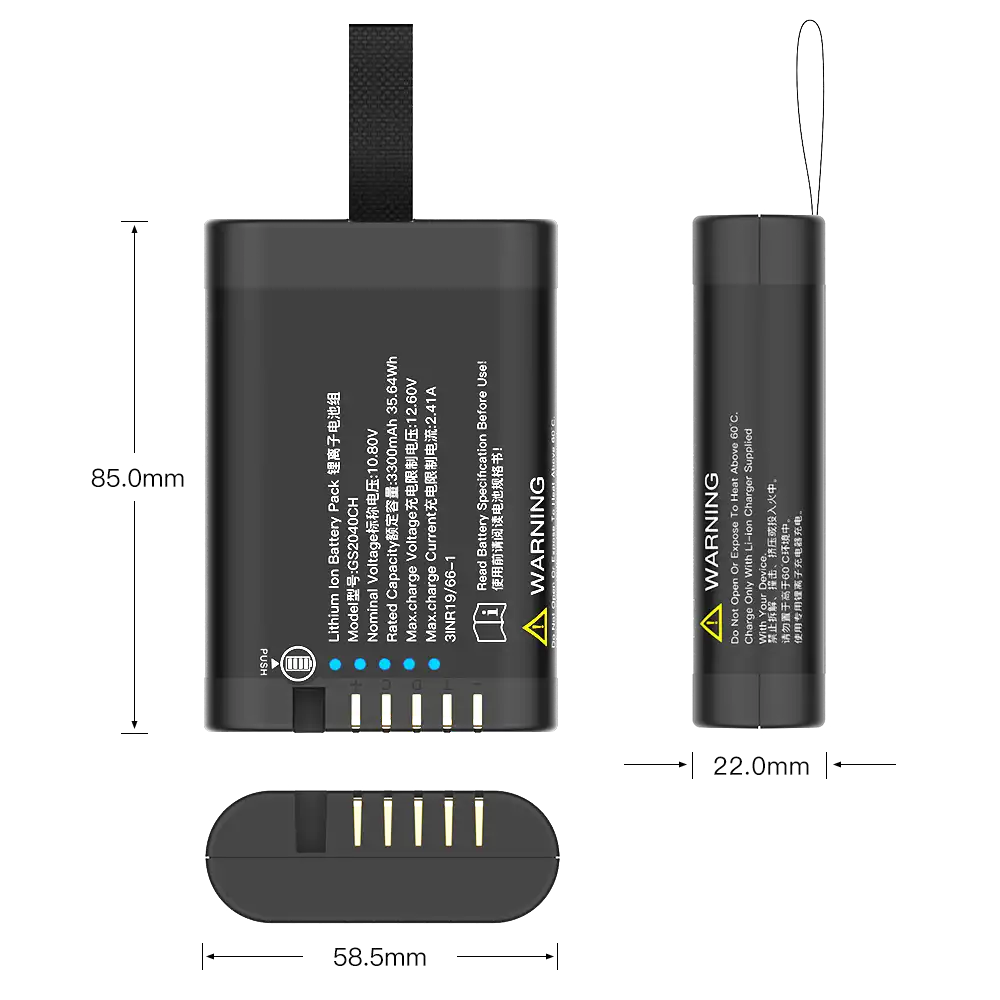
A 10.8V infusion pump battery is, at its core, a 3-series (3S) lithium-ion configuration. The nominal voltage is 3.6V per cell × 3 = 10.8V, with a full-charge voltage of 12.6V (4.2V × 3) for standard lithium cobalt / NMC chemistry, or 12.3V for cells rated at 4.1V.
Two engineering realities follow from this architecture:
- Cell matching matters. In a series string, the weakest cell limits the pack. Cells must be matched for capacity, internal resistance, and self-discharge at the pack level, or the pack will age unevenly and trip protection early.
- Cell balancing is mandatory. Series cells drift apart over charge/discharge cycles. A 3S medical pack needs active or passive balancing within the BMS to keep every cell in its safe voltage window — a requirement that a simple protection circuit cannot meet.
Typical capacity ranges for infusion pump packs fall between 2,200 mAh and 5,200 mAh depending on pump power draw and target battery life, with pouch and cylindrical formats both common. The physical envelope — width, length, mounting points, connector orientation — is nearly always custom to the pump’s mechanical design.
The Smart Battery: SMBus Communication and the BMS
The defining feature of a modern 10.8V infusion pump battery is its smart BMS with SMBus (System Management Bus) communication. The Smart Battery System (SBS) data specification, maintained by the Smart Battery System Implementers Forum (SBS-IF), defines how the pack reports its state to the host device (Smart Battery Data Specification, SBS-IF).
Through the SMBus interface, the battery continuously reports:
- Relative and absolute state of charge (SOC) — the percentage clinicians and the pump UI rely on
- Remaining capacity and run-time estimates
- Voltage, current, and temperature of the pack
- Charge/discharge cycle count and state of health (SOH)
- Fault and alarm status, including over-voltage, under-voltage, over-temperature, and short-circuit events
This data channel turns the battery into an active participant in pump safety. When the host detects a low-SOC or fault condition, the pump can warn staff, switch to mains power, or initiate a controlled shutdown — behavior that a passive protection IC cannot support.
For the OEM, this means the battery supplier must be able to develop and validate BMS firmware against the pump’s own software, tune the fuel gauge for the pump’s real load profile, and support custom SMBus command sets where the device requires them. This is firmware-level engineering, not off-the-shelf sourcing — and it is one of the most common reasons pump OEMs move away from consumer battery vendors.
Safety and Protection Layers in a 10.8V Medical Pack
A medical battery is judged on how it behaves when something goes wrong. A properly engineered 10.8V infusion pump battery layers protection at multiple levels:
Electrical protection (BMS level)
- Over-charge and over-discharge cutoffs per cell, not just per pack
- Over-current and short-circuit protection with fast response
- Cell balancing to prevent cell-level over-voltage during charging
Thermal management
- Temperature sensing at multiple points in the pack
- Charge and discharge derating outside safe temperature windows
- Thermal runaway mitigation through cell selection and pack design
Mechanical design
- Vibration and shock resistance for transport and pump operation
- Connector retention and keying to prevent reverse insertion or partial mating
- Flame-retardant enclosure materials consistent with the medical electrical equipment standard’s requirements
End-of-life behavior
- Accurate SOH reporting so the hospital can plan battery replacement
- Gradual, predictable capacity fade rather than sudden failure
- Safe state handling for storage, shipping, and disposal
Each of these layers must be documented and tested. In our experience building medical packs, the validation data — not the bill of materials — is what ultimately earns a battery its place in a regulated device.
Regulatory and Standards Compliance: The Non-Negotiables
Compliance is the backbone of trust in the medical battery supply chain. For a 10.8V infusion pump battery intended for global markets, the relevant framework includes:
| Standard / Regulation | Scope | Relevance to the Battery |
| IEC 60601-2-24:2012 | Basic safety and essential performance of infusion pumps and controllers (IEC) | Defines the system-level performance the battery must support; the pump’s battery-related requirements trace back to this standard |
| IEC 62133-2:2017+A1:2021 | Safety requirements for portable sealed lithium cells and batteries (IEC) | The core cell- and pack-level safety standard for lithium systems in portable applications |
| ISO 13485:2016 | Quality management systems for medical devices (ISO) | The QMS framework the battery manufacturer must operate under to serve medical device OEMs |
| UN 38.3 | Transport of dangerous goods — lithium battery testing (IATA guidance) | Required for air and ground transport of the battery; certification evidence must accompany shipments |
| 21 CFR 880.5725 (FDA) | Infusion pump device classification — Class II (eCFR) | Sets the regulatory context for the finished pump; battery documentation supports the pump OEM’s submissions |
Two practical points for OEMs:
- Ask for the battery manufacturer’s ISO 13485 certificate and check its scope. A general “battery company” without a medical-device QMS cannot credibly support a regulated pump program.
- Request the IEC 62133-2 test reports and UN 38.3 summary documents. These should be current, cover the actual cell and pack configuration, and be traceable to the production design — not a generic report for a similar-looking product.
What a Medical Device OEM Should Verify Before Qualifying a Supplier
Selection criteria go beyond price and lead time. Based on what we see when medical device OEMs audit battery manufacturers, these are the dimensions that separate a genuine medical battery partner from a general pack assembler:
- QMS and certification depth. ISO 13485 certified, with design controls and documented risk management. A medical battery is a component of a safety-critical system; its manufacturer should operate like one.
- BMS firmware capability. Does the supplier develop its own SMBus firmware and fuel-gauge algorithms? Can they adapt the data set to your pump’s display and alarm logic? This is the single biggest differentiation between a smart medical pack and a commodity pack.
- Validation infrastructure. In-house environmental testing (temperature, humidity, vibration), electrical safety testing, and aging/cycle testing. Evidence of test execution matters more than claimed “quality”.
- Traceability. Batch-level traceability of cells, PCBA, and final assembly. If a field issue occurs, the manufacturer must be able to isolate the affected serial range.
- Engineering collaboration. Will they co-develop the mechanical envelope, connector, and charging algorithm with your team? Medical pack development is iterative, not transactional.
- Regulatory support. Will they supply the documentation pack — cell certifications, test reports, MSDS, UN 38.3 — in the format your regulatory affairs team needs for 510(k), CE, or other submissions?
Frequently Asked Questions
Why 10.8V specifically for infusion pumps?
10.8V (3S) provides ample voltage headroom for the pump’s motor and electronics while keeping the pack compact enough to fit mid-size pump enclosures. It has become the standard platform across the category, which also means mature, well-documented supply chains.
Can a 10.8V battery be replaced with an 11.1V one?
The terms are sometimes used interchangeably for 3S lithium packs: 10.8V is the nominal voltage at a 3.6V-per-cell rating, while 11.1V corresponds to a 3.7V-per-cell rating. The real constraints are the pump’s voltage window and the BMS firmware — the pack must be specified for the exact device design, not chosen by label.
Does every infusion pump battery need SMBus?
Not every legacy design does, but any pump that displays accurate run-time, remaining capacity, or battery health data needs a smart pack. For new designs, SMBus-capable packs are the industry direction and simplify regulatory documentation of battery-related alarms.
What documentation should a supplier provide for a new project?
At minimum: ISO 13485 certificate, IEC 62133-2 test reports, UN 38.3 summary, MSDS, cell datasheets, and a validated BMS firmware specification. For serial production, expect batch traceability records and incoming inspection reports.
About TEFOO
TEFOO is a medical battery manufacturer specializing in intelligent lithium battery packs for infusion pumps and other medical devices. We develop our own SMBus smart BMS firmware, engineer custom 10.8V pack architectures around each device’s mechanical and electrical constraints, and operate under a medical-device quality management system — from cell selection through firmware validation to serial production.
If you are qualifying a battery partner for an infusion pump program, we are happy to walk through your voltage window, load profile, and regulatory documentation needs. Contact our engineering team to start the conversation.