-260719-4-edited.png)

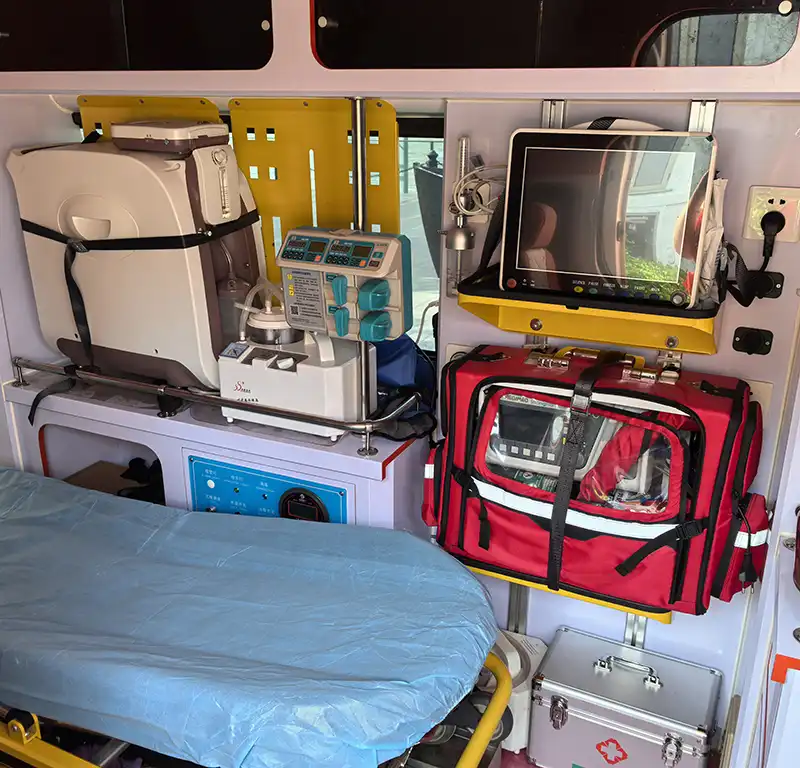
For a patient receiving mechanical ventilation, the power source is not a convenience feature; it is part of the life-support chain. When mains power fails, when an ambulance is rolling down a highway, or when a patient is moved between wards, the battery alone keeps the ventilator delivering breaths.
The short version: a ventilator battery is a safety-critical subsystem. It must survive single-fault conditions, deliver predictable runtime, communicate its state honestly, and remain traceable for years after shipment. The sections below walk through the engineering decisions behind each of those requirements.
1. Why a Ventilator Battery Is a Safety-Critical System
In consumer electronics, a battery failure is an inconvenience; in a ventilator, it is a clinical event. Medical electrical equipment is evaluated against IEC 60601-1 [1], which holds the device to basic safety and essential performance, including behavior under single-fault conditions. If the AC supply disappears and the battery cannot carry the essential performance of ventilation, the design has failed its primary duty.
This changes the design philosophy at every layer. Cell selection is chosen for controlled failure modes rather than maximum energy. The battery management system is built for fail-safe behavior rather than convenience. Mechanical construction is validated for shock and vibration, not just drop survival. And every unit is traceable to its build batch, test records, and firmware version—because when an OEM files a device registration, regulators will ask for exactly that evidence.
2. Hospital vs. Ambulance Ventilator: Two Different Duty Cycles
One of the most common mistakes I see in battery procurement is asking for “a battery for a ventilator” as if one specification fits every ventilator. It does not. An ICU ventilator and an ambulance transport ventilator impose fundamentally different duty cycles on the battery.
In the hospital, the ventilator runs from AC mains and the battery is a backup. The environment is climate-controlled, the device sits on a cart, and the battery typically needs to sustain ventilation through a power outage or an intra-hospital transfer—commonly on the order of two to four hours, depending on the product and ventilation settings.
In the ambulance, the battery may be the primary power source for the entire mission. The vehicle supplies 12 V or 24 V with transients, cranking dips, and alternator noise. The pack must tolerate continuous vibration and shock from rough roads—EN 1789:2020 addresses road ambulance equipment [7]—and a wide temperature range that includes hot vehicle cabins in summer, with the emergency medical services (EMS) environment defined in IEC 60601-1-12 [3]. Hot-swappable operation is highly desirable so crews can extend runtime without interrupting ventilation. Transport ventilators themselves are covered by ISO 80601-2-84:2020 [5], while the EU’s long-standing EN 794-3 [6] is still cited in many programs. Runtime targets vary widely by product; commercial lithium-powered transport ventilators list internal runtimes on the order of ten to fifteen hours depending on settings [13][14].
Table 1. Hospital vs. Ambulance Ventilator Battery Requirements
| Requirement | Hospital (ICU) Ventilator | Ambulance / Transport Ventilator |
| Primary role | Backup during mains failure and intra-hospital transfer | Often the primary power source during the whole transport mission |
| Power environment | Clean AC mains; stable internal rails | 12/24 V vehicle supply with transients, cranking dips, alternator noise |
| Typical runtime target | On the order of 2–4 hours (product-dependent) | Multi-hour transfers; hot-swappable for extended missions |
| Mechanical environment | Benign; wheeled-stand handling | Continuous vibration, shock, tilt, rough roads (EN 1789:2020) |
| Temperature range | Controlled room climate | Wide range including hot vehicle cabins; EMS environment (IEC 60601-1-12) |
| Communication | Increasingly expected for runtime and health data | Essential: honest runtime/health reporting over SMBus |
| Design priority | Energy density and quiet operation | Ruggedness, thermal stability, hot-swap, predictable runtime |
The takeaway: specify the battery from the duty cycle, not from the device name. Ask first where the ventilator will be used and what the longest uninterrupted period the battery must survive actually is.
3. Cell Chemistry Selection
Chemistry is where safety is decided before the pack is even assembled. For ventilator programs we work with two families of lithium-ion cells, and we qualify both against IEC 62133-2:2017+A1:2021 [9].
Nickel-manganese-cobalt (NMC) cells offer the highest energy density, which matters in an ICU ventilator where the battery lives inside a tight enclosure and must provide meaningful backup without stealing space from the electronics. The trade-off is that NMC requires disciplined thermal management and a robust BMS, because energy density and failure energy scale together.
Lithium iron phosphate (LFP) cells trade some energy density for significantly better thermal stability, longer cycle life, and a wider operating temperature window. For ambulance packs that spend summers in hot cabins, sit at high state of charge for long periods, and cycle frequently, LFP is frequently the better engineering choice.
Two rules govern our cell selection process. First, the cell must carry IEC 62133-2 certification from its manufacturer, and we audit batch consistency and traceability; cells are the one component we do not substitute casually. Second, we use only cells qualified for portable medical applications—a cell that performs well in another application class is not automatically safe or predictable inside a ventilator. We also characterize the load itself: ventilation is not a constant resistive load, and the pack must hold its voltage across the peak-current pulses of the breathing cycle.
4. Electrical Architecture: the Smart Battery (BMS + SMBus)
Capacity planning starts from the load envelope. We multiply the ventilator’s power profile by the target runtime, then add margins for aging and temperature: a pack that ends its useful life at roughly 80% of initial state of health (SOH) must still meet the runtime specification. The result determines the nominal capacity and the series/parallel configuration.
The battery management system is the intelligence of the pack. It performs state-of-charge (SOC) and state-of-health estimation, balances cells, and enforces over-voltage, under-voltage, over-current, and over-temperature limits—with a second protection layer, such as a chemical fuse or secondary protector, that acts independently of the primary electronics.
Where TEFOO adds particular value is the communication layer. Ventilators increasingly use the SMBus and the Smart Battery Data Specification [11][12] so the host device can read RemainingCapacity, RunTimeToEmpty, RelativeStateOfCharge, DesignCapacity, and cycle count in real time. For clinicians this is not a luxury: during a transport, the difference between a battery that reports honest remaining time and one that does not can change operational decisions. The smart-battery interface also lets the ventilator escalate alarms as the battery crosses defined thresholds.
5. Mechanical, Thermal and Environmental Design
An ambulance battery pack is a mechanical component as much as an electrical one. EN 1789:2020 [7] and IEC 60601-1-12 [3] define environments that include continuous vibration, mechanical shock, wide temperature swings, and altitude changes. The pack structure, cell interconnection and welding process, connector strain relief, and mounting all have to be engineered and tested for these conditions—not assumed.
Thermal design deserves its own paragraph. In a closed vehicle cabin on a summer day, ambient temperature can climb well above the comfort range while the pack is charging. Our designs include thermally conductive paths, charge-temperature limits, and, where needed, passive insulation to keep cells within their rated window. Cold is handled too: charging below the cell’s low-temperature threshold is inhibited by firmware, because charging a cold lithium cell is a well-understood hazard.
Practical details matter as much as analysis: keyed connectors that cannot be inserted incorrectly, locking mechanisms that survive vibration, hot-swap contacts rated for repeated mating cycles, and an enclosure that meets the device’s ingress-protection requirements. These are the details that separate a pack that works in the field from one that only works in the lab.
6. Safety and Compliance Roadmap
Compliance is a program, not a certificate. For a ventilator battery program we maintain a standards map covering the battery as a component and the ventilator as a finished medical device. Table 2 summarizes the standards that appear in essentially every ventilator program we work on.
Table 2. Compliance Roadmap for a Ventilator Battery Program
| Standard | Scope | What it means for the battery |
| IEC 60601-1 (Ed 3.2) [1] | Basic safety and essential performance; single-fault conditions | Battery must not create single-fault hazards; isolation, enclosure, markings |
| IEC 60601-1-2 (Ed 4.1) [2] | Electromagnetic compatibility | Battery electronics must neither disturb ventilation nor be disturbed by it |
| IEC 60601-1-12 (Ed 1.1) [3] | EMS environment | Temperature, humidity, altitude and vibration profiles for emergency use |
| ISO 80601-2-12:2023 [4] | Critical care ventilators | Reference for ICU ventilator system behavior, including power-failure response |
| ISO 80601-2-84:2020 [5] | EMS-environment ventilators | Transport ventilator performance, including power-source changeover |
| EN 794-3:2000+A2:2009 [6] | Emergency and transport ventilators (EU legacy) | Historical reference still cited in European transport ventilator programs |
| EN 1789:2020 [7] | Road ambulances | Vehicle integration: vibration, mounting, 12/24 V compatibility |
| IEC 62133-2:2017+A1:2021 [9] | Portable sealed lithium cells and batteries | Cell- and pack-level safety tests: overcharge, short circuit, thermal |
| UN 38.3 (Rev. 8) [10] | Transport of lithium batteries | T1–T8 tests required for air, sea and road transport |
| ISO 13485:2016 [8] | Quality management for medical devices | Design control, risk management and traceability across the lifecycle |
A practical clarification that saves OEMs time: the battery pack is a component. Component-level tests—IEC 62133-2 safety, UN 38.3 transport testing [10], and environmental and EMC tests at the pack level—are our responsibility, and we document them completely. Certification of the finished device under IEC 60601-1 [1] and its collateral standards is the OEM’s responsibility, and we support it with design documentation, test reports, and traceability records. A battery vendor that promises to “certify your ventilator” is overpromising; a vendor that hands you clean component-level evidence is the one you want.
7. Validation We Run Before Shipping
Every production batch at TEFOO goes through formation, capacity grading, internal-resistance and open-circuit-voltage checks, and SOC calibration. Beyond that, our qualification programs run cycle-life tests to the OEM’s defined end of life, high- and low-temperature storage, vibration, shock and drop tests, over-charge, over-discharge and short-circuit abuse tests, fault injection on the BMS, and EMC testing at the component level.
Real-world lessons are where this investment pays off. In one ambulance program, early prototypes showed SOC drift after repeated exposure to cabin temperatures above 50 °C; we traced it to the impedance model and added temperature compensation plus periodic recalibration. In another, hot-swap testing revealed that the first connector candidate could not handle the number of mating cycles a crew performs in a year, so we replaced it with a higher-durability contact. Neither issue would have surfaced in a datasheet review; both surfaced because we test the way the product is used.
Traceability closes the loop. Every pack carries a unique serial number tied to its cell batches, firmware version, test results and design history file, so the OEM can answer any regulatory question about a specific unit years after shipment.
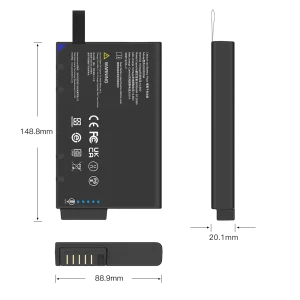
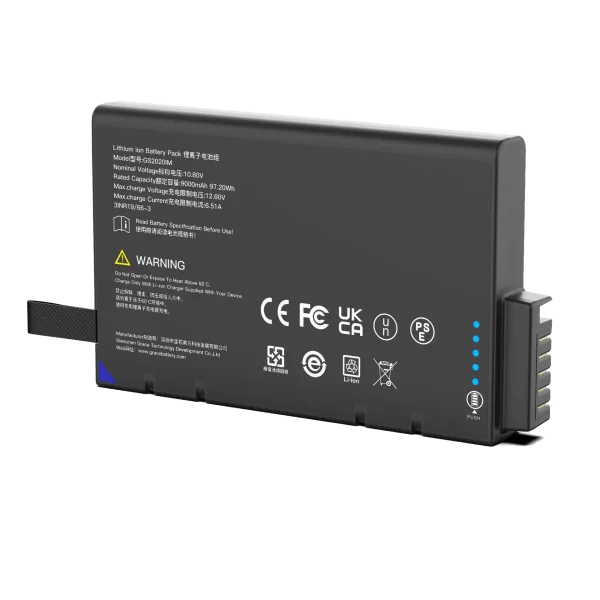
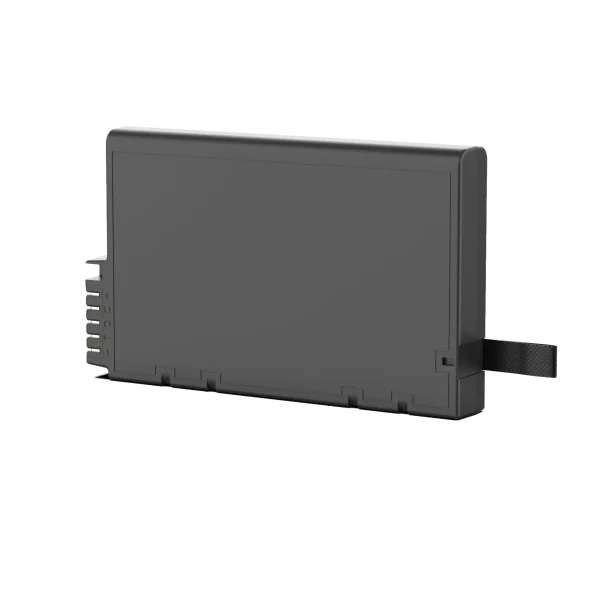
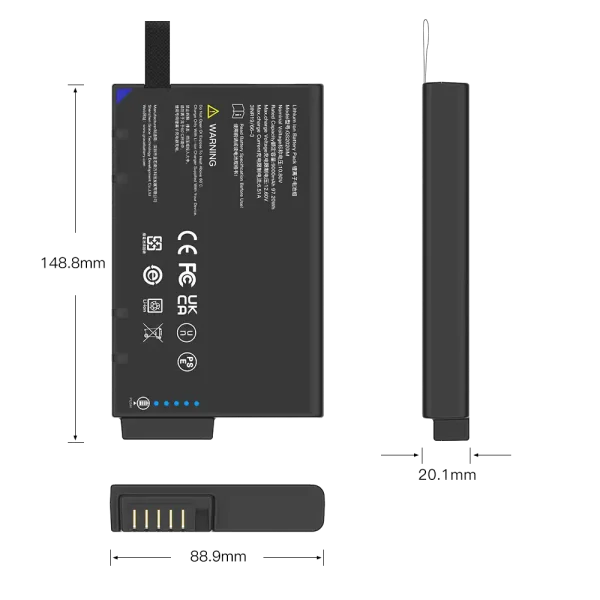
GS2020IM
10.8V/9300mAh/97.2Wh
8. Closing Thoughts
A custom battery pack for a medical ventilator—or an ambulance ventilator—is not a box of cells with a label. It is a safety system, a data source and a mechanical component, engineered around a specific duty cycle and validated for a specific environment. Done properly, it disappears into the product and does its job for years; done casually, it becomes the weakest link in the life-support chain.
If you are specifying a ventilator battery program, we would be glad to review your requirements. Contact the TEFOO engineering team, and we will start from your load envelope and duty cycle—not from a catalogue.
References
[1] IEC 60601-1:2005+AMD1:2012+AMD2:2020 CSV (Ed 3.2), Medical electrical equipment – Part 1: General requirements for basic safety and essential performance. IEC Webstore. https://webstore.iec.ch/publication/67497
[2] IEC 60601-1-2:2014+AMD1:2020 CSV (Ed 4.1), Medical electrical equipment – Part 1-2: Collateral Standard: Electromagnetic disturbances – Requirements and tests. IEC Webstore. https://webstore.iec.ch/en/publication/2590
[3] IEC 60601-1-12:2014+AMD1:2020 CSV (Ed 1.1), Medical electrical equipment – Part 1-12: Collateral Standard: Requirements for ME equipment and ME systems intended for use in the emergency medical services environment. IEC Webstore. https://webstore.iec.ch/en/publication/2589
[4] ISO 80601-2-12:2023, Medical electrical equipment – Part 2-12: Particular requirements for basic safety and essential performance of critical care ventilators. ISO/IEC. https://www.iso.org/obp/ui/en/#!iso:std:82707:en
[5] ISO 80601-2-84:2020, Medical electrical equipment – Part 2-84: Particular requirements for the basic safety and essential performance of ventilators for the emergency medical services environment. ISO/IEC. https://www.iso.org/obp/ui/en/#!iso:std:72441:en
[6] EN 794-3:2000+A2:2009, Lung ventilators – Part 3: Particular requirements for emergency and transport ventilators. CEN. https://www.iteh.eu/catalog/standards/sist/b196da80-b0c5-449b-be38-3e5c59aeeae8/sist-en-794-3-2000a2-2009
[7] EN 1789:2020, Medical vehicles and their equipment – Road ambulances. CEN. https://www.iteh.us/catalog/standards/sist/2003c69f-8bef-43c3-9764-4e99bd52ab34/sist-en-1789-2020
[8] ISO 13485:2016, Medical devices – Quality management systems – Requirements for regulatory purposes. ISO. https://www.iso.org/es/contents/data/standard/05/97/59752.html
[9] IEC 62133-2:2017+A1:2021, Secondary cells and batteries containing alkaline or other non-acid electrolytes – Safety requirements for portable sealed secondary cells, and for batteries made from them, for use in portable applications – Part 2: Lithium systems. IEC Webstore. https://webstore.iec.ch/publication/32662
[10] United Nations, Recommendations on the Transport of Dangerous Goods: Manual of Tests and Criteria, Eighth revised edition and Amendment 1, Section 38.3 (ST/SG/AC.10/11/Rev.8). UNECE. https://unece.org/sites/default/files/2025-07/ST-SG-AC10-11-Rev8-Amend1e.pdf
[11] Smart Battery Data Specification, Revision 1.1. Smart Battery System Implementers Forum. https://sbs-forum.org/specs/sbdat110.pdf
[12] System Management Bus (SMBus) Specification, Version 2.0. Smart Battery System Implementers Forum. https://smbus.org/specs/smbus20.pdf
[13] Medtronic, Newport HT70 Plus ventilator product information (hot-swappable battery, up to ~10 hours). https://www.medtronic.com/covidien/en-nz/products/mechanical-ventilation/newport-ht70-plus-ventilator.html
[14] Philips, Trilogy Evo portable ventilator product information (15-hour battery life). https://www.philips.nl/healthcare/product/HC0055500/trilogy-evo-portable-hospital-to-home-ventilator