
By Senior Battery R&D Engineer, TEFOO | Published November 2026
Executive Summary
Patient monitors are Class II medical devices that run continuously at the bedside, in transport, and during surgical procedures. A single battery failure can interrupt ECG, SpO2, NIBP, and temperature readings—directly affecting clinical decisions. For patient monitor manufacturers, selecting or customising a lithium ion battery pack is therefore not a procurement decision; it is a medical-device engineering decision that must satisfy ISO 13485, IEC 62133-2, UL 1642/2054, UN38.3, EU MDR 2017/745, and—from 2026—the EU Battery Regulation 2023/1542.
Based on 2026 market data, the global medical batteries market reached approximately USD 3.54 billion in 2026, with the medical lithium-ion cell segment alone valued at roughly USD 1.75 billion and growing at a 6–9% CAGR through 2030. This guide gives monitor OEMs a senior-engineer-level view of cell selection, smart BMS architecture, SMBus communication, regulatory timing, vendor evaluation criteria, and the lessons from a recent FDA Class II recall of a 10.8V SMBUS patient-monitor battery.
1. Why Patient Monitor Battery Packs Are Different From Consumer Packs
1.1 The failure mode is clinical, not convenience
A consumer laptop battery dying means downtime. A patient monitor battery dying during anaesthesia or patient transfer means loss of vital-sign visibility. Under IEC 60601-1 and its collateral standards, the battery is part of the medical device’s essential performance loop. This imposes three engineering constraints that rarely apply to consumer packs:
- High cycle life under partial state-of-charge (PSoC) operation, because hospital carts leave monitors docked at 90–100% for weeks.
- Predictable end-of-discharge warning communicated digitally to the monitor firmware, so clinicians are not surprised by a sudden blackout.
- No thermal runaway propagation under abuse, because packs are stored inside patient-connected equipment and near the patient’s body.
1.2 Voltage platforms commonly used in modern monitors
Most mid-range and high-end patient monitors released after 2020 use one of three lithium-ion platforms. Understanding which platform your product targets is the first OEM specification decision:
| Platform | Cell Configuration | Typical Capacity | Typical Use Case |
| 10.8V / 11.1V | 3S1P or 3S2P (18650 or 21700) | 2.6Ah–4.5Ah | Bedside vital-signs monitors, transport monitors |
| 14.4V / 14.8V | 4S1P or 4S2P | 2.0Ah–4.0Ah | High-end modular monitors, anaesthesia monitors |
| 7.4V | 2S1P or 2S2P (pouch cells) | 2.5Ah–5.0Ah | Compact handheld/wearable patient monitors |
Table 1. Common lithium-ion voltage platforms in patient monitors (2026). Source: TEFOO Energy OEM engineering database.
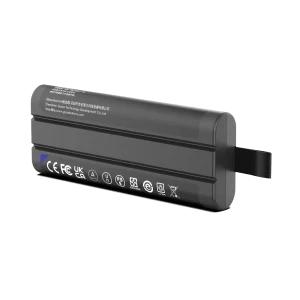
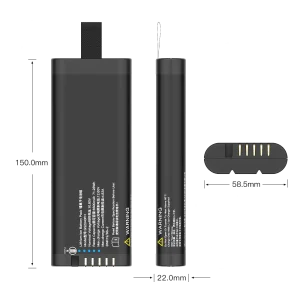
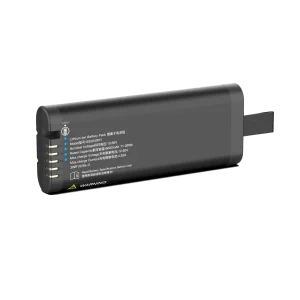
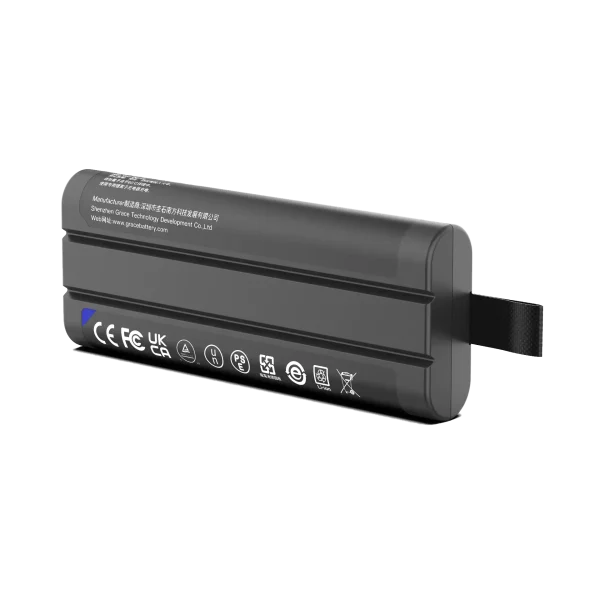
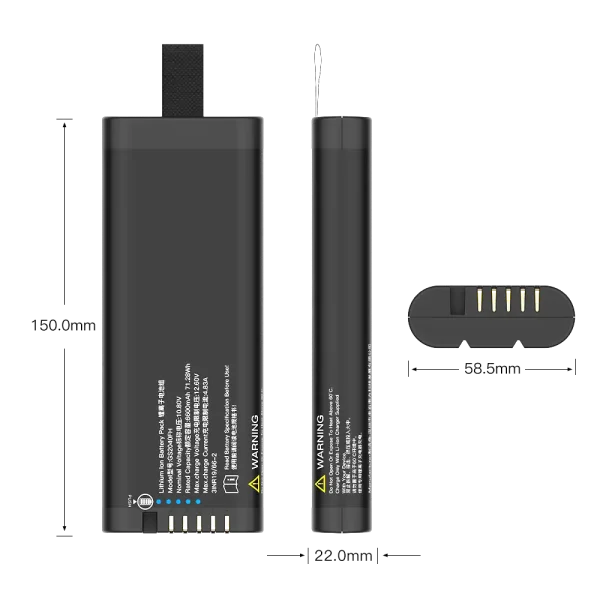
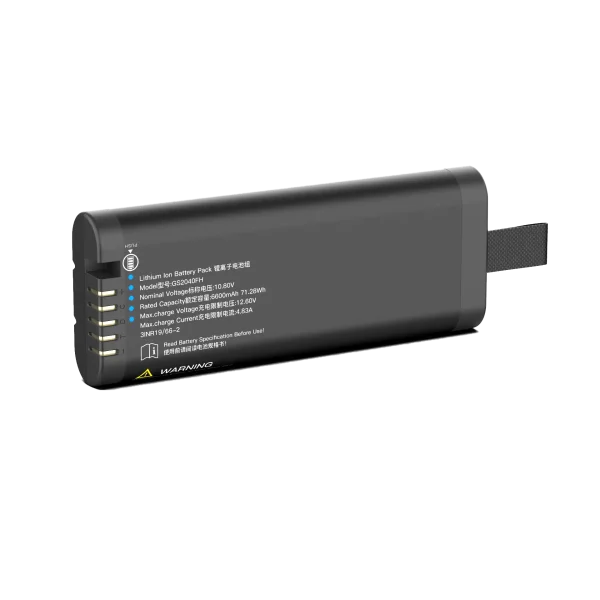
GS2040FH
10.8v/6900mAh/71.28h
2. The 2026 Regulatory Landscape You Must Design Against
A 2026 patient-monitor battery pack shipped into the EU, US, UK, or Japan must carry a layered set of approvals. Below is the verification matrix that a competent OEM supplier should be able to hand you at sample stage—not after production.
| Standard / Regulation | Scope | 2026 Status & Note |
| IEC 62133-2:2017+A1:2021 | Safety of portable sealed secondary lithium cells | Harmonised under EU; required for CE and for FDA-recognised consensus standard pathway. |
| UL 1642 / UL 2054 | Lithium cell and pack safety for North America | UL 2054 is the pack-level standard; UL 1642 governs the cells. Most US hospital tenders require both. |
| UN 38.3 + MSDS/SDS | Transport of lithium-ion cells by air, sea, road | Mandatory for every shipment; test summary must be available before first sea freight. |
| ISO 13485:2016 | Quality management system for medical devices | Applies to the pack manufacturer’s QMS, not just the monitor OEM. Request a valid ISO 13485 certificate and audit report. |
| EU MDR 2017/745 | Medical Device Regulation | The battery is a critical accessory; the OEM’s technical file must include pack test reports, cell traceability, and SDS. |
| EU Battery Regulation 2023/1542 | Battery sustainability, labelling, passport | In force since 17 Aug 2023; applicable from 18 Feb 2024. Labelling requirements apply from 2026, QR code from 2027, and the full Digital Battery Passport for industrial batteries from 18 February 2027. |
| UKCA / PSE / CCC | UK, Japan, China market access | Required separately for those markets; do not assume CE or FCC automatically extends. |
Table 2. 2026 compliance matrix for patient-monitor lithium-ion packs. Sources: IEC, FDA Recognised Consensus Standards database, EUR-Lex Regulation (EU) 2023/1542, European Commission Environment DG.
3. Core Engineering Design Requirements
3.1 Cell selection: brand and chemistry matter clinically
For patient monitors, we generally recommend NMC (nickel-manganese-cobalt) cylindrical cells from tier-1 manufacturers—Panasonic/Sanyo, Samsung SDI, LG Energy Solution, or Murata—rather than generic unbranded cells. The reason is not marketing: tier-1 cells ship with a controlled self-discharge distribution and a verified cycle-life curve under the actual PSoC profile a hospital monitor sees. A generic cell may meet a single IEC 62133 test, but its capacity fade at 80% DoD over 500 cycles can be 15–25% worse, which becomes a warranty problem in year two of field service.
LFP cells are occasionally proposed for cost reasons, but their lower energy density typically forces a 20–30% larger pack for the same runtime—a poor trade inside a handheld monitor where ergonomics are fixed by the mechanical design.
3.2 Smart BMS architecture: what the monitor firmware actually needs
A modern patient-monitor pack is not a dumb power bank. It carries a smart BMS that performs four jobs simultaneously:
- Protection: over-charge, over-discharge, over-current, short-circuit, and over-temperature cut-off—with independent second-level protection (a dedicated safety IC) mandated under IEC 62133-2 for medical applications.
- Fuel gauging: remaining capacity, run-time-to-empty, and state-of-health (SoH) calculated by a gauging algorithm (e.g., TI bq series or equivalent).
- Communication: SMBus v1.1 (or I2C derivative) exposing voltage, current, temperature, remaining capacity, and manufacturer data to the monitor’s power-management firmware.
- Authentication: a secure ID (often via the SMBus or a separate 1-Wire chip) so the monitor can verify that the pack is an approved medical-grade unit—a requirement that hospitals increasingly write into procurement specs to prevent counterfeit packs entering patient areas.
3.3 SMBus register mapping: the hidden integration risk
The most common OEM integration failure is not electrical—it is register mismatch. Two packs that both claim “SMBus compliant” can expose ManufacturerAccess, RemainingCapacity, and FullChargeCapacity at different SMBus addresses, or interpret BatteryStatus bits differently. When this happens, the monitor either shows a generic “check battery” error or, worse, reports an incorrect remaining-time estimate to the clinician.
At design kick-off, request the supplier’s SMBus register map (SMBus v1.1 defined keys plus any custom ManufacturerAccess words) and align it with your monitor firmware team before tooling. A pre-certified reference platform—for example a 10.8V 3300mAh 3S1P pack built around Panasonic cells with SMBus v1.1 and a 5-pin blade connector—can cut this integration cycle by 8–12 weeks.
3.4 Mechanical and environmental design
- Enclosure: UL94 V-0 flame-retardant PC/ABS; gasketed seam for IP41–IP54 where the monitor itself is washable.
- Cycle life target: ≥500 cycles to 80% initial capacity at 23°C, and ≥300 cycles at 40°C operating ambient.
- Operating temperature range: 0–50°C discharge (medical monitors see both refrigerated transport and warm ICU environments).
- Connector: industry-standard blade or D-sub with gold-plated contacts; >5,000 mating cycles per hospital replacement schedule.
4. OEM Battery Pack Vendor Comparison: What to Evaluate
When shortlisting a contract manufacturer for your patient-monitor pack, do not compare on unit price alone. The table below summarises the dimensions our engineering team uses to grade OEM candidates. Use it as your own supplier audit checklist.
| Evaluation Dimension | What to Ask For | Red Flag If Absent |
| Quality system | Valid ISO 13485:2016 certificate; willingness to undergo your medical-device supplier audit. | Only ISO 9001; no ISO 13485. |
| Cell traceability | Cell batch log per pack; full lot genealogy back to Panasonic/Samsung/LG/Murata. | Cells sourced through distributors with no batch record. |
| Pre-certified platforms | Existing packs already certified to IEC 62133-2, UL 2054, UN38.3, CE, UKCA, PSE. | Every project starts from zero certification. |
| Smart BMS & SMBus | In-house BMS firmware team; published register map; gauging algorithm support. | BMS bought off-the-shelf with no firmware ownership. |
| Test & validation lab | Internal or partner lab for altitude, thermal shock, vibration, short-circuit, and abuse tests. | All testing outsourced with no pre-verification. |
| EU 2023/1542 readiness | Plan for carbon-footprint declaration, labelling, QR code, and Battery Passport data structure. | No awareness of the 2027 passport deadline. |
| Field recall support | Procedure for lot-based field action, containment, and 8D reporting. | No documented recall process. |
Table 3. OEM vendor evaluation matrix for medical lithium-ion pack programmes. Source: TEFOO Energy supplier audit practice, 2026.
5. A Real-World Lesson: The October 2026 FDA Class II Recall
In late October 2026, the FDA posted a Class II device recall covering a battery identified as “FLEX-3S2P 10.8V 18650 LI-ION SMBUS” used with affected patient monitor models. Class II is the FDA’s intermediate recall classification—it means the product has a reasonable chance of causing temporary or medically reversible adverse consequences, short of the severe injury category.
For OEM engineering teams, three takeaways emerge from this event:
- SMBus does not equal safety. The pack in the recall was a smart, SMBus-communicating pack; the issue nonetheless required field action. Communication and protection are separate BMS functions and must be validated separately.
- Lot-level traceability is what allowed the recall to be scoped. If your supplier cannot trace cells back to a production lot, a future defect cannot be contained—it becomes a full-market withdrawal.
- Second-level over-current protection must be designed in, not assumed. The pack architecture, connector gauge, and fuse rating should be reviewed against a worst-case short-circuit fault at the pack terminals, not just at the cell.
6. EU Battery Regulation 2023/1542: The 2026–2027 Deadline That Cannot Be Missed
Most medical-device teams are familiar with EU MDR 2017/745, but Battery Regulation 2023/1542 is a parallel regulation that directly applies to your pack—not just to EV batteries. The hard dates confirmed by EUR-Lex and the European Commission Environment DG are:
- 18 February 2024: Regulation became applicable (general provisions).
- 2026: Labelling and marking requirements begin to apply, including the separate collection symbol, capacity marking, and chemical content identification.
- 18 February 2027: Digital Battery Passport becomes mandatory for industrial batteries with capacity above 2 kWh—and, critically, for any battery placed on the EU market as a replaceable or removable component of a medical device.
- Carbon-footprint declaration: methodology delegated acts expected in 2026; declarations follow 12–18 months after the methodology enters into force.
Patient-monitor packs are typically below the 2 kWh threshold, but they are still classified as “industrial batteries” when integrated into medical equipment, and labelling plus due-diligence obligations for raw materials already apply. Ask your pack supplier in 2026 whether their declaration of conformity, cell-batch documentation, and carbon-footprint data structure are ready for the 2027 passport—retrofitting this into an existing SKU in 2027 is significantly more expensive than designing it in now.
7. Frequently Asked Questions
Q1. Can we use generic (unbranded) 18650 cells to reduce cost?
Short answer: not for a Class II medical device. Generic cells may pass IEC 62133-2 once, but their batch-to-batch consistency, cycle-life curve under PSoC, and self-discharge distribution are rarely documented to the level a notified body will accept under MDR 2017/745. The unit-price saving is typically erased by warranty returns and a technical-file gap.
Q2. Is SMBus mandatory for patient monitors?
It is not a legal mandate in every jurisdiction, but it is effectively required by high-end monitor platforms from major OEMs. SMBus v1.1 (or an equivalent I2C smart-bus) is the only practical way to deliver accurate remaining-time estimates and SoH to the monitor UI. Dumb voltage-only packs are increasingly rejected in hospital tenders.
Q3. How long should a patient-monitor battery last in the field?
Design target: ≥500 cycles to 80% capacity at 23°C, which in a typical hospital workload translates to roughly 3–4 years of service. Below 300 cycles, the pack becomes a clinical-reliability problem and a procurement complaint.
Q4. Do we need to certify the pack separately, or does the monitor’s CE cover it?
The monitor’s MDR certificate covers the finished device, but the pack itself must still carry IEC 62133-2, UN38.3, and—where sold separately as a service part—its own CE declaration. Keep pack-level certificates on file even when the pack ships inside the device.
Q5. When should we engage a custom pack manufacturer—at concept stage or after ID is frozen?
At concept stage. The pack voltage, cell format, connector position, and thermal envelope drive the mechanical ID and the monitor’s battery-compartment geometry. Engaging the pack supplier after ID freeze usually forces a compromise in runtime, weight, or connector layout.
Q6. What is TEFOO Energy’s position on the EU 2023/1542 Battery Passport?
As of Q4 2026, TEFOO Energy has begun structuring pack-level data (cell batch, carbon-footprint input, test reports, and SoH history) into a passport-ready data model for medical OEM customers. This is described transparently because our company is itself a pack supplier—see the conflict-of-interest statement at the end of this article.
8. Conclusion
For patient monitor manufacturers, a lithium ion battery pack is a critical medical sub-system, not a commodity. The engineering bar in 2026 is defined by five things: tier-1 cells with documented batch genealogy, a smart BMS with SMBus communication and second-level protection, full compliance with IEC 62133-2 / UL 2054 / UN38.3 / ISO 13485, readiness for EU Battery Regulation 2023/1542 including the 2027 Battery Passport, and a supplier organisation that can demonstrate lot-level traceability because they understand what a Class II recall looks like.
The OEMs that will ship on time and without field actions in 2027 are the ones that treat the pack as a co-development item from the earliest concept phase—aligning voltage platform, register map, connector, and compliance documentation before tooling, not after.
About the Author & Disclosure
The author is a senior lithium-ion battery R&D engineer at TEFOO, a Shenzhen-based OEM/ODM manufacturer of smart lithium-ion battery packs for medical, industrial, and portable instruments. TEFOO ’s medical product line includes ISO 13485-supported, IEC 62133-2 and UN38.3 certified SMBus battery packs for patient monitors, ventilators, infusion pumps, and portable diagnostic equipment.
Conflict of interest: TEFOO is itself a supplier of the type of products discussed in this article. The evaluation criteria, regulatory dates, and engineering recommendations are presented for technical guidance; they are not legal advice, and manufacturers should validate every requirement against their own notified body and regulatory counsel. No specific commercial offer is made here.
References
[1] International Electrotechnical Commission. IEC 62133-2:2017+A1:2021, Secondary cells and batteries containing alkaline or other non-acid electrolytes — Safety requirements for portable sealed secondary lithium cells. https://www.iec.ch/
[2] U.S. Food and Drug Administration. Recognized Consensus Standards: Medical Devices database. Accessed 28 September 2026. https://www.accessdata.fda.gov/scripts/cdrh/cfdocs/cfStandards/
[3] U.S. Food and Drug Administration. FDA recall classification: Class II Device Recall “BATTERY FLEX3S2P 10.8V 18650 LIION SMBUS.” Posted 27 October 2026. https://www.accessdata.fda.gov/scripts/cdrh/cfdocs/cfRes/res.cfm?ID=216585
[4] Regulation (EU) 2023/1542 of the European Parliament and of the Council of 12 July 2023 concerning batteries and waste batteries. EUR-Lex. In force since 17 August 2023; applicable from 18 February 2024. https://eur-lex.europa.eu/legal-content/EN/TXT/?uri=CELEX:32023R1542
[5] European Commission, Environment Directorate-General. Batteries — Sustainability rules for batteries and waste batteries. Updated 30 October 2026. https://environment.ec.europa.eu/topics/waste-and-recycling/batteries_en
[6] Precedence Research. Medical Batteries Market Size, Share & Trends Report, 2026–2035. Published September 2026. https://www.precedenceresearch.com/medical-batteries-market
[7] PW Consulting / P Market Research. Worldwide Medical Batteries Market 2026 and Medical Lithium-Ion Cell Market 2026 reports. Published June 2026. https://pmarketresearch.com/
[8] European Parliament Legislative Observatory. Procedure file 2023/0002(COD) — Batteries and waste batteries: labelling 2026, QR code 2027. https://oeil.secure.europarl.europa.eu/oeil/en/document-summary?id=1754181
[9] TEFOO Energy. SMBus Register Mapping for Custom Medical Battery Packs. Technical article, August 2026. https://tefoo-energy.com/news/smbus-register-mapping-for-custom-medical-battery-packs/