-260719-4-edited.png)

Main Factors Affecting the Self-Discharge Rate of Lithium-Ion Batteries:
1.Cell self-discharge rate and battery storage temperature.
2.Consumption current generated by the battery management circuit within the battery pack.
3.Consumption current generated by the device’s quiescent current when the battery is installed inside the host equipment.
4.Consumption current generated by the charger circuit’s quiescent current when the battery is connected to a charger.
5.The capacity of the battery, including the number of cells connected in parallel within the battery pack.
What is Lithium-Ion Battery Self-Discharge?
Due to spontaneous physical and chemical processes within lithium-ion cells, a slow self-discharge occurs, leading to loss of charge and a reduction in chemical energy. Typically, the monthly self-discharge rate for lithium-ion batteries is 0.5% to 3% ( The self-discharge rate of batteries in different chemical systems varies). The factor with the greatest impact on the self-discharge rate is the storage temperature. Higher temperatures accelerate internal chemical reactions, resulting in increased self-discharge. Therefore, the storage environment significantly affects battery lifespan.
Self-Consumption of the Battery Management System (BMS)
In addition to the cells, an intelligent battery requires a Battery Management System (BMS) circuit to monitor battery current, voltage, and temperature in real-time, providing safety protection and capacity calculation. Besides the cell’s self-discharge, these electronic components also contribute additional current consumption from the battery.
The BMS is meticulously designed to minimize current consumption and features different
operational modes, each with distinct current draw. Standard intelligent batteries typically have the following operational modes:
1.Normal Mode: <500 μA (during battery charge/discharge or communication)
2.Sleep Mode: <200 μA (entered automatically after >20s with no charge/discharge current and no communication)
3.Shutdown Mode: <10 μA (entered when cell voltage drops below 2.2V or upon host command)
Using the above data, the theoretical battery capacity consumed by the BMS circuit during one month of static storage can be calculated:
0.2 mA * 24 h * 30 D = 144 mAh. (200 μA = 0.2 mA)
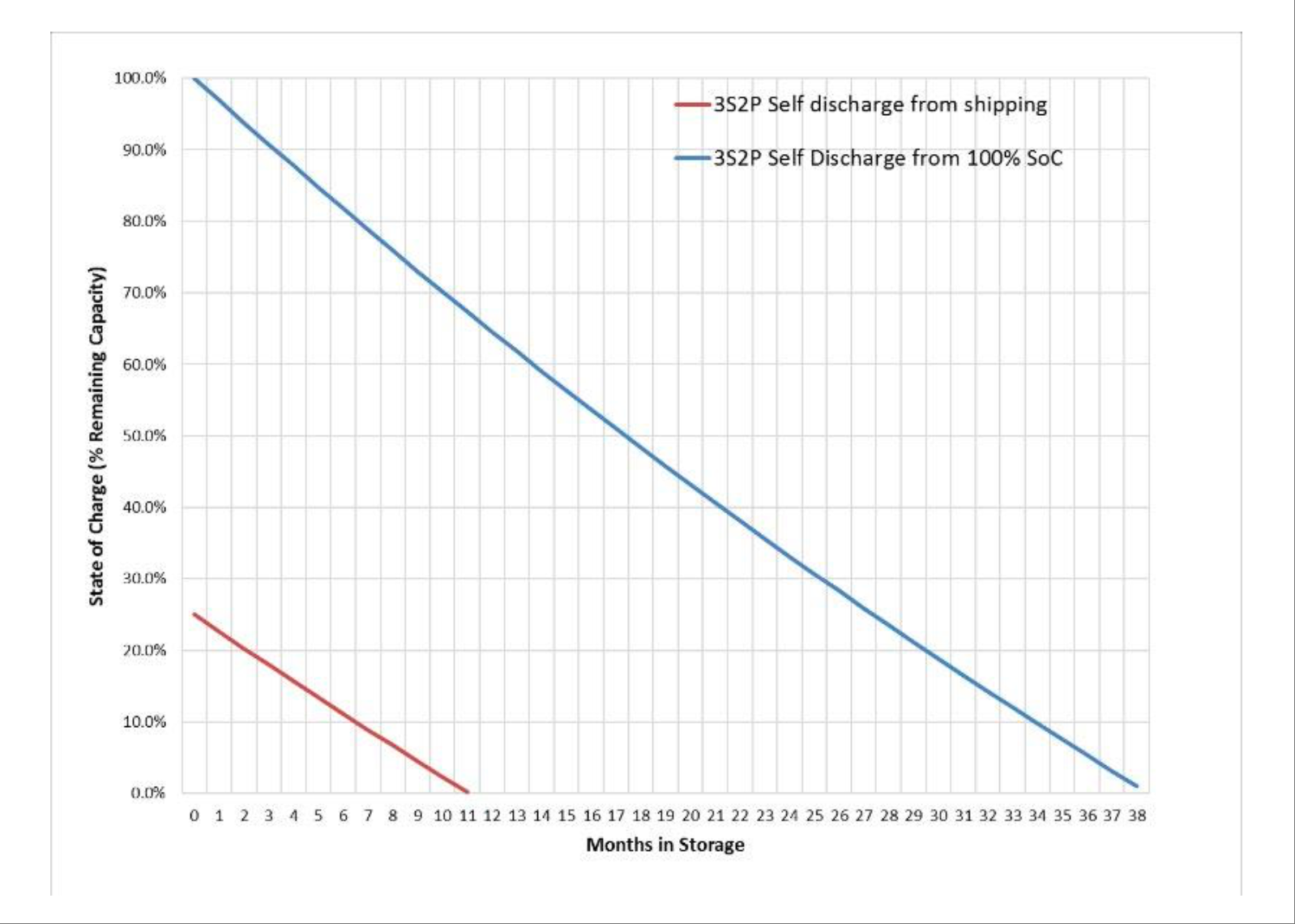
Assuming the battery is stored under optimal conditions, the combined self-discharge from the BMS and the cell self-discharge (estimated at 1%/month) is referenced in the figures below:
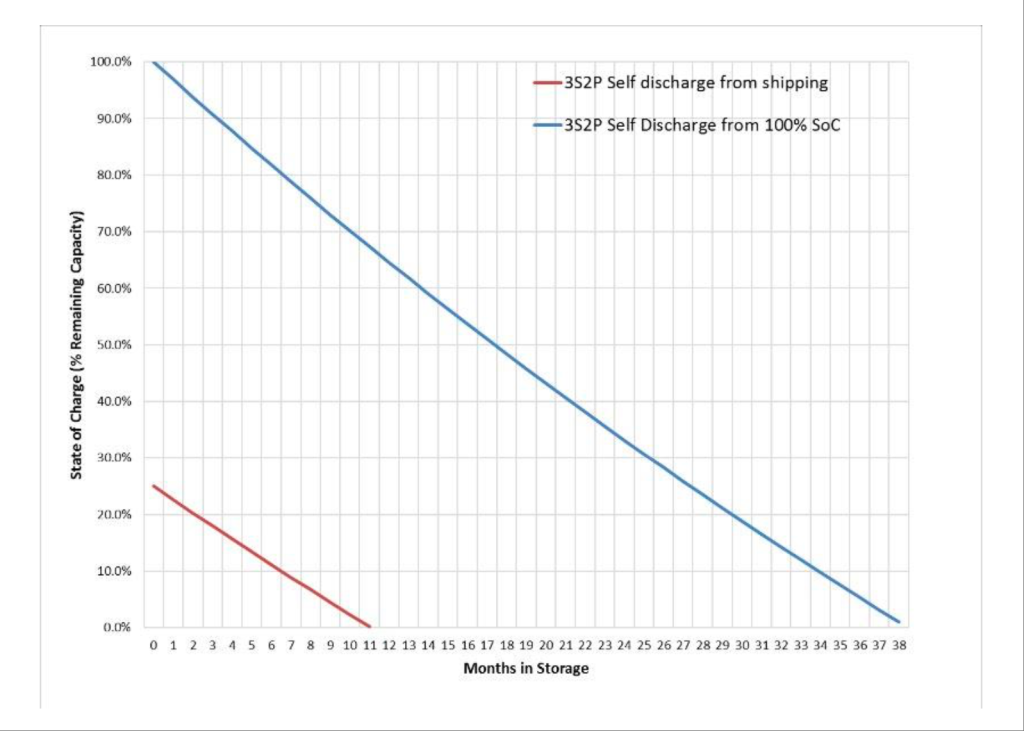
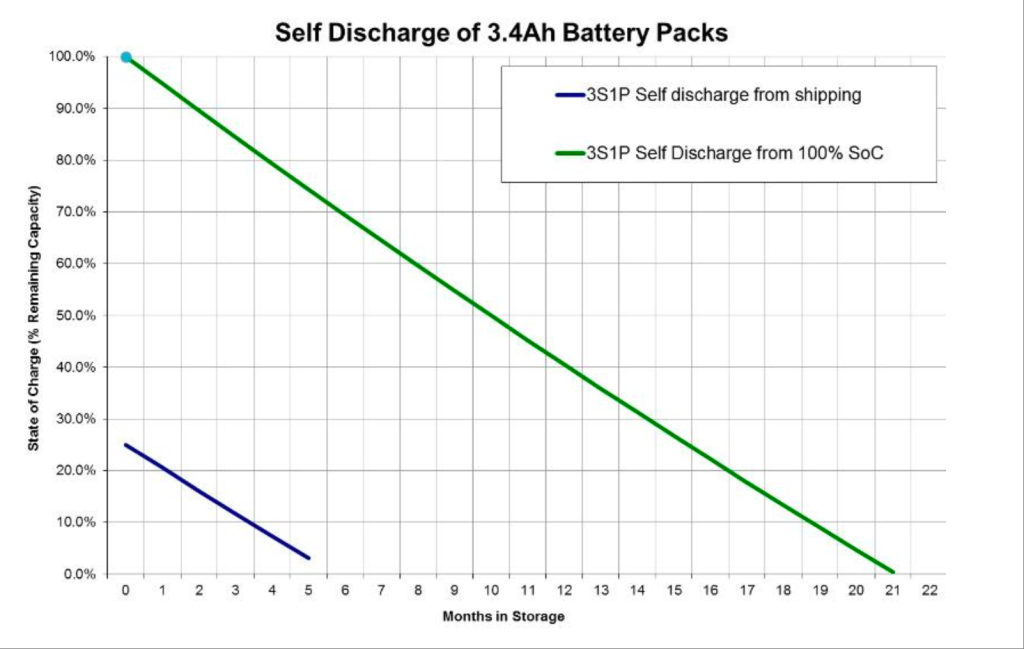
From the figures above, we can draw the following conclusions:
1.Battery capacity directly relates to storage shelf life. Smaller capacity batteries can be stored safely for a shorter duration, while larger capacity packs or packs with more parallel cells can be stored safely for longer.
2.The State of Charge (SOC) directly affects storage shelf life. Before long-term storage, the battery should be charged to above 30% SOC.
3.Batteries should be checked every 6 months. If the capacity is below 30%, they should be recharged to above 30% SOC.
Shutdown Mode
1.The BMS features a shutdown mode to minimize current consumption. When the cell voltage drops below 2.2V, the BMS will automatically enter shutdown mode and disable battery output. At this point, BMS self-consumption reduces to approximately 10 μA, preventing severe undervoltage and potential permanent battery failure. This mode requires charging to activate.
2.If customers require long-term storage or extended maritime transportation, the host equipment can actively send a command to put the battery into shutdown mode. This minimizes battery self-discharge and extends storage time.
3.Shutdown Command: Send the command 0x0010 to the manufacturer block access address 0x44 twice within 4 seconds to trigger the battery into shutdown state.
Transportation Safety
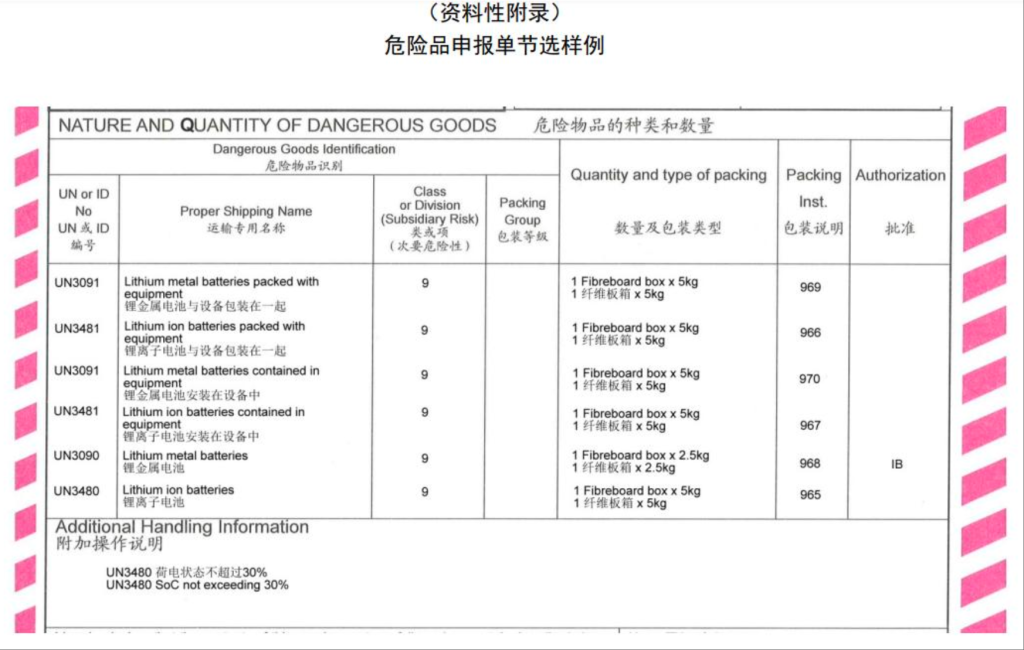
Since 2016, IATA/UN/DOT regulations have limited the state of charge for transported batteries to <30%. We must adhere to these requirements; therefore, all our batteries are shipped with a State of Charge (SOC) below 30%. It is recommended to recharge the battery promptly upon receipt. If the battery is not used for an extended period after receipt, its charge may deplete to 0%. If not charged within 6 months from the manufacturing date, the battery risks permanent failure.
Full Charge Storage
Considering self-discharge, some customers might charge the battery fully before storage to
maximize storage time. However, lithium-ion batteries should not be stored at 100% SOC. Continuous storage at full charge (100% SOC) will cause the lithium-ion battery to lose some capacity. This is common in UPS applications and laptops. When continuously maintained at full charge, lithium batteries can lose 5%-10% of their original capacity. We recommend storing batteries long-term at around 50% SOC.
Calendar Life and Cycle Life
1.Calendar Life: Even without charge/discharge cycles, capacity degrades over time during storage due to aging of the internal chemical materials. Our empirical value is 1% to 3% capacity loss per year.
2.Cycle Life: Under normal use, the empirical value is approximately 3% to 5% capacity degradation per 100 cycles.
3.These are empirical values based on typical usage and storage conditions, and the actual decay rate may vary due to factors such as temperature, discharge depth, and charge discharge rate.
Summary
Many other factors can affect the actual shelf life of lithium-ion batteries. For general lithium-ion battery maintenance, we recommend:
1.Check inventory batteries every 4 months; this is especially important for batteries already installed in equipment that remains unused for long periods, preventing situations where the battery is not charged.
2.Do not exceed 6 months of storage for lithium-ion batteries at a low State of Charge (SOC).
3.Storage temperature significantly impacts the battery. Store batteries at room temperature or slightly below (ideally 10-20°C).
4.For transportation, maintain the State of Charge (SOC) below <30% to comply with regulatory requirements.
5.Our product specifications require capacity checks every 6 months, with timely recharging as needed.
Ideal Storage Conditions
Temperature: -20°C to 25°C
Humidity: <70% R
Atmospheric Pressure: 86 kPa to 106 kPa
Battery RSOC (Relative State of Charge): 50% to 70%
Battery BMS Status: Shutdown Mode
Extreme Storage Conditions
Temperature: -20°C to 50°C
Humidity: 10% to 90% RH
Atmospheric Pressure: 86 kPa to 106 kPa
Battery RSOC (Relative State of Charge): >20%
Battery BMS Status: Normal Mode
Note: The above are conservative rules of thumb intended as guidelines for the use and
maintenance of lithium-ion battery packs and do not constitute apromise or warranty.