-260719-4-edited.png)

In today’s rapidly evolving lithium-ion battery technology landscape, ternary lithium-ion batteries and lithium iron phosphate batteries stand as the two dominant technical approaches, with their performance differences remaining a focal point of industry attention. Among these, the State of Charge (SOC) serves as a core metric reflecting the remaining capacity of the battery, directly impacting the accuracy of the Battery Management System (BMS), the battery’s lifespan, and application safety. This article will start with the definition of SOC and conduct an in-depth comparison of the key differences in SOC characteristics between the two battery types, providing reference for original equipment manufacturers (OEMs), particularly those in the medical device and detection instrument sectors, in their selection process.
The Core Significance of SOC: Why It Is the “Lifeline” of Battery Management
SOC represents the percentage of remaining capacity relative to the rated capacity, serving as a direct indicator of a battery’s “endurance capability.” In scenarios such as medical devices and portable detection instruments, accurate SOC display can prevent sudden device shutdowns caused by misjudged battery levels (e.g., medical devices shutting down during surgery or detection instruments interrupting operations outdoors); For original equipment manufacturers (OEMs), precise SOC control is directly linked to device reliability, user trust, and after-sales costs.
Lithium-ion batteries with different chemical compositions have significant differences in SOC estimation difficulty, effective range, and stability due to material property variations—this is also a key reason for the performance divergence between ternary lithium-ion batteries and lithium iron phosphate batteries in portable devices.
Ternary Lithium Batteries: SOC Characteristics More Suitable for “High-Precision Application Scenarios”
Ternary lithium batteries use nickel-cobalt-manganese (NCM) or nickel-cobalt-aluminum (NCA) as cathode materials. Their SOC characteristics exhibit high linearity and low estimation difficulty, making them particularly suitable for portable devices with high sensitivity to battery capacity accuracy:
1. Good linearity of the SOC-OCV curve
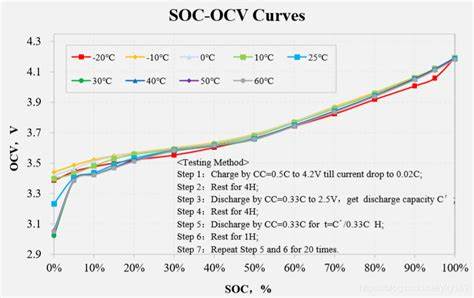
The open-circuit voltage (OCV) of ternary lithium batteries has a relatively linear relationship with SOC. Within the range of 10% to 90%, the voltage decreases steadily as SOC changes. This characteristic enables the device’s BMS to calibrate SOC more easily through voltage monitoring. Even under complex operating conditions such as frequent device startups and shutdowns or low-power standby mode, the error can be controlled within ±3%, ensuring that medical devices and detection instruments can accurately display the remaining operating time.
2. Flexible effective SOC range, suitable for mobile scenarios
The recommended SOC range for ternary lithium batteries is typically 10% to 90%, and brief exposure to extreme ranges (such as 0% to 100%) has minimal impact on battery life. For portable devices that require frequent movement (such as handheld ultrasound devices or outdoor environmental detection instruments), this flexible power management capability reduces the risk of “mid-use power failure” and enhances the device’s continuous operational reliability.
3. Superior SOC stability at low temperatures
In low-temperature environments (such as outdoor detection or medical devices in cold chain transportation), the accuracy of SOC estimation for ternary lithium batteries decreases only slightly, maintaining good consistency and avoiding “battery capacity mislabeling” issues caused by low temperatures.
Lithium iron phosphate batteries: SOC characteristics suitable for “long standby, low-frequency use scenarios”
Lithium iron phosphate batteries (LFP) use lithium iron phosphate as the cathode material, which is lower in cost and higher in safety, but their SOC characteristics are relatively complex. Their suitability for specific scenarios must be considered in conjunction with device usage habits:
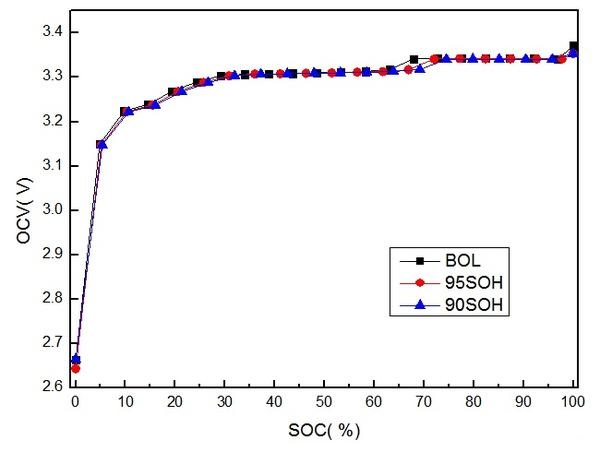
1. The SOC-OCV curve has a “plateau period,” requiring higher standards for BMS algorithms.
The OCV of lithium iron phosphate batteries changes very little (remaining nearly flat) within the 25%-98% SOC range, making it difficult for device BMS to directly determine the SOC in the intermediate range via voltage. Instead, more complex current integration (coulombic counting method) or algorithmic compensation is required. For medical devices with extremely high requirements for power display accuracy (such as life monitors), additional calibration designs may be needed to control errors (typically ±5%-8%).
2. SOC calibration relies on “endpoint triggering,” suitable for regular charging scenarios
Due to the stable OCV in the intermediate range, SOC calibration for lithium iron phosphate batteries typically relies on “full charge” or “low charge” states (e.g., charging to 100% or discharging below 5%). For devices with fixed charging cycles (e.g., portable detection instruments used in laboratories that are charged daily at fixed intervals), regular charging and discharging can reduce error accumulation; however, for devices that remain in a “shallow charge/shallow discharge” state for extended periods (e.g., handheld medical devices used in emergency rooms), regular manual calibration may be required.
3. Outstanding stability in high SOC ranges, suitable for backup scenarios
Lithium iron phosphate batteries exhibit superior cycle stability in high SOC ranges (e.g., 80%-100%), with minimal impact on lifespan from long-term full-charge storage. They are suitable as backup batteries for portable devices (e.g., emergency medical kits’ backup power sources, redundant battery packs for detection instruments).
Original Equipment Manufacturer (OEM) Selection Recommendations: Decision-Making Based on Medical and Detection Equipment Characteristics
Considering the core requirements of medical equipment and portable detection instruments (accuracy, reliability, and mobility), the suitability of the SOC characteristics of the two battery types can be further detailed as follows:
Ternary Lithium Batteries: More suitable for devices with high requirements for SOC display accuracy and continuous operational stability, such as handheld surgical instruments, real-time monitoring medical devices, and outdoor detection instruments used frequently. Their advantage lies in enabling devices to accurately report remaining battery levels, reducing the risk of medical accidents or data loss caused by “battery level misjudgment,” particularly suitable for high-end medical device manufacturers with stringent reliability requirements.
Lithium iron phosphate batteries: More competitive in devices sensitive to cost, with low usage frequency, or requiring backup power, such as portable health screening devices (used periodically), laboratory backup detection equipment, and basic diagnostic instruments in primary healthcare facilities. Their long cycle life and high SOC storage stability help reduce long-term maintenance costs for devices.
Additionally, original equipment manufacturers (OEMs) can choose based on the device’s BMS algorithm capabilities when integrating batteries: if the device has a mature SOC compensation algorithm, the cost advantage of lithium iron phosphate batteries can be fully leveraged; if “plug-and-play” high precision is prioritized, ternary lithium batteries are a more reliable choice.
Summary: Focusing on equipment requirements to align with SOC characteristic value
The SOC characteristics of ternary lithium batteries and lithium iron phosphate batteries fundamentally reflect the chemical properties of their materials: ternary lithium batteries excel in the convenience of SOC estimation and adaptability to dynamic scenarios, while lithium iron phosphate batteries offer advantages in cost and static stability.
For original equipment manufacturers (OEMs) in the medical device and detection instrument sectors, understanding these differences can help optimize product reliability. For example, when targeting high-end medical clients, emphasizing the SOC accuracy of ternary lithium batteries can enhance surgical safety, while highlighting the cost and lifespan advantages of lithium iron phosphate batteries when addressing primary healthcare institutions. Ultimately, by considering the device’s usage scenarios, precision requirements, and user habits, the optimal match between the battery and the device can be achieved.