By the TEFOO R&D Team | Senior Lithium-Ion Battery Engineering
Introduction: Why Certification Is More Than a Sticker
When an OEM engineer specifies a custom lithium-ion battery pack for a medical device, industrial controller, or ruggedized field instrument, the request almost always includes two words: ISO 9001 and CE certified. Yet in practice, these two terms are routinely conflated. ISO 9001 is a quality management system (QMS) certification that governs how a factory runs its processes; CE marking under the EU Battery Regulation is a product-level declaration that the finished pack meets essential health, safety, and environmental requirements before it can be placed on the European market. Understanding the difference is the first step toward sourcing a battery pack that will pass your own design reviews, regulatory audits, and field reliability targets.
This article walks through what ISO 9001 and CE certification actually require from a battery pack manufacturer, how they relate to other common standards such as IEC 62133 and UN38.3, and what an engineering team should look for when evaluating a certified OEM partner. It is written from the perspective of an R&D engineer who has taken custom packs from cell selection through mass production and regulatory submission.
What ISO 9001 Means for Battery Pack Manufacturing
ISO 9001:2015 is the current revision of the international QMS standard. (A revised edition is expected to be published around September 2026, with the Draft International Standard circulated in late 2025; manufacturers should plan for transition audits.) For a battery pack factory, ISO 9001 certification means the entire value stream is documented, controlled, and traceable — from incoming raw material receipt through final dispatch.
Scope of a Battery Pack QMS
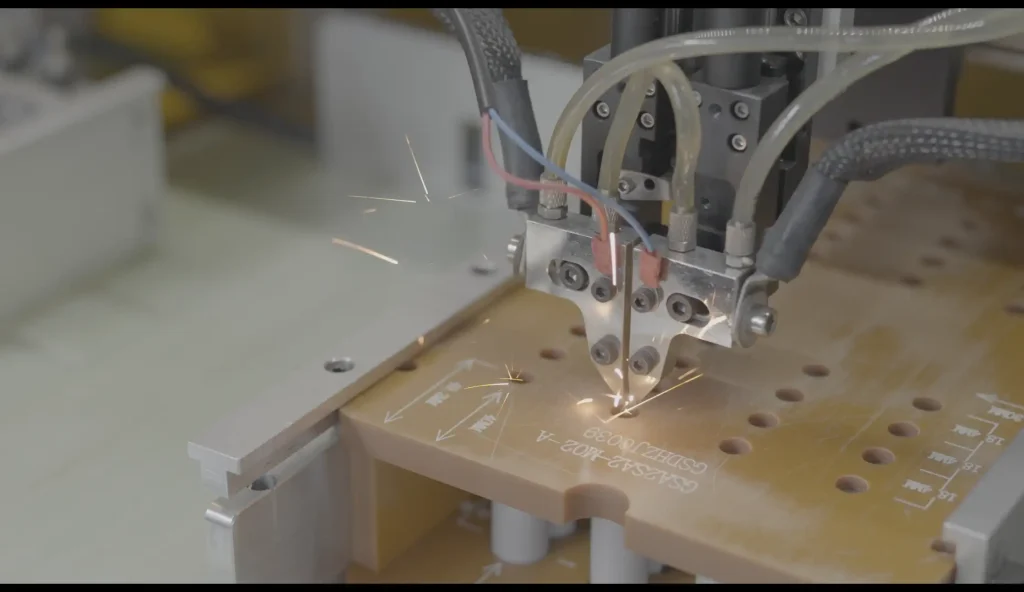
A credible ISO 9001 battery manufacturing scope should explicitly cover: incoming inspection of cells, protection boards (PCBs/BMS), nickel strips, connectors, and enclosures; electrical and mechanical assembly; soldering and ultrasonic welding; charge/discharge formation and grading; final pack testing; and packing. Documented procedures must exist for each of these stages with clear acceptance criteria, not generic templates reused from an unrelated factory.
What Auditors Actually Check
- Traceability: every pack can be traced back to cell lot numbers, BMS PCB serial numbers, and assembly operator records.
- Calibration: all formation cyclers, insulation testers, and high-potential (hipot) testers have current calibration certificates and are scheduled on a defined cycle.
- Corrective and Preventive Action (CAPA): nonconformances are investigated to root cause, not just reworked at the station, and lessons are fed back into work instructions.
- Internal audits and management review: the QMS is audited at least annually across every process, and senior management reviews quality metrics, customer complaints, and CAPA status.
- Customer feedback and complaint handling: a closed-loop process that links field returns to engineering changes and supplier corrections.
In our own practice at TEFOO, this means every custom pack line has a real-time batch record system, and every engineering change request goes through a documented risk assessment before it touches the production floor. That is the operational difference between a factory that holds a paper certificate and one that runs a controlled process.
CE Marking and the EU Battery Regulation (EU) 2023/1542
CE marking for batteries is governed by Regulation (EU) 2023/1542 concerning batteries and waste batteries. The regulation entered into force on 17 August 2023 and has applied since 18 February 2024. Critically, as of 18 August 2024, all batteries newly placed on the EU market must undergo a CE conformity assessment and bear the CE marking visibly, legibly, and indelibly on the product.
What CE Conformity Assessment Requires
Under Article 20 of Regulation (EU) 2023/1542, the manufacturer must draw up an EU Declaration of Conformity (DoC) and affix the CE marking. Where the harmonized standards or Annex VIII require it, a notified body must intervene in the conformity assessment process, and its four-digit identification number must appear alongside the CE marking. For most industrial and portable battery packs, the assessment covers safety, performance, durability, and — increasingly — sustainability and carbon footprint declarations.
Upcoming Obligations You Should Plan for Now
- Battery labeling requirements begin phasing in from 2026, including separate collection symbols, capacity marking, and chemical content labels.
- QR code-based labeling becomes mandatory from 2027, linking to a public information database.
- The EU Digital Product Passport (battery passport) is being rolled out under the same regulation; manufacturers should already be collecting the data points required by Commission guidance, even though the exact implementation dates are still being finalized.
A common mistake among OEM buyers is to assume that a single CE test report from a cell supplier automatically covers the finished pack. It does not. The pack-level CE assessment must consider how cells, BMS, mechanical enclosure, thermal management, and protective devices interact after assembly. Your pack manufacturer should be able to show you the pack-level DoC, not just a cell-level IEC or UN certificate.
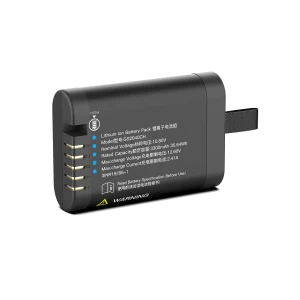
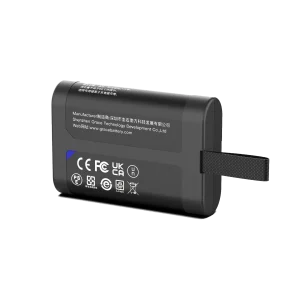
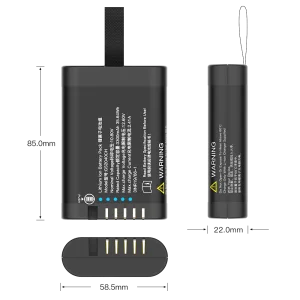
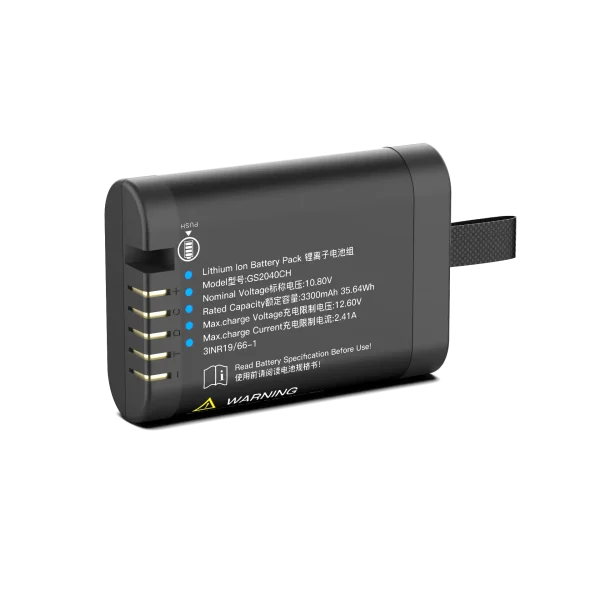
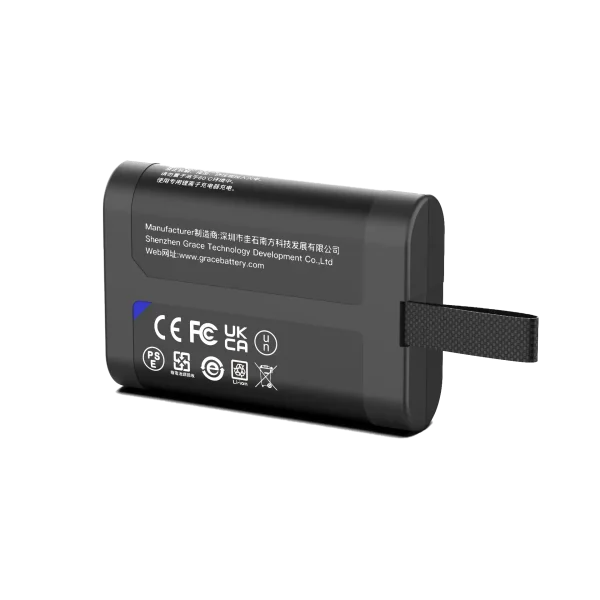
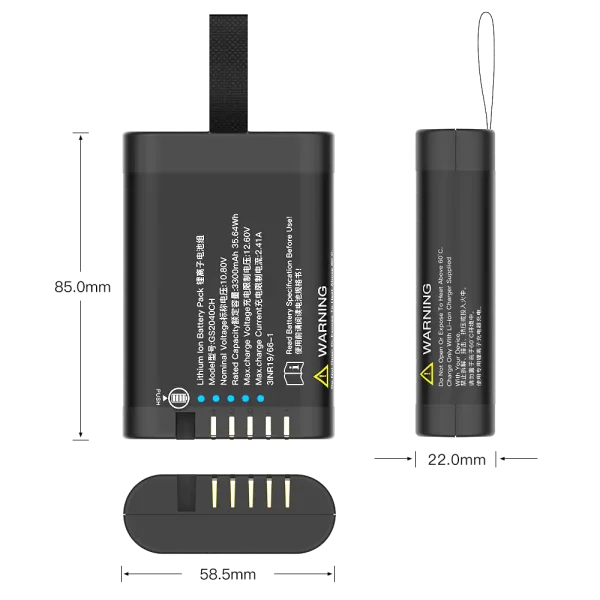
GS2040CH
10.8V/3450mAh/35.64Wh
Certification Comparison: What Each Standard Actually Covers
Buyers often ask which certification they actually need. The table below summarizes the standards most commonly specified alongside ISO 9001 and CE, and how they differ in scope and intent.
| Standard / Regulation | Type | What It Certifies | Who Needs It |
| ISO 9001:2015 | QMS / system certification | The manufacturer’s quality management processes; not a product safety certificate. | OEMs auditing supplier process control and traceability. |
| CE marking under (EU) 2023/1542 | Product conformity (EU market access) | The finished battery pack meets EU essential safety, performance, and environmental requirements. | Any battery placed on the EU market from August 2024. |
| IEC 62133-1/-2 | Product safety standard | Safety requirements for portable sealed secondary lithium cells and batteries under intended use. | Underpins CE conformity for portable packs; widely required by global buyers. |
| UN 38.3 | Transport safety test | Safety of lithium batteries during transport (altitude, thermal, vibration, shock, short circuit, etc.). | Mandatory for shipping lithium batteries by air, sea, or land. |
| UL 1642 / UL 2054 | North American safety standard | Cell-level (UL 1642) or household/commercial battery pack (UL 2054) safety. | Products sold into the US and Canadian markets. |
Table 1. Common battery pack certification standards and their scope.
Engineering Perspective: How a Certified Pack Is Actually Built
Certification is the output; engineering is the input. Below is the validation workflow we follow on every custom OEM project, and the kind of evidence a buyer should request when auditing a supplier.
1. Cell Selection and Incoming Inspection
We start with vetted cell suppliers and a defined approved manufacturer list (AML). Incoming lots are sampled for capacity, internal resistance, OCV, and dimensions, and the lot is held until data is logged to the traceability system. No cell enters assembly without a recorded batch.
2. Smart BMS Design
For medical and industrial packs, a smart BMS is not optional. It should support voltage/current/temperature monitoring, cell balancing, charge/discharge FET protection, and — increasingly — a digital communication interface such as SMBus (SMBus 1.1/2.0) or I2C so the host device can read state of charge, state of health, and cycle count. The BMS firmware must be version-controlled, and every change must be risk-assessed under the ISO 9001 change-control process.
3. Mechanical and Thermal Design
Pack enclosure materials, potting compound, gap padding, and connector choice are all part of the certified design. A pack that passes IEC 62133 on the bench may fail CE assessment if its enclosure does not meet the relevant IP rating or flammability requirement for the end application. Thermal interface design between cells and the BMS board is equally important: it directly affects cycle life and the accuracy of temperature-based protection thresholds.
4. Validation Test Matrix
- Electrical: capacity, cycle life, internal resistance, charge/discharge cutoff, overcharge/overdischarge recovery.
- Environmental: high/low temperature operation and storage, thermal shock, humidity.
- Mechanical: vibration, shock, drop (where applicable), crush.
- Safety: external short circuit, free fall, impact, forced discharge (per IEC 62133 and UN38.3 methods).
- Transport: UN38.3 Test Summary, available before the first shipment.
Frequently Asked Questions
Q: Is ISO 9001 the same as CE certification?
A: No. ISO 9001 certifies the manufacturer’s quality management system; it does not certify that a specific product is safe for the EU market. CE marking under Regulation (EU) 2023/1542 is a product-level declaration covering the finished battery pack. Buyers need both: ISO 9001 gives confidence in the process, and CE gives market access.
Q: Does a CE certificate for the cells cover the finished battery pack?
A: No. Cell-level certificates (e.g., IEC 62133 for cells) are inputs to the pack-level assessment, but the finished pack must be assessed as a system. The BMS, enclosure, protection devices, and assembly all affect safety performance. Always request the pack-level EU Declaration of Conformity.
Q: When did CE marking become mandatory for batteries in the EU?
A: Regulation (EU) 2023/1542 has applied since 18 February 2024, and CE marking has been mandatory for batteries newly placed on the EU market since 18 August 2024. Labeling updates begin in 2026 and QR-code labeling in 2027.
Q: What is the EU Battery Passport and does it affect my pack?
A: The Battery Passport is a digital record required under (EU) 2023/1542, linked by a QR code on the battery. It will contain information on composition, carbon footprint, recycled content, and performance. While final implementation dates are being phased in, manufacturers should already collect the required data points now to avoid a gap when the obligation applies.
Q: Do I need UL certification if I already have CE?
A: CE is not automatically recognized in the US or Canada. Products sold into North America typically need UL 1642 (cells) and/or UL 2054 (battery packs), or equivalent NRTL certification. For global OEMs, we recommend planning to hold IEC 62133, UN38.3, CE, and UL in parallel from the start of the design.
Q: How do I verify that a supplier’s ISO 9001 certificate is genuine?
A: Check the certificate scope — it should explicitly mention battery pack or lithium-ion battery assembly, not a generic ‘manufacturing.’ Verify the issuing certification body is accredited by an IAF signatory accreditation body, and confirm the certificate number is current through the body’s online directory. A reputable supplier will share the certificate without redaction.
Conclusion: Choosing a Certified OEM Partner
A battery pack that carries both ISO 9001 and CE certification — backed by IEC 62133, UN38.3, and (where required) UL — is the baseline, not the finish line for a dependable custom power solution. The real value of certification shows up in how a manufacturer handles traceability, change control, validation, and field feedback across hundreds of production lots.
At TEFOO, we design and manufacture custom smart battery packs for medical devices and industrial equipment, with a focus on intelligent BMS, SMBus communication, and full OEM customization. Our ISO 9001-certified process, combined with pack-level CE and UN38.3 compliance, is built around the reality that our customers ship their own products into regulated markets and cannot afford a battery-related field failure. If you are specifying a pack for a new product program, we recommend starting the certification conversation at the engineering design stage — not after the first prototype is built.
References: ISO 9001:2015 (BSI revision update, 2025–2026); Regulation (EU) 2023/1542 (EUR-Lex consolidated text, 18 July 2024); European Commission, Batteries policy; IHK Ostwestfalen, EU Battery Ordinance guidance.