By the TEFOO Battery Engineering Team | October 2026
1. Introduction: Why the Battery Defines Industrial PDA Productivity
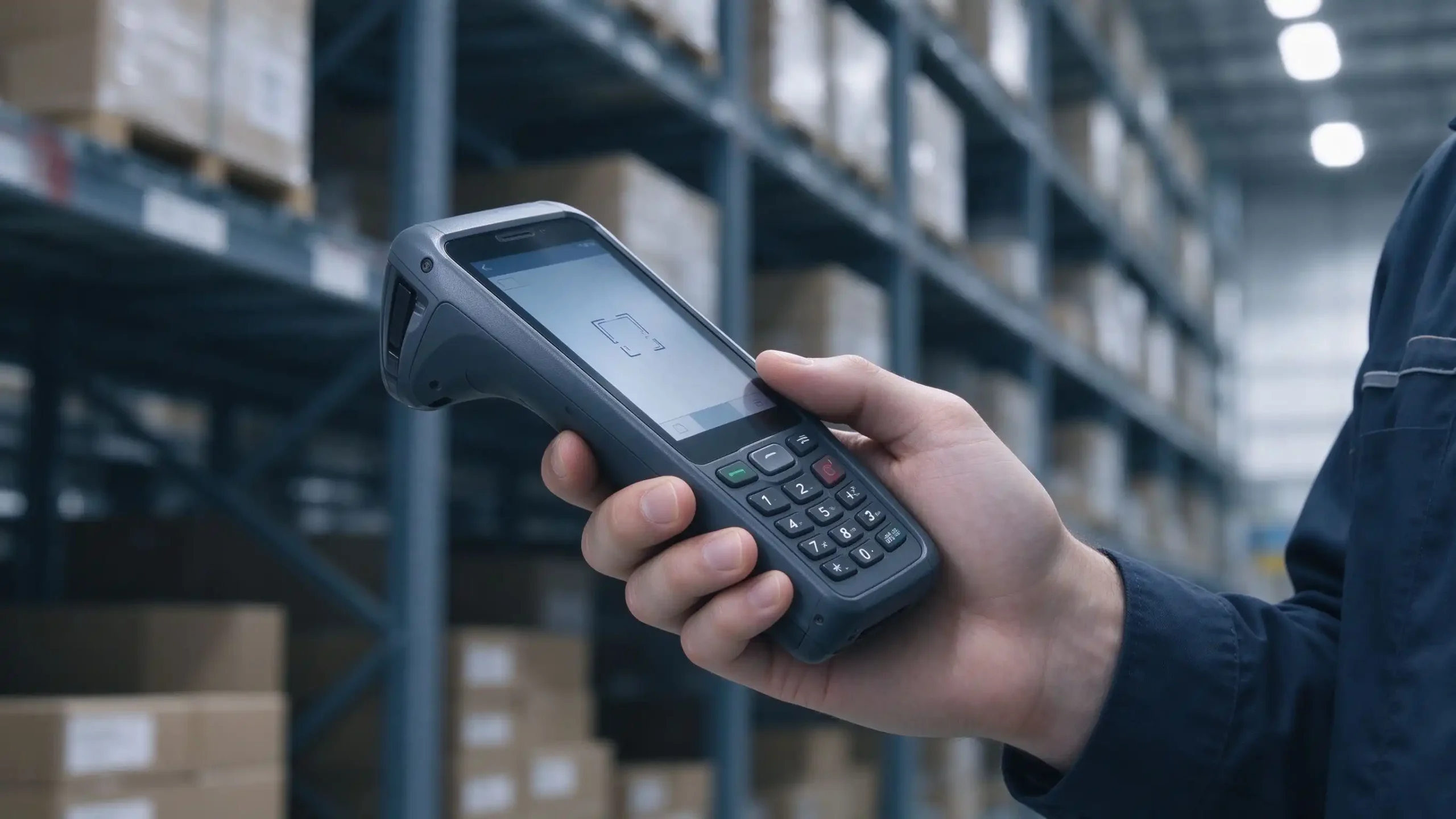
An industrial PDA (Personal Digital Assistant) — also called a rugged handheld terminal, data collection terminal, or mobile computer — is the workhorse of warehousing, logistics, manufacturing floor operations, field service, retail inventory, and healthcare asset tracking. In 2026, a single device may scan thousands of barcodes per shift, maintain a persistent Wi-Fi 6E or 5G connection, run a full-touch Android or Windows application, and survive drops from 1.5 m onto concrete. Yet for all the advances in scanning engines, processors, and displays, the battery remains the component that most directly determines whether a shift runs uninterrupted.
From an engineering standpoint, the industrial PDA battery is not a consumer smartphone cell pack repackaged into a larger enclosure. It must deliver high peak current for barcode illumination and radio transmission, tolerate extreme temperature swings in cold storage or desert loading docks, support hot-swap replacement in 24/7 operations, and communicate accurate state-of-charge to the host through a standardized smart-bus protocol. This guide, written from the perspective of a battery R&D team that designs OEM packs for rugged-device manufacturers, covers the 2026 state of the art in cell selection, BMS architecture, communication protocols, certification, and vendor benchmarking.
2. Core Technical Requirements for Industrial PDA Batteries
2.1 Capacity and Runtime Benchmarks (2026)
As of 2026, the entry threshold for a genuine industrial-grade PDA battery has moved from 3,000–4,000 mAh to a minimum of 5,000 mAh at a nominal voltage of 3.8 V–3.87 V. Premium and extended-capacity packs reach 5,200–7,000 mAh. For example, the Honeywell CK62 ships with a 7,000 mAh pack, the Unitech HT330 uses a 5,200 mAh removable battery, and the Newland MT95 specifies a 3.87 V / 5,100 mAh smart pack with hot-swap support. A 5,000 mAh / 3.85 V pack stores roughly 19.25 Wh, which — under realistic scan-intensive workloads (screen on, periodic 2D imager flash, Wi-Fi connected) — typically delivers 10–15 hours of continuous operation, enough for a full shift on a single charge.
2.2 Operating and Storage Temperature
Consumer Li-ion cells are rated for 0 °C to 45 °C charging, but industrial PDAs operate in environments that demand far more. Leading devices specify an operating range of -20 °C to +50 °C (e.g., Honeywell CT70 and EDA52), with storage tolerance down to -30 °C. Cold-storage warehouses running at -25 °C require packs built with low-temperature-rated cells and a BMS that gates charging below 0 °C to prevent lithium plating. This is a non-negotiable design constraint: a standard consumer cell will lose 50% or more of its available capacity at -10 °C and may permanently degrade if charged below freezing.
2.3 Cycle Life and Durability
A typical industrial PDA battery pack is expected to endure 500–1,000 full charge-discharge cycles before dropping to 80% of its rated capacity, measured at 25 °C under a standard 0.5C/0.5C profile. Heavy-use fleets that swap batteries twice per shift may see a pack exceed 500 cycles within 8–12 months, which is why hot-swappable, field-replaceable packs are standard on every enterprise-grade device rather than the sealed-in approach used on consumer phones.
2.4 Hot-Swap and Field Replaceability
Hot-swap (also called warm-swap) capability means the user can replace a depleted battery without powering down the device or losing the active application session. This requires a supercapacitor or small auxiliary buffer inside the handset to bridge the 2–5 second window during which the main pack is removed. Honeywell, Datalogic, Newland, and Zebra all offer hot-swap on their flagship terminals. For battery pack designers, this imposes a strict mechanical and electrical handshake: the pack must include identification pins that the host detects within milliseconds of insertion, and the BMS must be pre-charged and ready to communicate before the main power contacts engage.
2.5 Smart Battery and Fuel Gauge Integration
Modern industrial PDA packs are “smart batteries” — they incorporate a fuel-gauge IC that reports remaining capacity, voltage, current, temperature, and predicted runtime to the host operating system. The TI bq20xx series (bq2060, bq2063, bq2083) is the dominant platform in this space, supporting the Smart Battery Data (SBData) command set over either the SMBus 2-wire interface or the 1-wire HDQ protocol. This telemetry is what allows the OS to display an accurate percentage rather than the coarse voltage-based estimate used on basic devices, and it enables enterprise battery-health analytics across a deployed fleet.
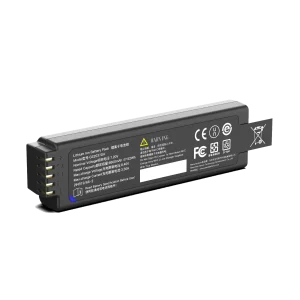
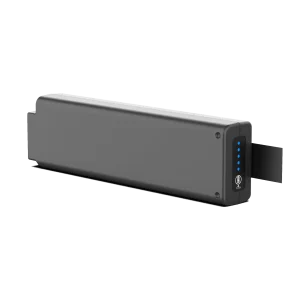
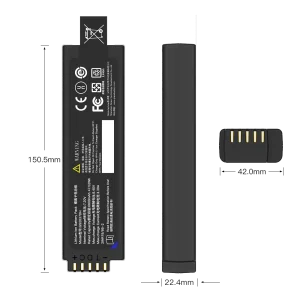
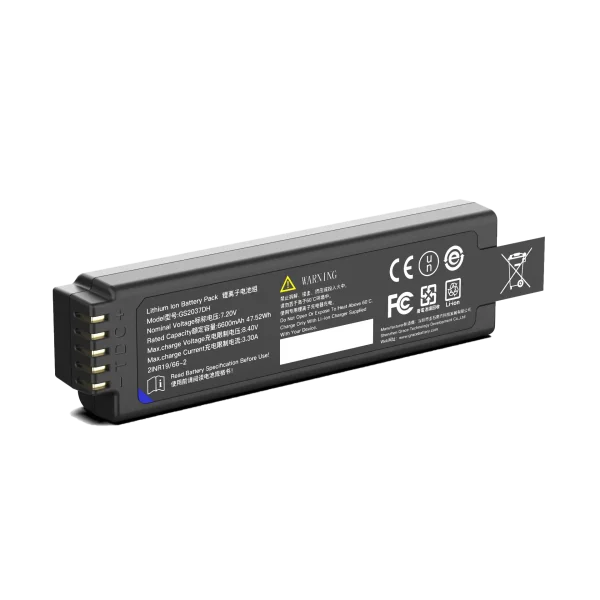
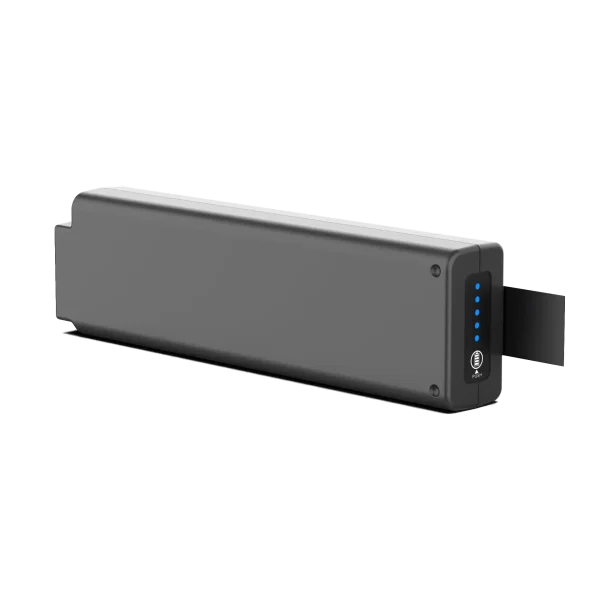
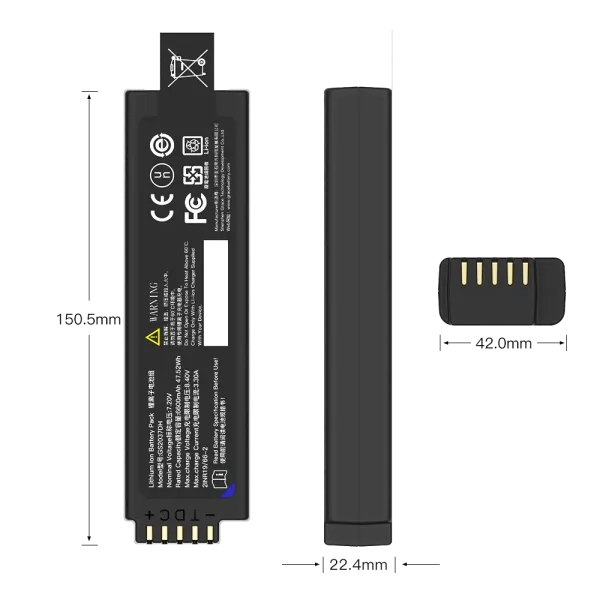
GS2037DH
7.2V/6900mAh/47.52Wh
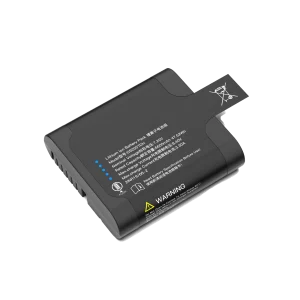
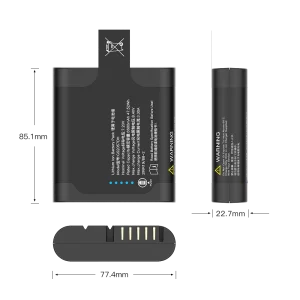
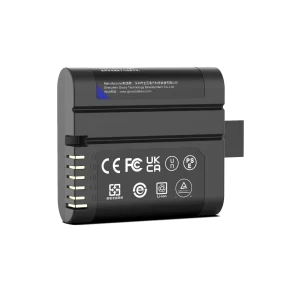
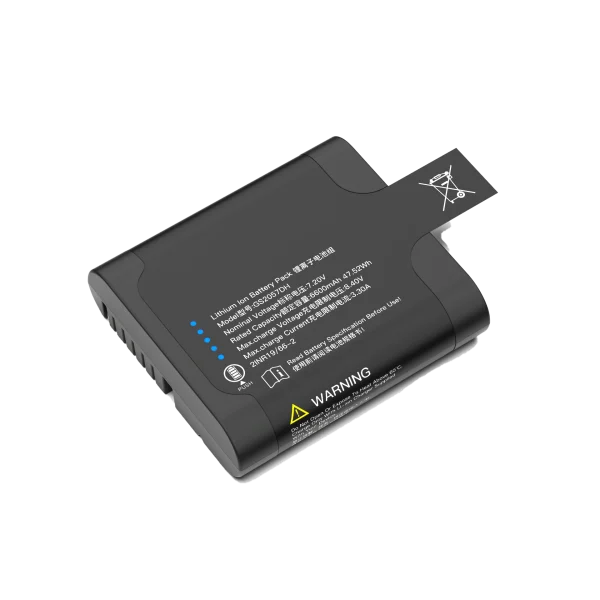
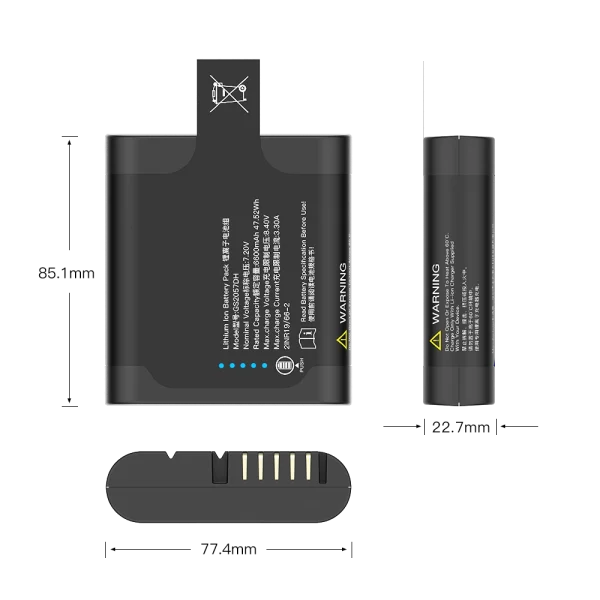
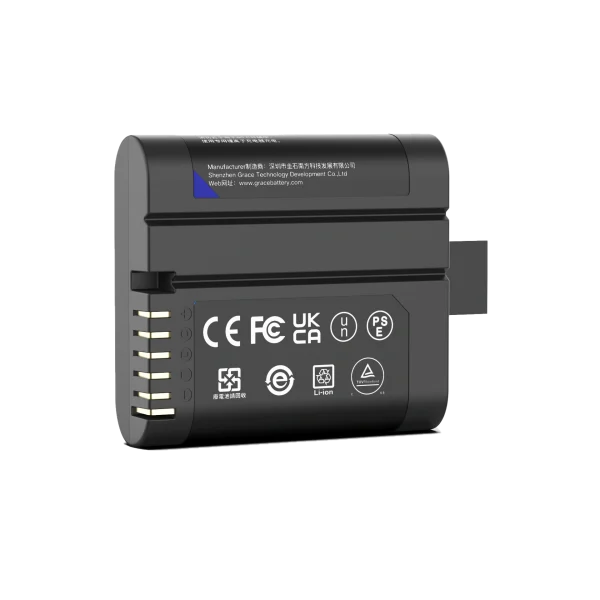
GS2057DH
7.2V/6900mAh/47.52Wh
3. Cell Chemistry and Pack Architecture
3.1 Pouch Polymer vs. Cylindrical Cells
Industrial PDA packs use two primary cell form factors, and the choice has direct implications for energy density, thermal behavior, and mechanical fit:
- Pouch (polymer) cells: Thin, flexible, and able to be molded to fit the irregular space inside a handheld grip. Most premium PDAs (Honeywell CT30 XP, Newland MT95, Datalogic Memor 35) use custom pouch packs because they maximize mAh per cubic centimeter. The trade-off is higher manufacturing cost and a more complex protective wrapper.
- Cylindrical 18650 / 21700 cells: More standardized, easier to source, and available from a wide supplier base. A 1S1P 18650 pack (typically 2,500–3,500 mAh) suits compact scanners, while a 1S2P configuration reaches 5,000–6,000 mAh. Cylindrical cells have well-understood thermal runaway behavior and are preferred in cost-sensitive or high-volume designs.
3.2 Single-Cell vs. Multi-Cell Configurations
The vast majority of industrial PDAs use a single-cell (1S) architecture at 3.6–3.87 V, stepped up to the system rail by a DC-DC converter on the motherboard. Multi-cell packs (2S, 3S) at 7.4 V or 11.1 V are reserved for higher-power devices such as vehicle-mounted mobile computers, rugged tablets, or wearable ring scanners with integrated RF guns. For battery pack designers, a 1S pack is simpler to protect and certify, but it must deliver high discharge current (typically 2–5 A peak) to drive the scanning engine and Wi-Fi/Bluetooth radio simultaneously.
3.3 BMS and Protection Circuit
The Battery Management System (BMS) inside a PDA pack performs four core functions: over-voltage protection (≈4.2 V per cell), under-voltage protection (≈2.5–3.0 V), over-current and short-circuit protection, and temperature monitoring. In a smart pack, the BMS is paired with a fuel-gauge IC that implements the SBS command set. The pack typically uses a dual-FET protection design (one FET on charge, one on discharge) plus a current-sensing resistor. For OEM customers, the BMS firmware can be customized to match the host device’s charging profile, identification requirements, and LED fuel-gauge button interface.
3.4 Communication Protocols: SMBus, HDQ, and I2C
The smart-battery communication layer is where pack and host engineering must align precisely. Three protocols dominate the rugged-handheld space:
- SMBus (System Management Bus): A 2-wire, 100 kHz/400 kHz interface based on I2C, governed by the Smart Battery System (SBS) specification. The host sends 8-bit command codes (e.g., 0x0F for remaining capacity, 0x09 for temperature) and receives 16-bit little-endian responses with Packet Error Checking (PEC). Most enterprise devices from Honeywell, Zebra, and Datalogic use SMBus.
- HDQ (1-Wire HDQ16): A single-wire protocol used in certain TI fuel-gauge generations. It saves a pin on the host connector but is less common in new designs.
- I2C: A generic I2C link is used when the host wants full control over a custom fuel-gauge solution rather than adopting the SBS command set wholesale.
For OEM projects, getting the SMBus register map, cell chemistry profile (Qmax, Ra table), and PEC handling right is the difference between a battery that reports accurate runtime and one that shows erratic percentage jumps. This is an area where experienced pack engineers shorten development cycles dramatically.
4. Certification and Compliance Landscape (2026)
An industrial PDA battery sold into global markets must clear a layered set of safety, transport, and environmental certifications. The following table summarizes the requirements that every OEM and procurement team should verify on a datasheet:
| Certification / Standard | Scope | Applicable Market |
| IEC 62133-1/-2 | Safety requirements for portable sealed secondary lithium cells and packs | International (IECEE CB scheme) |
| UL 2054 / UL 1642 | Household and commercial battery safety; cell-level UL 1642 | United States |
| UN38.3 | Transport safety: altitude, thermal, vibration, shock, short circuit, crush | Global air/sea/rail freight |
| CE (EN IEC 62133 + EMC) | Conformity with EU health, safety, and environmental protection directives | European Union |
| UKCA | UK product safety conformity (post-Brexit replacement for CE in Great Britain) | United Kingdom |
| FCC Part 15 | EMC / radio-frequency emissions (where pack includes electronics) | United States |
| RoHS 3 / REACH | Restriction of hazardous substances; chemical registration | European Union |
| GB 31241-2022 | Safety requirements for portable electronic products lithium batteries | China (CCC mandatory list) |
| EU Battery Regulation 2023/1542 | Carbon footprint, due diligence, recycling, and battery passport requirements | European Union (phased to 2027) |
Table 1. Principal certifications required for industrial PDA battery packs in 2026.
The EU Battery Regulation 2023/1542 is the most significant regulatory shift since the original CE marking. Starting in 2025–2027, portable and industrial lithium batteries placed on the EU market must declare their carbon footprint, meet recycled-content thresholds, and support a digital “battery passport” with full supply-chain traceability. For PDA manufacturers sourcing packs from Asia, this means selecting a battery partner that can provide lifecycle documentation, not just a UN38.3 test report.
5. OEM Custom Battery Pack: When Off-the-Shelf Is Not Enough
For PDA OEMs, rugged-device designers, and ODM teams, choosing a battery partner is a structural decision, not a sourcing transaction. Off-the-shelf packs from generic suppliers may match a nominal mAh rating, but they rarely match the host device’s mechanical envelope, charging profile, SMBus register map, LED fuel-gauge behavior, or fleet diagnostic requirements. A custom pack program with an experienced battery engineering team typically covers:
- Cell selection matched to the device’s peak current profile and temperature range.
- Custom BMS firmware calibrated to the host charger and fuel-gauge algorithm (TI bq series).
- SMBus / HDQ register mapping aligned to the host driver and Android / Windows power manager.
- Mechanical and connector design, including hot-swap handshake sequencing.
- Full certification package: IEC 62133, UL, UN38.3, CE, UKCA, FCC, RoHS, and GB 31241.
- EU 2023/1542 carbon footprint and due-diligence documentation.
At TEFOO, our battery engineering team has spent over a decade developing smart Li-ion battery packs for medical, industrial, and rugged-device OEMs. Our reference industrial PDA packs integrate TI fuel-gauge ICs with a fully characterized SMBus / HDQ communication stack, support 5,000–7,000 mAh pouch or 18650 configurations, and ship with a complete IEC 62133 / UL / UN38.3 / CE / UKCA certification dossier. For OEMs launching a new handheld terminal, we provide cell selection, BMS customization, mechanical prototyping, and certification support from EVT through mass production — reducing the battery subsystem from a common delay item to a non-event.
6. Frequently Asked Questions
Q: What is the typical battery life of an industrial PDA?
A: Under realistic scan-intensive workloads, a 5,000 mAh / 3.85 V pack delivers 10–15 hours of continuous operation, covering a full 8-hour shift with margin. Extended packs of 7,000 mAh+ can run a second shift on a single charge.
Q: Can I use a higher-capacity battery in my existing PDA?
A: Mechanically, an extended pack may fit, but the host device must support the higher current draw and the BMS must be calibrated to the larger cell. Using an uncertified third-party pack voids the device warranty and may trigger safety-protection faults.
Q: What is hot-swap, and why does it matter?
A: Hot-swap allows battery replacement without powering off the device, preserving the active application session. It is essential for 24/7 warehouses and distribution centers where downtime directly impacts throughput.
Q: What certifications should I require from a battery supplier?
A: At minimum: IEC 62133 (safety), UN38.3 (transport), CE/UKCA (EU/UK market), and RoHS/REACH. For the US market, add UL 2054/UL 1642 and FCC. For China, GB 31241 and CCC. EU-bound shipments should also plan for Battery Regulation 2023/1542 compliance.
Q: Why does my PDA show an inaccurate battery percentage after using a replacement pack?
A: This is almost always a fuel-gauge calibration issue. A smart pack must have the correct cell chemistry profile (Qmax, impedance track table) written to the BMS during production. Generic replacement packs that skip this step will show erratic percentage readings even when the underlying cell capacity is correct.
Q: How do I extend the service life of my PDA battery fleet?
A: Avoid storing packs fully depleted at high temperatures; keep them at 40–60% state of charge for long-term storage; rotate spare batteries; and use the manufacturer-approved charger. A well-managed fleet can extend average pack life from 12 to 18+ months.
7. Conclusion
The industrial PDA battery has evolved from a commodity power cell into a sophisticated subsystem that combines high-energy-density chemistry, a precision BMS, a standardized smart communication bus, and a global certification dossier. In 2026, the market has settled on 5,000 mAh as the entry capacity, hot-swap as a baseline feature, and SBS-based fuel gauging as the expected interface. For device manufacturers, the strategic choice is no longer where to buy the cheapest pack — it is which engineering partner can deliver a certified, smart, future-proof battery subsystem that aligns with the host platform and the evolving regulatory landscape, including the EU Battery Regulation 2023/1542.
If you are developing a new industrial handheld, rugged scanner, or data collection terminal and need a custom smart battery pack that matches your mechanical, electrical, and certification requirements, the TEFOO engineering team is ready to support your project from cell selection through mass production.