By a Senior Lithium Battery R&D Engineer | TEFOO Battery Engineering Team | Updated October 2026
1. Introduction: Why Medical Grade Batteries Demand a Higher Standard
In the world of portable medical devices, the battery is not a commodity component — it is a safety-critical subsystem. A patient monitor that unexpectedly loses power during a nocturnal vitals check, an infusion pump that resets mid-drug delivery, or a defibrillator that fails to deliver a charge in an emergency can have life-threatening consequences. This is precisely why medical device OEMs cannot simply take a consumer-grade lithium battery off the shelf and drop it into a regulated product.
As a battery engineer who has spent over a decade designing lithium battery packs for medical and industrial equipment, I have seen first-hand how the gap between a commercial battery and a true medical-grade battery plays out in certification audits, regulatory submissions, and field reliability data. The two standards that anchor this distinction are ISO 13485 — the quality management system standard for medical devices — and IEC 62133-2 — the safety standard for portable sealed lithium cells and batteries.
This guide walks through what these standards actually require, how they interact with other regulatory frameworks (including FDA recognition, UN 38.3 transport testing, and the EU Battery Regulation 2023/1542), and what medical device engineers and procurement teams should evaluate when selecting a medical battery manufacturer. Whether you are designing a patient monitor, a portable ultrasound system, an infusion pump, or a wearable diagnostic device, understanding the compliance landscape early in your development cycle will save you months of rework and audit findings later.
2. What Is a Medical Grade Lithium Battery?
The term “medical grade lithium battery” is often used loosely in marketing materials, but in engineering and regulatory terms it has a specific meaning. A medical grade battery pack is a rechargeable lithium-based energy storage system designed, manufactured, and traceable under a controlled quality management system suitable for use in medical devices, where failure could result in patient harm or interruption of clinical care.
2.1 Key Design Differences from Consumer Batteries
Consumer lithium-ion packs — the kind found in smartphones and power banks — are engineered for cost, energy density, and a 300 to 500 cycle lifespan. Medical grade packs are engineered differently across several dimensions:
- Redundant protection circuits: Medical packs typically include both primary and secondary protection ICs, plus a smart battery management system (BMS) that monitors cell voltage, current, temperature, and state of charge in real time.
- Tight cell grading: Cells are sorted for capacity, internal resistance, and self-discharge rate within much narrower tolerances than consumer-grade packs, ensuring balanced performance across the battery string.
- Low self-discharge: Medical devices may sit in inventory or on standby for extended periods. A medical pack must retain its charge reliably over months of storage, not days.
- Smart communication: Many medical packs implement SMBus (System Management Bus) or I2C communication, allowing the host device to read fuel gauge data, cell voltages, temperature, and diagnostic history — a requirement for many modern medical device architectures.
- Full traceability: Every pack carries a lot number linked to specific cell production batches, BMS firmware versions, component suppliers, and assembly records. If a field issue arises, the manufacturer can trace every affected unit.
2.2 Chemistry Selection
The choice of cell chemistry depends on the device’s power profile, form factor constraints, and safety requirements:
- Lithium-ion (LiCoO₂ / NMC): High energy density, widely used in patient monitors, infusion pumps, and portable diagnostic equipment. Requires careful BMS protection due to thermal runaway risk under abuse.
- Lithium polymer (LiPo): Flexible form factor, thinner profiles, common in wearable and compact medical devices. Offers good energy density with improved mechanical safety in pouch form factor.
- LiFePO₄ (LFP): Superior thermal and chemical stability, longer cycle life, but lower energy density. Preferred for high-reliability, larger portable devices where safety margins are critical.
3. ISO 13485: The Quality Management Foundation for Medical Batteries
3.1 What ISO 13485:2016 Requires
ISO 13485:2016, titled “Medical devices — Quality management systems — Requirements for regulatory purposes,” is the internationally recognized standard for quality management systems (QMS) in the medical device industry. It is published by the International Organization for Standardization (ISO) and is currently in its 2016 edition.
Unlike generic quality standards such as ISO 9001, ISO 13485 is specifically tailored to medical device regulation. It emphasizes regulatory compliance, risk management, design controls, and traceability throughout the product lifecycle. For a battery pack manufacturer serving medical clients, ISO 13485 certification means the organization has established documented procedures for:
- Design and development controls, including design inputs, outputs, reviews, verification, and validation.
- Risk management aligned with ISO 14971, identifying and controlling hazards throughout the product lifecycle.
- Supplier control and incoming material inspection, ensuring cells, PCBs, and enclosures meet specified requirements.
- Production process controls, including clean manufacturing environments where required and documented work instructions.
- Full product traceability — from raw cell lot to finished pack serial number, supporting field action and recall.
- Change control, ensuring any modification to the battery design, BMS firmware, or supplier is formally assessed and approved.
- Post-market surveillance, collecting and analyzing field performance data and customer complaints.
3.2 Why Battery Pack Manufacturers Need ISO 13485
A common misconception is that only the medical device OEM needs ISO 13485. In practice, device manufacturers that outsource battery pack design and assembly must ensure their suppliers operate under an equivalent quality system. Under ISO 13485’s purchasing controls clause (Section 7.4), the medical device company is responsible for verifying that outsourced processes — which include custom battery pack manufacturing — are controlled and meet specified requirements.
This means that when a medical device company audits its battery supplier, ISO 13485 certification is typically the baseline expectation. A supplier without ISO 13485 will face significant scrutiny, and many OEMs will not even consider them for medical programs. Additionally, the U.S. FDA’s 2024 Final Rule harmonized 21 CFR Part 820 (the Quality System Regulation) with ISO 13485, further reinforcing the standard’s role in the U.S. market as well.
3.3 ISO 13485 vs. ISO 9001: What Medical Buyers Should Notice
It is important to distinguish between a battery manufacturer that holds ISO 9001 and one that holds ISO 13485. ISO 9001 is a general quality management standard applicable across industries. It does not require design controls specific to medical devices, does not mandate ISO 14971 risk management integration, and does not enforce the same level of traceability and regulatory documentation. When a supplier claims “medical-grade quality,” ask specifically whether they hold ISO 13485 certification — not just ISO 9001.
4. IEC 62133-2: Safety Testing for Portable Lithium Batteries
4.1 Standard Overview
While ISO 13485 governs the manufacturer’s quality system, IEC 62133 governs the safety performance of the battery itself. The current version is IEC 62133-2:2017+AMD1:2021 CSV (consolidated version), published by the International Electrotechnical Commission (IEC). Part 2 covers lithium-based systems; Part 1 covers nickel-based systems, which are largely obsolete in modern medical devices.
The standard’s full title is: “Secondary cells and batteries containing alkaline or other non-acid electrolytes — Safety requirements for portable sealed secondary cells, and for batteries made from them, for use in portable applications — Part 2: Lithium systems.”
The U.S. FDA recognizes IEC 62133-2 Edition 1.1 (2021-07) as a consensus standard for medical devices, meaning that compliance with this standard provides a presumption of regulatory compliance for battery safety in FDA submissions. This recognition was most recently updated on May 26, 2025.
4.2 Key Test Categories
IEC 62133-2 subjects cells and completed battery packs to a rigorous battery of electrical, mechanical, and thermal tests. The major test categories include:
| Test Category | Specific Tests | What It Verifies |
| Electrical | Continuous low-rate charging, overload (overcharge), external short circuit, free fall | Cell/pack does not vent, rupture, or catch fire under abnormal charging and short-circuit conditions. |
| Mechanical | Impact, crush, vibration, shock, acceleration | Pack withstands physical abuse expected during transport and portable device use. |
| Thermal | Thermal abuse (heating to 130°C), temperature cycling, hot air exposure | Cell remains safe at elevated temperatures and across temperature extremes. |
| Forced Discharge | Forced discharge at 1C and at high/low temperatures | Cell does not experience reverse-venting or leakage under deep discharge conditions. |
4.3 Cell-Level vs. Pack-Level Certification
An important distinction: IEC 62133-2 testing occurs at both the cell level and the battery pack level. A cell manufacturer may provide IEC 62133-2 certified cells, but the completed battery pack — with its BMS, protection circuits, enclosure, and connectors — typically requires its own certification. A pack built from certified cells is not automatically IEC 62133 certified. When evaluating suppliers, ask for the test report specific to your exact pack configuration, not just the cell-level certification.
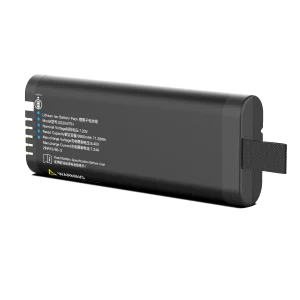
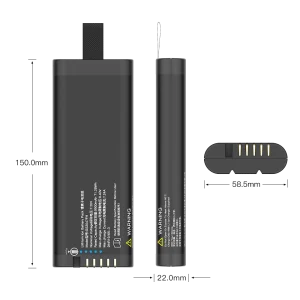
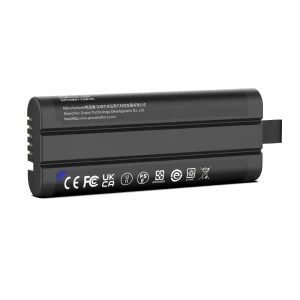
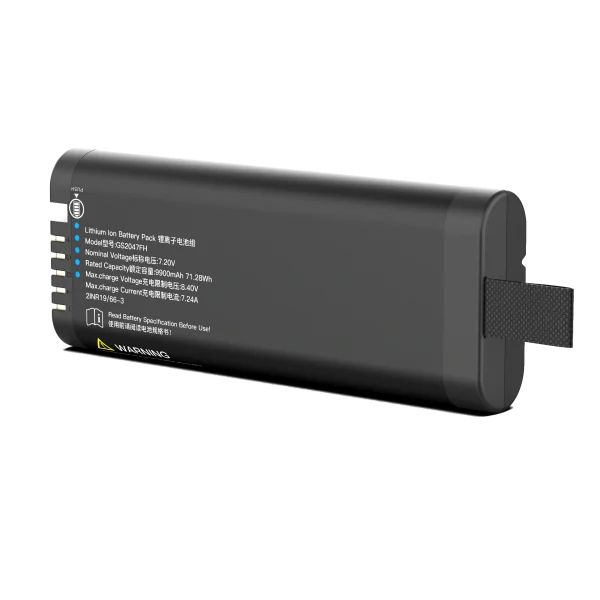
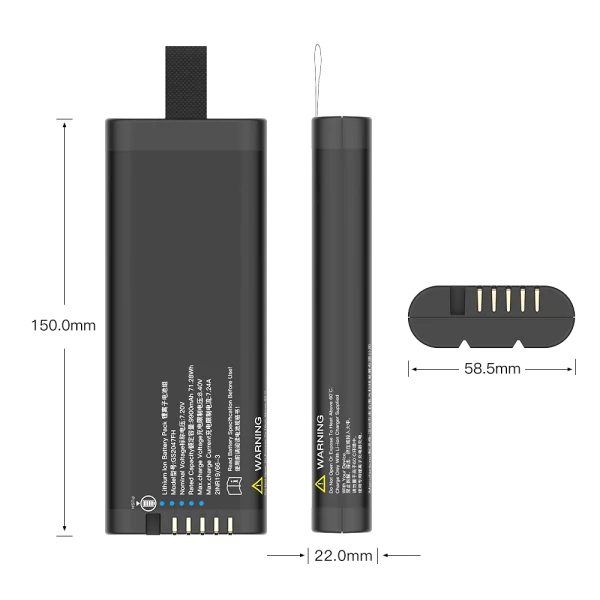
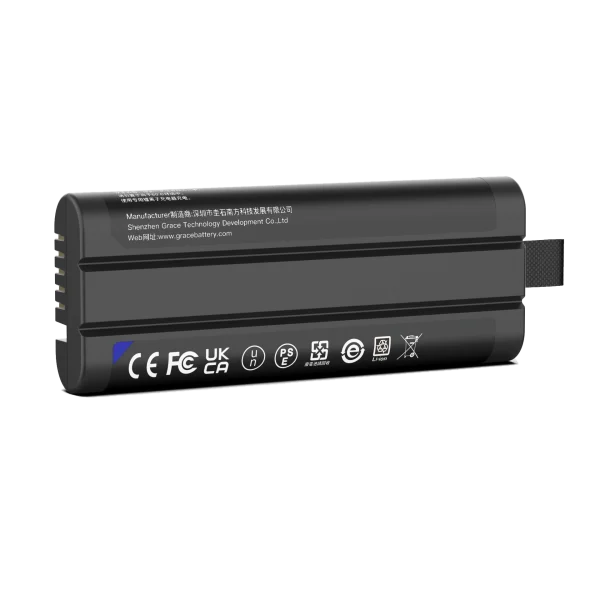
GS2047FH
7.2V/10350mAh/71.28Wh
5. The Full Certification Landscape for Medical Batteries
Medical battery compliance involves a layered set of standards, each addressing a different aspect of safety and quality. The table below summarizes the key standards, their scope, and where they apply in the supply chain:
| Standard | Scope / What It Covers | Applies To | Market |
| ISO 13485:2016 | Quality management system for medical device design and manufacture | Manufacturer’s QMS | Global |
| IEC 62133-2:2017+A1:2021 | Safety of portable sealed lithium cells and batteries | Cells and battery packs | Global (FDA recognized) |
| UN 38.3 | Transport safety: altitude simulation, thermal cycling, vibration, shock, short circuit, impact, overcharge, forced discharge | Cells and packs (shipping) | Global (air/sea/road transport) |
| IEC 60601-1 Ed 3.2 (2020) | General safety and essential performance of medical electrical equipment | Complete medical device system | Global |
| ISO 14971:2019 | Risk management for medical devices | Device and battery design process | Global |
| UL 1642 | Safety of lithium-ion cells | Cells | North America |
| UL 2054 | Safety of household and commercial battery packs | Battery packs | North America |
| CE / UKCA marking | EU/UK regulatory conformity (covering EMC, safety, MDR) | Complete device / pack | EU / UK |
| EU Battery Regulation 2023/1542 | Sustainability, labeling, carbon footprint, battery passport | Batteries placed on EU market | EU |
Note that some standards apply to the cell (UL 1642), some to the pack (IEC 62133-2, UL 2054), some to the manufacturer’s process (ISO 13485), and some to the complete medical device (IEC 60601-1). As a medical device engineer, you need to coordinate with your battery supplier to ensure that the pack-level certifications are in place and that the supplier’s quality system supports your device-level regulatory submission.
6. How to Evaluate a Medical Battery Manufacturer: A Comparison Framework
Choosing the right battery pack partner for a medical program is a decision that directly affects your time-to-market, regulatory readiness, and long-term field reliability. Based on my experience working with medical OEMs, here are the dimensions that matter most:
| Evaluation Dimension | What to Ask For | Red Flag |
| Quality System Certifications | ISO 13485 certificate (not just ISO 9001), ISO 14001, valid for your product category | Supplier claims “medical-grade” but only holds ISO 9001 |
| Product Safety Certifications | IEC 62133-2 test report for your specific pack, UN 38.3 summary, UL/cUL if targeting North America | Only provides cell-level cert, not pack-level; expired certificates |
| Smart BMS Capability | Experience with SMBus 1.1/2.0, I2C, fuel gauge ICs (TI bq series, etc.), accurate SOC reporting (<3% error) | Uses only basic protection board without fuel gauge or communication |
| Customization (OEM/ODM) | In-house mechanical design, firmware development, PCBA layout, ability to adapt to your form factor and connector | Only sells standard catalog packs, no engineering support |
| Documentation & Regulatory Support | Technical files, risk analysis per ISO 14971, DHF/DMR support, traceability records, change notification process | Cannot provide controlled documents or design history files |
| Production Capability | Capacity to support your volume ramp, lead time, minimum order quantity, pilot line for NPI | No clear NPI process; long lead times for design changes |
| Application Experience | References in medical devices (patient monitors, infusion pumps, etc.), understanding of IEC 60601-1 system-level requirements | Only consumer electronics references; no medical program history |
7. TEFOO Medical Battery Solutions
At TEFOO (Shenzhen Guishi Nanfang Technology Co., Ltd.), our engineering team has spent years developing smart lithium battery systems specifically for medical and industrial equipment. Our approach to medical battery programs is built on three pillars:
7.1 Smart BMS with SMBus Communication
Our medical-grade battery packs feature advanced smart BMS designs that support SMBus protocol communication, allowing the host medical device to read accurate state-of-charge, cell voltage, pack temperature, cycle count, and diagnostic data in real time. This level of transparency is essential for medical devices that must monitor battery health as part of their clinical safety case. We work with leading fuel gauge ICs and tailor the BMS firmware to each device’s power profile and communication requirements.
7.2 OEM/ODM Custom Pack Design
Every medical device has unique form factor, voltage, current, and communication requirements. We provide full OEM/ODM services — from cell selection and mechanical design to BMS firmware development, enclosure design, and validation testing. Our engineering team supports customers through design inputs, risk analysis, verification testing, and design history file documentation, aligning with ISO 13485 design control practices.
7.3 Certifications and Quality
TEFOO maintains ISO 9001 and ISO 14001 certifications, and our medical battery programs are designed and documented under ISO 13485-aligned quality processes. Our packs carry IEC 62133-2 and UN 38.3 certifications, and we support CE, UKCA, and UL certification for customer-specific programs. We work closely with medical device OEMs to provide the technical documentation and traceability records needed for FDA submissions and EU MDR compliance.
Our medical battery solutions serve applications including patient monitors, portable ultrasound systems, infusion pumps, diagnostic equipment, and industrial handheld medical devices. If you are developing a portable medical product and need a battery partner that understands both the engineering and the regulatory requirements, our team is ready to support your program.
8. Frequently Asked Questions
Q1: Is IEC 62133 certification mandatory for medical device batteries?
There is no single global law that says “all medical batteries must carry IEC 62133.” However, in practice, it is the de facto safety standard. The FDA recognizes IEC 62133-2 as a consensus standard, and EU MDR and IEC 60601-1 conformity assessments expect demonstrated battery safety. Without IEC 62133-2 test data, your battery will face questions during regulatory review and likely require additional safety testing. It is effectively mandatory for any medical program targeting major markets.
Q2: What is the difference between ISO 13485 certified cells and an ISO 13485 certified battery pack?
ISO 13485 is a quality management system certification — it applies to an organization, not to a specific cell or battery. When a supplier says their cells are “ISO 13485 certified,” they mean the cell manufacturer operates under an ISO 13485 QMS. For a battery pack, the pack assembler also needs ISO 13485 (or an equivalent medical-grade QMS), because the pack involves additional design, assembly, and testing steps. Ideally, both your cell supplier and your pack integrator operate under controlled quality systems.
Q3: Can I use consumer-grade lithium cells in a medical device?
Technically, consumer-grade cells can be integrated into a medical device, but doing so creates significant regulatory and liability risks. Consumer cells are not graded for the tight tolerances, traceability, and reliability margins that medical applications require. They may also lack the full safety test data and controlled supply chain documentation needed for a medical device submission. Most medical OEMs and their notified bodies expect cells sourced from suppliers with medical-grade quality systems and full traceability.
Q4: What does SMBus communication add to a medical battery?
A basic (“dumb”) battery only provides power through its terminals. A smart battery with SMBus communication reports state of charge, remaining capacity, cell voltages, pack temperature, cycle count, and fault codes to the host device. For medical devices, this enables accurate battery fuel gauging, predictive maintenance alerts, and diagnostic logging — all of which contribute to patient safety and device reliability. It is increasingly expected in modern portable medical equipment.
Q5: How long does medical battery certification take?
Timelines vary by program complexity. IEC 62133-2 pack-level testing typically takes 8 to 12 weeks once production-ready samples are available. UN 38.3 testing takes 4 to 6 weeks. ISO 13485 certification for a new manufacturer can take 6 to 12 months. The key is to engage your battery supplier early — ideally during the design phase — so that certification testing is planned in parallel with product development, not after.
Q6: What is UN 38.3 and do I need it for shipping?
UN 38.3 is the United Nations transport testing standard for lithium batteries. It covers eight tests: altitude simulation, thermal cycling, vibration, shock, external short circuit, impact/crush, overcharge, and forced discharge. Any lithium battery shipped by air, sea, or road — including medical batteries — must pass UN 38.3 and have the associated test summary documentation. Without it, carriers will refuse shipment. It applies to both cells and battery packs.
Q7: How does the EU Battery Regulation 2023/1542 affect medical batteries?
Regulation (EU) 2023/1542, which entered into force in 2023 with phased compliance deadlines, introduces requirements for battery labeling, carbon footprint declarations, recycled content, performance and durability specifications, and eventually a “battery passport.” While medical device batteries are not fully exempt, some provisions apply differently to specialized industrial and medical batteries. Medical device manufacturers placing batteries on the EU market should monitor the phased implementation and work with suppliers who can provide the required documentation and compliance data.
Q8: How do I choose between Li-ion and Li-polymer for my medical device?
The choice depends on your form factor and safety priorities. Lithium-ion cylindrical cells (18650, 21700) offer high energy density, lower cost, and wide supplier availability — a good fit for devices with available internal volume. Lithium polymer pouch cells offer thinner, flexible form factors and improved safety in impact scenarios, making them suitable for compact or wearable devices where space is constrained. Your battery engineer can model the trade-offs based on your device’s power budget, envelope, and safety requirements.
9. Conclusion
Medical grade lithium batteries are a critical safety component, not a line-item procurement decision. The combination of ISO 13485 quality system controls and IEC 62133-2 safety testing establishes the baseline that medical device regulators, notified bodies, and OEM quality teams expect. Add in UN 38.3 for transport, IEC 60601-1 at the system level, and the emerging EU Battery Regulation 2023/1542 requirements, and it becomes clear that battery compliance is a multi-layered engineering challenge that starts with selecting the right manufacturing partner.
As a medical device engineer, your checklist should be: (1) confirm the supplier operates under ISO 13485-aligned design controls; (2) verify IEC 62133-2 certification for your specific pack configuration; (3) assess smart BMS and SMBus communication capabilities; (4) request references and documentation support for regulatory submissions; and (5) engage early enough in the development cycle to align certification timelines with your product launch.
If you are evaluating battery partners for a medical device program, TEFOO’s engineering team brings hands-on experience in smart BMS design, SMBus communication, and OEM custom battery pack development for medical and industrial applications. Contact us to discuss your requirements — from initial cell selection through validation testing and regulatory documentation.