By the TEFOO Battery R&D Team | Senior Lithium Battery Engineer, Shenzhen Guishi Nanfang Technology Development Co., Ltd.
1. Introduction
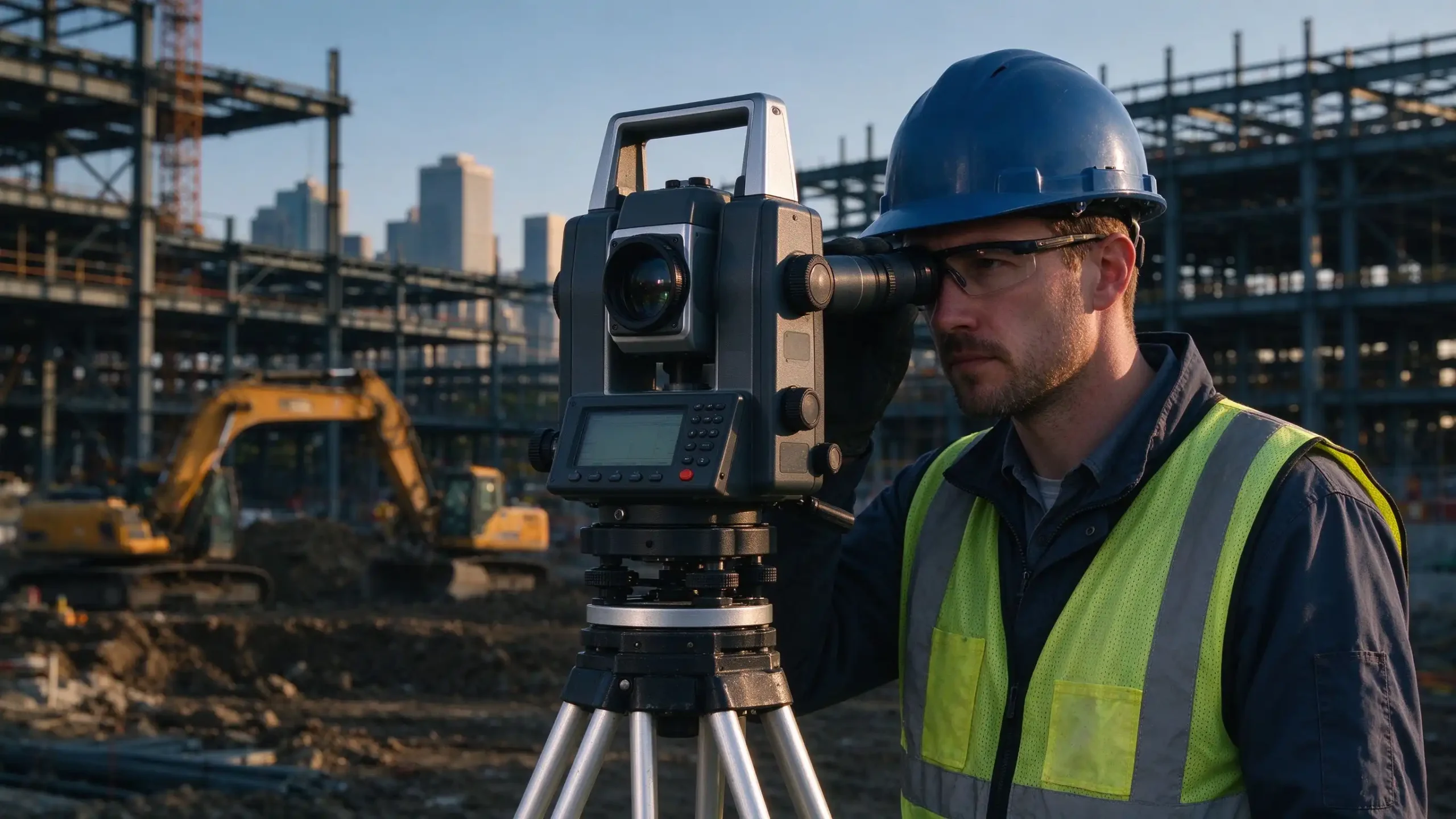
In surveying, the most expensive measurement is the one you cannot complete. A GNSS static observation scheduled over eight hours, a robotic total station locked on a prism target on a busy construction site, or a mobile mapping vehicle collecting lidar strips across a highway — all of them depend on a single component that field crews often take for granted: the battery pack. When a pack drops to 3.3 V mid-observation, the data file is invalidated, the site is re-visited at additional cost, and deadlines slip.
The global market for lithium-ion packs in professional and industrial field equipment is expanding rapidly; the adjacent aerial-work-platform Li-ion battery segment alone is projected to grow from roughly USD 1.2 billion in 2025 to USD 3.5 billion by 2034, a compound annual growth rate of about 12.5% (Verified Market Reports, 2026). Surveying instruments share the same Li-ion chemistries and BMS architectures, but they impose harsher environmental and runtime demands than most consumer devices.
2. Why Surveying Instrument Batteries Are a Specialized Product
A survey instrument is not a smartphone. It is deployed in deserts, on glaciers, on offshore wind farms and in mine tunnels, and it is expected to hold a precision measurement for hours on end. Four engineering requirements distinguish survey packs from generic Li-ion packs:
- Wide-temperature operation. Field work routinely spans −20 °C in winter surveys to +60 °C on black asphalt in summer. Cells must be selected for low-temperature discharge performance, and the BMS must derate charge current below 0 °C to prevent lithium plating.
- Vibration and shock resistance. Total stations are carried in backpacks, mounted on tripods and bumped in truck racks. Cell spacing, welding and enclosure design must survive UN38.3 vibration and shock profiles without internal shorts.
- Long runtime, not peak power. GNSS RTK rovers typically draw 1.5–2.5 W; a modern rover with a 6800 mAh pack (≈50 Wh) will run 20–24 hours on a charge. The design target is energy density and low self-discharge, not high C-rate.
- Smart fuel gauging. Professional instruments expect a reliable SOC readout. Higher-end packs use SMBus or HDQ communication and a battery-aware fuel-gauge IC; cheap aftermarket packs with a simple NTC thermistor give the instrument inaccurate percentage readings.
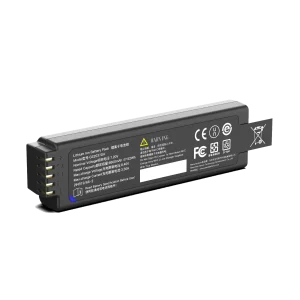
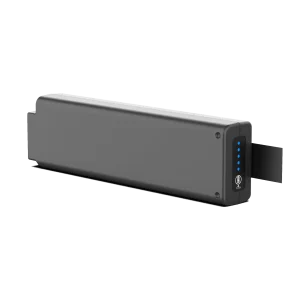
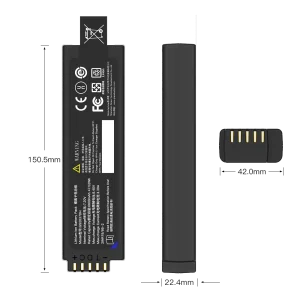
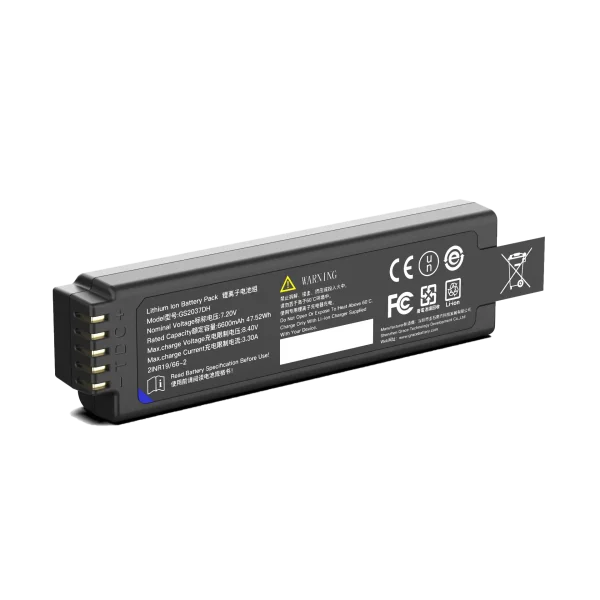
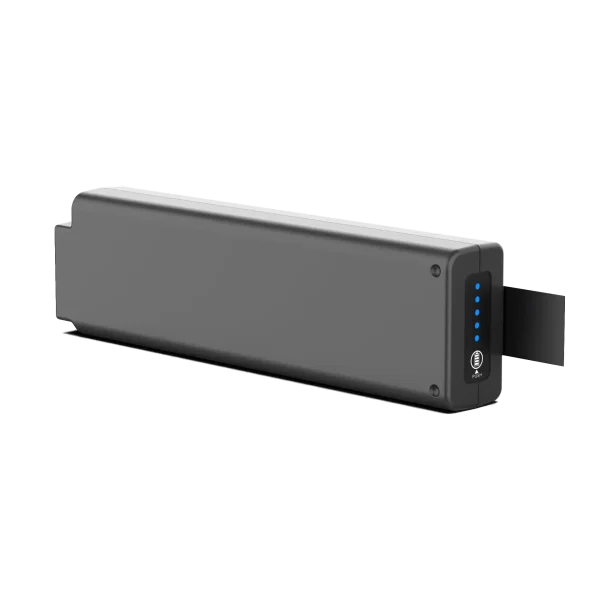
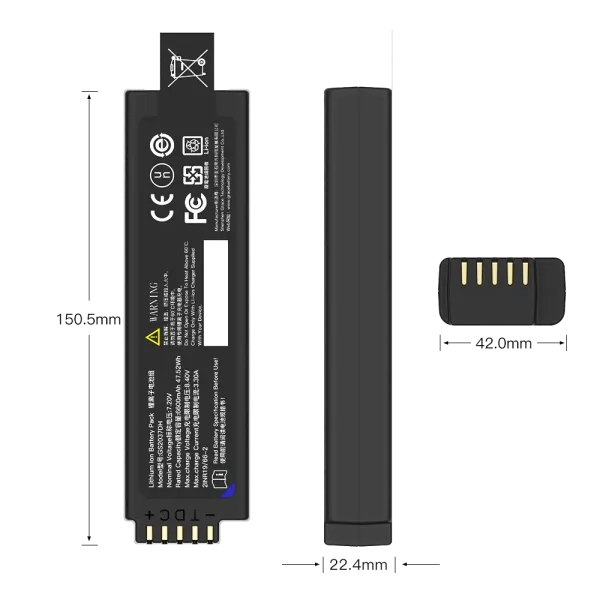
GS2037DH
7.2V/6900mAh/47.52Wh
3. Technical Evaluation Checklist for a Replacement Pack
When qualifying a new battery supplier for surveying instruments, the R&D and procurement team should request the following items in writing before placing a trial order:
- Cell specification: brand, model, grade (A/B/C), capacity, and country of origin. A-grade cells from Tier-1 suppliers should carry a 0% RPP (reject-per-thousand) incoming inspection.
- BMS schematic and protection thresholds: over-voltage cutoff (≈4.25 V/cell), under-voltage cutoff (≈2.5–3.0 V/cell), over-current, short-circuit response, and thermal cutoff temperature.
- Fuel gauge: whether the pack uses a standard fuel-gauge IC (e.g., TI bq series, Microchip) and whether SMBus addresses and commands match the OEM instrument.
- Cycle life test report: minimum 500 cycles at 1 C charge / 1 C discharge, 25 °C, to 80% initial capacity. Survey fleets should expect 800–1000 cycles from a well-designed pack.
- Environmental test: operating temperature −20 °C to +60 °C discharge, 0 °C to +45 °C charge; storage −40 °C to +70 °C.
- Mechanical: connector mating cycles ≥500, contact plating ≥3 µin gold, housing material (PC/ABS or glass-filled nylon), and ingress rating of the pack itself.
- Aging test: every pack should undergo 48–72 hours of charge/discharge aging at 23–25 °C before shipment.
4. Compliance and Certification Standards Required in 2026
Survey batteries cross borders constantly: packs ship from manufacturers to distributors in the EU, UK, US, Australia, the Middle East and Southeast Asia. A pack without the correct documentation will be refused by freight forwarders, customs, or enterprise customers. The following standards are the baseline, not the ceiling:
- UN38.3 — United Nations Manual of Tests and Criteria, Section 38.3. Eight tests: altitude simulation, thermal test, vibration, shock, external short circuit, impact/free fall, overcharge, and forced discharge. Required for air, sea and road transport of Li-ion cells and packs.
- IEC 62133-1:2017+A1:2021 and IEC 62133-2:2017+A1:2021 — secondary cells containing alkaline or other non-acid electrolytes; Part 2 covers lithium systems. This is the portable-equipment safety certification recognized by CE, KC, BIS and many national schemes.
- IEC 62619 — safety requirements for secondary lithium batteries for industrial applications. Relevant when the pack is integrated into a fixed or semi-fixed survey station (e.g., a permanent GNSS reference station).
- CE / UKCA / FCC / RoHS / REACH — market-access marks for the European Economic Area, United Kingdom, and electromagnetic compatibility.
- EU Battery Regulation (EU) 2023/1542 — entered into force in 2023 and is phasing in obligations through 2027–2028: carbon footprint declaration, minimum recycled content, due-diligence obligations, and eventually a battery passport for packs above 2 kWh. Survey packs are below the passport threshold today, but importers into the EU must already meet labeling and carbon-footprint documentation.
A manufacturer that cannot produce a UN38.3 summary test report (no more than one year old per shipment, per IATA rules) should not be on an approved-vendor list, regardless of price.
5. TEFOO as a Survey Equipment Battery Manufacturer
TEFOO — Shenzhen Guishi Nanfang Technology Development Co., Ltd. — has spent more than a decade designing and manufacturing smart Li-ion battery packs for medical devices, industrial instruments and professional surveying equipment. Our engineering team treats survey packs as precision power systems, not commodity products.
Our survey battery program is built around four commitments:
- Drop-in compatibility.
- Smart BMS with SMBus. Our packs use automotive-grade MCUs and fuel-gauge ICs that replicate OEM SMBus behavior, so the instrument displays accurate runtime, fuel percentage and charge status without error codes.
- Certified, audited manufacturing. Our facility operates under ISO 9001 and ISO 14001, with process controls aligned to ISO 13485 (the medical-device quality standard). Every pack ships with UN38.3, IEC 62133, CE and UKCA documentation, and we support EU 2023/1542 compliance for customers shipping into Europe.
- OEM/ODM flexibility. We support capacity upgrades (e.g., a 7.4 V 5000 mAh pack where the OEM ships 3400 mAh), custom connector retention, private labeling, and low-volume pilot runs for instrument manufacturers launching new rovers or total stations.
Every pack leaves our Shenzhen facility after a 48-hour aging cycle, capacity verification, internal-resistance check and final inspection. We offer a one-year warranty on packs and work directly with survey fleet operators, instrument dealers and OEMs on replacement programs.
6. Frequently Asked Questions
Q: How do I identify the correct replacement battery for my total station or GNSS receiver?
A: The safest approach is to read the OEM part number printed on the original pack (e.g., GEB223, BDC72, 79400) and match it exactly. Cross-reference the instrument model in the manufacturer’s compatibility list. If the original pack is missing, provide the instrument brand, model and a photo of the battery compartment to the supplier; a competent manufacturer will confirm compatibility before shipping.
Q: What is the typical cycle life of a survey instrument battery?
A: A well-designed Li-ion pack should deliver 500–800 cycles to 80% of its initial capacity at 25 °C. Field packs that are routinely charged in cold vehicles or left fully discharged over winter will reach end-of-life sooner. A pack that drops below 80% capacity after 200 cycles indicates either consumer-grade cells or a BMS that is not balancing cells correctly.
Q: Can I upgrade to a higher-capacity battery than the OEM?
A: In most cases yes, because the battery compartment has physical volume that the OEM may under-fill for cost reasons. A 7.4 V 5000 mAh pack can often replace a 3400 mAh OEM pack at the same voltage and form factor, extending runtime by roughly 40%. Do not attempt to change the series count (e.g., replacing a 2-series 7.4 V pack with a 3-series 11.1 V pack); this will damage the instrument.
Q: Will using an aftermarket battery void my instrument warranty?
A: In the United States, the Magnuson-Moss Warranty Act prohibits a manufacturer from voiding a warranty solely because an aftermarket part was used, unless the part itself caused the damage. In the EU, Directive 1999/44/EC provides similar protection. In practice, keep purchase records and test reports for the replacement pack; if a warranty claim arises, the burden is on the OEM to prove the pack caused the failure.
Q: How should I store survey batteries over the off-season?
A: Store packs at 40–60% state of charge in a dry, cool environment (15–25 °C). Do not store fully charged or fully discharged. Re-charge to 50% every six months. Avoid leaving packs in a vehicle over winter; below −20 °C, Li-ion cells can be permanently damaged by metallic lithium plating.
Q: What shipping documents are required for Li-ion survey batteries?
A: For air transport, you need a UN38.3 test summary, a Class 9 lithium-battery label, and (for shipments above certain weight thresholds) a lithium battery handling mark. Sea and road shipments under ADR/DOT require similar documentation. Reputable manufacturers supply these documents with every shipment; if a supplier cannot provide them, the freight forwarder will refuse the cargo.
Q: How long does an OEM/ODM custom battery pack take to develop?
A: For a drop-in replacement based on an existing form factor, tooling and validation typically take 4–6 weeks. For a fully custom pack for a new instrument (new connector, new BMS firmware, new enclosure), plan 8–12 weeks including EVT/DVT/PVT stages. A serious manufacturer will provide a project plan with cell selection, schematic review, sample testing and certification milestones.
7. Conclusion
Surveying instruments are precision tools, and their power packs deserve the same engineering rigor as the instruments themselves. As of 2026, the replacement battery market is mature enough that fleet managers no longer need to choose between OEM pricing and unknown-quality generic packs. A specialized manufacturer can deliver drop-in compatible packs with A-grade cells, smart SMBus BMS, full UN38.3/IEC 62133/CE/UKCA documentation, and cycle life equal to or better than the OEM — typically at 40–60% of OEM cost.
When evaluating a survey equipment battery manufacturer, ask for three things before negotiating price: the cell brand and grade, the certification file, and a sample pack tested on your own instrument. If those three are in order, the rest of the commercial conversation is straightforward.