A 2026 guide for engineers and product teams specifying lithium batteries for rugged handheld, IoT and portable industrial devices
By the R&D Engineering Team, TEFOO Battery technology blog · Updated October 2026
1. Introduction: Four marks, three different jobs
A field device is not a consumer gadget. It is deployed in warehouses, on construction sites, in cold-chain logistics, on survey poles, in ambulances and on factory floors. It is dropped, rained on, vibrated, exposed to extreme temperatures, and expected to keep working for years with a battery that an operator can swap in seconds.
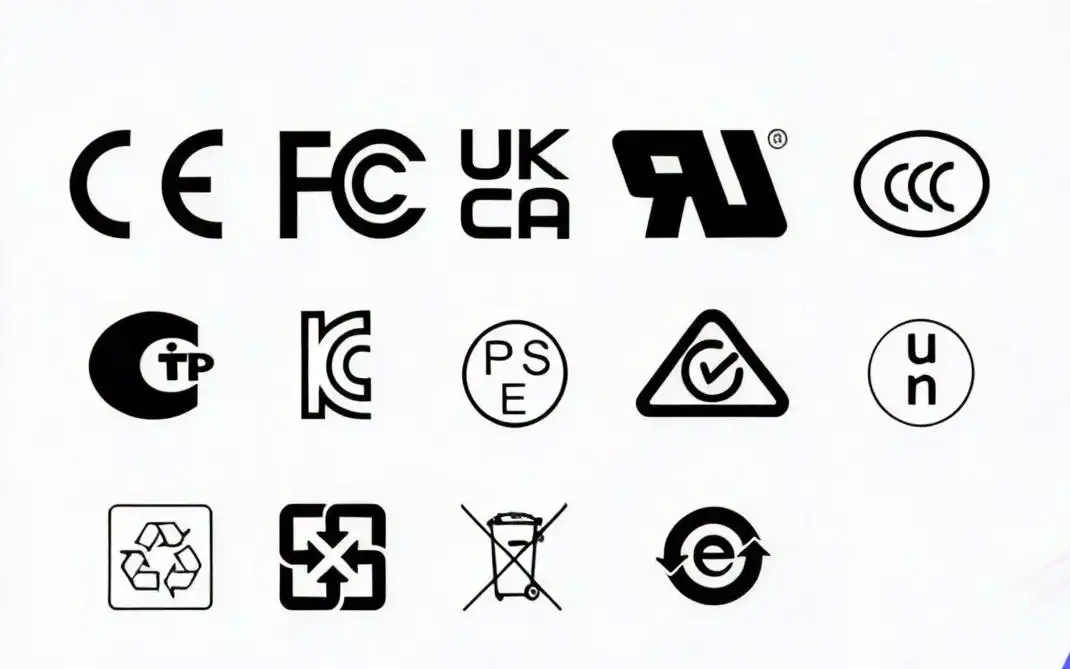
That battery is the only subsystem that is simultaneously a product, a power source and a regulated dangerous good. That is why a serious specification sheet quotes four marks together — UN 38.3, IEC 62133, CE and FCC. Each answers a different question:
- UN 38.3 — transport safety: can the cells and battery be shipped by air, sea, road and rail?
- IEC 62133-2 — product safety: is the battery safe to use in a portable application?
- CE — EU market access: do the battery and the device comply with EU legislation?
- FCC — US market access: does the device meet FCC equipment-authorization requirements?
The critical point: these four marks are complementary, not interchangeable. Passing UN 38.3 does not earn CE. An IEC 62133 report does not clear customs. And from 2026 the EU rules are changing faster than most product roadmaps expect — labelling obligations arrive on 18 August 2026, and removability and replaceability requirements follow on 18 February 2027.
2. UN 38.3 — The transport passport
2.1 What it is
Section 38.3 of the UN Manual of Tests and Criteria (current edition: 8th Revised Edition, 2023, with Amendment 1 published in October 2025) defines the transport-safety test regime for lithium cells and batteries. It is not a “certificate” in the CE sense; it is a test series that dangerous-goods regulations — IATA DGR for air, IMDG for sea, ADR/RID for road and rail, and national rules such as China’s MH/T 1052—2025 for air transport — require before lithium cells and batteries may be shipped.
2.2 The eight tests (T1–T8)
The regime comprises eight tests. A battery that passes is eligible for a UN 38.3 test summary; a battery that fails does not move, by any mode.
Table 1 — UN 38.3 tests T1–T8
| Test | Procedure | Key acceptance criteria |
| T1 — Altitude simulation | Simulated air transport at reduced pressure (about 15,000 m) | No leakage, venting, disassembly, rupture or fire; open-circuit voltage not reduced by more than 10 % |
| T2 — Thermal test | Rapid temperature cycling from −40 °C to +72 °C | Same as T1 |
| T3 — Vibration | Sinusoidal vibration sweep, 7 Hz to 200 Hz | Same as T1 |
| T4 — Shock | Mechanical shock up to 150 g | Same as T1 |
| T5 — External short circuit | External short at less than 0.1 Ω, up to 24 h | Surface temperature ≤ 170 °C; no disassembly, rupture or fire within 6 h |
| T6 — Impact / crush | 9.1 kg impact for cylindrical cells; 13 kN crush for prismatic cells and packs | Same as T5 |
| T7 — Overcharge | Charge at twice the maximum rated voltage | No disassembly, rupture or fire within 7 days |
| T8 — Forced discharge | Forced discharge of a fully charged cell | No disassembly, rupture or fire within 7 days |
2.3 What changed in 2025, and what is coming
Amendment 1 to the 8th Revised Edition (published October 2025) refines definitions in Section 38.3, including the definition of “rupture” for cells whose internal components are partially exposed by design — a change that affects how some cylindrical and pouch cells are assessed. In the same period, the UN Sub-Committee of Experts on the Transport of Dangerous Goods has been discussing a hazard-based classification with new tests T9 to T13, including thermal-runaway propagation. These proposals signal that transport classification is moving from a fixed test set towards design-dependent hazard assessment — plan for stricter requirements in the next revision cycle.
2.4 2026 operational notes
- IATA DGR 67th Edition applies from January 2026; the 1 January 2026 addendum includes provisions on data loggers and cargo-tracking devices.
- UK CAA changes to passenger and crew carriage rules for lithium batteries and power banks take effect on 27 March 2026.
- IATA Battery Shipping Regulations (BSR) 13th edition (2026) and 14th edition (2027) add new entries (for example battery-powered vehicles) and clarify packing instructions.
- China CAAC MH/T 1052—2025 (in force since 1 December 2025) specifies UN 38.3 testing for air transport of lithium batteries within China.
Each carrier and freight forwarder may request the UN 38.3 test summary (Section 38.3.5) with its ten mandatory data elements. Keep the summary in sync with your design: any change of cell, BMS or firmware can invalidate it.
3. IEC 62133-2 — Product safety for portable sealed batteries
3.1 The standard
IEC 62133-2:2017 (+ Amendment 1:2021) is the international safety standard for portable sealed secondary lithium cells and batteries used in portable applications. The consolidated current edition is Edition 1.1 (2021); Edition 2.0 is under development with a forecast publication date of 28 February 2027.
Where UN 38.3 asks “can we transport it?”, IEC 62133-2 asks “is it safe to use as a product?”. It evaluates the cell and the battery under electrical, mechanical and environmental abuse — external short circuit, abnormal and overcharging, forced discharge, crush and impact, vibration, and thermal abuse — at both cell and pack level. China has adopted the standard identically as GB/T 28164.2-2025.
3.2 Why OEMs specify it
- It is the most widely referenced safety baseline for portable lithium packs worldwide, and the basis of IECEE CB scheme test reports accepted by many national certification bodies.
- Device-level standards — from IEC 60601-1 for medical equipment to industrial tooling standards — frequently require battery safety evidence at this level.
- It is battery-level, not just cell-level: the final pack — protection circuit, wiring, connectors and enclosure — is what gets tested.
4. CE marking — EU market access under the Battery Regulation
4.1 The new regime
Since 18 August 2024, batteries placed on the EU market must undergo a conformity assessment and bear CE marking under Regulation (EU) 2023/1542 — the EU Battery Regulation. This is the first dedicated EU product regime for batteries themselves: it replaces the old directive framework and adds safety, sustainability, performance, labelling and conformity requirements. It applies to all battery categories, including portable batteries and batteries incorporated into products — including the battery inside your field device.
4.2 What the Regulation requires of a battery
- CE marking under the Regulation, backed by an EU declaration of conformity and a technical file (conformity assessment per Annex VIII).
- Compliance with the Regulation’s safety requirements and hazardous-substance restrictions.
- Labelling and information obligations, which expand in 2026–2027 (see 4.3).
4.3 Dates that change your product plan
Three dates matter for anyone specifying batteries for field devices in 2026 and 2027:
Table 2 — EU Battery Regulation timeline
| Date | Obligation | Impact on field devices |
| 18 Aug 2024 | CE marking and conformity assessment under Regulation (EU) 2023/1542 apply | Battery must carry CE mark and EU declaration of conformity before first placement |
| 14 Jul 2026 | Delegated regulation on derogations from removability and replaceability | Rugged devices for splash/immersion environments and professional medical imaging equipment may qualify for professional-only replacement |
| 18 Aug 2026 | Labelling: general-information label for all batteries; capacity label for rechargeable portable, LMT and SLI batteries | Update labels, packaging and technical file before placing batteries on the EU market |
| 18 Feb 2027 | Removability and replaceability of portable batteries (Article 11); battery passport (LMT/EV/industrial); QR-code labelling | Portable batteries must be readily removable and replaceable by end users — or the device must meet and document a derogation |
| End of 2027 | Portable waste-battery collection target 63 % (73 % by end of 2030) | Producer registration and take-back obligations cascade into procurement |
For a rugged field device the removability rule is a design decision, not a paperwork exercise. The 2026 delegated regulation and the Commission guidelines exempt specific categories — including appliances primarily designed for environments regularly subject to splashing water or immersion (think IP67 handhelds) and professional medical imaging equipment — where batteries may be replaceable only by independent professionals. If your device qualifies, document the basis before market entry; if it does not, plan the end-user-replaceable design now.
4.4 CE is device-level too
The battery’s CE marking under the Regulation is necessary but not sufficient for your product. The host field device must also satisfy the EMC Directive, RoHS and REACH and — because almost every field device contains a radio — the Radio Equipment Directive. A battery with only an IEC 62133 report and no 2023/1542 conformity package cannot legally enter the EU in 2026.
5. FCC — US market access under Part 15
5.1 The device, not the cell
The FCC does not “certify batteries”. Under 47 CFR Part 15, equipment authorization (FCC ID) is granted to radio-frequency devices. A field device with Wi-Fi, Bluetooth, cellular or another intentional radiator needs Part 15 Subpart C certification before it can be marketed in the US; many digital devices without radios fall under Part 15 as unintentional radiators through a Supplier’s Declaration of Conformity (SDoC).
5.2 Where the battery matters
- §15.107(d): a device that operates purely on battery power and has no provision for AC-line connection is exempt from conducted-emissions limits. Add “charge while operating” capability or an AC adapter, and the conducted requirements return — the charging architecture is a compliance decision.
- RF exposure (47 CFR §1.1307(b), §1.1310, §2.1091 and §2.1093): mobile and portable devices require RF-exposure evaluation; battery configuration affects duty cycles and test conditions.
- Power integrity: switching-regulator noise and cell voltage droop under load influence radiated emissions. The battery pack and BMS are part of the EMC picture, not accessories to it.
5.3 What to ask a supplier
When a data sheet says “FCC certified battery”, it usually means the battery was validated as part of an FCC-certified device platform. Ask for the device-level test reports and the FCC ID trail, and freeze the battery design — a BMS or firmware change can trigger re-testing.
6. Certification matrix
Table 3 — What each mark covers
| Mark | Regulatory layer | Governing instrument | Market / scope | What it demonstrates | Typical deliverables |
| UN 38.3 | Transport safety | UN Manual of Tests and Criteria, Section 38.3 — 8th Revised Edition (2023) + Amendment 1 (2025) | Global; air, sea, road and rail | Cells and batteries survive transport abuse | UN 38.3 test summary (Section 38.3.5); accredited-laboratory battery certificate |
| IEC 62133-2 | Product safety | IEC 62133-2:2017 + Amendment 1:2021 (Edition 2.0 expected 2027) | Global baseline; CB scheme | Safe under electrical, mechanical and environmental abuse | IEC / CB test report; GB/T 28164.2-2025 report for China |
| CE | EU market access | Regulation (EU) 2023/1542, plus EMC, RoHS, REACH and RED for the device | EU / EEA | Legal placement on the EU market | EU declaration of conformity, technical file, CE mark, 2026-compliant labels |
| FCC | US market access | 47 CFR Part 15 (Subpart C or B) | United States | Device RF and EMC compliance | FCC ID and test reports (SDoC where applicable) |
7. From the engineer’s bench — designing for certification
From our bench at TEFOO, where we engineer custom lithium packs for medical and industrial devices, these are the practices that keep certification predictable:
- Start with certified cells. Select cells with valid IEC 62133-2 (or UL 62133-2 / equivalent) reports and UN 38.3 summaries. You cannot “test safety into” a pack built on a bad cell.
- Design the protection chain, then the BMS. Redundant protection — protection IC plus secondary fuse or PTC — is the baseline; a smart BMS adds accurate state-of-charge (SoC), cell balancing, temperature cut-offs and data logging via SMBus, which is exactly what medical and industrial OEMs need in the field.
- Engineer for the environment, not the lab. UN 38.3 T3/T4 and the IEC mechanical tests are minima. Real field margin means operating-temperature derating (−20 °C to +60 °C), potting and conformal coating, and mechanical retention for vibration.
- Plan the test matrix early. UN 38.3 covers cells, batteries and configuration variants (packed with equipment, contained in equipment), and samples are conditioned to defined states of charge. Every cell, BMS or firmware change can invalidate a summary — freeze the bill of materials before testing, not after.
- Keep documentation and traceability current. UN 38.3 summary, IEC/CB reports, EU DoC, FCC reports, MSDS and batch traceability (cell date codes, BMS firmware versions) are the deliverables customers and regulators actually audit.
Common pitfalls we see in the field:
- “A certified cell means a certified pack.” Wrong: the pack — protection, wiring, enclosure — is tested as a product on its own.
- Changing cell suppliers mid-project without re-running the test matrix.
- Treating FCC as a battery-level mark, or CE as a single directive.
- Forgetting that 2026 EU labelling and 2027 removability are design and labelling obligations, not just paperwork.
- Shipping prototypes without a current UN 38.3 test summary.
8. 2026–2027 compliance roadmap
Table 4 — What changes and what to do
| When | What changes | What to do |
| January 2026 | IATA DGR 67th Edition in force; IATA BSR 13th edition (2026) | Recheck shipping declarations and packing instructions; verify data-logger and cargo-tracking provisions |
| 27 March 2026 | UK CAA rules on power banks and passenger/crew carriage | Update operator and crew guidance for UK operations |
| 18 August 2026 | EU labelling: general-information and capacity labels | Update labels, packaging and technical file for EU placement |
| 2026 | EU battery passport and QR-code framework prepares for 2027 | Start collecting the data fields the passport will require |
| 18 February 2027 | EU removability and replaceability (Article 11); battery passport; QR codes | Design for end-user replaceability or document a derogation |
| End of 2027 | EU portable battery collection target 63 % | Confirm producer registration and take-back coverage |
| 2027 (forecast) | IEC 62133-2 Edition 2.0 | Plan re-certification testing against the new edition |
9. FAQ
Q1. Is UN 38.3 a certificate?
No. It is a test regime in the UN Manual of Tests and Criteria that dangerous-goods regulations require before lithium batteries can be transported. Compliance is documented with a UN 38.3 test summary (Section 38.3.5), which carriers and authorities request.
Q2. Does my field device need all four marks?
It depends on your markets and logistics. Air, sea, road or rail shipment requires UN 38.3; selling in the EU requires the battery’s CE conformity under Regulation (EU) 2023/1542 plus device-level directives; selling in the US requires FCC equipment authorization for radio-enabled devices. IEC 62133-2 is the safety baseline most OEMs and integrators specify regardless of destination.
Q3. What is the difference between UN 38.3 and IEC 62133-2?
UN 38.3 tests transport safety under altitude, temperature, vibration, shock, short circuit, crush and overcharge/forced-discharge conditions. IEC 62133-2 tests product safety for portable applications — electrical, mechanical and environmental abuse at cell and battery level. You normally need both.
Q4. If the cell is certified, is the battery pack certified?
No. Cell-level reports do not cover the pack. The pack — protection circuit, BMS, wiring, connectors and enclosure — must be tested and documented on its own.
Q5. What must I change for the EU 2026 labelling and 2027 removability rules?
From 18 August 2026, batteries placed on the EU market need the Regulation’s labelling (general information; capacity label for rechargeable portable batteries). From 18 February 2027, portable batteries in appliances must be readily removable and replaceable by end users, unless a derogation applies (for example rugged devices designed for immersion environments or professional medical imaging equipment) — in which case the basis must be documented.
Q6. Does FCC certify batteries?
No. FCC equipment authorization applies to RF devices. A battery contributes to device compliance through power integrity and charging architecture; ask for the device-level FCC test reports, not a battery-level “FCC certificate”.
Q7. What documents should I request from a battery supplier?
At minimum: UN 38.3 test summary, IEC 62133-2 (or equivalent) test report, EU declaration of conformity and CE marking evidence, FCC device-level reports where applicable, MSDS, and batch traceability documentation.
10. Conclusion
Certification is a system, not a sticker. The four marks in the title cover transport safety, product safety and two regional market-access regimes — and each is changing: UN 38.3 Amendment 1 (2025) and the T9–T13 proposals, the 2026 IATA edition, the EU Battery Regulation’s 2026 labelling and 2027 removability obligations, and FCC’s device-level authorization.
For field devices, the battery is often the last component validated and the first to cause a shipment delay. Choose a partner who owns the cell-to-pack-to-testing chain, keeps compliance current, and treats certification as a design input rather than an afterthought. That is how we engineer at TEFOO — smart BMS, SMBus communication and OEM/ODM customization included.
11. About the author and TEFOO
This article was written by the R&D engineering team at TEFOO , a custom lithium battery pack engineering company serving OEMs in the medical and industrial device sectors. TEFOO specializes in smart BMS battery systems, SMBus communication and OEM/ODM customization.
The information reflects the state of regulations as of October 2026 and is provided for general guidance only; it does not constitute legal advice. Verify applicable obligations with your certification body or counsel before placing products on any market.
References
[1] UNECE — UN Manual of Tests and Criteria Rev.8 (2023) and Amendment 1 (2025)
[4] UN SCETDG — Process for the new classification of a cell or a battery (test parameters)
[5] IATA — Dangerous Goods Regulations 67th Edition, Addendum 1 (1 January 2026)
[6] IATA — Battery Shipping Regulations (13th ed. 2026; 14th ed. 2027)
[8] 中国民用航空局 — 航空运输锂电池测试规范 MH/T 1052—2025
[9] IEC Webstore — IEC 62133-2:2017 + AMD1:2021 (Edition 2.0 forecast 2027-02-28)
[10] 全国标准信息公共服务平台 — GB/T 28164.2-2025(等同采用 IEC 62133-2:2017)
[11] EUR-Lex — Regulation (EU) 2023/1542 (consolidated text)
[15] European Commission — Guidelines on removability and replaceability, C(2026) 5032
[16] GOV.UK — EU Batteries Regulations in Northern Ireland (18 August 2026 labelling obligations)
[17] eCFR — 47 CFR Part 15 Subpart C (Intentional Radiators)
[18] GovInfo — 47 CFR §15.107 (conducted limits; battery-powered exemption)
[19] GovInfo — 47 CFR §15.247 and RF exposure requirements[20] 贸企通(中国贸促会)— 锂电池海运、空运、铁路、公路运输的 UN38.3 测试要求