By Senior R&D Engineer, TEFOO Medical Battery Systems · October 2026
1. Why the Battery Is the Most Safety-Critical Subsystem in a Defibrillator
A defibrillator exists for one reason: to deliver a controlled electrical shock to a heart in fibrillation. Whether it is an automated external defibrillator (AED) mounted in an airport concourse or a manual defibrillator on a hospital crash cart, the entire clinical mission depends on stored energy. In sudden cardiac arrest there is no second chance — the device must work the first time, every time.
That mission places an unusual demand profile on the battery. Unlike a consumer pack that is cycled daily, a defibrillator battery spends most of its life in standby: months or years at very light load while the host device performs self-tests and readiness checks. Then, with no warning, it must support the high-power charging of the energy-storage capacitor to several hundred joules within seconds, and repeat that cycle for multiple shocks — often at the very moment the device is needed most. It must do this across a wide operating-temperature range, after exposure to humidity, vibration, and the occasional drop that portable use brings.
“Medical-grade” is not a marketing label. In engineering terms, it means the battery is designed, verified, and manufactured inside the same regulatory framework as the defibrillator itself: the IEC 60601 family for medical electrical equipment, ISO 13485 for quality management, and ISO 14971 for risk management. Every design decision downstream — cell selection, protection architecture, testing, traceability — follows from that obligation.
2. What “Cell-Level Protection” Means — and Why Pack-Level Protection Alone Is Not Enough
Cell-level protection means that protection functions are applied at every individual cell (or, in a parallel-connected group, at the group): per-cell voltage and temperature sensing, the ability to disconnect charge or discharge, per-cell balancing, and the physical safety devices embedded in the cell itself. Pack-level protection, by contrast, watches only the terminals of the whole battery: total voltage, total current, and one or two pack temperatures.
The limitation of pack-level protection becomes obvious in a series string. The pack voltage is the sum of all cell voltages, so a single cell can drift far outside its safe window while the pack voltage still looks normal. In a six-cell string, a healthy neighbor compensating for a weak cell can mask that cell’s overcharge for a long time. The weakest cell — not the average — determines both capacity and safety.
The same logic applies to imbalance. Cells in a string age differently; capacity fade and self-discharge are never perfectly identical. As imbalance grows, the weakest cell is cycled harder, ages faster, and drifts further — a feedback loop that can end in overdischarge or overcharge of a single cell even while the pack average remains fine.
A further reason is observability. An internal short circuit can begin inside one cell with no immediate change at the pack terminals. Per-cell voltage and temperature measurement is the only way to see the first signs — a cell whose voltage decays overnight, a cell that runs warmer than its neighbors — and to act before the fault propagates to adjacent cells.
Pack-level protection protects the load and the pack as a whole. Cell-level protection protects the cell that is most likely to fail first. A medical-grade battery needs both — but the cell level is the layer that earns the name.
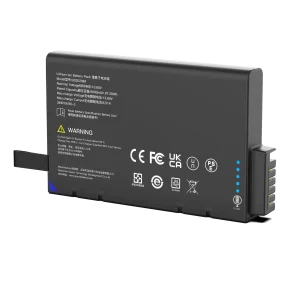
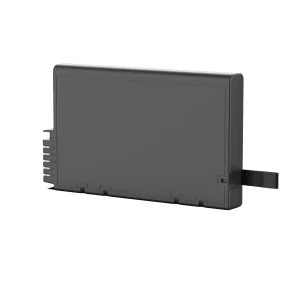
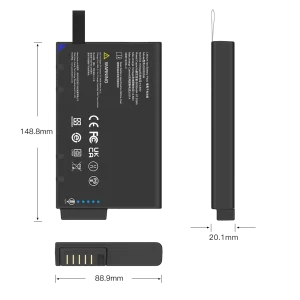
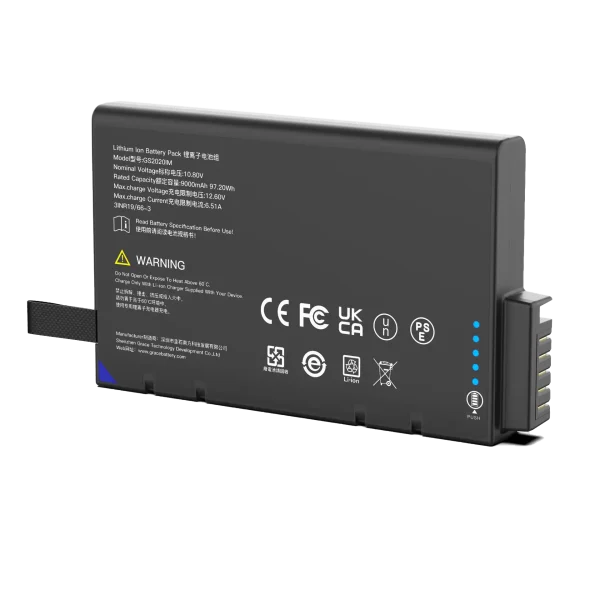
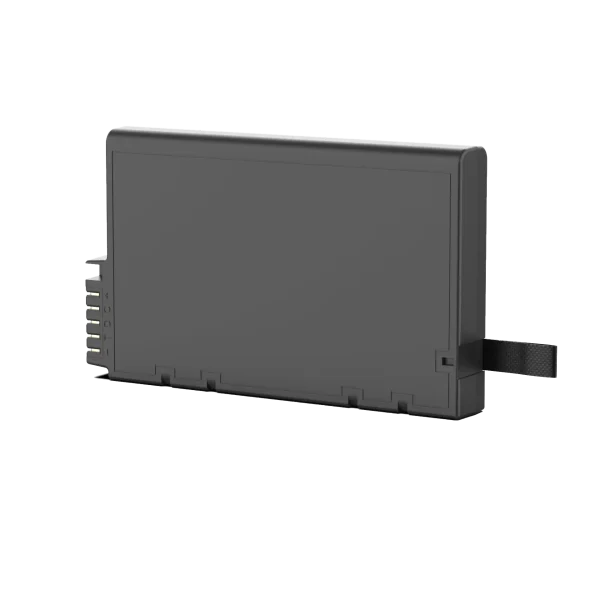
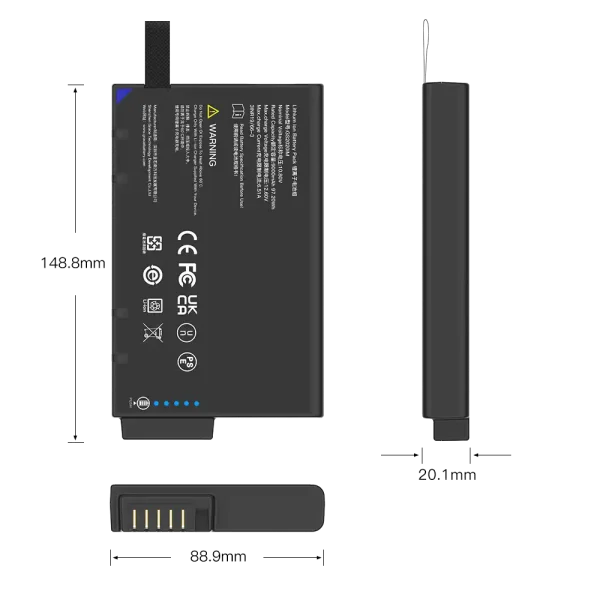
GS2020IM
10.8V/9300mAh/97.2Wh
3. The Cell-Level Protection Architecture
3.1 Cell Selection and Grading
The first protection layer is the cell itself. We qualify cell vendors against strict criteria: stable high-rate discharge performance, low self-discharge, mechanical robustness, and consistent lot quality. Incoming cells are graded and matched — capacity, impedance, and self-discharge within tight windows — because a battery is only as strong as its weakest cell. Every cell keeps its lot identity through assembly, so any issue can be traced from the finished pack back to a specific production lot.
3.2 Per-Cell Electrical Protection
Each cell’s voltage is monitored continuously. Overvoltage and undervoltage thresholds are set with margins below the cell manufacturer’s absolute limits, and the battery management system (BMS) can disconnect charge or discharge through the protection MOSFETs. Current limiting and overcurrent and short-circuit detection operate on both the charge and discharge paths. Independent of the electronics, physical safety devices provide a final layer: the cell’s current interrupt device (CID), which opens on internal pressure; a PTC element, where applicable, limiting current; and a pack-level fuse as the last-resort disconnect.
3.3 Per-Cell Temperature Monitoring
Temperature is measured at each cell, not at the pack wall. Charging is gated by cell temperature, and discharge current is derated when any cell leaves its safe range. This matters most in a defibrillator: the highest-rate events are rare, and a thermal anomaly between events is precisely the kind of early warning that per-cell sensing can capture.
3.4 Balancing
Balancing keeps cells aligned so that no single cell is overcharged while its neighbors lag. Passive balancing during charge dissipates excess energy from the highest cells; the goal is not only capacity but safety margin. In a medical pack that may sit in standby for years, balancing also compensates for the small self-discharge differences that would otherwise widen imbalance over time.
3.5 Redundancy and Fail-Safe Behavior
Protection must never depend on a single point of failure. Our architecture separates the hardware protection path from the firmware: the analog protection circuit can disconnect the pack even if the microcontroller is unresponsive, while the firmware path adds sophisticated, configurable thresholds on top. At every power-on, the battery runs a self-test that verifies the protection circuitry, the sensing paths, and the disconnect switches. The default state is fail-safe: when in doubt, disconnect and report.
4. The BMS: A Continuous Watchdog, Not a Fuel Gauge
A medical battery management system is not primarily a fuel gauge. Its first job is continuous supervision: acquiring every cell’s voltage and temperature, tracking current, comparing against protection thresholds, and maintaining state-of-charge (SOC) and state-of-health (SOH) estimates. Its second job is communication. Using SMBus and related smart-battery protocols, the battery gives the defibrillator host live access to cell voltages, temperatures, current, remaining capacity, cycle count, and diagnostics.
The most important message a defibrillator battery can send is its readiness state. The battery reports READY only when every cell is within limits and all self-tests pass. If any cell drifts, the battery enters a controlled fail-safe state and tells the host device exactly why. A defibrillator that announces “replace battery” during routine service is doing its job; the alternative is a device that fails silently at the moment of rescue.
Standby performance is engineered as deliberately as discharge performance: ultra-low quiescent current, storage-mode management, and self-discharge accounting that keep the battery inside its readiness window across the stated shelf life. Data logging supports service decisions and post-market analysis. BMS firmware is developed and maintained under IEC 62304, with a software safety classification matched to the risks it mitigates.
5. Standards and Regulatory Compliance
A medical-grade battery is defined, in large part, by the standards it is designed and tested to. The table below maps the standards that govern a defibrillator battery to the engineering responses they drive.
Table 1. Standards that define a medical-grade defibrillator battery
| Standard | What it governs | Engineering response |
| IEC 60601-1:2005+A1:2012+A2:2021 | General requirements for basic safety and essential performance of medical electrical equipment | System-level electrical safety, energy and temperature limits; the battery is designed and tested as part of the medical electrical equipment |
| IEC 60601-1-2:2014+A1:2020 | Electromagnetic compatibility (EMC) | Emissions and immunity design so the BMS neither disturbs defibrillator sensing nor misbehaves under interference |
| IEC 60601-2-4:2010+A1:2018 | Particular requirements for cardiac defibrillators | Delivered-energy performance, charging times, and shock sequences the battery must support under worst-case load |
| IEC 62133-2:2017+A1:2021 | Safety of portable sealed lithium cells and batteries | Cell and battery abuse tests: overcharge, external short circuit, forced discharge, thermal abuse |
| UN 38.3 (Manual of Tests and Criteria, 8th edition) | Safe transport of lithium batteries | Tests T1–T8: altitude, thermal cycling, vibration, shock, external short, impact/crush, overcharge, forced discharge |
| ISO 13485:2016 | Quality management systems for medical devices | Design controls, supplier control, traceability, corrective action, post-market surveillance |
| ISO 14971:2019 | Risk management for medical devices | Hazard identification; cell-level protection functions are documented as risk control measures |
| IEC 62304:2006+A1:2015 | Software life cycle for medical device software | Disciplined development of BMS firmware with a risk-based software safety classification |
| IEC 62366-1:2015 | Usability engineering for medical devices | Connector keying, battery status indication, and replacement procedures that resist user error |
These are the building blocks; the finished defibrillator is certified as a whole by the responsible device manufacturer (for example through FDA 510(k) clearance or EU MDR conformity assessment in the applicable markets). Our role as the battery engineering partner is to provide the evidence trail — design documentation, risk files, test reports, and traceability — that makes that certification possible.
6. Verification: Proving It Under Realistic and Abuse Conditions
Verification is where “medical-grade” stops being an intention and becomes evidence. A defibrillator battery is tested at three levels: cell, pack, and system. The table summarizes the test program.
Table 2. Verification program for a medical-grade defibrillator battery
| Test | Purpose | Typical conditions | What must hold |
| Cell abuse (IEC 62133-2) | Verify the cell’s intrinsic response to electrical and thermal faults | Overcharge, external short circuit, forced discharge, high-temperature storage | No fire, explosion, or hazardous leakage |
| Transport (UN 38.3) | Verify safe shipment of cells and batteries | Tests T1–T8 on representative samples | Pass all T1–T8 tests; no dangerous failure |
| Internal-short simulation (development) | Understand worst-case cell response and validate pack barriers | Nail penetration or crush on cell samples | Contained thermal response; findings feed pack design |
| Pack electrical | Verify protection thresholds and charge control | Charge and discharge across the full temperature range; fault injection on every protection channel | Protection trips correctly; pack returns to fail-safe state |
| Load-profile endurance | Verify readiness for real defibrillator use | Repeated charge-to-full-energy cycles of the capacitor at rated power, across temperature | Meets the device’s shock-sequence specification without derating or protection trips |
| Mechanical and environmental | Verify survival in portable use | Vibration, drop, shock, humidity, altitude, temperature cycling | No damage, no safety hazard, no performance loss beyond specification |
| EMC | Verify electromagnetic compatibility | Per IEC 60601-1-2 | Compliant emissions and immunity |
| Aging and shelf life | Verify readiness across the product life | Accelerated cycle and calendar aging; storage self-discharge measurement | Battery remains within its readiness window over the stated life; end-of-life behavior is predictable |
| Reliability engineering | Find weak points before customers do | Step-stress (HALT-style) testing; failure analysis of returned packs | Design margins understood; findings feed back into design and process |
7. Manufacturing: Where “Medical-Grade” Is Earned or Lost
A design is only a design until it is manufactured. Under an ISO 13485 quality management system, we treat every production step as a control point: incoming cell inspection and grading; automated welding with tight process control, because interconnect quality directly determines high-rate discharge behavior; and 100% functional testing of every pack, with the full test record archived against the pack serial number.
Traceability is non-negotiable in a life-safety component: from cell lot through pack assembly to the serial number of the finished defibrillator. Storage and handling are controlled — temperature, humidity, and charge state — because a battery that is perfect at the factory can be damaged by poor handling before it ever reaches the device. And when field data reveals anything unexpected, the change-management and corrective-action loop ensures the lesson returns to design and process, not just to a spreadsheet.
8. Questions to Ask a Defibrillator Battery Supplier
If you are selecting a battery partner for a defibrillator program, the following questions separate engineering substance from marketing claims.
Table 3. Supplier evaluation checklist
| Question | Why it matters |
| Where exactly is your protection at cell level, and what happens if the microcontroller fails? | Tests whether protection is redundant and fail-safe, or a single point of failure |
| Can the host device read per-cell voltage and temperature in real time? | Tests observability — the ability to see the first signs of a cell fault |
| Which editions of IEC 62133-2 and IEC 60601-1 do you design and test to, and may we see the reports? | Tests whether compliance is current and evidenced, rather than merely claimed |
| How is a cell lot traced from the cell vendor to the finished pack? | Tests traceability depth — the difference between a component supplier and a medical-grade partner |
| What is your quiescent current and shelf-life policy? | Tests whether standby readiness is engineered or incidental |
| Walk us through a recent failure analysis. | Tests the learning loop: what was found, what changed, and how the customer was informed |
9. Conclusion
Cell-level protection is not a feature list; it is a design discipline. It begins with qualified, matched cells; continues with per-cell voltage and temperature sensing, per-cell protection and balancing, and redundant, fail-safe disconnection; and it is completed by standards-based verification and controlled manufacturing that can trace every pack back to its cells. No battery can be made risk-free — the honest engineering goal is layered defense: detect the first cell to fail, contain it, and tell the device before it ever fails silently. That is what we mean when we call a defibrillator battery medical-grade.
About the Author
Author is a senior R&D engineer at TEFOO, leading the development of medical-grade lithium battery systems with smart BMS and SMBus communication — including cell-level protected batteries for defibrillators and other life-safety equipment.
References
1. IEC 60601-1:2005+A1:2012+A2:2021 — Medical electrical equipment — Part 1: General requirements for basic safety and essential performance. IEC Webstore. https://webstore.iec.ch/en/publication/2606
2. IEC 60601-1-2:2014+A1:2020 — Medical electrical equipment — Part 1-2: Collateral Standard: Electromagnetic disturbances — Requirements and tests. IEC Webstore. https://webstore.iec.ch/en/publication/67554
3. IEC 60601-2-4:2010+A1:2018 — Medical electrical equipment — Part 2-4: Particular requirements for the basic safety and essential performance of cardiac defibrillators. IEC Webstore. https://webstore.iec.ch/en/publication/2654
4. IEC 62133-2:2017+A1:2021 — Secondary cells and batteries containing alkaline or other non-acid electrolytes — Safety requirements for portable sealed secondary cells, and for batteries made from them, for use in portable applications — Part 2: Lithium systems. IEC Webstore. https://webstore.iec.ch/en/publication/32662
5. UN Manual of Tests and Criteria, Eighth revised edition (UN 38.3), incl. Amendment 1. United Nations (UNECE). https://unece.org/sites/default/files/2025-07/ST-SG-AC10-11-Rev8-Amend1e.pdf
6. ISO 13485:2016 — Medical devices — Quality management systems — Requirements for regulatory purposes. ISO. https://www.iso.org/standard/59752.html
7. ISO 14971:2019 — Medical devices — Application of risk management to medical devices. ISO. https://www.iso.org/standard/72704.html
8. IEC 62304:2006+A1:2015 — Medical device software — Software life cycle processes. IEC Webstore. https://webstore.iec.ch/en/publication/22794
9. IEC 62366-1:2015 — Medical devices — Part 1: Application of usability engineering to medical devices. IEC Webstore. https://webstore.iec.ch/publication/21863