By a Senior Lithium Battery R&D Engineer
1. Introduction: Why Data Acquisition Systems Need a Smart Battery
Every data acquisition (DAQ) system — a data logger in a field station, a telemetry unit on a pipeline, a portable spectrum analyzer in a lab, a remote sensing node on a rooftop — has the same mission: capture data without interruption. The battery is the least glamorous part of that mission, and the most likely to break it. In my years as a lithium battery R&D engineer, I have seen more data loss caused by battery management failures than by cell failures. The chemistry was fine; the system around it was guessing.
The market reflects how much weight this problem now carries. The global data acquisition system market is projected to reach USD 2.07 billion in 2026, growing at a CAGR of 4.1% through 2030 (The Business Research Company, 2026). The battery-for-IoT market that powers much of this equipment is valued at USD 3.8 billion in 2026 and is expected to reach USD 10.88 billion by 2035, at a CAGR of 12.4% (Morgan Reed Insights, 2026). Battery monitoring solutions alone represent a USD 4.6 billion market in 2026 (Fact.MR, 2026). None of that growth helps if the power source cannot be trusted.
This article explains what a smart battery solution for data collection actually is, why ordinary batteries fail in data acquisition applications, how to specify one correctly, and how to compare suppliers on objective engineering grounds.
2. What Makes a Battery “Smart”
A smart battery is a sealed lithium-ion pack that carries its own intelligence: a battery management system (BMS), a fuel gauge, and a standardized communication interface, most commonly the System Management Bus (SMBus). It is defined by what it can tell you, not just by how much energy it holds. Three subsystems do the work:
Battery management system (BMS). The BMS monitors each cell group, enforces charge and discharge limits, performs cell balancing, and protects against overcharge, over-discharge, overcurrent, and over-temperature. In a data collection device, the BMS is also responsible for temperature-aware charging that follows JEITA guidelines — reducing charge current and voltage at low and high temperatures to prevent lithium plating and thermal stress.
Fuel gauge. The fuel gauge continuously samples voltage, current, and temperature and computes state of charge (SoC) and state of health (SoH). A high-accuracy gauge combines coulomb counting with cell modeling to hold SoC error to roughly 1% — the difference between “the logger will finish the night shift” and “the logger died at 2 a.m.”
Communication interface. The Smart Battery Data (SBD) specification and SMBus v1.1 define a two-wire serial bus over which the host polls telemetry registers. Core registers include Temperature (0x08), Voltage (0x09), Current (0x0A), RelativeStateOfCharge (0x0D), RemainingCapacity (0x0F), FullChargeCapacity (0x10), and BatteryStatus (0x16). Transactions can carry a CRC-8 Packet Error Checking (PEC) byte so the host never acts on corrupted data — essential in electrically noisy industrial environments. The physical interface is typically a 5-pin blade connector (V+, V−, SCL, SDA, thermistor).
For a data acquisition system, this combination delivers three things no ordinary battery can: predictable runtime, early warning, and a record of the battery’s own health.
3. Why Data Acquisition Systems Fail with Ordinary Batteries
Most field failures I investigate are not cell failures; they are management failures. A DAQ device powered by a generic battery, or by a pack with only a simple protection PCB, typically suffers from:
Unpredictable runtime. Without a fuel gauge, “remaining capacity” is a guess based on voltage, which is a poor proxy under load. A wireless module transmitting every few seconds creates current pulses that sag the voltage, and the host cannot distinguish “loaded” from “empty.”
Sudden shutdown and data loss. When the battery trips undervoltage protection without warning, the host gets no graceful-shutdown window. A 30-minute logging session becomes a corrupt file.
Temperature drift. Data loggers sit in attics, pipelines, and rooftops. Ordinary batteries deliver less capacity at low temperatures and age faster at high temperatures, so runtime and measurement accuracy drift silently with the seasons.
Unmanaged aging. Cycle count, capacity fade, and impedance growth are invisible. By the time the system misbehaves, the data is already lost, and there is no diagnostic record to explain why.
For unattended monitoring, these are not minor annoyances. They are the difference between a dataset you can publish and one you must discard.
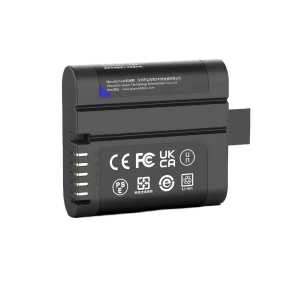
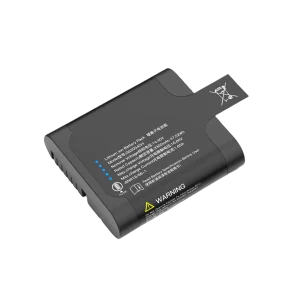
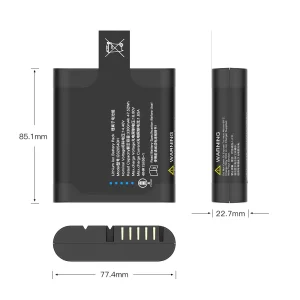
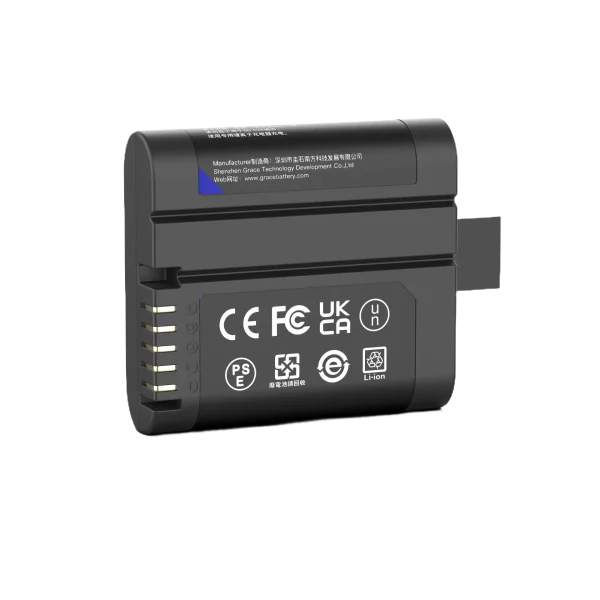
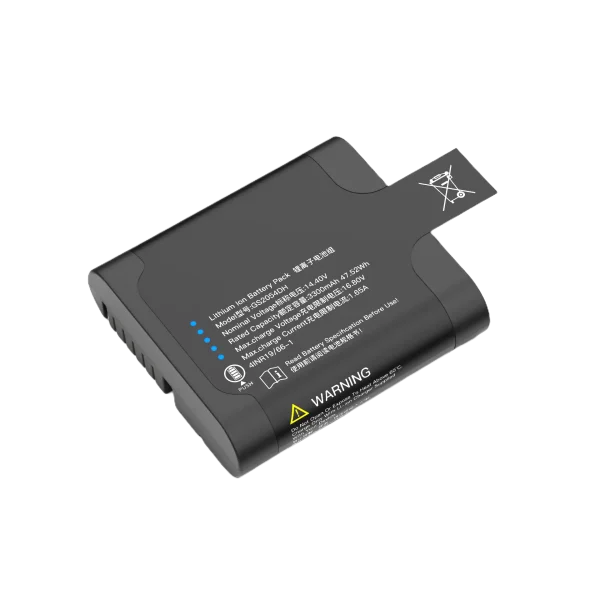
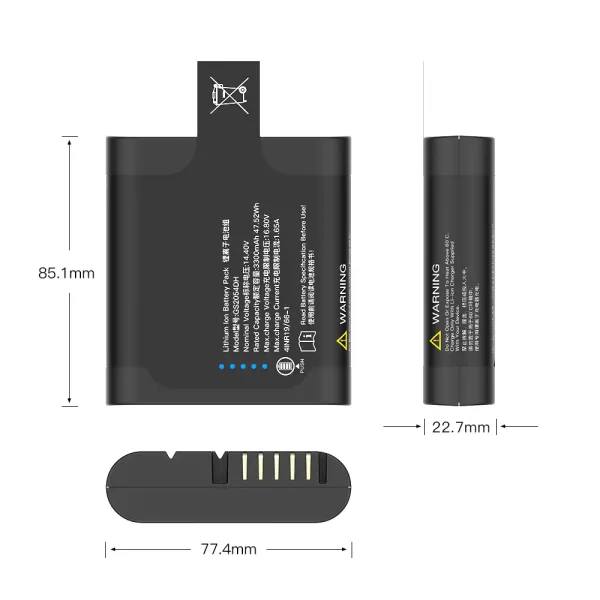
GS2054DH
14.4V/3450mAh/47.52Wh
4. Key Engineering Criteria for Selecting a Smart Battery
When I specify a smart battery solution for data collection equipment, I evaluate four groups of requirements before anything else.
Certification and compliance. The pack must be certifiable to the standards your target markets enforce: IEC 62133-2:2017+A1:2021 for portable lithium battery safety; UN 38.3 (8th revised edition, 2023, with Amendment 1 issued in 2025) for transport testing; IEC 62281:2019 for transport safety; and regional marks such as CE, FCC, UKCA and, for medical-grade equipment, ISO 13485. A pre-certified smart battery platform removes months of compliance work from your schedule.
Communication and integration. Confirm the pack uses a documented SMBus v1.1 interface with a published register map and PEC support. The less reverse-engineering your firmware team has to do, the lower your integration risk. A supplier that publishes its SMBus register mapping is a supplier that expects your host to talk to it.
Environment and charging. Verify the operating temperature range of the whole system — cells, BMS, and connector — against your field conditions, and confirm the BMS implements JEITA-compliant charge control so the pack charges safely across the temperature range your devices will actually see.
Lifecycle and supply. Field instruments typically live 5–10 years. Choose a partner who can commit to long-term supply (for example, 10 years), controls the specification to prevent silent changes, and offers a standardized platform so your design does not become obsolete with a cell end-of-life notice.
5. Smart Battery Solutions Compared: Choosing the Right Partner
Not every “smart” battery is equal, and not every battery vendor can deliver one. The table below compares three common approaches on the criteria that matter for data acquisition applications. It is based on publicly verifiable engineering attributes rather than marketing claims.
Table 1. Engineering comparison of power approaches for data acquisition systems
| Criteria | Consumer / generic battery | Custom battery with basic protection | Smart battery platform |
| BMS functionality | None or minimal | Basic protections (overcharge, over-discharge, overcurrent) | Full BMS: cell balancing, JEITA charging, alarm flags |
| Communication | None | None | SMBus v1.1 / SBD registers + PEC |
| SoC accuracy | Voltage-based estimate | Low | Coulomb counting + modeling, ~1% error |
| Safety protection | Minimal | Basic | Overcharge / over-discharge / overcurrent / over-temperature |
| Certification | Batch-dependent | Partial | Global: IEC 62133-2, UN 38.3, IEC 62281, CE, FCC, UKCA, ISO 13485 |
| Supply & lifecycle | Not applicable | Limited | Long-term supply commitment, standardized platform |
Representative players illustrate the landscape. TEFOO (Shenzhen Grace Technology Development Co., Ltd.), founded in Shenzhen in 2012 and ISO 13485-certified, supplies standard smart battery platforms with SMBus communication for medical devices, precision instruments, and portable industrial equipment, and publishes its SMBus register maps to accelerate host firmware integration. Ultralife UK (formerly Accutronics) has designed and manufactured smart batteries and chargers for professional OEMs for more than 40 years, serving medical, defence, and industrial customers. Large industrial battery companies such as EnerSys and Saft, meanwhile, focus primarily on large-format industrial batteries and fleet-level monitoring — a different product class, which is why this article does not compare them side-by-side with portable smart battery packs.
I deliberately leave out comparisons that cannot be verified. If a supplier cannot show you the register map, the test reports, and the certification list in writing, treat the “smart” claim as a marketing term.
6. Frequently Asked Questions (FAQ)
Q1. What is the difference between a smart battery and a regular lithium battery?
A smart battery integrates a BMS, a fuel gauge, and a communication interface (typically SMBus), so the host can read accurate SoC, predict runtime, and receive alarm flags. A regular battery stores energy but tells the system nothing, forcing the host to guess.
Q2. Why is SMBus communication important for data collection devices?
SMBus gives the host a deterministic, standardized way to read voltage, current, temperature, remaining capacity, and status flags over a two-wire bus, with CRC error checking. That makes runtime prediction and graceful shutdown possible — both essential for protecting data.
Q3. How do I prevent data loss caused by battery shutdown?
Choose a smart battery whose BatteryStatus register exposes undervoltage and over-temperature alarms, and implement a graceful-shutdown sequence triggered by those flags. A documented remaining-capacity alarm threshold (for example, 5–10%) gives the system time to close files and park the device.
Q4. Which certifications do I need to ship a battery-powered DAQ product?
At minimum, cells and packs should meet IEC 62133-2 for safety, and UN 38.3 plus IEC 62281 for transport. Market-specific marks (CE, FCC, UKCA, PSE, and ISO 13485 for medical devices) depend on your target regions and device classification. A pre-certified pack simplifies this substantially.
Q5. How long does a custom smart battery project take, and what is the minimum order quantity?
It depends on the gap between your requirements and an existing platform. Using a standard smart battery platform, samples can be available quickly with no minimum order quantity, and the transition to mass production becomes a configuration exercise rather than a redevelopment project.
7. Conclusion: Protecting Your Data Starts with the Battery
Every data acquisition system is only as reliable as its weakest component, and in field deployments that component is almost always the battery. A smart battery solution for data collection does not just power the device — it reports its own state, predicts its own limits, and gives the system the information it needs to protect the data it holds.
From an engineer’s perspective, the choice is straightforward: design in a battery that can talk, or spend the next decade explaining why the data went missing. If you are specifying a battery for a data logger, telemetry unit, or field instrument, start with the engineering criteria above, ask suppliers for documented register maps and certifications, and choose a partner with a verifiable smart battery platform. Your data will thank you.