A 2027 Compliance Roadmap for Medical OEMs
By the Battery R&D Engineering Team, TEFOO
Last updated: November 2026 | Reviewed against the European Commission DG GROW guidance of August 2026
1. Introduction
On 18 February 2027, every industrial battery above 2 kWh placed on the European Union market will carry its own Digital Product Passport (DPP) [1][4]. For medical device OEMs building patient monitors, ventilators, portable ultrasound systems, surgical power tools, and mobile clinical workstations, that date is no longer abstract. Under Regulation (EU) 2023/1542 — the new Batteries and Waste Batteries Regulation that replaced the 2006 Battery Directive — the battery is no longer a passive component inside a finished device. It becomes a traceable, data-carrying product with a lifecycle identity that travels with it from the production line through use, remanufacturing, repurposing, and recycling.
This guide is written from the seat of a battery pack R&D engineer. It cuts through the regulatory noise and answers the questions medical device teams actually ask: Is my battery in scope? What data must I collect? How does the Battery Management System (BMS) connect to the passport? And what should we be doing now, in 2026, to be ready?
2. The Regulatory Timeline Under EU 2023/1542
The Batteries Regulation was published in the Official Journal on 28 July 2023 and entered into force on 17 August 2023 [1]. It is directly applicable in all Member States without national transposition. The compliance clock has been running for more than two years, and the milestone most consequential for battery manufacturers and their OEM customers is approaching quickly.
| Date | Milestone |
| 17 Aug 2023 | Regulation (EU) 2023/1542 enters into force. |
| 18 Aug 2024 | CE marking and conformity assessment obligations apply; batteries without CE may no longer be placed on the EU market. |
| Early 2026 | EV battery carbon footprint declaration begins, twelve months after the Commission’s methodology act enters into force. |
| 18 Feb 2027 | Battery Passport (DPP) becomes mandatory for EV, LMT, and industrial batteries with capacity above 2 kWh. |
| 18 Aug 2030 | Extended producer responsibility and recycled-content obligations tighten further across the battery categories. |
Table 1. Key compliance milestones under Regulation (EU) 2023/1542.
The European Commission’s Directorate-General for Internal Market, Industry, Entrepreneurship and SMEs (DG GROW) published an updated guidance document, Digital Batteries Passport: Data Points by Category, in August 2026 [2][5]. This is the practical reference economic operators should be working from today. It identifies which data points are mandatory from February 2027, which apply only in specific circumstances, and which are deferred.
3. Does Your Medical Battery Actually Need a DPP?
This is the single most common question we receive, and the honest answer is: it depends on how your pack is classified. The Regulation defines five battery categories: portable, SLI (starting, lighting and ignition), LMT (light means of transport), electric vehicle (EV), and industrial. The DPP obligation currently attaches to three of them: EV batteries, LMT batteries, and industrial batteries with a rated energy greater than 2 kWh.
Most small medical devices — insulin pumps, wearable monitors, pulse oximeters, compact diagnostic handhelds — use sealed packs weighing under 5 kg that are not specifically designed for industrial purposes. Those fall into the portable battery category. As of the February 2027 mandate, portable batteries are not yet required to carry a full battery passport. They remain subject to other obligations: CE conformity, marking and labeling, collection and recycling targets, and, where applicable, removability and replaceability rules.
The classification question becomes genuinely important for larger medical systems:
- Mobile clinical workstations, ventilators, patient monitor carts, and portable ultrasound systems often ship with battery packs in the 2 kWh to 10 kWh range. If those packs are purpose-built as permanent, non-consumer power sources for professional medical equipment, they can be classified as industrial batteries rather than portable ones. Once rated energy exceeds 2 kWh, the DPP obligation applies.
- The Regulation’s definition of industrial battery is deliberately broad — it covers batteries intended for industrial activities, communication infrastructure, or to power electric vehicles. A purpose-built medical-grade pack integrated into a fixed or mobile medical appliance is a strong candidate for industrial classification.
Medical-device derogations
Article 11(3), together with the Commission Delegated Regulation of 14 July 2026, provides limited derogations from the removability and replaceability requirements for certain portable batteries [6]. Implantable active medical devices and certain in-vitro diagnostic (IVD) devices are explicitly recognized, because an interruption in power supply poses a direct risk to patient safety. Importantly, these derogations concern battery removability by the end user — they do not exempt a pack from DPP obligations if it otherwise meets the industrial-battery criteria.
Engineering takeaway: work with your notified body and EU Authorised Representative early. Classify every SKU against the Article 3 definitions and document the rationale. A 1.9 kWh pack and a 2.1 kWh pack may look nearly identical on the bench, but they sit on opposite sides of a regulatory line.
4. Anatomy of a Battery Passport
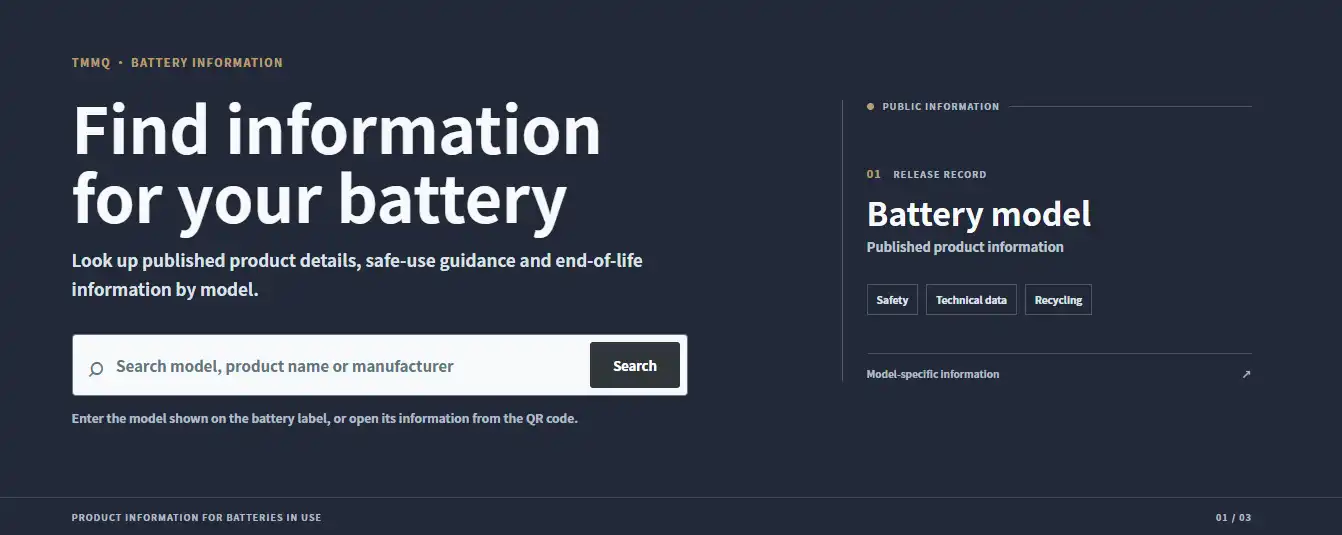
A battery passport is not a PDF certificate. It is a data repository linked to the physical battery by a QR code or equivalent data carrier affixed to the pack label. Scanning the code opens a web interface that serves the right information to the right audience.
The data specification lives in Annex XIII of the Regulation and, per the Commission’s August 2026 guidance, breaks down into roughly 40-plus performance and durability data attributes, grouped into the following families [5]:
- Battery identity: unique identifier, manufacturer name and address, place and date of manufacture, battery category, chemistry, model, and serial number.
- Technical characteristics: rated capacity, rated energy, nominal voltage, maximum charge voltage, maximum continuous and peak discharge current, weight, dimensions, and operating temperature range.
- Carbon footprint: carbon footprint declaration and performance class, phased in for industrial batteries over time.
- Performance and durability: initial capacity, initial internal resistance, expected cycle life, and — critically — dynamic values that change over the battery’s service life.
- Supply chain and due diligence: raw-material sourcing chains for cobalt, lithium, nickel, and natural graphite, together with recycled-content percentages.
- Materials composition: hazardous substances, critical raw materials, and a list of components and removable parts to support repair and recycling.
- End-of-life information: instructions for dismantling, recycling routes, and treatment information for waste operators.
Access is tiered. Public information — identity and basic sustainability data — is open to anyone scanning the QR code. Restricted information, such as full test data, supply-chain detail, and certain performance records, is available only to economic operators with a legitimate interest: repairers, remanufacturers, recyclers, and market surveillance authorities. This tiered-access design is what makes the system practical rather than an open data dump.
5. The BMS as the Data Engine Behind the Passport
This is where battery design becomes compliance design. The passport is not a static datasheet. Annex XIII requires dynamic, use-related data: the battery’s State of Health (SoH), cycle count, internal-resistance evolution, temperature exposure history, and record of fault events. The European Commission’s own FAQ is explicit: State of health requirements apply only where the battery has a BMS [3].
That single sentence is the most important engineering fact in the entire DPP transition. A battery without a BMS can still carry its static identity and manufacturing data, but it cannot natively report SoH or cycle-life data over its service life. A battery with a well-designed BMS already generates most of the dynamic data the passport demands.
What this means in practice:
- SoH estimation is the headline dynamic field. Modern smart BMS track capacity fade against the beginning-of-life reference and report SoH as a percentage. This number is exactly what a remanufacturer or second-life operator needs to decide whether a pack can be repurposed — and exactly what the passport is required to expose.
- Cycle counting and fault logging become passport-worthy records. A pack that has been through 1,200 deep cycles or has recorded a cell-level over-temperature event carries that history with it into the next handover.
- Standardized communication interfaces matter. Packs that already expose SoH, State of Charge (SoC), cycle count, and alarm status over SMBus (following the Smart Battery System specification) can feed this data into the passport infrastructure with minimal additional engineering. In our engineering practice, SMBus is the lowest-friction path for medical packs because it is already widely supported by medical device host systems and has a mature, field-proven track record.
- Data upload architecture is the missing piece many OEMs are only now starting to design. The BMS holds the data locally; the passport needs it accessible through a hosted, web-resolvable record. OEMs and pack integrators must define how SoH snapshots move from the pack, or from the medical device host, into the passport record — whether through periodic bench telemetry, device-to-cloud sync, or a dealer and manufacturer service portal.
Table 2 maps the SMBus data items most medical packs already expose to the dynamic DPP fields they can feed:
| SMBus data item (Smart Battery Spec.) | DPP dynamic field (Annex XIII) | Engineering note |
| Relative State of Charge (RelativeStateOfCharge) | Current State of Charge at handover | Read directly from the fuel gauge; no additional sensor work needed. |
| State of Health (StateOfHealth, %) | Battery State of Health (SoH) | The headline passport dynamic field; must be computed against beginning-of-life capacity. |
| Cycle Count (CycleCount) | Number of equivalent full charge-discharge cycles | Already logged by most modern medical-pack BMS firmware. |
| FullChargeCapacity / DesignCapacity | Current rated capacity vs. initial rated capacity | Drives the SoH calculation and the durability record. |
| Temperature (PackTemperature / CellTemperature) | Temperature exposure and extreme-event log | Record peak/ambient exposure; supports warranty and second-life decisions. |
| AlarmStatus / BatteryStatus | Record of fault events and safety events | Must be persisted in non-volatile memory, not lost on power-down. |
Table 2. SMBus data items and their corresponding dynamic Battery Passport fields.
The strategic implication is significant: packs designed today with a smart, SMBus-equipped BMS are not just better medical products — they are DPP-ready products. The R&D investment in accurate SoH algorithms, fuel gauging, and fault logging pays a second dividend as regulatory-compliance infrastructure.
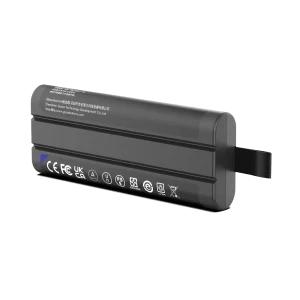
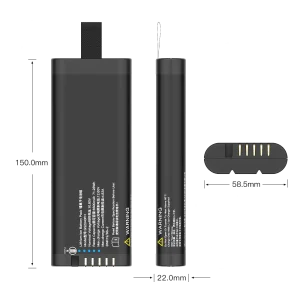
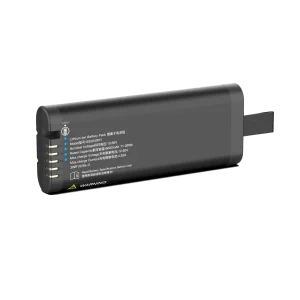
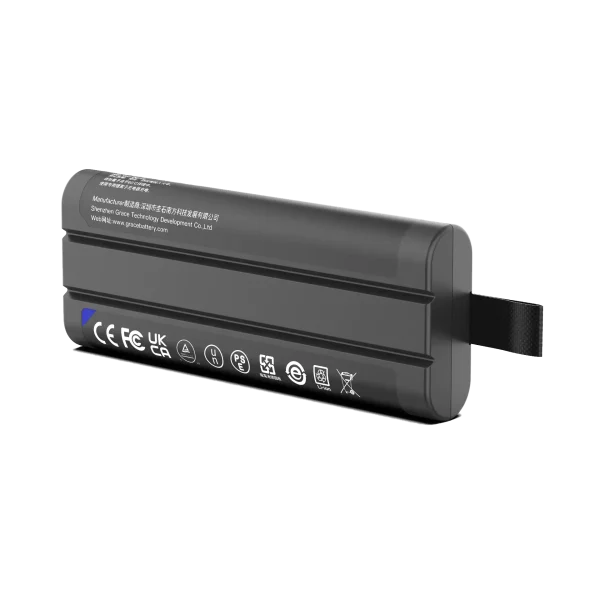
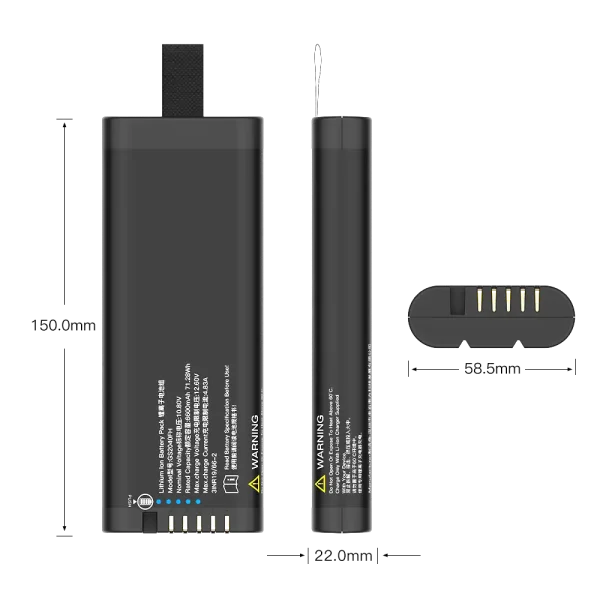
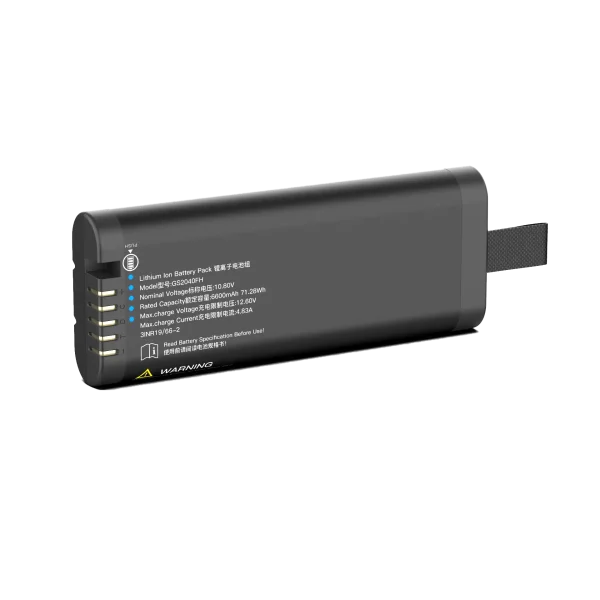
GS2040FH
10.8v/6900mAh/71.28h
6. A Practical Compliance Roadmap for Medical OEMs
Based on our own work with medical device customers and the DG GROW guidance, we recommend a six-step sequence over the next 12 to 18 months:
1. Classify your battery portfolio. List every pack SKU shipped into the EU market. Map each to a Regulation category — portable versus industrial. Flag every pack at or above 2 kWh for DPP treatment, and document the classification rationale with your notified body.
2. Audit your BMS data capability. For each in-scope pack, inventory what the BMS already measures: SoH, cycle count, internal resistance, temperature history, fault logs. Identify gaps. Packs without a BMS, or with BMS firmware that does not log durability data, need a design refresh — not a paperwork exercise.
3. Define the data architecture. Decide how passport data will be captured and hosted. Static data — identity, chemistry, carbon footprint, supplier due diligence — comes from manufacturing systems; dynamic data comes from the BMS. Choose the data carrier (QR code or data matrix), a hosting platform, and an access-tier policy that respects confidential business information.
4. Build the carbon footprint and due-diligence files. The carbon-footprint declaration for industrial batteries ramps in on its own schedule, but the underlying LCA data and supply-chain due-diligence records feed directly into the passport. Begin collecting them now; waiting until 2027 means a scramble.
5. Update your OEM and label artwork. The QR code, unique battery identifier, CE marking, and separate-collection symbol (the crossed-out wheeled bin) must coexist cleanly on the pack label — often a challenge on compact medical enclosures. Coordinate label layout with mechanical and regulatory teams early.
6. Pilot before scale. Pick one high-volume, EU-bound SKU, stand up its passport end-to-end, and test it with a notified body or a conformity-assessment service. The lessons learned will propagate to the rest of the portfolio far faster than a theoretical compliance review.
7. Frequently Asked Questions
Q1. Is every medical device battery required to have a DPP by February 2027?
No. The February 2027 mandate covers EV batteries, LMT batteries, and industrial batteries above 2 kWh. Small, sealed portable medical packs under 5 kg remain outside the passport obligation, although they remain subject to CE, labeling, and recycling rules. The critical thresholds to watch are 2 kWh and the portable-versus-industrial classification.
Q2. Does the BMS have to transmit data continuously to the passport?
No. The passport must make status and performance data available, but the Regulation does not mandate real-time telemetry from every pack. Periodic updates — for example, when a pack returns to a service center, is remanufactured, or undergoes a maintenance event — are consistent with the guidance. What matters is that the data exists and can be retrieved.
Q3. What if our pack has no BMS?
The SoH and dynamic durability reporting requirements apply only to batteries equipped with a BMS. However, the use-related data fields under Annex XIII point 4(d) do not carry the same exemption, so even non-BMS packs in scope must still provide the applicable static and lifecycle data. If you are designing new medical packs for the EU market, building in a smart BMS is now a forward-compliance decision rather than a premium feature.
Q4. Do implantable medical batteries receive any special treatment?
Implantable active medical devices and certain IVD devices benefit from derogations to the removability and replaceability requirements under Article 11(3), because interrupting patient power is a safety-critical event. These derogations address end-user battery replacement, not the DPP data obligations. Always confirm scope with your notified body.
Q5. How does SMBus help with DPP?
SMBus (the Smart Battery System management bus) is a standardized two-wire interface through which a medical device host can read state of charge, state of health, remaining capacity, cycle count, cell voltage, temperature, and alarm flags from the pack. Because the interface and the data-item definitions are already standardized, packs using SMBus can feed passport telemetry into host systems and cloud infrastructure with well-understood engineering, rather than requiring a custom protocol stack.
Q6. What certifications should a DPP-ready medical battery supplier already hold?
Look for ISO 13485 (medical device quality management), IEC 62133 (safety of portable sealed secondary cells), UN 38.3 (transport), CE marking under the Battery Regulation, and UKCA for the UK market. These are baseline credibility markers, not DPP substitutes — but they indicate a supplier whose documentation systems are mature enough to feed a passport record.
8. Conclusion
The battery passport is not paperwork dressed up as a QR code. It is a structural change in how medical battery packs are designed, documented, and supported across their service life. For medical OEMs, the teams that treat 2027 as a hardware and data-architecture project — not a labeling project — will clear the transition without product delays.
The common thread across every requirement is data: clean, traceable, dynamically updated data about what the pack is made of, how it has performed, and where it goes at end of life. A smart BMS with a standard communication interface is the foundation of that data. The packs engineering ships in 2026 will be the packs that need passports in 2027 — which is exactly why building DPP readiness into the next design cycle is the highest-leverage compliance decision available today.
About the author: TEFOO designs and manufactures smart BMS battery packs for medical and industrial equipment, including patient monitors, ventilators, portable diagnostic devices, and ruggedized field instruments. Our engineering team has shipped OEM battery programs under ISO 13485-certified processes for Class II and Class III medical device customers, packs support SMBus (Smart Battery System) communication, and are engineered for programs requiring IEC 62133-2, UN 38.3, CE marking under the Battery Regulation, and UKCA compliance. This article reflects our internal engineering review of the EU 2023/1542 transition; it is not legal advice and does not replace a formal conformity assessment with a notified body.
Disclaimer: This article is a technical engineering briefing written for informational purposes only. It summarises the authors’ understanding of Regulation (EU) 2023/1542 and related Commission guidance as of November 2026, and is not a legal opinion, a conformity assessment, or a substitute for advice from an EU Authorised Representative, a notified body, or qualified regulatory counsel. Battery classification, data-point applicability, and derogation eligibility must be confirmed for each specific product with the relevant conformity-assessment body.
References
[1] Regulation (EU) 2023/1542 of the European Parliament and of the Council on batteries and waste batteries. Consolidated text, EUR-Lex. https://eur-lex.europa.eu/legal-content/EN/TXT/?uri=CELEX:32023R1542
[2] European Commission DG GROW. Guidance to support preparations for the Digital Batteries Passport, 21 August 2026. https://single-market-economy.ec.europa.eu/news/guidance-support-preparations-digital-batteries-passport-2026-08-21_en
[3] European Commission. EU Digital Product Passport — FAQ for Batteries (updated October 2026). https://single-market-economy.ec.europa.eu/single-market/digital-product-passport/eu-digital-product-passport-faq-batteries_en
[4] European Commission. Digital Product Passport — Batteries (overview and key requirements). https://single-market-economy.ec.europa.eu/single-market/digital-product-passport/batteries_en
[5] European Commission DG GROW. Guidance Document: Digital Batteries Passport — data points by category (PDF). https://single-market-economy.ec.europa.eu/document/download/cd1e5e6c-4a4a-4b99-995a-49eb6916187e_en
[6] European Commission. Commission Notice on removability and replaceability of portable and LMT batteries under Regulation (EU) 2023/1542 (C/2026/5032), including medical-device derogations. https://environment.ec.europa.eu/document/download/17491562-50cc-443a-897f-b50848ab0a8a_en