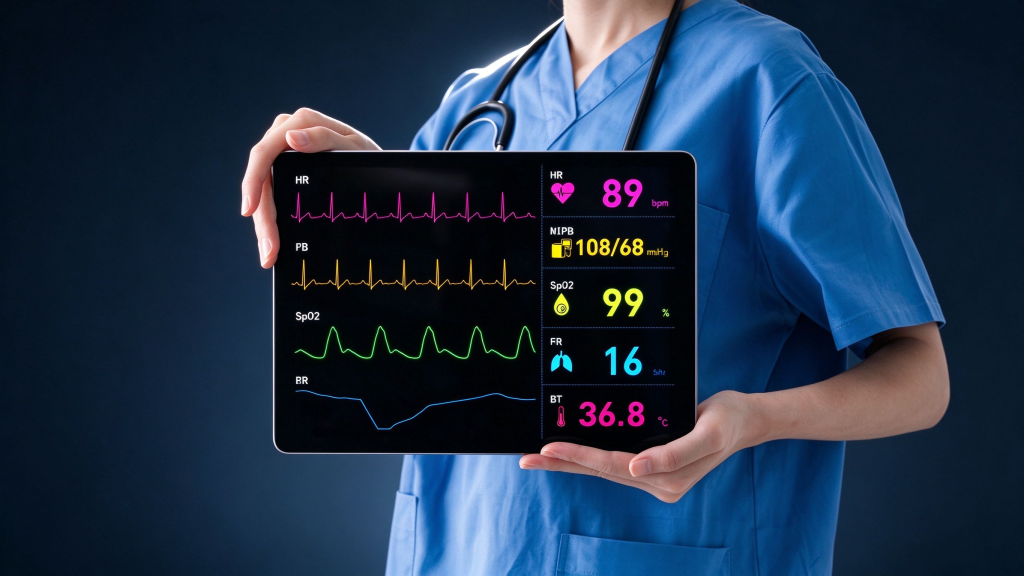
From a battery R&D engineer desk — chemistry, hot-swap architecture, smart BMS, and the standards that actually matter
1. Introduction
A mobile medical cart is no longer a rolling shelf. It is a point-of-care workstation that carries the electronic health record (EHR), medication barcode scanner, label printer, vital-signs monitor, and often a telemedicine endpoint directly to the patient bedside. The clinical workflow assumes this equipment is always on, always reachable on the hospital Wi-Fi, and always ready when a nurse or physician steps up. That assumption rests on a single, often under-specified component: the onboard battery backup system.
The global market for battery-powered medical carts was valued at roughly USD 1.5 billion in 2025 and is projected to reach USD 3.8 billion by 2034, growing at a CAGR of about 10.5% [1]. The broader lithium-ion battery segment for medical and healthcare devices is expected to grow from USD 1.05 billion in 2025 to USD 1.69 billion by 2032, at a 7.3% CAGR [2]. Behind these numbers is a quiet engineering shift: hospitals are replacing wired, fixed-wall workstation on wheels (WOWs) with truly mobile, battery-autonomous carts, and the battery pack has become a mission-critical sub-system rather than an afterthought.
This guide walks through what backup power really means on a medical cart, the regulatory boundaries an OEM must design to, the chemistry and architecture trade-offs, and how to evaluate vendors in 2026. It is written from the perspective of a battery engineering team that has shipped smart lithium packs into medical, industrial and portable-instrument applications, and it intentionally favors measurable engineering criteria over marketing claims.
2. What “Backup Power” Actually Means on a Medical Cart
In engineering practice, “backup power” on a cart covers two distinct functions that are often conflated in product datasheets. Separating them is the first step toward a defensible requirements document.
2.1 Mobile autonomy
This is the runtime the cart delivers while being pushed between wards, elevators and patient rooms, away from any wall outlet. A typical nursing or phlebotomy cart consumes 35–70 W (fanless PC or panel PC, screen, scanner and printer) and is expected to run a full 8–12 hour shift with a single battery or a hot-swappable pair. The pack is sized to the worst-case shift load, not the idle load.
2.2 DC-UPS function during line interruption
The second function is a true uninterruptible supply: when the cart is docked at a wall outlet and the mains drops (a brief dip, a breaker trip, or a longer outage), the battery must take over the DC rail without rebooting the PC or dropping the EHR session. This demands a sub-20 ms transfer time and clean DC output — not just a charger and a battery in parallel. Dedicated medical DC-UPS platforms, such as the IEI AXON-mPOWER family, implement this with two or three hot-swappable packs and an explicit UPS / power-bank mode [3].
A pack that only delivers mobile autonomy will cause an unplanned PC shutdown the moment the wall power fails at the bedside. A pack that only acts as a UPS will not get a nurse to the next room. The requirements document should state both, in watts and watt-hours, with the transfer-time number called out explicitly.
3. Regulatory and Safety Framework
For an EEAT-driven technical audience, citing the right standards is not a box-ticking exercise — it is evidence that the design team understands the hospital environment. The relevant framework for a medical cart battery in 2026 looks like this:
- IEC 60601-1 / UL 60601-1: general safety and essential performance of medical electrical equipment. It defines the allowable patient leakage current limits (on the order of 100 µA in patient-care environments) and the isolation expectations for any power supply that sits near the patient [4].
- IEC 60601-1-2: electromagnetic compatibility. The DC-DC stage and charger must not radiate or susceptibly interfere with monitors, infusion pumps or other bedside devices.
- IEC 60601-1-12 (adopted in China as YY 9706.112-2021): collateral standard for emergency medical services environments. It requires an internal-power ME device to maintain its intended use for at least 20 minutes on internal power, and to give the operator a clear state-of-charge indication [5].
- Particular standards set minimum backup durations for life-support functions. For example, ISO 80601-2-84 for emergency ventilators requires at least 120 seconds of battery operation after a mains loss, alongside a redundant alarm and power path [6]. A cart itself is usually not a life-support device, but any cart that docks a monitor or ventilator accessory inherits part of that expectation.
- IEC 62133-2: safety requirements for sealed lithium-ion cells intended for portable use — the cell-level certification that a reputable pack builder should hold on the cells they buy.
- UN 38.3: transport safety for lithium batteries, mandatory before air or sea shipment of the finished pack.
- EU Battery Regulation 2023/1542: the new EU framework now requires a declared capacity, durability performance, and a removable/replaceable battery design for many portable medical products. For OEMs shipping into the EU in 2026 onward, the replaceability and labelability clauses are no longer optional.
- Region marks: CE (EU), UKCA (UK), FCC/UL (US), and the relevant national marks. A pack sold into multiple regions should be specified with the full mark set up front, rather than re-certified later.
A practical red flag in vendor datasheets is a claim of “medical grade” without either IEC 60601-1 compliance on the power assembly or a clear statement that the pack is tested as part of the system. True medical-grade UPS products are designed around isolation transformers, restricted leakage current and EMI/RFI filtering for sensitive diagnostic equipment [7].
4. Chemistry Selection: LiFePO4 vs NMC vs Lead-Acid
For nearly all fixed and semi-mobile medical carts, lithium iron phosphate (LiFePO4, LFP) has become the default chemistry. The decision is driven by thermal safety, cycle life and tolerance of partial-state-of-charge (PSOC) storage — all attributes that matter in a hospital that charges opportunistically between shifts rather than on a deep-cycle schedule. NMC still earns its place on weight-critical carts; lead-acid is now mostly a legacy comparison rather than a serious 2026 choice.
| Parameter | LiFePO4 (LFP) | NMC / NCA | Lead-Acid (AGM/Gel) |
| Typical cycle life @80% DoD | 3,000–6,000 cycles | 1,000–1,500 cycles | 300–500 cycles |
| Usable depth of discharge | 80–100% | 80–100% | ~50% recommended |
| Energy density | 90–140 Wh/kg | 180–250 Wh/kg | 30–50 Wh/kg |
| Thermal runaway onset | ~270 °C (high) | ~150–200 °C (medium) | n/a (but outgassing) |
| PSOC storage tolerance | Excellent | Good | Poor (sulfation risk) |
| Self-discharge / month | 1–3% | 2–5% | 3–5%, accelerated |
| Best-fit cart use | Fixed/rolling nursing, workstation, phlebotomy | Lightweight vital-signs / telemedicine cart | Legacy carts, budget retrofit |
Table 1. Representative chemistry comparison for medical-cart battery packs (typical engineering ranges; verify with the cell vendor datasheet).
The LFP advantage is not abstract. A lead-acid pack that sees daily deep discharges in a hospital cart will typically reach end of life in 12–18 months, and must be derated to 50% depth of discharge to reach even that. A well-engineered LFP pack at 80% DoD will deliver 3,000–6,000 cycles — on a daily cycle, that is an 8–10 year service life, which fundamentally changes the total cost of ownership and the biomedical team’s replacement workload [8][9].
The one reason to pay the NMC premium is weight. On a slim telemedicine or vital-signs cart where every hundred grams changes steering effort and caster load, the higher specific energy of NMC can justify the tighter thermal management and shorter cycle life. In every other cart configuration, LFP is the engineering default.
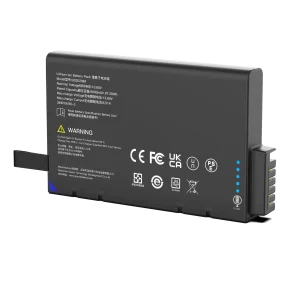
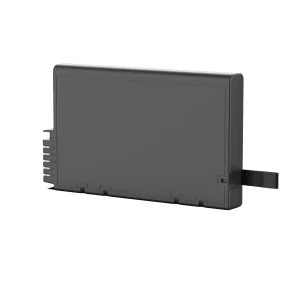
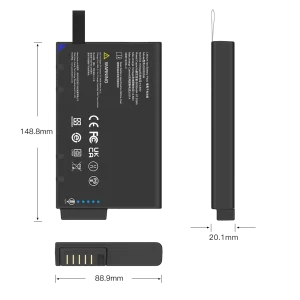
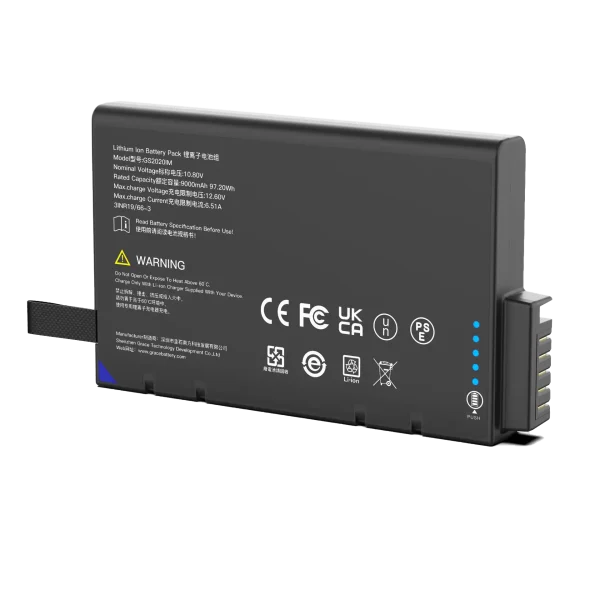
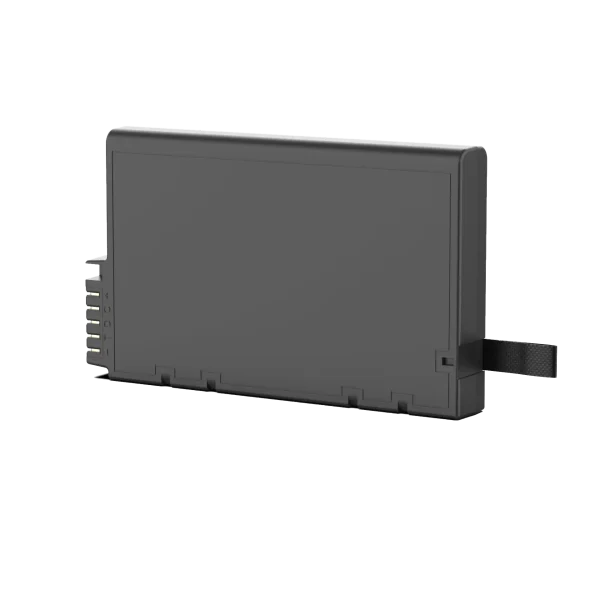
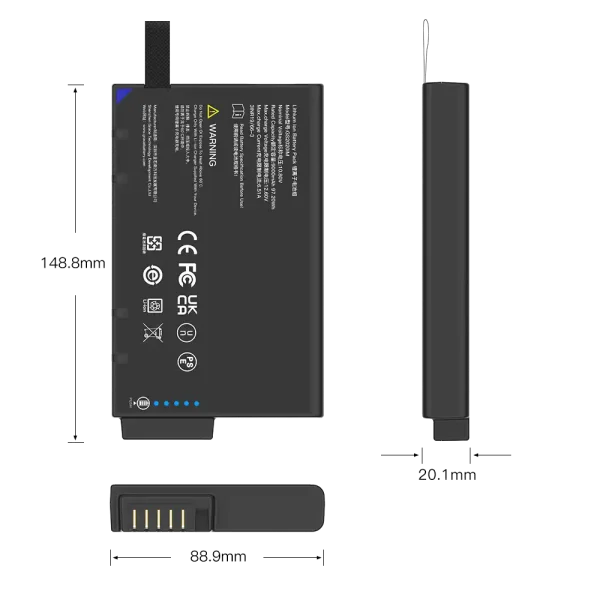
GS2020IM
10.8V/9300mAh/97.2Wh
5. Core Engineering Design Choices
5.1 Hot-swap architecture
Hot-swap is the single highest-leverage architecture decision for a cart battery. With a dual- or triple-pack design, a depleted pack can be swapped for a charged one while the cart is still running, eliminating the “parked cart” queue that traditional single-battery workstations create between shifts. Production systems already on the market implement this with three hot-swappable 9,000 mAh packs in a medical DC-UPS enclosure [3], or with dual hot-swappable rear modules that support selectable 12 V / 19 V output [10].
For the design team, the non-negotiable detail is the ORing MOSFET path between the two packs: the transfer must be fast enough that the panel PC does not brown out, and the charging path must be inactive on the pack being removed so that it cannot be back-driven.
5.2 Smart BMS and SMBus communication
A hospital biomedical engineering team needs to know, remotely, how many cycles each pack has seen, its state of health, and whether it is trending toward end of life. This is what a smart battery management system (BMS) with SMBus or I2C fuel-gauge communication provides. The medical BMS segment is growing at a projected CAGR of about 12.3% through 2030, faster than the packs themselves, because hospitals are moving from reactive replacement to fleet-level battery asset management [11].
At minimum, the pack should report via SMBus: remaining capacity, full-charge capacity, cycle count, state of health, cell-voltage extremes, pack temperature, and a manufacturer-accessible warranty log. The host software should surface these on the cart screen, as leading mobile workstation platforms already do with live runtime, cycle count and battery-health readouts [12].
5.3 DC rail selection and runtime budgeting
Most medical panel PCs and mini-PCs expect a 12 V or 19 V input; some telemedicine endpoints still use 24 V. A well-designed pack delivers a regulated DC output rather than the raw cell voltage, so the cart OEM does not see output sag as the pack discharges. A practical runtime budgeting example:
- Target runtime: 8 hours of mixed use (active + idle), derated to 6 hours on a fully discharged pack for safety margin.
- Average load: 50 W (panel PC ~25 W, screen ~15 W, scanner + peripherals ~10 W).
- Required energy: 50 W × 6 h = 300 Wh. Add 15% conversion margin for the DC-DC stage → ~350 Wh usable.
- On a 25.6 V (8S) LFP pack, this is roughly 13.7 Ah — i.e., a 14–15 Ah pack, with a second hot-swap pack on board for shift-long autonomy.
Sizing to the peak load rather than the average load is a common mistake: the pack’s continuous current rating must cover the printer motor burst and the backlight brightness spike, or the protection circuit will trip mid-task.
5.4 Mechanical, thermal and environmental design
A cart gets bumped in elevators, dropped off curbs, and wheeled through temperature-controlled but sometimes dusty corridors. Ruggedized medical packs are increasingly specified to MIL-STD-810 shock and vibration criteria, with drop-tested structures (150 cm class) and dedicated drop-protection sensing in the BMS [13]. Thermal design matters even indoors: charging a sealed LFP pack above the cell vendor’s recommended charge window (typically 0–45 °C, with 0–10 °C charging prohibited) is the fastest way to shorten pack life, and the BMS must enforce that rather than rely on the user.
6. Vendor Landscape: How to Compare in 2026
The market splits into three groups: (a) cart PC / workstation OEMs that bundle their own battery platforms; (b) embedded medical power specialists that sell DC-UPS modules to cart integrators; and (c) custom battery pack builders (including TEFOO) that design smart LFP/NMC packs to an OEM’s mechanical and electrical specification. The table below summarizes representative products in each group as of late 2026; treat it as a starting point for a request-for-quote, not as a short list.
When you evaluate vendors, we recommend scoring them against a fixed rubric rather than a feature list. The dimensions that actually predict fleet success are:
- System certification: is the power assembly itself tested to IEC 60601-1 / the applicable EN 60601, and does the vendor participate in the system-level certification with you?
- Cycle-life warranty at the actual DoD the cart will use (80% DoD, not 100% DoD cherry-picked).
- Communication: SMBus/I2C fuel-gauge protocol support, and whether the host software SDK is available.
- Hot-swap transfer time and measured brownout behavior on your actual panel PC.
- Replaceability: does the pack meet EU 2023/1542 removable/replaceable expectations for your EU SKU?
- Supply chain: cell qualification, long-term purchase agreement, and end-of-life cell-migration plan.
7. The TEFOO Engineering Perspective
At TEFOO , our medical-cart program is built around the same criteria we would demand from a supplier ourselves. We design smart LFP packs with a proprietary BMS that exposes state of charge, state of health, cycle count and cell-level voltage through SMBus or I2C, so the cart OEM’s fleet-management software can treat batteries as measurable assets rather than disposable consumables.
Three choices we make deliberately, and that we encourage cart OEMs to require in any vendor:
- LFP by default, NMC only on request. LFP’s ~270 °C thermal-runaway onset and 3,000–6,000 cycle life at 80% DoD are the right safety and TCO answer for the majority of hospital carts; NMC is reserved for weight-critical slim profiles.
- Full certification stack designed in from day one: ISO 13485 quality system, IEC 62133-2 cell certification, UN 38.3 transport, CE / UKCA / FCC, and support for the system-level IEC 60601-1 certification that the cart OEM must complete.
- True OEM/ODM engineering, not a catalog pack. We co-design the mechanical envelope, the hot-swap ORing path, the DC-DC output rail (12 V / 19 V / 24 V as required), and the SMBus profile with the cart team, rather than asking them to fit a standard box into an industrial design that was never sized for it.
8. Frequently Asked Questions
Q1. How long should a medical cart battery last on a single charge?
Plan for a full clinical shift — typically 8 hours of mixed active and idle use — with a 25–30% reserve. That usually translates to 300–450 Wh of usable energy for a panel-PC-based cart. If the cart supports hot-swap, a second pack can extend the fleet day indefinitely without downtime.
Q2. Is LiFePO4 really safer than NMC in a hospital?
On thermal-runaway onset and cycle life, yes. LFP cells typically enter thermal runaway above ~270 °C, versus ~150–200 °C for high-energy NMC. In a patient-care corridor, that margin matters. NMC remains acceptable when weight is the dominant constraint and the BMS enforces strict charge-temperature and current limits, but LFP is the conservative default.
Q3. Do we actually need hot-swap, or can nurses just swap packs between shifts?
If the cart must never reboot — because it holds an open EHR session, a medication-verification sequence, or a telemedicine call — hot-swap is required. If carts can be safely parked and rebooted between patients, a single swappable pack is acceptable, but you should budget the downtime and the biomed team’s swap labor explicitly.
Q4. What certifications must the pack itself hold?
Cell-level: IEC 62133-2. Transport: UN 38.3. Region marks: CE / UKCA for the EU and UK, FCC / UL component recognition for the US. The medical-device-level IEC 60601-1 certification belongs to the whole cart system, but the pack vendor should provide the technical file, leakage-current data and EMC evidence needed to support that system-level approval. ISO 13485 on the pack manufacturer is a strong indicator that their quality system will survive your technical file audit.
Q5. How do we calculate the right pack capacity?
Sum the real worst-case load of the cart (PC, screen, scanner, printer, peripherals) in watts, multiply by the desired runtime in hours, then divide by the DC-DC efficiency (typically 0.85). Add 15–20% margin for end-of-life capacity fade and temperature derating. Size the continuous current rating to the printer burst, not the average.
Q6. Does the new EU Battery Regulation 2023/1542 change anything for medical carts?
Yes, for EU-bound SKUs. It imposes declared-capacity labeling, durability performance information, and a removable/replaceable battery expectation for many portable products. For a cart OEM, that means designing the battery access panel and the pack fasteners for tool-less or simple tool replacement by biomedical staff, and ensuring the datasheet carries the required performance and end-of-life information.
9. Conclusion
Medical cart backup power has matured from a battery-in-a-box accessory into a safety-relevant, fleet-managed sub-system. In 2026, the engineering answer is well established: an LFP-based smart pack with a properly implemented hot-swap architecture, SMBus fuel-gauge telemetry, regulated DC output, and a certification stack that supports the cart’s IEC 60601-1 system approval. The choice of vendor should be made on cycle life at your actual depth of discharge, on transfer-time and brownout behavior measured on your real cart, and on their willingness to co-engineer the pack to your mechanical and software spec — not on the headline watt-hour number.
Get the power backbone right, and the cart fades into the background of clinical work. Get it wrong, and every nurse on the ward knows it before the biomedical engineer does.
References
[1] Verified Market Reports, Global Battery Powered Medical Carts Market Size, Growth Analysis & Forecast 2026–2034. https://www.verifiedmarketreports.com/product/battery-powered-medical-carts-market/
[2] MarketPublishers, Global Lithium-ion Batteries for Medical and Healthcare Device Market Growth 2026–2032. https://pdf.marketpublishers.com/lpinfo/global-lithium-ion-batteries-4-medical-n-healthcare-device-market-lp.pdf
[3] IEI, AXON-mPOWER Three Hot-Swappable Batteries Medical DC-UPS System. https://www.ieiworld.com/tw/product/AXON-mPOWER.php
[4] MedicSolar, Medical Grade UPS for CPAP and O2 Users (2026) — IEC 60601-1 / UL 60601-1 leakage-current and isolation summary. https://medicsolar.com/medical-grade-ups/
[5] NMPA CMDE, YY 9706.112-2021 Medical electrical equipment — Part 1-12: General requirements — Collateral standard: Emergency medical services environment. https://www.cmde.org.cn/hbpdf/YY9706.112-2021.pdf
[6] IMT AG, Uninterrupted power supply in life-supporting medical devices (ISO 80601-2-84 120 s backup). https://www.imt.ch/en/expert-blog-detail/uninterrupted-power-supply-in-life-supporting-medical-devices
[7] Sanyang Medical, Surgical Light Backup Power: Complete UPS Planning Guide (IEC 60601-2-41). https://sanyangmedical.com/surgical-light-backup-power-ups-guide/
[8] Redway Power, How much longer can lithium-ion batteries last compared to lead-acid? https://www.redwaypower.com/how-much-longer-can-lithium-ion-batteries-last-compared-to-lead-acid/
[9] EverPlus Battery, Lead-Acid vs Lithium-Ion: Cost, Weight & Lifespan Compared. https://everplusbattery.com/id/lead-acid-vs-lithium-ion-fix-your-battery-pain-points-cost-weight-lifespan-compared/
[10] AVALUE Healthcare, EPB-1001 Add-On Power Module datasheet. https://www.avalue-healthcare.com/en/product/Power_bank/EPB-1001_add_on_power_module
[11] Accio, Medical BMS: Advanced Battery Management for Healthcare (market CAGR 2024–2030). https://www.accio.ai/find-product/medical-bms
[12] Kinetic-ID, ID-Flex 3 Mobile Workstation — medical-grade DC battery system and on-screen runtime. https://www.kinetic-id.com/healthcare-products/id-flex3
[13] Onyx Healthcare, Introducing the Onyx XLP Military-Grade Active Protection Battery (OPM-P08T). https://www.onyx-healthcare.com/en-US/news/OPM-P08T-Military-Grade
[14] Cybernet, Battery-Powered Medical Computers / Hot-Swappable Cart PCs. https://www.cybernetman.com/en/medical-cart-computer
About the author: Senior Battery R&D Engineer, TEFOO , focused on smart lithium battery systems with SMBus communication and OEM/ODM customization for medical, industrial and portable-instrument applications.