
By the TEFOO Battery R&D Team | November 2026
1. Introduction
If your company places rechargeable battery packs on the European Union market, the word “battery passport” has likely moved from a distant regulatory footnote to a board-level project. Under Regulation (EU) 2023/1542 (the “Batteries Regulation”), a unique digital passport tied to every covered battery becomes legally mandatory on 18 February 2027. For industrial battery OEMs that serve medical device, precision instrumentation, and portable equipment brands, this is not a labeling exercise: it requires verified data on carbon footprint, recycled content, state of health (SoH), supply-chain due diligence, and a whole-of-life digital identity linked by a QR code.
As a battery pack manufacturer that has shipped smart BMS-based packs to medical and industrial OEMs since 2012, we have spent 2025–2026 translating Articles 77 and 78 of the Regulation, Annex XIII, and the European Commission’s August 2026 guidance into an engineering roadmap. This article explains what the passport actually requires, which products fall in scope, where the hard engineering work sits, and how a structured compliance solution reduces both regulatory risk and rework cost before the 2027 deadline.
2. Regulatory Foundation and Key Deadlines
The EU Battery Passport is mandated by Article 77 of Regulation (EU) 2023/1542, which entered into force on 17 August 2023 and has been phased in since 2024. The passport is accessible to competent authorities, economic operators, and—for non-commercially sensitive data—to end users via a QR code printed on the battery or its packaging. Article 78 requires the passport to be updated whenever the battery’s status changes (e.g., from “original” to “repurposed” or “remanufactured”) and when relevant performance or SoH data is refreshed.
The Commission’s phased timelines, as restated on its dedicated battery passport page (updated November 2026), are:
| Date | Obligation |
| 20 July 2026 | EU DPP (Digital Product Passport) Registry becomes operational; Implementing Regulation (EU) 2026/1778 on the Registry is published. |
| 18 February 2027 | Battery passport becomes mandatory for electric-vehicle (EV) batteries, light means of transport (LMT) batteries, and industrial batteries with a capacity > 2 kWh placed on the EU market. |
| Q4 2026 – 2027 | Secondary implementing act on access rights to restricted passport data and remaining CEN-CENELEC harmonized standards are still being finalized; manufacturers should design data systems to track these updates. |
Table 1. Phased battery passport deadlines under Regulation (EU) 2023/1542. Source: European Commission, DG GROW, “Batteries” DPP page (Nov 2026).
Two implementation acts are still moving as of Q4 2026. The first governs access rights to restricted (commercially sensitive) passport data and was expected to be opened for public consultation on “Have your Say” in October–November 2026. The second is the CEN-CENELEC JTC24 harmonized standards package, six of eight of which were adopted by Commission implementing decision in July 2026. OEMs should treat both as moving targets and design their data architecture to be configurable rather than fixed.
3. Scope: Which Batteries Actually Need a Passport
A common misconception is that every lithium pack shipped into the EU needs a passport after February 2027. It does not. Article 77(1) limits mandatory passports to three categories:
- Rechargeable EV batteries (passenger and commercial vehicles).
- Light means of transport (LMT) batteries—e-bikes, e-scooters, e-mopeds.
- Rechargeable industrial batteries with a capacity greater than 2 kWh.
Smaller industrial packs, portable batteries, and LMT batteries below the threshold do not receive a full passport, but Article 13(6) still requires a printed QR code that links to the EU Declaration of Conformity, recycling information, and separate-collection instructions. In practice, nearly every lithium pack a B2B OEM ships into the EU will carry a QR code after 2027; only packs above 2 kWh (plus EV and LMT) require the richer, lifecycle-tracked passport.
3.1 Medical Device Batteries: No Blanket Exemption
Medical-device OEMs often assume their packs are exempt. They are not—not for passport purposes. The Regulation does not carve out medical batteries from Article 77. Where medical devices do benefit from a derogation is under Article 11 on portable-battery removability: professional medical imaging, radiotherapy, and in-vitro diagnostic (IVD) devices may use professional rather than end-user replaceability. That derogation says nothing about the passport.
The practical consequence for a medical pack maker is straightforward: if your pack exceeds 2 kWh (increasingly common for mobile X-ray carts, ultrasound carts, ventilators on wheels, and high-end patient monitors with redundant batteries), it needs a full passport. Below 2 kWh, it needs the Article 13 QR code but not the 71-point passport. Either way, you need a data strategy today, because BMS telemetry that is not logged at the pack level cannot be retroactively reconstructed in 2027.
4. The 71 Data Points and Where BMS Data Comes In
The Commission’s August 2026 “Digital Batteries Passport — data point by category” guidance enumerates roughly 71 data points across EV, LMT, and industrial categories. They fall into four engineering-relevant buckets:
- Identity and provenance (mandatory for all covered batteries): unique battery identifier (Article 77(3)), manufacturer name and address, manufacturing date and place, battery category, and lifecycle status (“original”, “repurposed”, “remanufactured”, “end-of-life”).
- Sustainability: carbon footprint declaration and performance class, recycled content percentages for cobalt, lithium, nickel, and lead, and due-diligence chain-of-custody evidence.
- Performance and durability: rated capacity, rated voltage, reference cycle life under specified test conditions, C-rate, and round-trip efficiency where applicable. For industrial batteries, several performance fields are marked “applicable where relevant” rather than universally mandatory.
- State of health (Article 14): certified energy (SOCE) for EV packs; remaining capacity, internal ohmic resistance, self-discharge evolution, and remaining power capability for LMT and, where relevant, industrial packs. This is where the BMS becomes the system of record.
From an engineering standpoint, the SoH bucket is the most consequential. A pack that ships in 2027 must be able to report its remaining capacity and internal resistance years later—not because a lab measured it once at type approval, but because the fuel-gauge IC and BMS firmware have been logging it continuously. SMBus v1.1 Smart Battery Data (SBD) hosts already expose Relative State of Charge (RSOC), cycle count, pack voltage, current, temperature, and pack-serialized firmware data; these fields map cleanly onto the passport’s SoH endpoints, but only if the pack manufacturer stores them against a unique identifier that can later be reconciled with the DPP Registry.
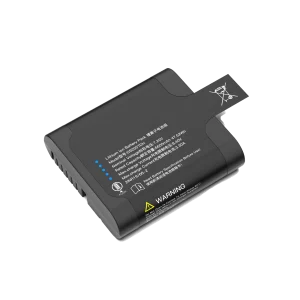
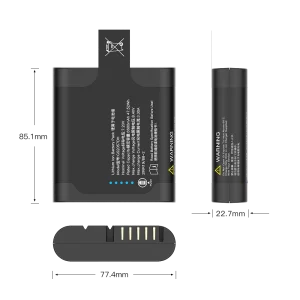
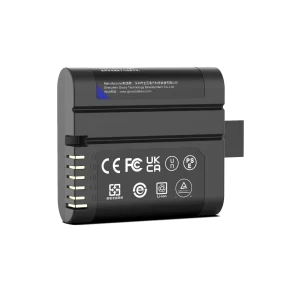
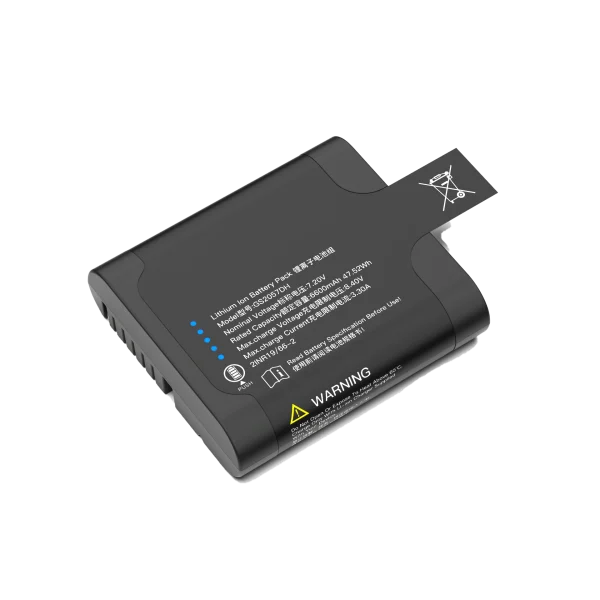
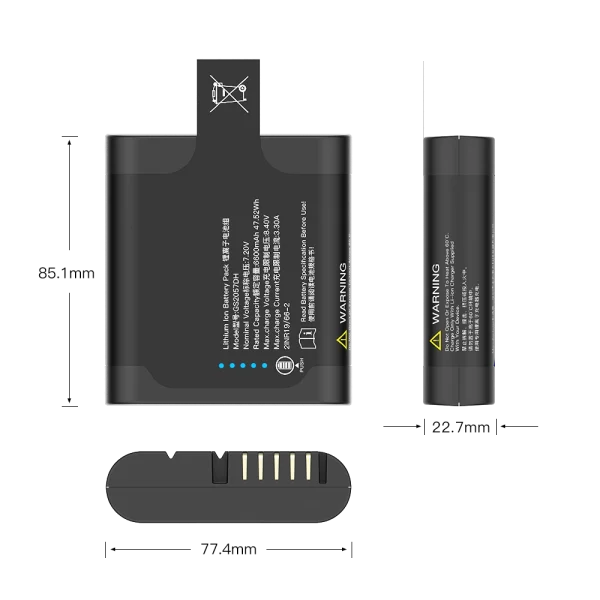
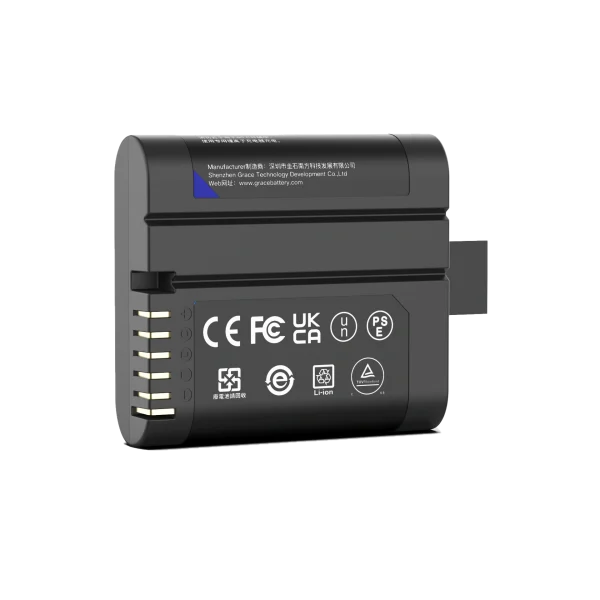
GS2057DH
7.2V/6900mAh/47.52Wh
5. A Five-Step Compliance Solution Framework
Step 1 — Classification and gap analysis
Map every SKU you currently ship (or plan to ship) into the EU against Article 3 definitions: portable, LMT, EV, or industrial. Record each pack’s rated energy in Wh. Any industrial SKU above 2 kWh is a passport SKU; everything above zero Wh needs the Article 13 QR code. Output: a one-row-per-SKU matrix with classification, deadline, and responsible engineer.
Step 2 — Stand up the data infrastructure
Identify which of the 71 data points your PLM, MES, BMS, and test-engineering systems already produce, and which must be collected from upstream cell suppliers (recycled content, carbon footprint) or third-party notified bodies (type testing). This is the step most OEMs underestimate: recycled-content and carbon-footprint declarations depend on cell suppliers whose own data pipelines are not yet mature. Start supplier data calls no later than Q1 2027—preferably Q1 2026—to leave time for audits.
Step 3 — Assign unique identifiers and QR codes
Generate a persistent, scannable unique identifier for every pack at end-of-line test. The QR code must encode a URL that resolves to the pack’s passport record on the DPP Registry (or a gateway you host that proxies to the Registry). Laser-mark the code onto the pack enclosure; verify readability after conformal coating and after a 72-hour thermal cycle—medical and industrial enclosures are often sealed and labeled in ways that defeat inkjet labels.
Step 4 — Register with the DPP Registry and configure access rights
The DPP Registry went live on 20 July 2026 under Implementing Regulation (EU) 2026/1778. Manufacturers (or their EU authorized representatives) must register each covered battery’s passport record and define which fields are public, which are restricted to authorities and downstream operators, and which remain confidential. The secondary access-rights implementing act’s draft should be reviewed the moment it lands on “Have your Say” in late 2026; your field-level permissions may need a re-pull.
Step 5 — Close the loop on lifecycle status
Article 78 requires passport updates whenever status changes. If your pack is repurposed from stationary backup to mobile use, or remanufactured after first-life service, the passport must reflect that—along with the new SoH and performance values. For OEMs that sell directly into end-user service networks, this means defining who is allowed to write to the passport after sale, and how that write is authenticated.
6. Comparing Compliance Approaches
Pack makers approaching the deadline typically choose one of three paths. They differ sharply on time-to-deadline, internal build effort, and who owns the SoH data.
| Approach | Best For | Strengths | Watch-outs |
| Build in-house DPP integration | Large OEMs with existing PLM/ERP teams and >50k packs/year into the EU. | Full data ownership; tight coupling to PLM; long-term cost control. | 12–18 month engineering effort; must track every delegated/implementing act yourself; high compliance risk if you miss a late rulebook. |
| Third-party DPP SaaS platform | Mid-size OEMs without a dedicated regulatory-IT team. | Faster time-to-market; platform vendor tracks the rulebooks; pay-as-you-go. | Recurring subscription cost; SoH telemetry still has to be piped up from the BMS; limited customization for medical-grade audit trails. |
| Partner with a compliant smart-BMS pack maker (e.g., TEFOO) | Medical/industrial device brands that buy finished packs rather than building them. | Pack maker owns BMS telemetry, unique ID, QR labeling, and passport data feeds; device OEM inherits compliance at the sub-assembly level. | Requires early supplier qualification; works best when pack design is co-developed rather than spec’d at the last minute. |
Table 2. Three EU battery passport compliance approaches, compared.
7. Why Smart BMS Architecture Is the Hard Part — and How We Address It
Of the five steps above, Steps 2 and 5 are where most non-battery OEMs get stuck. A medical device company knows its own firmware and clinical quality system cold, but it rarely owns the pack-level fuel-gauge algorithm, the cycle-count accumulator, or the cell-level ohmic-resistance measurement—and those are exactly the data points Article 14 wants in the passport.
At TEFOO, our smart battery packs are built around SMBus v1.1-compliant fuel-gauge ICs with in-house BMS hardware and firmware. Every pack we ship already exposes, on the SMBus, a uniquely identified serial number, RSOC, cycle count, pack and cell voltage, current, temperature, and computed state-of-health parameters. We manufacture under medical-grade quality processes (ISO 13485-aligned design controls, IEC 62133-2 cell safety, UN 38.3 transport certification, CE and UKCA marking support), and we treat the passport data feed as a natural extension of the EOL (end-of-line) test record rather than a bolt-on project.
Practically, that means when a medical or industrial OEM co-develops a pack with us, the passport-relevant fields are decided at the requirements stage—not after the tooling is cut. We define which SoH parameters the host device will read over SMBus, how the unique pack ID is laser-marked, and how the EOL test record maps to the DPP Registry record. The device OEM then inherits a sub-assembly whose passport data layer is already engineered, rather than having to retrofit a serial-data pipeline into a pack that was never designed to report it.
8. Frequently Asked Questions
Q: Does a medical device battery always need a passport after February 2027?
A: No. Only if it exceeds 2 kWh as an industrial battery (or qualifies as an EV/LMT battery, which medical packs do not). Smaller medical packs still require an Article 13 QR code linking to the Declaration of Conformity, but not the 71-point passport.
Q: We buy packs from a sub-supplier. Who is the “manufacturer” responsible for the passport?
A: Under the Regulation, the party that places the battery on the EU market under its own trademark or name is the manufacturer of record. Brand owners should contractually require their pack supplier to produce the passport data feed and unique identifier, and confirm the supplier can evidence recycled-content and carbon-footprint claims upstream.
Q: Can we wait for the access-rights delegated act before starting?
A: No. The core data model, unique identifier, QR code, and BMS telemetry pipeline are already defined by Article 77/78, Annex XIII, and the August 2026 Commission guidance. The pending act only restricts who sees which restricted fields; building a configurable data architecture now means you can flip permissions when the act lands.
Q: What certifications should a pack supplier already hold to be passport-ready?
A: Look for IEC 62133-2 (cell safety), UN 38.3 (transport), ISO 9001 (quality management), and—for medical customers—ISO 13485 (medical device QMS). CE marking and UKCA support are table stakes for EU market access. Recycled-content and carbon-footprint data must come with supplier declarations that can withstand a notified-body audit.
Q: How does the BMS feed the passport?
A: The BMS does not call the DPP Registry directly. It writes structured telemetry (unique ID, cycle count, SoH estimates, EOL test results) to the manufacturer’s own cloud or on-prem data system, which in turn exposes the approved data points to the passport. SMBus v1.1 smart-bus interfaces are the cleanest existing standard because they already expose the SBD commands the passport data model expects.
9. Conclusion
The EU Battery Passport is a hard 18 February 2027 deadline for EV, LMT, and >2 kWh industrial batteries, with a softer but universal QR-code obligation that effectively touches every lithium pack sold into the Union. For medical and industrial device OEMs, the compliance work that actually matters starts well before the label goes on the box: it starts in the BMS requirements review, in the supplier recycled-content declaration, and in the end-of-line test record that assigns a unique, scannable identity to every pack. Companies that treat the passport as a data-architecture project in 2026 will hit the deadline cleanly; those that treat it as a labeling project will find themselves rebuilding telemetry pipelines under regulatory pressure in early 2027.
If you are specifying a new medical or industrial pack for the EU market, the cheapest and least risky moment to engineer passport compliance in is at the co-development stage—not after tooling, not after certification, and certainly not after a customs authority in Rotterdam scans a QR code that resolves to nothing.
References
[1] Regulation (EU) 2023/1542 of the European Parliament and of the Council concerning batteries and waste batteries (consolidated text, 18 July 2024). EUR-Lex. https://eur-lex.europa.eu/legal-content/EN/TXT/HTML/?uri=CELEX:02023R1542-20240718
[2] European Commission, DG GROW. “Batteries — Digital Product Passport.” Updated November 2026. https://single-market-economy.ec.europa.eu/single-market/digital-product-passport/batteries_en
[3] European Commission, DG GROW. “Guidance to support preparations for the Digital Batteries Passport,” 21 August 2026. https://single-market-economy.ec.europa.eu/news/guidance-support-preparations-digital-batteries-passport-2026-08-21_en
[4] European Commission, DG GROW. “Digital Batteries Passport — Data point by category” (guidance PDF), August 2026. https://single-market-economy.ec.europa.eu/document/download/cd1e5e6c-4a4a-4b99-995a-49eb6916187e_en?filename=Digital+Batteries+Passport+-+data+point+by+category.pdf
[5] Commission Implementing Regulation (EU) 2026/1778 on the DPP Registry. Cited in DG GROW FAQ, October 2026. https://single-market-economy.ec.europa.eu/single-market/digital-product-passport/eu-digital-product-passport-faq-batteries_en
[6] Arianee. “The 71 Data Points of the EU Battery Passport,” 22 August 2026. https://www.arianee.com/en/blog/battery-passport-71-data-points
[7] EU Digital Product Passport Observatory. “Battery passport data points: the Commission’s version 2.0 guidance, explained,” 8 September 2026. https://www.eudigitalproductpassport.org/updates/battery-passport-data-points-guidance-v2
[8] European Commission, Directorate-General for Internal Market, Industry, Entrepreneurship and SMEs. “Removability and Replaceability of Portable Batteries and LMT Batteries” (guidance on Article 11 derogations, including medical imaging and IVD devices). https://publications.europa.eu/resource/cellar/3dc853b9-cef6-11ef-be2a-01aa75ed71a1.0006.01/DOC_1
About the Author
The TEFOO Battery R&D Team , founded in 2012 and headquartered in Guangming District, Shenzhen. TEFOO designs and manufactures medical-grade smart lithium-ion battery packs, industrial portable power systems, and SMBus v1.1-compliant smart BMS solutions for OEM customers in medical devices, precision instrumentation, and portable industrial equipment. All packs are developed and manufactured under an ISO 13485-aligned quality system and certified to IEC 62133-2, UN 38.3, CE, and UKCA requirements.
Disclosure: TEFOO is itself a supplier of battery packs to EU-market OEMs. This article is provided for general technical information purposes and does not constitute legal advice. Always consult your EU authorized representative and a qualified notified body before making conformity-assurance decisions under Regulation (EU) 2023/1542. Regulations and implementing acts cited above reflect the state of play as of November 2026 and are subject to amendment.