
By TEFOO Energy R&D Team | November 2026 | 12 min read
1. Introduction
Portable patient monitors have become indispensable across emergency departments, ICU wards, ambulance transport, and home-care settings. Unlike their fixed-bed counterparts, these devices must operate continuously while being moved between rooms, imaging suites, and patient wards. A single power interruption during transport can trigger false alarms, interrupt vital-sign trend recording, and—most critically—break the clinician’s view of hemodynamic data at the exact moment it matters.
This is why hot-swappable battery architecture has moved from a premium optional feature to a near-requirement for mid-to-high-end portable patient monitor platforms. As an OEM battery engineer who has worked on transport-monitor power systems for medical device manufacturers, I want to walk through the engineering reality behind hot-swap battery packs: what it takes to design one, which standards govern it, and how device makers should evaluate OEM partners.
The global patient monitor battery replacement market is projected to grow at a CAGR of approximately 6.8% from 2024 to 2030, driven by rising healthcare infrastructure investment and the ongoing shift toward ambulatory and mobile monitoring [1]. Within that growth, dual- or triple-battery hot-swap designs are expanding from high-end carts into compact handheld monitors—a trend that raises the bar for battery pack design density, thermal management, and communication protocol fidelity.
2. What Is a Hot-Swappable Battery Pack?
A hot-swappable battery pack is a removable energy module that can be inserted or removed while the host device remains powered on and running. In a portable patient monitor, this typically means the device houses two (or more) battery bays. At any moment, at least one bay is actively discharging into the system rail. When the clinician removes a depleted pack from one bay, the remaining pack—or the AC/DC adapter, if connected—assumes the full load without any voltage dropout, reset, or alarm.
The technical distinction matters: a “replaceable battery” (found in many lower-cost monitors) simply means the pack can be taken out after the device powers down. Hot swap goes further. It requires a seamless power-path transition on the order of milliseconds, controlled by dedicated hot-swap controllers, ideal diodes, and a smart Battery Management System (BMS) that negotiates handoff with the host firmware.
3. Why Hot Swap Matters for Portable Patient Monitors
3.1 Uninterrupted Vital-Sign Monitoring
Patient monitors continuously sample ECG, SpO₂, NIBP, respiration, and temperature at intervals ranging from milliseconds (waveform) to minutes (trend). A brief power cycle can gap waveform data, reset alarm thresholds, and force the device through a 30–60 second boot sequence during which no patient data is captured. In a cardiac arrest or rapid deterioration, that window is clinically meaningful.
3.2 Workflow Efficiency Across Shifts
Hospital nursing shifts run 8–12 hours. A single internal battery that delivers 4–6 hours of runtime must be recharged or replaced mid-shift. With hot-swap packs, staff simply swap in a fully charged spare and send the depleted pack to a charging dock—the monitor never leaves the patient’s side. IEI’s MPOCm-W24 mobile medical monitor, for example, uses three hot-swappable batteries to deliver 24/7 runtime on non-powered carts [2]. AValue Healthcare’s EPB-1001 add-on power module similarly employs dual hot-swappable packs with thumb-screw access panels for tool-less clinician swapping [3].
3.3 Redundancy for Life-Support-Adjacent Devices
While most portable patient monitors are not classified as life-support devices, they sit directly adjacent to them. During transport to the OR, cath lab, or CT scanner, a monitor that loses power because its single battery was changed is a patient-safety event by association. Redundant battery architecture—two independent packs, each capable of sustaining the full load—is the standard mitigation.
4. Core Engineering Design Considerations
4.1 Redundant Power Architecture
The foundation of a hot-swap design is the power-ORing topology. Each battery bay feeds its own ideal-diode or load-switch controller, and the outputs are tied together at the system’s main power rail. When one pack is removed, the other rail must take over before the bus sags below the undervoltage lockout threshold—typically within 1–5 milliseconds.
Design parameters to lock early include: system voltage rail (commonly 11.1 V or 14.8 V nominal for patient monitors), peak discharge current (ECG front-end plus display plus thermal printer can spike to 5–8 A), and the hold-up capacitance required on the main rail to bridge the swap transition.
4.2 Hot-Swap Controller and Power-Path Management
A dedicated hot-swap IC (such as those from Texas Instruments or Linear Technology families) performs several functions simultaneously:
- Pre-charge: when a new pack is inserted, the controller softly charges the system bus capacitors to avoid inrush current that could weld contacts or trigger BMS faults.
- Reverse-current blocking: ideal-diode ORing prevents back-feeding into an inserted pack before its BMS is ready.
- Fault isolation: if one pack develops a short or cell-level fault, the controller disconnects that bay without affecting the other or the host.
- Status signaling: a PRSNT (present) pin notifies the host MCU the moment a pack is inserted or ejected, so firmware can update the battery gauge UI and start the fuel-gauge handshake.
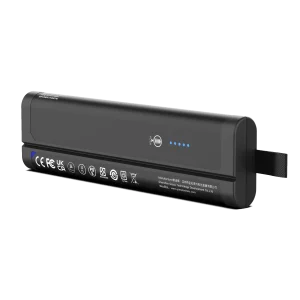
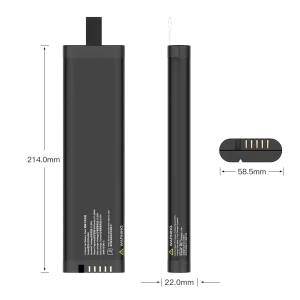
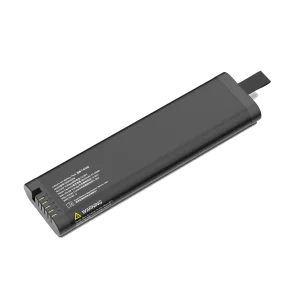
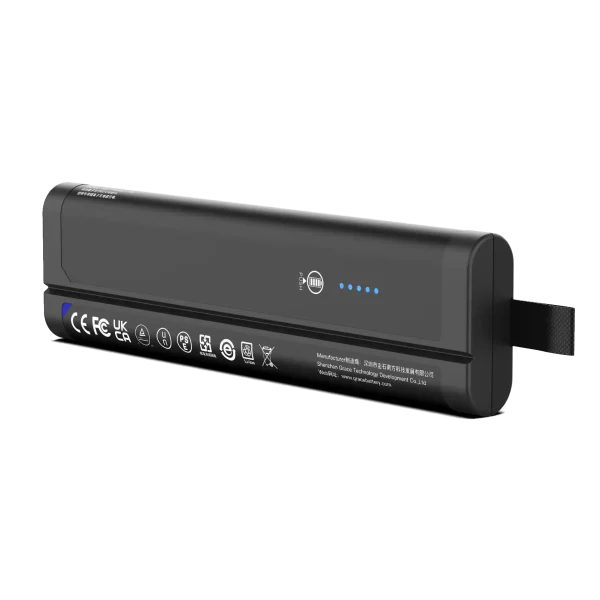
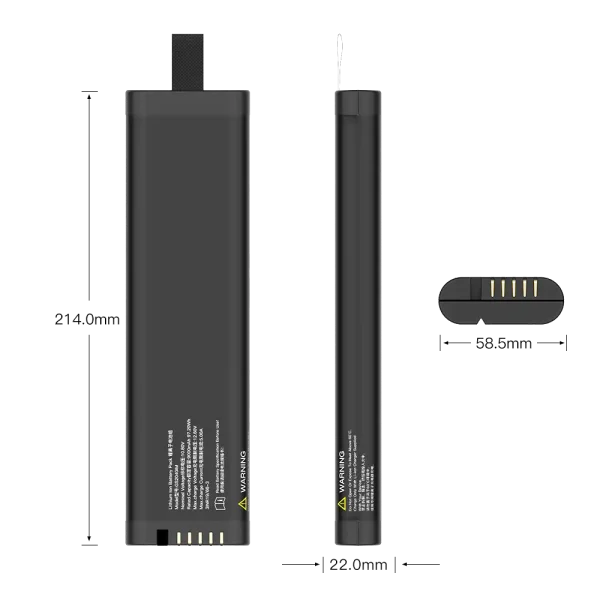
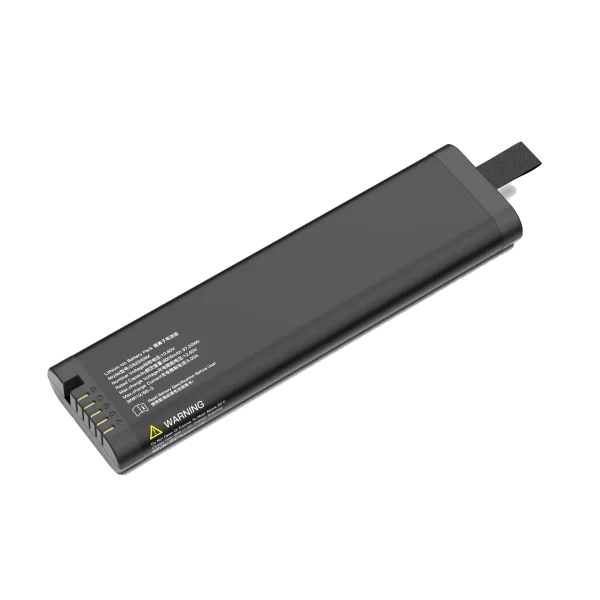
GS2040IM
10.8V/9300mAh/97.2Wh
4.3 Smart BMS with SMBus Communication
A portable patient monitor does not merely want voltage and current—it wants State of Charge (SoC), State of Health (SoH), cycle count, cell-by-cell voltage, pack temperature, and remaining runtime, all rendered on the monitor’s display. This is delivered via SMBus (System Management Bus), following the Smart Battery Data (SBD) specification. The host acts as bus master; the battery pack responds at slave address 0x16, exposing 16-bit word registers for voltage, current, SoC, and design capacity [4].
For OEM projects, SMBus register mapping is the single most common integration point—and the most common source of bugs. Vendors should provide a complete register map (not just a sample sheet), including manufacturer-access commands for firmware updates to the fuel-gauge IC. Some OEMs also offer I2C, RS485, or UART alternatives depending on the host platform’s available bus.
4.4 Mechanical and Connector Design
Hot swap is not just electronics—it is a mechanical discipline. The connector must:
- Use staggered pin lengths so that ground contacts mate first and power contacts last, preventing hot-plug arcs.
- Withstand at least 10,000 insertion cycles at the rated current without significant contact resistance rise.
- Include a latching or thumbscrew mechanism so accidental bumps do not eject the pack during patient transport.
- Provide polarization and keying so a spare pack from the same product line cannot be inserted backwards.
IP-rating of the battery compartment is another consideration. Patient monitors undergo regular disinfection with hospital-grade wipes; the pack-to-device seal should resist fluid ingress at least to IP54 on the compartment door.
4.5 Thermal Management
Because two packs sit in close proximity inside a compact handheld enclosure, self-heating during high-current discharge can push cell temperatures above 45°C. A competent OEM design includes NTC thermistors in each pack, a thermal pad interface to the device chassis, and BMS derating that throttles discharge current if cells exceed 50°C. For continuous-duty carts with three-bay configurations, forced-air or passive finned cooling may be required.
5. Regulatory and Certification Landscape
A battery pack that ships inside a Class IIa medical device into the EU, US, or Japan must clear several overlapping regulatory layers. Below is the certification stack most relevant to hot-swappable patient-monitor battery OEMs as of 2026.
Table 1. Key standards applicable to hot-swappable medical battery packs
| Standard / Regulation | Scope | Why It Matters for Hot Swap |
| IEC 60601-1 (3.1 Ed.) | General safety of medical electrical equipment; includes general requirements for battery-powered equipment and protective measures against unintended power interruptions. | Defines the essential-performance baseline: the device must not become unsafe during battery swap; requires creepage/clearance between redundant battery rails. |
| IEC 62133-2:2017+A1:2021 | Safety requirements for portable sealed secondary lithium cells and batteries in portable applications. Recognized by FDA as a consensus standard [5]. | Applies at both cell and pack level; covers overcharge, over-discharge, short circuit, free-fall, and thermal abuse. Custom pack assemblies need their own pack-level testing. |
| UN 38.3 (Rev. 7, Ch. 38.3) | UN Manual of Tests and Criteria; eight-test battery: altitude, thermal cycle, vibration, shock, external short, impact/crush, over-charge, forced discharge. | Mandatory for air/sea/land transport of any lithium battery. Without it, packs cannot ship internationally. A custom pack based on certified cells still needs pack-level UN 38.3 testing [6]. |
| ISO 13485:2016 | Quality management system for medical device design and manufacturing. | The OEM battery supplier must hold ISO 13485 certification and maintain a technical file traceable to the host device’s regulatory submission. Ask for internal audit schedules and CAPA records. |
| CE / UKCA marking | EU Medical Device Regulation (MDR 2017/745) and UK CA mark for GB market; battery pack falls under the device’s overall certification. | Hot-swap transition behavior must be documented in the device’s risk file (ISO 14971). |
| FCC Part 15B / EN 55011 | EMC emissions and immunity for medical electrical equipment (IEC 60601-1-2). | SMBus communication switching during battery swap can generate transient emissions; the EMC test must include hot-swap events. |
| EU Battery Regulation 2023/1542 | New EU battery regulation covering carbon footprint, battery passport, and recycled content requirements for industrial and EV batteries; portable medical batteries are partially in scope. | As of 2026, digital battery passport provisions are being phased in; OEMs should plan for BMS data fields that support future passport requirements. |
6. OEM Battery Pack Supplier Landscape
The medical battery OEM space spans a range of suppliers, from large global conglomerates to specialized mid-tier pack integrators. For a portable patient monitor program, the right partner depends on volume targets, certification readiness, and communication-protocol complexity. The following comparison summarizes typical supplier categories rather than endorsing any specific vendor.
Table 2. OEM supplier categories for hot-swappable patient-monitor battery packs
| Supplier Tier | Typical Profile | Certification Strength | SMBus / Smart BMS Maturity | Best Fit |
| Tier 1: Global Battery Giants | Large Li-ion cell makers with dedicated medical divisions; multi-billion-dollar revenue. | Full IEC 62133-2, UN 38.3, ISO 13485; strong regulatory documentation. | Mature SMBus v1.1/v1.1.1, SBD-compliant fuel gauges; long product lifecycle commitments. | High-volume, multi-market platforms (>100k units/yr) requiring deep regulatory support. |
| Tier 2: Specialized Medical Pack Integrators | Mid-tier ODM/OEM houses focused on medical; 200–1000 employees; strong engineering services. | ISO 13485 quality system; IEC 62133-2 and UN 38.3 on pack topologies they assemble. | Custom BMS firmware, SMBus register mapping tailored to host MCU; faster NPI. | Mid-volume programs (5k–50k units/yr) where co-development and fast iteration matter. |
| Tier 3: Consumer Battery Factories | General-purpose pack assemblers; primarily consumer electronics background. | Basic UN 38.3 and CE; ISO 13485 may be absent or new. | Often uses off-the-shelf PCM with limited smart communication; SMBus may be bolted on. | Low-cost, low-complexity devices not classified as medical; not recommended for patient monitors. |
| Tier 4: Custom Boutique Design Houses | Small teams that design-to-print and outsource production. | Variable; may hold design certifications but not manufacturing QMS. | Deep protocol expertise but limited production ramp capacity. | Pre-production prototypes, alpha builds, and regulatory submission samples. |
TEFOO (Shenzhen) sits in the Tier 2 category: a medical-focused OEM pack integrator with ISO 13485 quality systems, in-house SMBus fuel-gauge firmware development, and experience designing dual-bay hot-swap packs for patient monitors and medical carts. We typically work with device makers at the 5,000–50,000-unit annual volume band where engineering responsiveness is as valuable as unit cost.
7. Key OEM Selection Criteria: A Checklist
When evaluating an OEM battery partner for a hot-swappable patient monitor program, we recommend auditing the following dimensions before issuing a purchase order. This checklist is drawn from our own supplier qualification experience and the due-diligence frameworks published by medical device quality auditors [7].
- Quality system: valid ISO 13485:2016 certificate covering design and manufacture; request internal audit reports, CAPA records, and change-control procedures.
- Cell sourcing: named cell model and manufacturer (Samsung SDI, LG Energy Solution, Murata, EVE, etc.) with full UN 38.3 and IEC 62133-2 cell-level certificates. Avoid unnamed cells.
- Pack-level certification: IEC 62133-2 test report covering the exact pack topology (series configuration, BMS IC, fuse rating), and UN 38.3 summary report with serial numbers matching production lots.
- Communication protocol: documented SMBus register map, SBD compliance test report, and sample pack that can be bench-tested against your host MCU before design freeze.
- Hot-swap validation: demonstrate a live swap test on the bench—your own engineer should watch the oscilloscope on the main rail during pack insertion and removal.
- Regulatory support: willingness to provide a technical file (drawing, BOM, risk file excerpt, traceability) for inclusion in your CE/FDA submission.
- Lifecycle commitment: minimum 5–7 year cell availability, end-of-life notification, and no obsolescence surprises mid-product-life.
8. Frequently Asked Questions
Q1: Can we use a single-battery monitor and just add a hot-swap feature later?
Not practically. Hot swap requires hardware changes: a second battery bay, a second hot-swap controller, ORing diodes on the power rail, a second connector, and mechanical redesign of the enclosure. Retrofitting hot-swap onto a single-battery reference design typically costs more than designing it in from the start. Make the hot-swap architecture decision at the platform definition stage.
Q2: How long does a custom OEM hot-swap battery pack take to develop?
From project kickoff to production-ready validation, plan for 16–24 weeks. The critical path runs through: mechanical enclosure and connector design (4–6 weeks), BMS firmware and SMBus integration (4–6 weeks), DV/PV testing (4–6 weeks including IEC 62133-2 and UN 38.3), and pilot run (2–4 weeks). Complex protocol customization (e.g., custom SMBus commands for a proprietary host interface) adds 4–8 weeks.
Q3: What capacity range is typical for a hot-swappable patient-monitor pack?
Most portable patient monitor packs fall in the 11.1 V (3S) or 14.8 V (4S) range, with capacities from 2,200 mAh to 5,200 mAh per pack. Dual-pack configurations deliver 4–8 hours of continuous monitoring on a single pack, plus infinite runtime while swapping. Heavier cart-based systems may use three-bay architectures at higher capacities [2].
Q4: Is SMBus the only communication option?
No. SMBus (following SBD specification) is the most common in patient monitors because major monitor OEMs host SMBus masters. Alternatives include I2C (lighter weight, simpler), CAN bus (common in medical carts), and RS485 (industrial environments). The choice should match your host MCU’s available peripherals and the protocol stack your firmware team already supports.
Q5: Do we need to re-certify if we change the BMS IC?
Yes—and this is a frequent and costly surprise. A BMS IC change alters the pack’s protection characteristics and requires re-running IEC 62133-2 pack-level testing, and potentially UN 38.3. Lock the BMS IC selection during design freeze and build obsolescence-notification clauses into the OEM agreement. A competent supplier will flag end-of-life notices at least 12 months ahead.
Q6: How does EU Battery Regulation 2023/1542 affect our medical battery packs?
The EU Battery Regulation 2023/1542 is phasing in requirements across 2024–2030. Portable medical batteries are partially in scope; the battery passport and digital-product-passport provisions are being staged. For an OEM program starting in 2026, the practical action is to ensure your BMS can already record and report the data fields (cell chemistry, manufacturer, carbon-footprint tier, state of health) that future passport requirements will demand—so you can add the digital interface without a hardware redesign later.
9. Conclusion
Hot-swappable battery architecture is no longer a luxury feature for portable patient monitors—it is a clinical-workflow requirement that directly reduces data gaps during patient transport, supports continuous monitoring across long shifts, and provides the redundancy clinicians expect from modern mobile medical equipment.
Engineering a reliable hot-swap pack is a cross-disciplinary exercise: redundant power-path design, smart BMS with verified SMBus communication, mechanical connector design that survives thousands of swaps, and a certification stack that spans IEC 60601-1, IEC 62133-2, UN 38.3, and ISO 13485. Choosing an OEM partner who understands all of these layers—and who can supply a complete technical file for your regulatory submission—is as important as the cell chemistry itself.
If you are developing a next-generation portable patient monitor platform, we recommend engaging your battery OEM partner at the platform-definition stage, not after the enclosure is frozen. The cost of adding a second battery bay after mechanical design lock is disproportionately high. Getting the power architecture right on day one is the cheapest insurance you can buy.
References
[1] Accio. “Patient Monitor Battery Replacement Market Trends.” 2026. https://www.accio.ai/find-product/patient-monitor-battery-replacement
[2] IEI Integration Corp. “MPOCm-W24: 24” Mobile Medical Monitor.” Product page, 2026. https://www.ieiworld.com/en/product/MPOCm-W24.php
[3] AValue Healthcare. “EPB-1001 Add-On Power Module.” Product page, 2026. https://avalue-healthcare.com/en/product/Power_bank/EPB-1001_add_on_power_module
[5] FDA. “Recognized Consensus Standards: IEC 62133-2 Edition 1.1 2021-07.” US Food and Drug Administration. https://www.accessdata.fda.gov/scripts/cdrh/cfdocs/cfStandards/detail.cfm?standard__identification_no=46161
[6] Zechmeister Solutions. “MDR Battery Safety: EN 60601-1 for Portable Medical Devices.” 2026. https://zechmeister-solutions.com/en/blog/battery-safety-portable-medical-equipment
[7] Haisic Green Energy. “OEM Lithium Battery Pack Manufacturer for Medical Devices – Due Diligence Checklist.” 2026. https://www.battery-in-china.com/oem-lithium-battery-pack-manufacturer-for-medical-devices/
About the Author
The TEFOO Energy R&D Team is a group of battery-system engineers specializing in medical and industrial lithium-ion battery packs, smart BMS design, and SMBus/I2C communication protocols. TEFOO (Shenzhen TEFOO Technology Co., Ltd.) is an ISO 13485-certified OEM/ODM battery pack manufacturer serving portable medical device, industrial instrumentation, and portable test equipment customers worldwide.
Disclaimer
This article is for informational and educational purposes and does not constitute engineering, regulatory, or legal advice. TEFOO is a supplier of battery packs and battery-management systems; references to third-party products, standards, or market data are provided for context and do not imply endorsement. Always consult your own regulatory affairs counsel and certified test laboratory when designing, certifying, or shipping a medical device. Specific design parameters, certification scopes, and regulatory timelines must be verified against the current official versions of all cited standards and regulations.