By Dr. Li Wei, Principal Battery Systems Engineer at TEFOO Energy
1. Introduction
Handheld medical diagnostic devices — from point-of-care blood analyzers and portable ultrasound scanners to handheld DNA readers and wearable patient monitors — depend entirely on their battery packs. Unlike consumer electronics, where a battery failure is merely an inconvenience, a power interruption in a handheld diagnostic instrument can compromise patient safety, invalidate test results, and delay critical clinical decisions.
As a battery engineer who has overseen more than 200 custom battery pack programs for medical OEMs over the past decade, I have seen firsthand how many product teams underestimate the gap between a “working” battery prototype and a fully certified, production-ready handheld diagnostic battery pack that can be legally shipped across borders. The most common pain point? UN 38.3 documentation delays that push product launches back by weeks — or even months.
This guide walks through every engineering and compliance consideration that goes into a custom battery pack for handheld medical diagnostics, with a detailed breakdown of UN 38.3 testing and documentation requirements. Whether you are an OEM project manager sourcing a new battery supplier, or an R&D engineer evaluating pack architectures, the information below will help you avoid costly redesigns and regulatory surprises.
2. Why Handheld Medical Diagnostics Demand Custom Battery Packs
Off-the-shelf laptop or power-tool batteries simply do not meet the requirements of handheld medical diagnostic instruments. Several constraints set medical-grade packs apart:
2.1 Size and Form-Factor Constraints
Handheld diagnostics are designed around ergonomic grip, single-handed operation, and pocket or belt carry. The battery pack must fit into a tight, often irregular-shaped cavity defined by the device housing, PCB layout, and display module. Standard cylindrical 18650 or 21700 cells may not fit at all — requiring custom prismatic Li-polymer cell configurations with voltages and capacities tailored to the device power budget.
2.2 Reliability in Clinical Settings
A handheld diagnostic device may be used in a hospital ward, a remote field clinic, or an ambulance in transit. The battery must deliver stable voltage across the entire state-of-charge range, support rapid current pulses during sample analysis or sensor excitation, and maintain predictable run-time so clinicians never lose confidence mid-test. A 5% run-time error that is tolerable in a smartphone is unacceptable when it causes a blood gas analyzer to shut down mid-calibration.
2.3 Smart Communication for Clinical Workflows
Modern handheld diagnostic instruments report remaining battery capacity, state-of-health, and cycle count directly on the device UI — and often sync with hospital electronic health record (EHR) systems. This requires a System Management Bus (SMBus) or HDQ interface, a fuel-gauge IC that supports the Smart Battery Data (SBD) specification, and carefully mapped registers that the device firmware can query consistently.
2.4 Dual-Path Safety Requirements
Under IEC 60601-1 (the general standard for medical electrical equipment), any failure that could lead to a safety hazard must be contained within a single fault condition. Battery packs for medical use therefore typically employ dual-redundant protection: a dedicated hardware protection IC for overvoltage, undervoltage, overcurrent, and short-circuit cutoff, plus a secondary software layer in the fuel-gauge MCU that monitors temperature, cell balancing, and state-of-health.
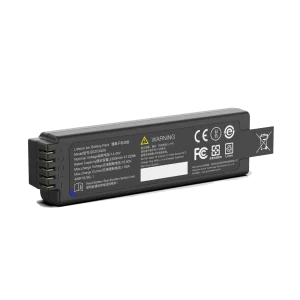
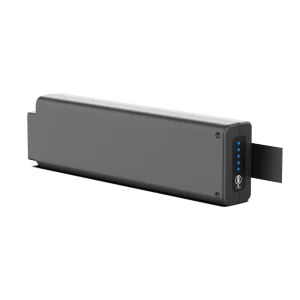
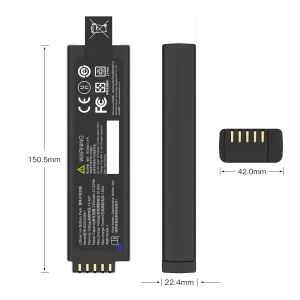
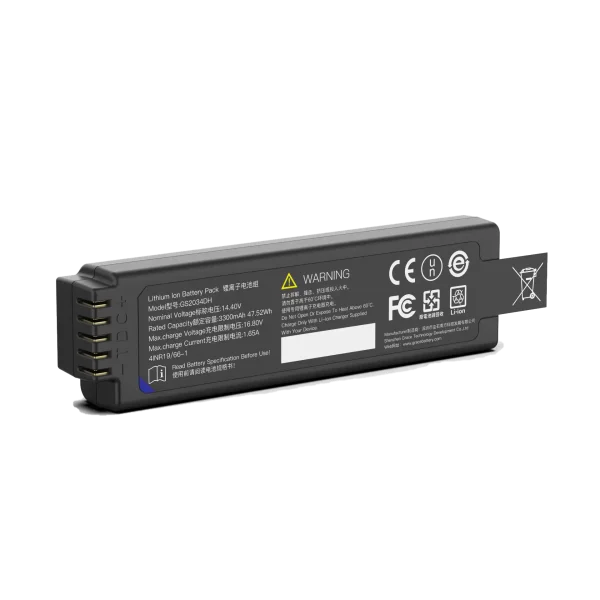
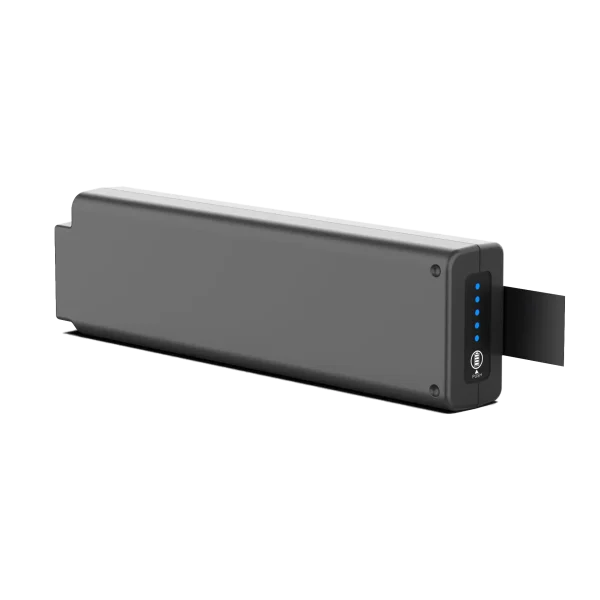
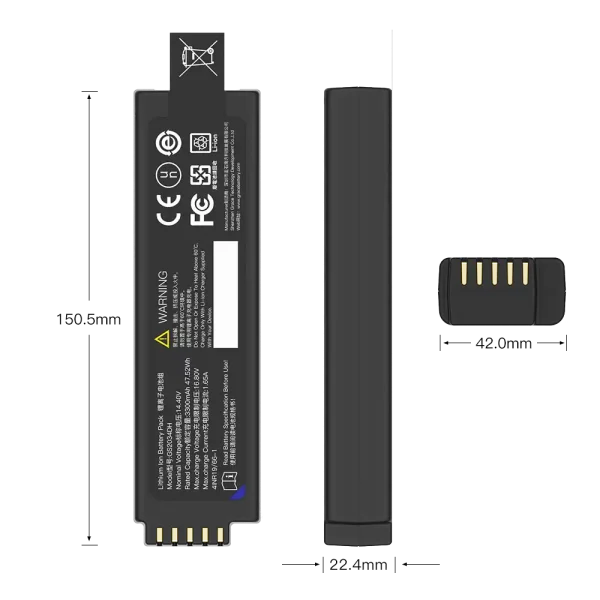
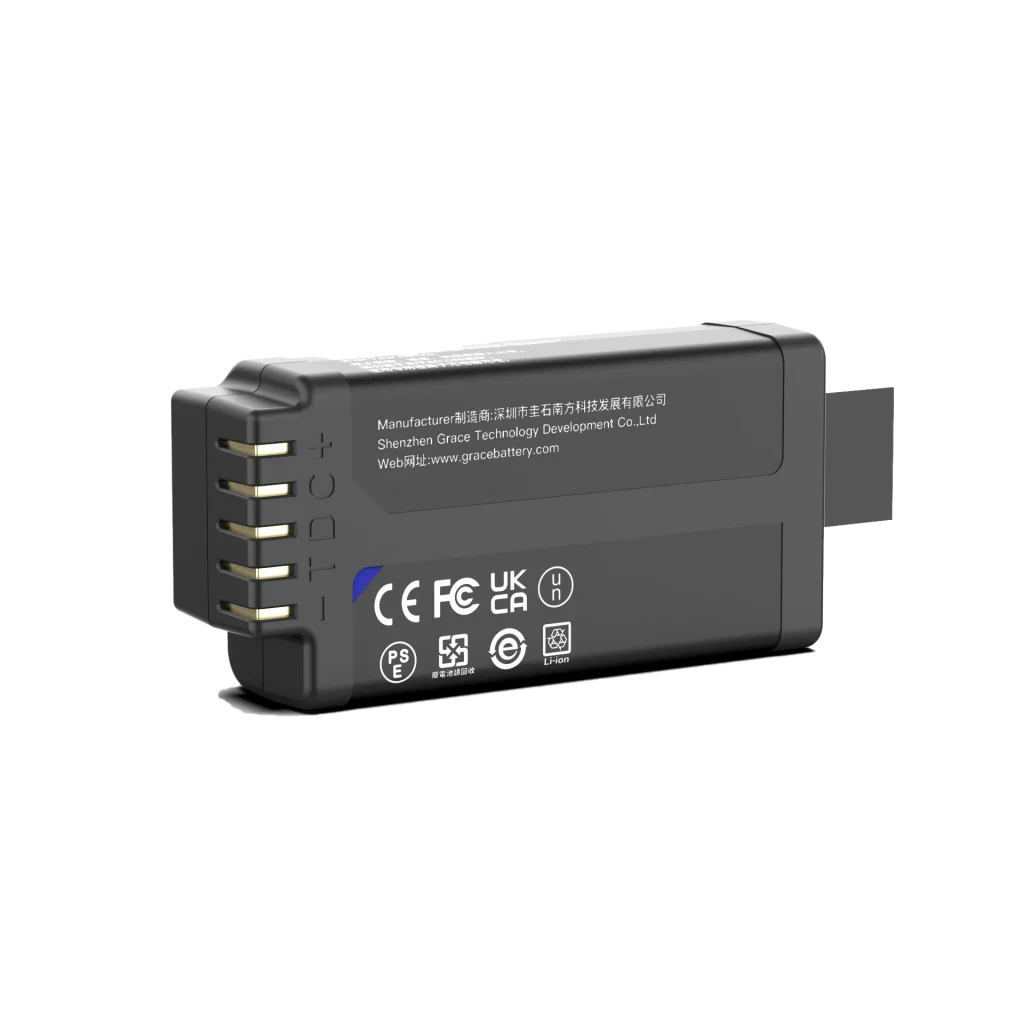
GS2034DH
14.4V/3450mAh/47.52Wh
3. Core Engineering Decisions for a Custom Handheld Diagnostic Battery Pack
3.1 Cell Chemistry Selection
Choosing the right cell chemistry is the first decision that cascades through the entire pack design. For handheld medical diagnostics, three chemistries are commonly considered:
| Chemistry | Typical Application | Energy Density | Cycle Life | Key Consideration |
| NMC (Nickel-Manganese-Cobalt) | Ultrasound scanners, blood analyzers, high-drain devices | High (250-280 Wh/kg) | 500-1000 cycles @ 80% DoD | Best balance of energy density and power delivery; standard choice for most handheld diagnostics |
| NCA (Nickel-Cobalt-Aluminum) | Long-run-time wearable monitors, low-power sensors | Very high (270-300 Wh/kg) | 300-500 cycles @ 80% DoD | Maximum energy density but narrower thermal safety margin; requires careful BMS tuning |
| LFP (Lithium Iron Phosphate) | High-cycle-use devices, sterilizable handheld tools | Moderate (120-160 Wh/kg) | 2000-4000 cycles @ 80% DoD | Superior thermal stability and cycle life; heavier and larger for equivalent capacity |
Table 1. Cell chemistry comparison for handheld medical diagnostic battery packs
In practice, approximately 70% of the handheld diagnostic packs we design at TEFOO use NMC prismatic or pouch cells, because they strike the best compromise between energy density, thermal safety, and supply-chain availability. LFP is reserved for devices that go through hundreds of charge cycles per year (such as triage devices used in busy emergency departments), where cycle life outweighs weight.
3.2 Battery Management System (BMS) Architecture
The BMS is the intelligence of the pack. For medical-grade handheld diagnostics, a robust BMS must provide:
- Primary protection: overcharge (OVP), over-discharge (UVP), over-current (OCP), short-circuit (SCP), and over-temperature (OTP) cutoff — implemented in hardware IC for nanosecond response.
- Secondary monitoring: cell-voltage balancing, pack-temperature sensing via NTC thermistors, and state-of-charge (SOC) estimation with accuracy within +/-3% under clinical load profiles.
- SMBus communication: compliance with Smart Battery System (SBS) 1.1 specification, exposing standard registers such as RemainingCapacity (0x0F), FullChargeCapacity (0x10), Voltage (0x09), Temperature (0x08), and CycleCount (0x17).
- Authentication: optional SHA-1 or AES-128 challenge-response authentication to prevent counterfeit battery packs from being used with the medical device — a requirement that is increasingly common among Class II and III device manufacturers.
3.3 Mechanical and Enclosure Design
Handheld diagnostic devices are dropped, disinfected with alcohol wipes, and exposed to variable humidity. The pack enclosure must therefore:
- Meet the device-level ingress protection rating (commonly IP54 to IP67), often achieved through ultrasonic welding of the PC+ABS or polycarbonate housing and silicone gaskets around the connector.
- Withstand 1.0 m to 1.5 m drop tests onto concrete, per IEC 60601-1 Clause 15.3.2, without exposing live terminals or causing pack deformation that would breach the device enclosure.
- Use a UL 94 V-0 flame-retardant plastic housing, which is both a safety requirement and typically expected by notified bodies during CE marking audits.
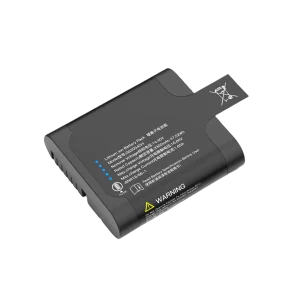
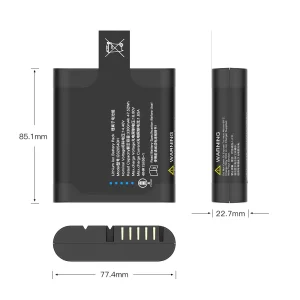
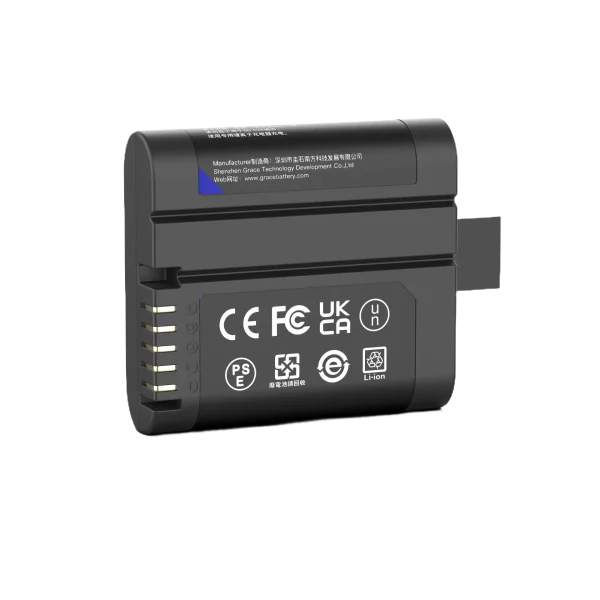
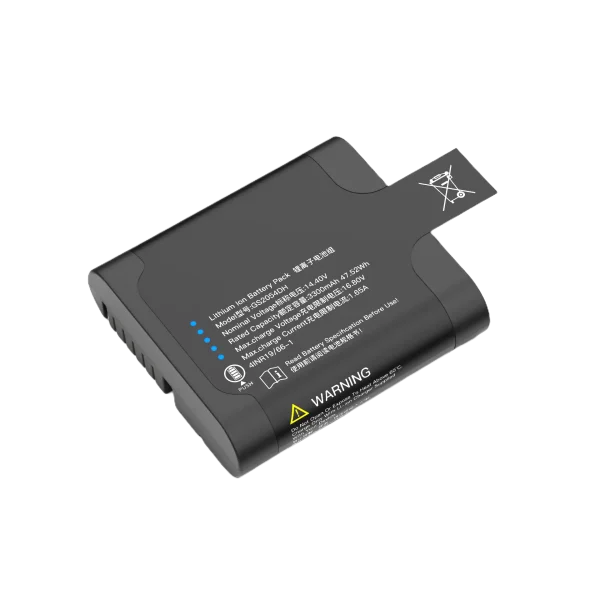
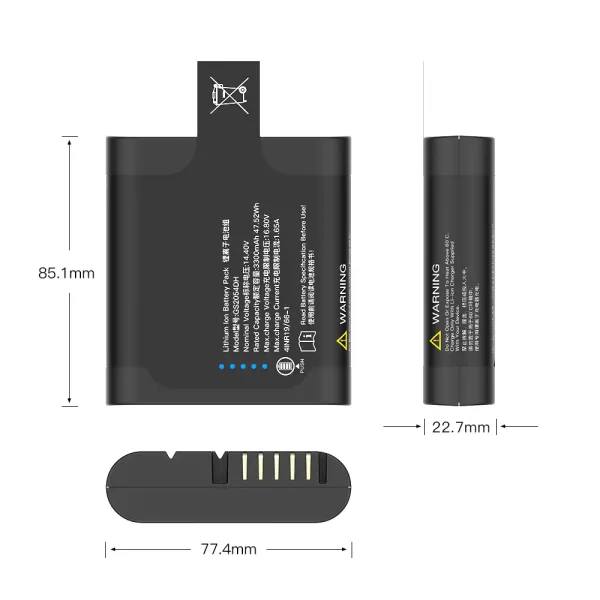
GS2054DH
14.4V/3450mAh/47.52Wh
4. UN 38.3 Documentation: What It Is and Why It Matters
UN 38.3 — formally Section 38.3 of the UN Manual of Tests and Criteria, Part III — is the mandatory transport safety standard for all lithium-ion and lithium-metal batteries shipped internationally, regardless of capacity. Without a passing UN 38.3 test summary, carriers will refuse to accept your handheld diagnostic battery pack, and customs authorities can seize shipments at the border.
For medical device OEMs, UN 38.3 documentation is not a one-time exercise: every cell change, every BMS firmware revision, and every mechanical redesign that alters the pack construction can trigger a partial or full retest. Getting the documentation right the first time directly translates to faster time-to-market.
4.1 The Eight UN 38.3 Tests
UN 38.3 comprises eight sequential tests that cells and battery packs must pass. The table below summarizes each test, its purpose, and the sample preparation required:
| Test | Name | Procedure Summary | Pass Criterion | Sample State |
| T1 | Altitude Simulation | Expose to low pressure <=11.6 kPa for at least 6 hours at ambient temperature | No disassembly, no leakage, no fire, no explosion | Fully charged cells and packs |
| T2 | Thermal Test | Temperature cycling between -40 C and +72 C, 10 cycles, >=6 hours at each extreme | No disassembly, no leakage, no fire, no explosion | Fully charged cells and packs |
| T3 | Vibration | Sinusoidal vibration 7-200 Hz, logarithmic sweep, 3 hours per axis (X/Y/Z) | No disassembly, no leakage, no fire, no explosion | Fully charged cells and packs |
| T4 | Shock | Half-sine shock, 150 g peak, 6 ms duration, 3 shocks per direction per axis (total 18 shocks) | No disassembly, no leakage, no fire, no explosion | Fully charged cells and packs |
| T5 | External Short Circuit | Short-circuit at 55 +/- 5 C with external resistance <=0.1 Ohm, until pack temperature returns to ambient | Case temperature <=170 C; no disassembly, no fire within 1 hour post-test | Fully charged packs |
| T6 | Impact / Crush | For cylindrical cells: 9.1 kg weight dropped from 61 cm onto a 15.8 mm rod placed across the cell center. For prismatic/pouch: crush test. | No fire, no explosion within 6 hours post-test | Partially discharged cells |
| T7 | Overcharge | Charge at twice the manufacturer maximum charge current to 2x maximum charge voltage (for secondary lithium batteries) | No disassembly, no fire within 7 days | Discharged packs |
| T8 | Forced Discharge | Discharge at 1.5x manufacturer maximum discharge current down to 0 V | No disassembly, no fire within 7 days | Discharged cells |
Table 2. UN 38.3 test summary for lithium-ion battery packs
4.2 Required UN 38.3 Documentation Package
When your testing laboratory completes the UN 38.3 program, they issue a UN 38.3 Test Summary (T.S.) document. For a handheld diagnostic battery pack, your documentation package should contain the following items to be accepted by freight forwarders and notified bodies:
- UN 38.3 Test Summary document, issued by an ILAC-accredited laboratory, listing all eight tests performed, sample serial numbers, and pass/fail results.
- Cell-level UN 38.3 test reports from the cell manufacturer (your pack-level report builds on these; you must retain the cell reports for your technical file).
- Battery pack specification sheet: nominal voltage, rated capacity, charge/discharge current limits, dimensions, weight, and cell configuration (e.g., 2S2P).
- UN number and proper shipping name classification (UN3480 for lithium-ion batteries alone, UN3481 for batteries packed with or contained in equipment).
- Section II of the IATA DGR / ADR / IMDG classification document, confirming the pack falls under the lithium battery exception provisions.
- 1.2 meter drop test report (packaged), as required by the UN Model Regulations for lithium batteries.
4.3 Common UN 38.3 Documentation Pitfalls
Based on our experience supporting dozens of medical OEMs through regulatory submissions, here are the most frequent UN 38.3 documentation errors that cause shipment delays:
Pitfall 1: Testing cells but not the finished pack. UN 38.3 requires both cell-level and pack-level testing. Many OEMs only have cell reports from the supplier and assume that is sufficient — it is not. Your finished pack, with its BMS, protection circuitry, enclosure, and connector, must be tested as a unit.
Pitfall 2: Outdated test summaries after cell substitutions. If you switch from a Samsung SDI 35E cell to an LG INR18650MH1 — even with the same nominal capacity and dimensions — you must retest. Freight forwarders and aviation auditors cross-reference the cell manufacturer and model on the test summary against the actual shipping documentation.
Pitfall 3: Missing the 1.2 m packaged drop test. The UN Model Regulations require a separate packaged drop test (not to be confused with the T4 shock test at the pack level). This is a common omission that causes airlines to reject cargo acceptance at the airport.
5. Beyond UN 38.3: Other Critical Standards for Medical Diagnostic Packs
UN 38.3 gets your battery shipped, but it does not make it safe to use inside a medical device. Several additional standards apply in parallel:
| Standard | Scope | Why It Matters for Handheld Diagnostics |
| IEC 62133-2:2017+A1:2021 | Safety requirements for portable sealed secondary lithium cells and batteries | The cell-level safety standard referenced by IEC 60601-1. Covers abuse conditions (external short, free fall, thermal abuse) that go beyond transport testing. |
| IEC 60601-1:2005+A1:2012+A2:2020 | General requirements for basic safety and essential performance of medical electrical equipment | The parent standard for all medical electrical devices. Clause 15.4.3.4 specifically requires secondary lithium batteries to comply with IEC 62133. |
| ISO 13485:2016 | Quality management system for medical devices | The QMS that governs your battery supplier — not just the product, but the entire design, manufacturing, and traceability process. |
| IEC 60601-1-2 | Electromagnetic compatibility (EMC) requirements | The battery pack and its BMS switching regulators must not emit conducted or radiated noise that interferes with the diagnostic device sensitive measurement circuits. |
| UN 38.3 + PI 965 / PI 967 | IATA Packaging Instructions for lithium batteries | Determines whether your pack ships as UN3480 (battery alone) or UN3481 (battery installed in equipment), and what packaging and labeling are required. |
| EU Battery Regulation 2023/1542 | EU-wide battery sustainability and regulatory framework | Applies from 2024 onward; requires battery passport, carbon footprint declaration, and recycled content reporting for batteries placed on the EU market. |
Table 3. Key regulatory standards for handheld medical diagnostic battery packs
6. How to Evaluate a Custom Battery Pack Vendor for Medical Diagnostics
Choosing the right partner for your custom handheld diagnostic battery pack is as important as the cell chemistry itself. Based on our work with medical OEMs, here are the five dimensions we recommend you score any prospective supplier on:
6.1 Medical-Grade Quality System (ISO 13485)
This is non-negotiable. A battery supplier without ISO 13485 certification cannot support your CE marking or FDA 510(k) submission, because your notified body will trace the battery pack back to its manufacturing site and audit the QMS. Ask for the supplier ISO 13485 certificate scope — it must explicitly include “design and manufacture of battery packs for medical devices,” not just general battery manufacturing.
6.2 Track Record with SMBus / Smart Battery Packs
Handheld diagnostic instruments rely on accurate fuel gauging to display remaining run-time. Ask the vendor for reference designs using TI BQ series or Renesas / SBS-compliant fuel gauges, and request a demonstration of the SMBus register map they would deliver for your device. A vendor that only builds “dumb” protection boards (no fuel gauge, no SMBus) will not meet clinical software requirements.
6.3 In-House UN 38.3 and IEC 62133 Testing Experience
While UN 38.3 testing must be performed by an accredited third-party lab, an experienced vendor will have a test chamber and vibration table on-site for pre-compliance screening. This catches failures early — before you pay for expensive official testing. Ask how many UN 38.3 programs they have supported in the past 12 months, and what their first-pass success rate is.
6.4 Supply Chain Resilience
Medical device programs run for 7-10 years or more. Your battery supplier must have dual-source cell options (e.g., both Samsung SDI and LG Energy Solution equivalents) and a component-obsolescence management process. A supplier that can only source cells from a single manufacturer creates a single point of failure that can halt your production line.
6.5 Design Support and NPI Process
A good custom battery partner does more than assemble cells. They should provide: mechanical CAD files that fit your enclosure, electrical schematics and BOMs for your regulatory file, SMBus firmware customization support, and a structured new product introduction (NPI) process with design review gates at prototype, DV, PV, and mass production stages.
7. Frequently Asked Questions
Q1: How long does UN 38.3 testing typically take for a custom medical battery pack?
A full UN 38.3 program for a new pack design, including sample preparation, lab scheduling, and report issuance, typically takes 6 to 10 weeks. If pre-compliance testing reveals failures and requires redesign, add another 4 to 8 weeks. We recommend budgeting 3 months total from design freeze to receiving the official UN 38.3 test summary.
Q2: Does my handheld diagnostic device battery need to pass IEC 62133 if it already has UN 38.3?
Yes. UN 38.3 is a transport standard only — it governs what happens to the battery during shipping. IEC 62133 governs safe operation during intended use inside the device. IEC 60601-1 Clause 15.4.3.4 explicitly requires secondary lithium batteries in medical devices to comply with IEC 62133. The two standards are complementary, not interchangeable.
Q3: What is the minimum order quantity (MOQ) for a custom medical battery pack?
Most reputable medical battery pack manufacturers have an MOQ between 500 and 1,000 packs for a fully custom design with unique mechanical housing and BMS firmware. For medium-volume diagnostic device programs (1,000-10,000 units per year), this is typically workable. NRE (non-recurring engineering) fees for tooling, firmware development, and certification testing usually range from $15,000 to $40,000, depending on complexity.
Q4: Can I use a consumer-grade battery and add a medical-grade BMS to save cost?
In practice, no. The cell selection itself matters: consumer-grade cells from bulk channels have wider capacity and internal-resistance tolerances, less consistent cycle-life data, and often lack the full UN 38.3 cell-level test documentation that notified bodies expect. For a Class II medical device, the risk of a regulatory finding or a field failure far outweighs the per-unit cost savings.
Q5: How does the EU Battery Regulation 2023/1542 affect my handheld diagnostic battery pack?
Regulation (EU) 2023/1542 applies to all batteries placed on the EU market, including industrial and medical batteries. Key near-term obligations include: CE marking of the battery itself as a standalone component, declaration of conformity, and from 2027 onward, a digital battery passport for larger industrial batteries. For medical device battery packs specifically, the recyclability and material-efficiency requirements are phased in through 2030, but you should design your pack with easy disassembly and cell-to-pack traceability now.
8. Conclusion
Designing and certifying a custom battery pack for handheld medical diagnostics is a multidisciplinary engineering challenge that spans cell chemistry, BMS firmware, mechanical packaging, and regulatory compliance. The difference between a successful product launch and a delayed one often comes down to how early you involve your battery partner in the design process — and how thoroughly you plan the UN 38.3 documentation and broader regulatory strategy.
The key takeaways are: (1) choose a cell chemistry matched to your device duty cycle and size constraints, not just the cheapest option; (2) build a dual-redundant BMS with SMBus communication from the start, not as an afterthought; (3) treat UN 38.3 as a critical-path activity, not a post-prototype checkbox; and (4) select a battery partner with proven ISO 13485 experience and a track record in medical-grade smart battery packs.
If you are currently developing a handheld diagnostic instrument and need a custom battery pack solution, our engineering team at TEFOO Energy works with medical OEMs from the early design phase through full certification. We bring deep experience with SMBus fuel gauging, IEC 62133 and UN 38.3 documentation, and ISO 13485-compliant manufacturing to every program.
About the Author
Dr. Li Wei is a Principal Battery Systems Engineer at TEFOO Energy, where he leads the medical battery pack product line. He holds a Ph.D. in Electrochemical Engineering from Tsinghua University and has 12 years of experience designing lithium-ion battery systems for medical, industrial, and aerospace applications. He has contributed to over 200 custom battery pack programs, including handheld blood analyzers, portable ultrasound systems, and wearable patient monitors. Dr. Wei is a member of the China Electrotechnical Society and participates in national standardization work for lithium battery safety in medical devices.
Disclaimer
TEFOO Energy is a manufacturer of custom lithium-ion battery packs and battery management systems for medical and industrial applications. This article is for informational purposes only and does not constitute legal, regulatory, or engineering advice. Always consult with a qualified regulatory consultant and accredited test laboratory for your specific product certification needs. The author has no financial relationship with any third-party company mentioned in this article other than TEFOO Energy, which is the author employer.
References
[1] United Nations. (2023). Recommendations on the Transport of Dangerous Goods: Manual of Tests and Criteria, 8th revised edition, Part III, subsection 38.3. UNECE. https://www.unece.org/trans/danger/publi/manual/manual_e.html
[2] International Electrotechnical Commission. (2021). IEC 62133-2:2017+A1:2021 — Secondary cells and batteries containing alkaline or other non-acid electrolytes — Safety requirements for portable sealed secondary lithium cells, and for batteries made from them. IEC Webstore.
[3] International Electrotechnical Commission. (2020). IEC 60601-1:2005+A1:2012+A2:2020 — Medical electrical equipment — Part 1: General requirements for basic safety and essential performance. Clause 15.4.3.4.
[4] International Organization for Standardization. (2016). ISO 13485:2016 — Medical devices — Quality management systems — Requirements for regulatory purposes.
[5] European Parliament and Council. (2023). Regulation (EU) 2023/1542 concerning batteries and waste batteries. Official Journal of the European Union.
[6] Smart Battery System Implementers Forum. (2018). Smart Battery Data (SBData) Specification, Revision 1.1.
[7] International Air Transport Association. (2025). Dangerous Goods Regulations (DGR), 66th Edition, Packaging Instruction 965 and 967.
[8] Texas Instruments. (2024). bq40z80 Li-ion Battery Pack Manager with Impedance Track Technology, Data Sheet SLUSCL5.