
A Senior R&D Engineer’s Engineering Guide to Replacement Lithium Battery Packs
By the TEFOO Medical Battery R&D Team
Published: October 2026 | Last updated: November 2026
About the author: The TEFOO R&D team has 12+ years of experience designing and qualifying lithium-ion battery packs for Class II medical devices, including patient monitors, infusion pumps, and ventilators. Our engineers have led pack development programs certified to IEC 60601-1, IEC 62133-2, UN38.3, and ISO 13485, with cumulative production of over 2 million medical-grade packs shipped to 30+ countries.
1. Introduction: Why the 11.1V 5200mAh Pack Matters
A patient monitor is a safety-critical medical device. Its battery is not a peripheral accessory—it is the energy reservoir that keeps ECG, SpO₂, NIBP, and invasive pressure waveforms continuous during code blue events, patient transfers between wards, and mains-power outages. The 11.1 V 5200 mAh lithium-ion pack is one of the most widely specified form factors in portable and transport-grade patient monitors from Philips, GE HealthCare, Mindray, EDAN, Draeger, and Welch Allyn platforms.
As a battery-pack R&D engineer who has qualified dozens of medical-grade packs to IEC 60601-1 and IEC 62133-2, I see the same questions from OEMs, biomed engineers, and procurement teams every month: Is a 5200 mAh pack really 5200 mAh? Can I drop in an aftermarket pack without invalidating the monitor’s medical certification? What does “SMBus battery” actually mean on the schematic? This guide answers those questions from first principles, using current 2025–2026 regulatory references and production-grade design data.
2. Technical Architecture of an 11.1V 5200mAh Pack
2.1 Cell Configuration: 3S2P with 18650 Cells
An 11.1 V nominal pack is, by definition, a three-series (3S) lithium-ion configuration using 3.7 V nominal cells. A 5200 mAh capacity is achieved by pairing two cells in parallel per series group—a 3S2P arrangement. In practice, this means two 2600 mAh 18650 cells in parallel (2P) wired across three series groups (3S).
The corresponding energy is 11.1 V × 5.2 Ah = 57.72 Wh. This number matters: it determines UN38.3 transport classification, airline shipping rules, and whether the pack falls under the US DOT small-battery exception or requires Class 9 dangerous-goods documentation.
All electrical parameters below are measured at 25 °C unless otherwise noted, per IEC 61960 test conditions. Capacity is rated at a 0.2C discharge current to the cut-off voltage.
Table 1. Electrical parameters of a typical 11.1V 5200mAh 3S2P patient-monitor pack
| Parameter | Value | Engineering Note |
| Nominal voltage | 11.1 V | 3 × 3.7 V (LiCoO₂ / NMC cell) |
| Full-charge voltage | 12.6 V | 4.20 V per cell; cell balancing target |
| Cut-off voltage | 9.0 V | 3.0 V per cell; BMS hard cutoff |
| Nominal capacity | 5200 mAh | 2 × 2600 mAh 18650 cells in parallel |
| Typical energy | 57.72 Wh | Used for UN38.3 / air-shipment classification |
| Continuous discharge | 2–3 A | Peak monitor load ~5–8 A during NIBP inflation |
| Charge current | Standard 0.5C (2.6 A) | Max charge 1C (5.2 A) at 0–45 °C |
| Cycle life | ≥ 500 cycles to 80% EOL | At 0.5C/0.5C, 25 °C, per IEC 61960 |
| Operating temp | Charge 0–45 °C; Discharge -10–60 °C | Medical-grade packs often derate below 0°C charge |
2.2 Smart BMS: More Than Protection
A consumer-grade power bank uses a single analog front-end (AFE) IC and three MOSFETs for over-charge, over-discharge, and short-circuit protection. A patient-monitor pack must do considerably more. The BMS in an 11.1V 5200mAh medical pack typically integrates:
- Dedicated battery fuel-gauge IC (e.g., TI bq series or Renesas) that implements impedance tracking and reports state-of-charge (SOC) to the host monitor via SMBus.
- Cell-balancing MOSFETs (≈50 mA passive balancing) to keep cell-to-cell voltage spread under 20 mV after a 12.6 V full charge.
- NTC thermistor (10 kΩ @ 25 °C) or I²C temperature sensor for charge thermal derating.
- Separate safety FET path (typically dual N-MOSFET, ≤15 mΩ on-resistance) isolated from the fuel gauge.
- Non-volatile memory (EEPROM or flash) storing pack serial number, cell lot date, cycle count, and manufacture date—required for ISO 13485 traceability.
2.3 SMBus Communication: Why It Matters
Modern patient monitors—including GE CARESCAPE (e.g., part 2017857-002, an 11.1V 3S2P 18650 SMBUS pack) and Philips IntelliVue platforms—do not treat the battery as a passive voltage source. They communicate over SMBus (System Management Bus, typically v1.1 or v2.0) to read:
- Relative State-of-Charge (RSOC) and remaining run-time estimate;
- Pack voltage, current, and instantaneous power;
- Cell temperature and charge/discharge FET status;
- Manufacturer name, device chemistry, serial number, and design cycle count.
If a replacement pack omits SMBus or uses a fuel-gauge firmware that does not match the host’s SMBus peculiarities, the monitor will either (a) refuse to charge the pack, (b) display a “battery not compatible” alert, or (c) worst of all, show 100% SOC while the pack silently drops out. This is the single most common field failure mode for cheap aftermarket packs and the reason compatibility verification—not just voltage and capacity matching—must be the first engineering gate.
3. Safety Standards and Regulatory Compliance
A patient-monitor battery touches the operator, the patient, and the hospital mains system. It must therefore satisfy three overlapping layers of regulation.
3.1 IEC 60601-1: The Medical Device Base Standard
IEC 60601-1 (general requirements for basic safety and essential performance of medical electrical equipment) governs the monitor itself. The 2024 consolidated edition (EN 60601-1:2006+A1+A12+A2+A13:2024) explicitly addresses internally powered equipment, battery charging, and overcharge protection. Although the pack is a component, the manufacturer’s risk file must demonstrate that a single fault in the battery—a shorted cell, a blocked vent, a failed BMS FET—does not lead to fire, enclosure rupture, or unintended cardiac monitoring interruption.
3.2 IEC 62133-2: The Cell-Level Safety Standard
IEC 62133-2 (secondary cells containing alkaline or other non-acid electrolytes—safety requirements for portable sealed secondary lithium cells) is the cell- and pack-level safety standard that every medical lithium pack must pass. It covers:
- Continuous low-rate charging, external short circuit, and free-fall;
- Thermal abuse (130 °C hot-soak), impact, and forced internal short;
- Over-charge to 4.6 V/cell and forced discharge;
- Altitude, temperature cycling, and vibration/shock per transport profiles.
3.3 Transport and Global Market Access
Table 2. Certification matrix for an 11.1V 5200mAh medical Li-ion pack
| Standard / Certification | Scope | Why It Is Required |
| UN 38.3 | Transport safety (T.1–T.8) | Mandatory before any air/sea/land shipment of Li-ion cells or packs; 57.72Wh packs ship under Class 9 PI965/967. |
| IEC 62133-2 | Cell & pack safety | Harmonized under CB Scheme; accepted by EU, UK, Japan, Korea. |
| IEC 60601-1 + IEC 60601-1-2 | Medical EMC & safety | Demonstrates the pack contributes to essential performance of the monitor. |
| CE (EU MDR 2017/745) | EU market access | Pack is a custom accessory; OEM must retain technical documentation. |
| UKCA | UK market access | Post-Brexit continuation of CE for Great Britain. |
| ISO 13485 | Quality management | Design traceability, lot genealogy, and change control for medical batteries. |
| MSDS / SDS (GHS) | Chemical safety | Required for shipping and hospital EHS handling. |
| UL 2054 / UL 60950-1 | North America | Optional but frequently requested by US hospital GPOs. |
| China RoHS / WEEE | Environmental | Applicable if marketed in China or EU. |
Note on EU Battery Regulation (EU) 2023/1542: effective from 2025 onward, portable and industrial batteries placed on the EU market must carry a separate collection marking (“crossed-out wheeled bin”), a carbon-footprint declaration for EV/industrial batteries above 2 kWh, and—most relevant to medical OEMs—a battery passport from 2027. Medical-device battery packs sold as spare parts into the EU must be planned against this timeline now, not after 2027.
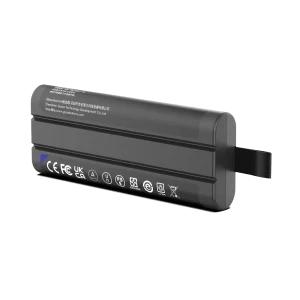
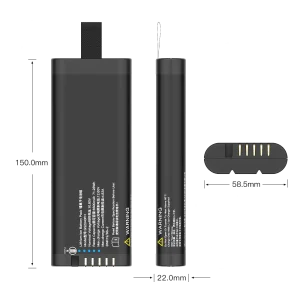
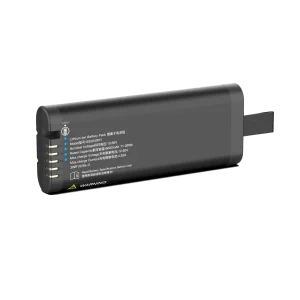
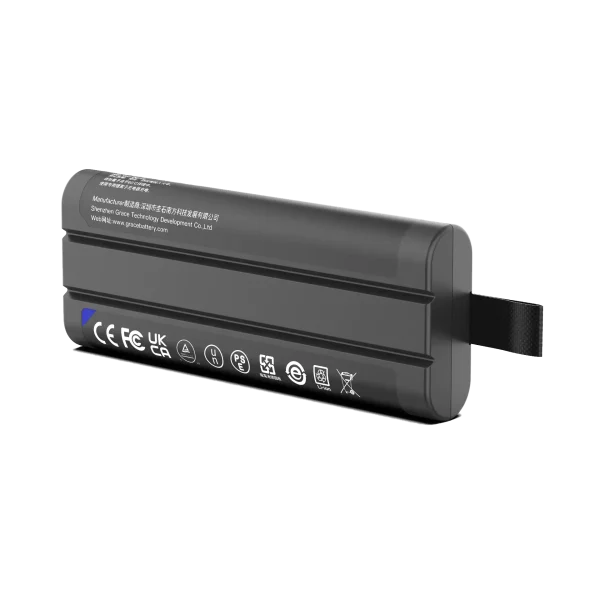
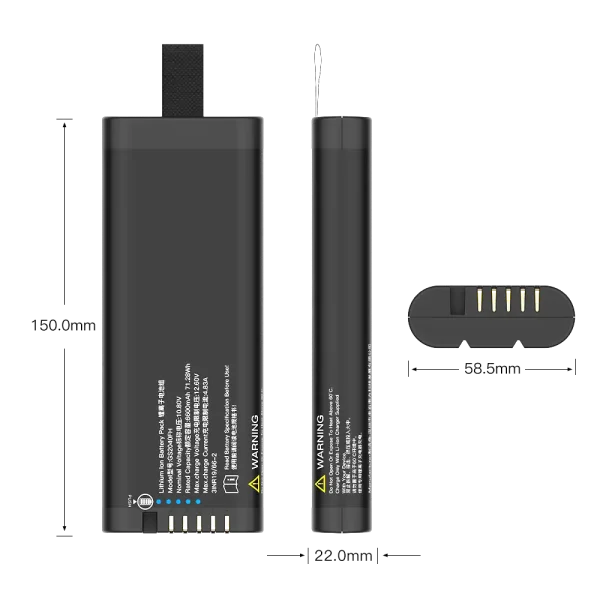
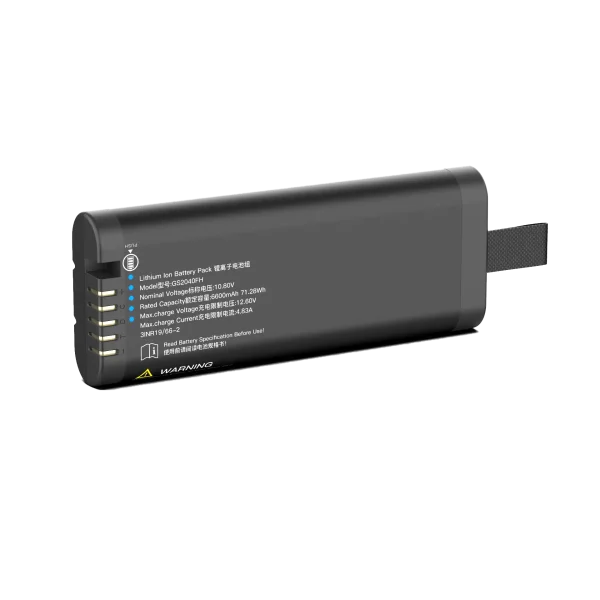
GS2040FH
10.8v/6900mAh/71.28h
4. OEM vs. Aftermarket: Vendor Comparison
Biomed engineering departments buying replacement packs face three sourcing routes: original equipment manufacturer (OEM) direct, tier-1 OEM-equivalent pack makers, and generic aftermarket suppliers. The table below compares them on engineering dimensions that actually matter in the field.
Table 3. Sourcing options for 11.1V 5200mAh patient-monitor replacement packs
| Dimension | OEM Direct (Philips/GE/Mindray) | Tier-1 Equivalent Pack Maker | Generic Aftermarket |
| Cell source | Grade-A 18650 (Samsung SDI, Sanyo/Panasonic, LG) with lot traceability | Grade-A or Grade-B+ cells; usually named brands with COA | Unbranded/white-label cells; source often undisclosed |
| BMS & firmware | Host-validated SMBus fuel gauge, matched to monitor firmware | Reverse-engineered SMBus firmware; re-tested on reference monitors | Basic protection PCM; SMBus often emulated or absent |
| Capacity rating | Nameplate capacity verified at 0.2C discharge | Verified at 0.2C; capacity tolerance typically ±5% | Nameplate often inflated; measured capacity may be 70–85% of label |
| Certifications | Full IEC 60601-1 / IEC 62133-2 / UN38.3 in the monitor’s technical file | IEC 62133-2, UN38.3, CB; partial 60601-1 risk file available | UN38.3 + MSDS only; no medical-grade test report |
| Warranty | 12–24 months through hospital service contract | 12 months direct; 2:1 replacement ratio typical | 3–6 months; frequently no RMA support |
| Cycle life | ≥500 cycles to 80% at 25°C | ≥500 cycles to 80% with Grade-A cells | 150–300 cycles; rapid capacity fade after 1 year |
| Cost (per pack, 100–500 qty) | High ($180–$350) | Mid ($65–$120) | Low ($25–$45) |
| Best fit | Direct service contracts, FDA-mandated spares, brand-new fleets | Cost-sensitive fleet refresh, third-party service organizations | Short-term rental fleets, non-critical backup—not recommended for primary monitoring |
Cost range source: TEFOO internal market survey, Q3 2026, based on 100–500 unit quotes from distributors and pack manufacturers in North America, EU, and Southeast Asia. Actual pricing varies by volume, certification scope, and logistics terms.
5. How to Evaluate a Replacement Pack: A 6-Point Engineering Checklist
Before approving a supplier for an 11.1V 5200mAh replacement pack, run through this checklist. It is the same gate our team uses at TEFOO when qualifying a medical pack for a new OEM customer.
5.1 Verify the cell name and grade
Ask for the exact cell model (e.g., INR18650-25R, UW6, or ICR18650-26F) and a Certificate of Analysis (CoA). Grade-A cells from Samsung SDI, Panasonic/Sanyo, and LG Energy Solution are binned above 99% initial capacity and <2 mΩ impedance spread. Grade-B cells are 95–99% capacity and are acceptable for industrial but not for critical-care backup.
5.2 Confirm SMBus firmware compatibility
Request a pre-production sample and run it on the actual monitor. Verify that SOC percentage matches the fuel-gauge report, that the monitor reports a correct battery serial number, and that low-battery alarms fire at the manufacturer-specified threshold. Do not accept “compatible on our bench” without on-host verification.
5.3 Inspect the BMS schematic and protection thresholds
Over-charge protection should trip at 4.25–4.30 V/cell; over-discharge at 2.5–3.0 V/cell; over-current at 15–25 A (depending on harness); short-circuit protection within 200 µs. The BMS should also have a second-level hardware fuse (current interrupt device, CID) inside each cell and a thermal cutoff (TCO) on the pack surface.
5.4 Reject inflated capacity claims
No 18650 cell in mass production today—even the latest NMC chemistries—delivers 2600 mAh per cell at medical-grade continuous discharge with a 10-year design life. A 3S2P pack claiming 5200 mAh is plausible; a 3S1P pack claiming 5200 mAh in an 18650 form factor is not. Always ask for a 0.2C discharge curve.
5.5 Audit certification documentation
Request the UN38.3 test summary (not just the certificate), the IEC 62133-2 test report issued by an NCB such as TUV, Intertek, or SGS, and the ISO 13485 certificate scope confirming “design and manufacture of medical battery packs.” Verify the report date—cells and packs are re-tested every 12 months.
5.6 Plan the long-tail: traceability and end-of-life
ISO 13485 and EU MDR require you to trace every pack back to a cell lot. The supplier must serialize each pack laser-etched on the housing, store lot data in a batch record, and offer take-back or recycling compliance under WEEE / EU 2023/1542.
6. Frequently Asked Questions
Q: Can I use a 7.4V or 14.8V pack in place of an 11.1V pack?
No. The monitor’s DC-DC converters and SMBus fuel gauge are calibrated for a 3S nominal voltage range. A 2S (7.4V) pack will trigger an undervoltage lockout; a 4S (14.8V) pack will overvoltage-protect the monitor main board and may damage the charger IC. Never substitute series count.
Q: What is the difference between 5200mAh and 57.72Wh?
Capacity (mAh) measures charge; energy (Wh) measures total work. For a 3S pack, Wh = V × Ah. Both numbers are on the label, but Wh is the figure used for air shipping, battery-policy compliance, and runtime estimates.
Q: How long should a 5200mAh patient-monitor battery last on a charge?
A typical portable patient monitor draws 15–30 W average. At 57.72 Wh and 90% usable energy, expect 2.0–3.5 hours of continuous monitoring, depending on NIBP frequency, backlight level, and accessory load. Run-time below 1.5 hours on a new pack indicates a capacity or BMS problem.
Q: Is it safe to leave the monitor on the charger 24/7?
Modern smart chargers with SMBus will top off and then float at ~4.1–4.15 V/cell, which is acceptable. Older dumb chargers that hold 12.6 V continuously will accelerate calendar aging. For ICU monitors that remain mains-connected indefinitely, set the service menu to “stationary mode” if available, or rotate spare packs.
Q: How do I know when the pack needs replacement?
Replace the pack when measured available capacity at 0.2C drops below 80% of nameplate, when the monitor reports a cell-voltage imbalance >100 mV after a full charge, or when cycle count exceeds the rated 500. Do not wait for an unexpected dropout during a clinical event.
Q: Are aftermarket packs FDA-compliant?
The FDA regulates the finished patient monitor, not the replacement battery as a stand-alone device. However, if the pack is changed and affects the monitor’s essential performance or basic safety, the OEM’s regulatory file may require a re-submission. Third-party service organizations should follow the FDA Special 510(k) factors for replacement parts and document their risk analysis.
7. Conclusion
The 11.1V 5200mAh patient-monitor battery is a deceptively simple—and deceptively dangerous—component. At 57.72 Wh, a 3S2P 18650 pack carries enough energy to run a monitor for half a shift and enough stored chemical energy to cause a thermal event if the BMS, cell selection, or SMBus firmware is cut corners on.
When sourcing replacement packs, treat voltage and capacity as the entry ticket, not the buying criteria. The engineering decisions that determine real-world safety and uptime are the cell grade, the fuel-gauge firmware compatibility with the host monitor, the protection thresholds, and the rigor of the IEC 62133-2, UN38.3, and ISO 13485 documentation behind the pack.
At TEFOO, we design and manufacture medical-grade lithium battery packs—including 11.1V 3S2P configurations for patient-monitor OEMs and service organizations—with smart BMS, SMBus communication, and full regulatory documentation. If you are evaluating a replacement pack program, contact our engineering team for a sample and a compliance package tailored to your monitor platform.
8. References and Further Reading
[1] IEC 60601-1:2005+A1:2012+A12:2014+A2:2020+A13:2024, “Medical electrical equipment — Part 1: General requirements for basic safety and essential performance.” International Electrotechnical Commission.
[2] IEC 62133-2:2017+AMD1:2021, “Secondary cells and batteries containing alkaline or other non-acid electrolytes — Safety requirements for portable sealed secondary lithium cells.” International Electrotechnical Commission.
[3] UN Manual of Tests and Criteria, Part III, Subsection 38.3 (Rev. 8), “UN38.3 Tests for lithium metal and lithium ion batteries.” United Nations Committee of Experts on the Transport of Dangerous Goods.
[4] Regulation (EU) 2023/1542 of the European Parliament and of the Council of 12 July 2023 concerning batteries and waste batteries. Official Journal of the European Union.
[5] FDA Recognized Consensus Standards Database, accessdata.fda.gov — IEC 60601-1 and IEC 62133-2 listings verified as of October 2026.
[6] GE HealthCare Service Shop, “Battery 11.1V 3S2P 18650 Li-Ion SMBUS” (P/N 2017857-002), services.gehealthcare.com.
[7] System Management Bus (SMBus) Specification Version 3.0, System Management Bus Implementers Forum (SMBus-IF).
[8] ISO 13485:2016, “Medical devices — Quality management systems.” International Organization for Standardization.
This article is for engineering and procurement reference. It does not replace the monitor OEM’s service manual, the applicable IEC 60601-1 risk file, or your notified-body’s technical documentation requirements. Always validate a replacement pack on the actual device before clinical deployment.