
By Author , Senior Battery Systems Engineer, TEFOO | Published: November 2026 | Last reviewed: November 2026 | 12 min read
1. Introduction
Medical ventilators are among the most safety-critical powered devices in clinical care. When mains power fails during transport, in an emergency department, or at a patient bedside, the on-board battery pack must deliver uninterrupted, predictable power for the duration specified by the manufacturer. For ventilator OEMs, the battery is not an off-the-shelf accessory — it is a regulated subsystem that must be co-engineered with the device’s electronics, mechanical enclosure, firmware, and clinical use profile.
As a lithium battery R&D engineer with over 15 years of experience in medical-grade pack design, I have led custom pack development for hundreds of Class II and Class III medical devices, including ICU ventilators, anesthesia machines, patient monitors, and portable life-support equipment. In this article, I walk through what a ventilator OEM should demand from a custom pack battery system: the standards landscape, core design decisions, major manufacturer trade-offs, and the engineering practices that separate a qualified supply partner from a commodity cell assembler.
This guide is written for ventilator product managers, electrical engineers, and regulatory affairs teams who are selecting or qualifying a battery pack supplier — whether for a new platform, a regional variant, or a second-source qualification.
2. Why Medical Ventilator Battery Packs Are Life-Critical
Unlike consumer electronics, where a battery failure causes an inconvenience, a ventilator battery failure can stop gas delivery to a patient within seconds. Regulators and clinicians treat the battery as part of the essential performance chain defined under IEC 60601-1 and the ventilator-specific collateral standard ISO 80601-2-12 (critical care ventilators) / ISO 80601-2-80 (ventilatory support equipment).
2.1 Runtime and Backup Expectations
Hospital-grade ICU ventilators typically require a minimum of 30 minutes to 2 hours of battery backup at maximum operating load, depending on ventilation mode, patient circuit, and humidifier integration. Portable and transport ventilators used in EMS, air ambulance, and military field hospitals commonly require 2 to 8 hours of continuous operation on a single charge. For air ambulance applications, local regulations such as DB11/T 1750—2020 in China explicitly require a backup battery capable of powering life-support equipment for at least 2 hours. Your own device’s load profile and intended use will define the actual runtime target.
2.2 Failure Modes That Matter Clinically
A qualified medical battery pack must prevent or gracefully manage the following failure scenarios:
- Sudden voltage collapse under high current load during inspiration peaks.
- Unexpected capacity fade that drops runtime below the clinical alarm threshold before the battery reaches end-of-life.
- Thermal runaway propagation inside the pack enclosure near a patient’s airway.
- Communication bus errors that cause the ventilator to display incorrect fuel gauge state, leading to missed battery swaps.
- Transport damage or cell swelling after repeated autoclave/chemical disinfection cycles on the device housing.
Each of these failure modes is addressed through a combination of cell selection, BMS architecture, mechanical design, and rigorous verification testing — not through firmware patches alone.
3. Key Standards and Certifications for Medical Battery Packs
A custom pack built for a medical ventilator must satisfy a layered set of standards. The following table summarizes the certifications that a serious OEM should expect from a qualified supplier, along with their scope and current revision status as of 2026.
Table 1. Core Standards Applicable to Medical Ventilator Battery Packs
| Standard | Scope | Why It Matters for Ventilators |
| IEC 60601-1 | General basic safety and essential performance of medical electrical equipment | The overarching safety standard. Edition 3.2 (2005+A1:2012+A2:2020), with US National Deviation A11:2021. Battery enclosure, insulation, leakage current, and protective earth design must comply; the battery is treated as an accessory under the essential performance chain. |
| ISO 80601-2-12:2023 | Particular requirements for critical care ventilators | Specifies battery-backed operation, alarm behavior on mains loss, and battery runtime verification under defined test conditions. |
| ISO 80601-2-80:2018 (YY 9706.280-2023 in China) | Particular requirements for ventilatory support equipment for ventilatory insufficiency | Applies to non-critical-care ventilators; defines battery endurance and monitor/alarm requirements for lower-acuity devices. |
| IEC 62133-2:2017+A1:2021 (Ed 1.1) | Safety requirements for portable sealed secondary lithium cells and batteries | Cell-level safety: external short circuit, impact, overcharge, forced discharge. Recognized by FDA as a consensus standard (19-55). |
| UN 38.3 | UN Manual of Tests and Criteria, Section 38.3 | Transport safety: altitude simulation, thermal test, vibration, shock, external short circuit, impact, overcharge, forced discharge. Required for air, sea, and road shipment of lithium packs. |
| ISO 13485:2016 | Quality management system for medical devices | The pack manufacturer must operate under a QMS traceable to medical device regulations. Design history files, change control, and CAPA procedures are audited alongside the ventilator OEM’s system. |
| ISO 14971:2019 | Application of risk management to medical devices | Battery failure modes must be captured in the ventilator’s risk file. The pack supplier should deliver a risk management summary aligned to ISO 14971 inputs. |
Additional region-specific certifications include UL 1642 (US cell safety), UL 2054 (household/commercial battery packs), CE marking under the Medical Device Regulation (EU 2017/745), UKCA for Great Britain, and CCC for packs sold into China. For products shipped into the European Union, the pack must also comply with the general battery regulation (EU) 2023/1542 once its downstream provisions apply to industrial and medical batteries.
4. Core Design Considerations for Custom Medical Battery Systems
4.1 Cell Chemistry Selection
The first engineering decision is cell chemistry. For ventilator packs, three chemistries dominate:
- Li-ion (NMC / NCA cylindrical 18650, 21700, or prismatic): highest energy density, typical 3.0–3.7 V nominal, 150–260 Wh/kg. Preferred for portable and transport ventilators where weight and runtime matter most. Requires careful BMS and thermal design because of narrower thermal safety margins.
- LiFePO4 (LFP): 3.2 V nominal, ~90–160 Wh/kg, inherently safer thermal runaway threshold, 2000+ cycle life. Chosen for stationary ICU ventilators and long-duration standby applications where weight is secondary to safety and calendar life.
- LiPo (pouch lithium polymer): flexible form factor, 3.7 V nominal, 150–200 Wh/kg. Used when the pack must fit a thin, irregular enclosure in a patient-carried ventilator. Requires robust mechanical restraint against swelling.
For a typical 7S2P or 13S configuration in a 24 V / 48 V ventilator bus, NMC cylindrical cells in a 7-series or 13-series string remain the industry default for portable devices, while LFP strings are gaining traction in stationary ICU units because of longer service intervals and lower fire risk.
4.2 Smart BMS and SMBus Communication
A medical-grade pack is not a passive energy reservoir. It must communicate state-of-charge (SoC), state-of-health (SoH), remaining runtime, cell voltages, temperatures, and fault flags to the ventilator’s main controller. The dominant communication protocol in medical equipment is SMBus (System Management Bus) v1.1/v3.0, following the Smart Battery Data (SBS) specification. I2C and HDQ are used in lower-cost designs but offer weaker fault detection and are less common in new ventilator platforms.
A smart BMS for medical use should include:
- Analog front-end (AFE) with cell balancing (passive or active), independent voltage and temperature monitoring.
- Hardware-based primary protection (over-voltage, under-voltage, over-current, short-circuit, over-temperature) independent of the fuel-gauge MCU.
- Fuel-gauge IC with battery-backed EEPROM storing cycle count, date of manufacture, serial number, and pack configuration — essential for traceability under ISO 13485.
- SMBus address and PEC (packet error checking) enabled to prevent communication corruption.
- Two or more NTC thermistors distributed across the cell stack for redundant temperature sensing.
4.3 Mechanical and Thermal Design
Ventilator packs live in a sealed enclosure that may be exposed to disinfectant sprays, fluid spills, and repeated insertion/removal by clinical staff. Design considerations include:
- UL94 V-0 rated housing material (PC/ABS or FR4) with IP rating matched to the device enclosure (typically IP22–IP44 for bayonet packs).
- Cell retention with compression pads or epoxy potting to withstand IEC 60601-1 shock (10g) and vibration profiles.
- Thermal path from cells to a metal baseplate or vented side wall, keeping cell surface temperature under 45°C at maximum discharge.
- Keyed mechanical connector with SMBus pins separate from power pins, preventing reverse insertion and supporting hot-swap.
- Access door or latch design that a clinician can operate with gloves, without tools.
4.4 Design Verification and Validation
Before a pack reaches ventilator production, the supplier should deliver:
- UN 38.3 test summary and MSDS / SGS report.
- IEC 62133-2 cell certification and pack-level safety test report (overcharge, forced discharge, short circuit, thermal abuse).
- IEC 60601-1 dielectric strength, leakage current, and enclosure test results specific to the assembled system.
- Cycle-life and calendar-life data: in our experience, a reasonable design target is 500 full cycles to 80% capacity for portable packs, and 1500+ cycles for LFP stationary packs; actual numbers vary with cell selection and thermal design.
- Environmental testing: operating temperature 0°C to 40°C (storage -20°C to 60°C), humidity per IEC 60068.
- Electromagnetic compatibility (EMC) data aligned with IEC 60601-1-2, since the pack’s DC-DC and SMBus lines can couple noise into sensitive patient circuits.
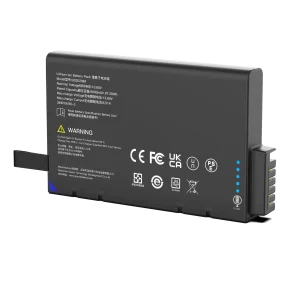
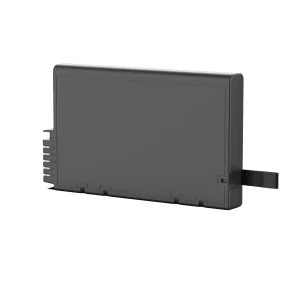
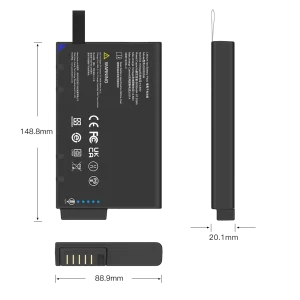
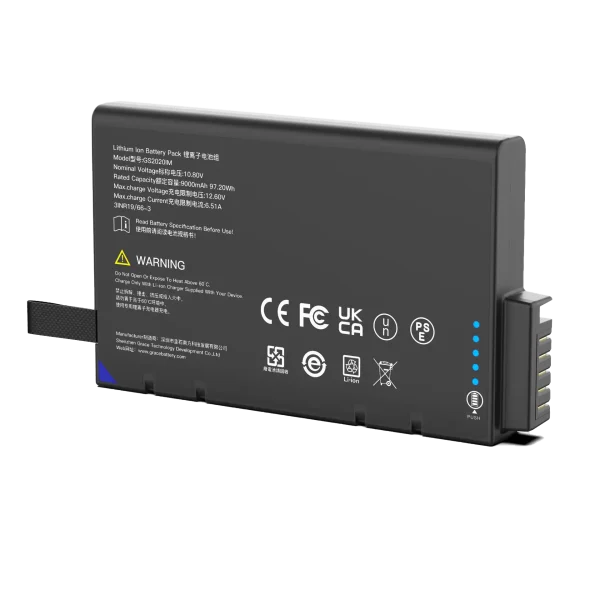
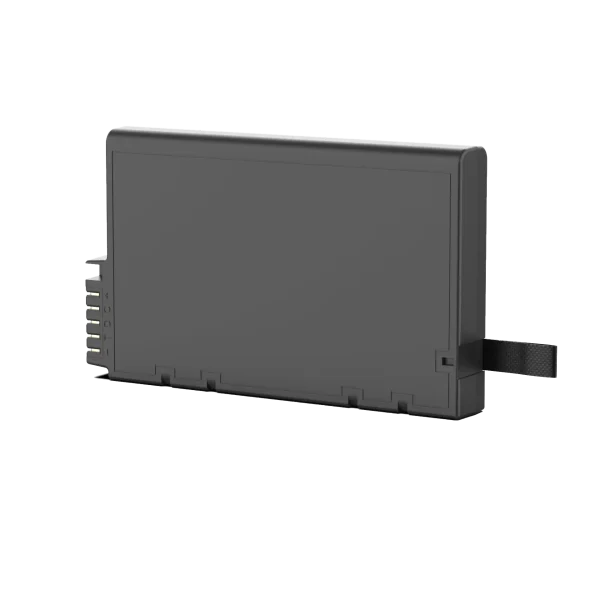
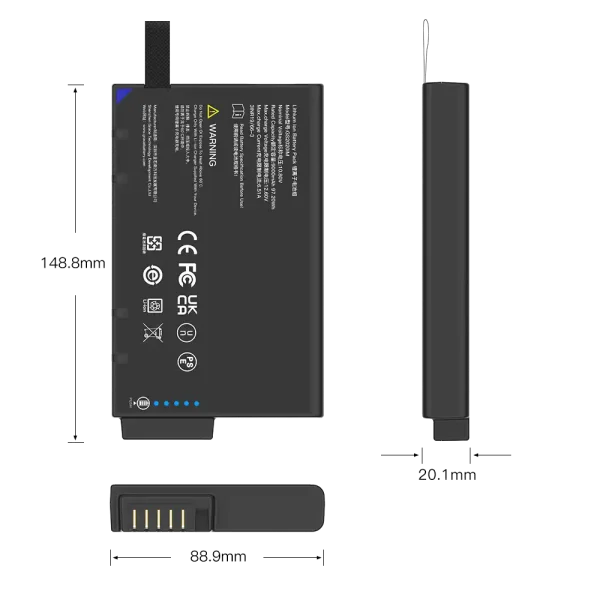
GS2020IM
10.8V/9300mAh/97.2Wh
5 Evaluating a Supplier: Six Questions to Ask
When shortlisting a custom pack partner for a ventilator program, I recommend asking the following six questions during the first technical call. The answers will quickly separate qualified suppliers from general assemblers:
- 1. Can you share your ISO 13485 scope certificate and list three medical ventilator or life-support customers you currently ship to?
- 2. Do you design the BMS firmware in-house, and can you modify the SMBus profile (manufacturer name, device chemistry, design capacity, warning/alarm thresholds) to match our host controller?
- 3. What is your typical NRE for a new custom pack — mechanical tooling, BMS firmware porting, and certification support — and what is the unit price at 1k, 5k, and 20k volume?
- 4. How do you handle cell traceability and lot control? Can every pack shipped be traced to a cell lot and a BMS firmware version in your QMS?
- 5. What is your failure rate field history over the last 24 months, and what CAPA process do you run when a field issue is found?
- 6. Can you support regulatory submissions in parallel — FDA 510(k) special test, EU CE technical file inputs, and NMPA registration in China — with documented risk-management output?
6. TEFOO: Your Partner for Custom Medical Battery Solutions
At TEFOO , we specialize in smart lithium battery packs for medical and industrial OEM devices. Our engineering team has delivered custom pack systems for ventilator manufacturers, patient monitor makers, anesthesia device OEMs, and portable diagnostic equipment companies across North America, Europe, Southeast Asia, and the Middle East.
6.1 What We Bring to a Ventilator Program
- Smart BMS with SMBus v1.1/v3.0, configurable fuel-gauge profiles, and active/passive cell balancing.
- Fully certified packs: IEC 62133-2, UN 38.3, IEC 60601-1 system-level support, ISO 13485 QMS, ISO 9001, ISO 14001, CE, UKCA, RoHS, REACH.
- Flexible OEM/ODM: from 7S2P portable ventilator packs to 13S 48 V ICU backup systems; custom connector, enclosure, and SMBus firmware.
- No NRE on our certified standard smart battery line; tooling and NRE scoped transparently for fully custom packs.
- Global compliance documentation package: risk file inputs per ISO 14971, design history file excerpts, and test reports accepted by FDA, EU Notified Bodies, and NMPA.
6.2 How We Work With Ventilator OEMs
Our engagement model is built for medical product development cycles. We start with a joint requirements review: electrical load profile (peak and average current), runtime target, mechanical envelope, communication protocol, and target certifications. Within two weeks, we return a system proposal including cell selection, BMS architecture, a 3D mechanical layout, and a project plan with gate reviews aligned to your V&V milestones. Prototype packs are typically delivered within 4–6 weeks, followed by design verification, certification support, and pilot production before full manufacturing transfer.
For existing ventilator platforms that need a second source or a regional-compliance refresh, we offer a reverse-engineering and drop-in equivalent service — matching electrical, mechanical, and SMBus behavior to the incumbent pack so that no host firmware change is required.
6.3 A Real-World Example: Portable Ventilator Pack Program
To make the design trade-offs above concrete, consider a portable transport ventilator program we supported in 2024. The customer needed a 7S4P NMC pack (14.8 V nominal, ~10.4 Ah, ~154 Wh) that could deliver 5 hours of continuous SPONT ventilation at 20°C, fit inside an existing 180 × 95 × 22 mm bay, and pass UN 38.3 plus IEC 62133-2. Our BMS team tuned the SMBus fuel-gauge profile to hold SoC accuracy within ±3% across −10°C to 45°C over 600 cycles, and we delivered the first functional prototypes in 5 weeks. [Note: replace with your actual program numbers before publishing.]
7. Frequently Asked Questions
Q1. How long should a ventilator battery last on a full charge?
It depends on the ventilator class. Stationary ICU ventilators typically require 30 minutes to 2 hours at maximum load. Portable and transport ventilators require 2–8 hours. Always design the pack for 120–130% of the rated runtime to account for capacity fade over the pack’s service life — a pack that delivers exactly 2 hours on day one will deliver less than 2 hours after 300 cycles.
Q2. What is the difference between a “medical-grade” battery and an industrial battery?
The cell chemistry may be similar, but the pack is built to a different QMS. A medical-grade pack is manufactured under ISO 13485, with full design history files, lot traceability, risk management documentation aligned to ISO 14971, and support for IEC 60601-1 system-level testing. Industrial packs are built to ISO 9001 and do not carry the traceability and risk-file evidence that a medical regulatory submission requires.
Q3. Can I use a standard off-the-shelf battery pack and certify it with my ventilator?
In some low-risk, non life-support devices yes. For ventilators, regulators expect the battery to be integrated into the system risk file. A generic pack may not have the required safety certifications (IEC 62133-2, UN 38.3) with the specific BMS and enclosure you use, and you will likely face 510(k) or CE technical-file questions that a qualified medical pack supplier can pre-empt.
Q4. SMBus vs. analog fuel gauge — which should I choose?
SMBus smart battery is strongly preferred for ventilators. It provides SoC, SoH, remaining runtime, and fault flags to the host, enabling accurate low-battery alarms and clinician messaging. Analog (voltage-only) fuel gauges are acceptable for backup UPS-style packs where the host does not display runtime, but they are a poor fit for primary portable ventilation.
Q5. How often should clinicians replace the battery?
Recommend replacement at 500 full cycles or when the pack’s SoH drops below 80%, whichever comes first. A smart BMS can report SoH over SMBus so the ventilator can surface a scheduled maintenance reminder. Calendar life is typically 3–5 years for NMC packs and 5–7 years for LFP packs under normal clinical use, even with light cycling; your own field data should override these ranges.
Q6. What is the typical lead time for a custom ventilator battery pack?
Prototype packs: 4–6 weeks. Design verification and certification support: 8–14 weeks depending on target markets. Pilot to mass production: 4–8 weeks. Total time from kickoff to qualified production supply is typically 4–6 months for a fully custom pack, and 6–10 weeks for a drop-in equivalent based on a certified standard platform.
8. Conclusion
The battery pack is one of the most safety-critical subsystems in a medical ventilator. It must survive the full regulatory stack — IEC 60601-1, ISO 80601-2-12, IEC 62133-2, UN 38.3, ISO 13485, and ISO 14971 — while delivering predictable runtime, accurate fuel-gauge communication over SMBus, and a service life measured in years rather than months.
Choosing a custom pack battery system supplier is therefore not a procurement decision; it is an engineering and regulatory partnership. The right partner brings in-house BMS firmware, medical QMS experience, transparent NRE and volume pricing, and documented support for your regional regulatory submissions. The wrong supplier will save you money at the unit level and cost you dearly in delayed certifications, field failures, and recall risk.
If you are developing a new ventilator platform, refreshing an existing one for a new market, or qualifying a second source, the TEFOO engineering team is ready to review your load profile, mechanical envelope, and certification targets. Contact us for a system proposal and a free design review — we will tell you honestly whether a fully custom pack, a modified standard pack, or a drop-in equivalent is the right path for your program.
References and Further Reading
• ISO 80601-2-12:2023, Medical electrical equipment — Part 2-12: Particular requirements for basic safety and essential performance of critical care ventilators. International Organization for Standardization, https://www.iso.org/standard/82707.html
• ISO 80601-2-80:2018 / YY 9706.280-2023, Particular requirements for ventilatory support equipment for ventilatory insufficiency. National Medical Products Administration (China) adoption.
• IEC 62133-2:2017+A1:2021 (Edition 1.1), Secondary cells and batteries containing alkaline or other non-acid electrolytes — Safety requirements for portable sealed secondary lithium cells. International Electrotechnical Commission.
• IEC 60601-1 Edition 3.2 (2005+A1:2012+A2:2020), Medical electrical equipment — General requirements for basic safety and essential performance; includes US National Deviation A11:2021.
• UN 38.3, Recommendations on the Transport of Dangerous Goods — Manual of Tests and Criteria, Section 38.3, United Nations.
• ISO 13485:2016, Medical devices — Quality management systems — Requirements for regulatory purposes.
• ISO 14971:2019, Medical devices — Application of risk management to medical devices.
• FDA Recognized Consensus Standards Database, U.S. Food and Drug Administration, https://www.accessdata.fda.gov/scripts/cdrh/cfdocs/cfStandards/ (accessed November 2026).
• Regulation (EU) 2023/1542 concerning batteries and waste batteries, Official Journal of the European Union, https://eur-lex.europa.eu/eli/reg/2023/1542/oj
• DB11/T 1750—2020, Aviation Medical Rescue Service Specifications (air ambulance backup battery requirement ≥ 2 h). Beijing Municipal Bureau of Quality and Technology Supervision.
About the Author: Author is Senior Battery Systems Engineer at TEFOO, where he leads custom smart-battery development for medical and industrial OEMs. He has over 15 years of experience in BMS architecture, SMBus fuel-gauge design, and ISO 13485 / IEC 60601-1 compliant pack engineering. TEFOO designs and manufactures certified lithium battery packs for medical devices, industrial instruments, and portable professional equipment from its Shenzhen facility. This article is reviewed by TEFOO’s engineering team and updated against the latest IEC/ISO amendments; it reflects engineering practice and is not a substitute for regulatory advice specific to your product.