An R&D Engineer’s Guide to Design, Safety and Compliance
Why the Surgical Light Deserves a Battery It Can Trust
In my years of designing lithium battery packs for medical devices, one question comes back more often than any other: “What happens to the operating light when the mains fails mid-procedure?”
It is a fair question, and a serious one. The surgical light is not an ordinary lamp. During a procedure it is part of the life-safety chain: the surgeon’s field of view, the anaesthetist’s monitoring station and the whole theatre team depend on it. A blackout in the middle of an operation is not an inconvenience — it is a hazard. Generators take time to start. Central UPS systems have their own duty cycles and maintenance schedules. None of this can be left to chance, which is why the battery backup for the surgical light is specified, engineered and tested like a safety-critical component rather than an accessory.
This article is written from the perspective of an R&D engineer who has spent years building exactly these packs — the cell selection, the protection electronics, the certification work and the failures we learned from along the way. It is intended for OEM design teams, hospital engineering staff and procurement professionals who need a defensible, standards-based understanding of what a surgical light backup battery must be.
What the Regulatory Framework Requires
Backup power for operating lights is not a nice-to-have. It is embedded in building codes, equipment standards and health-facility regulations across major markets. The requirements differ in detail but converge on the same principle: when the mains supply fails, the surgical light must keep operating — seamlessly, for a defined period, and without a single point of failure.
Table 1 summarises the requirements most relevant to the battery pack.
| Jurisdiction / framework | Requirement relevant to backup power | Status / note |
| China — GB 50333-2013, Architectural technical code for hospital clean operating department | Life-support electrical equipment in clean operating suites shall transfer to the emergency supply seamlessly; emergency power duration shall be at least 30 minutes; at least three luminaires on each side of the operating table shall be connected to the emergency lighting supply | National standard, in force; a local revision was published in July 2026 (effective 2026-11-01) |
| China — WS/T 835-2024, Configuration standard for operating room medical equipment | Surgical luminaires are listed as mandatory (Grade A) configuration for general operating rooms | Health-industry standard, 2024 |
| China — GB 9706.1-2020 and YY 9706.241-2020 (medical electrical equipment; particular requirements for surgical luminaires and luminaires for diagnosis) | Basic safety and essential performance; luminaires rated as fail-safe must maintain essential illumination under a single fault condition or interruption of the supply | GB 9706.1-2020 in force since 2023-05-01 |
| International — IEC 60601-1:2005+A1:2012+A2:2020; IEC 60601-2-41:2021; IEC 60601-1-2:2014+A1:2020 | General and particular requirements for basic safety and essential performance, and electromagnetic compatibility, of medical electrical equipment | Current editions |
| United Kingdom — HTM 06-01:2017, Electrical services supply and distribution in healthcare premises | Fixed operating lights (main and satellite) should be connected to a battery backup system providing a minimum of 3 hours autonomy | Health technical memorandum used across NHS projects |
| United States — NFPA 99:2021, Health Care Facilities Code; 42 CFR 482.41 | Emergency power and lighting required in operating, recovery, intensive-care and emergency rooms | Federal regulation and national code |
For an OEM, this regulatory landscape translates into concrete engineering inputs: transfer time, autonomy, fail-safe behaviour and EMC performance all end up as specifications on the battery pack.
Two Architectures: Integrated Pack or Remote Emergency Power Unit
There are two established ways to provide backup power for a surgical light, and both are legitimate. The choice shapes the battery pack completely.
- Integrated pack — the cells are mounted inside the luminaire head or its canopy. It is compact, close to the load, and travels with the light. The penalty is thermal: LED luminaire heads run warm, and heat is the enemy of lithium cells.
- Remote emergency power unit (EPU) — a separate enclosure, typically on a 24 VDC bus, feeds the light over a short dedicated cable. A well-known reference implementation is the iBEPU emergency power unit from Brandon Medical, which supplies a maintained 24 VDC supply for at least 3 hours using two 12 V 18 Ah batteries in series, in accordance with HTM 06-01. This architecture suits retrofit projects and centralised maintenance: the batteries live in a ventilated, serviceable box, and hospital staff can test and swap them without opening the luminaire.
Why 24 VDC? It is a de-facto standard in the sector — a safe low voltage that suits LED drivers and keeps the battery string simple. It also maps naturally onto 12 V battery modules, making standard, replaceable building blocks practical.
Sizing the Pack: A Simple, Defensible Method
The autonomy requirement — for example 3 hours per HTM 06-01, or a 30-minute minimum baseline per GB 50333-2013 — drives the capacity. The calculation is straightforward once the real-world losses are accounted for:
C = (P × t) / (V × η_conv × η_discharge × DOD × K_temp × K_aging)
Where: P is the average load power of the luminaire (W); t is the required autonomy (h); V is the nominal battery voltage (VDC); η_conv is the conversion efficiency of the driver or interface (typically 0.90–0.95); η_discharge is the battery discharge efficiency at the relevant rate (about 0.95–0.98 for lithium at moderate rates); DOD is the usable depth of discharge (0.8–0.9 for long life); K_temp is the temperature derating factor (for example 0.9 at elevated ambient); K_aging is the end-of-life capacity retention factor (about 0.8 at the specified service life).
For illustration: a 100 W LED luminaire, 3 hours of autonomy, 24 VDC nominal, η_conv = 0.92, η_discharge = 0.96, DOD = 0.85, K_temp = 0.9, K_aging = 0.8:
C = (100 × 3) / (24 × 0.92 × 0.96 × 0.85 × 0.9 × 0.8) ≈ 300 / 13.0 ≈ 23 Ah
A pack of roughly 23 Ah at 24 V — for example two 12 V modules in series, each rated around 23–26 Ah — is therefore a defensible starting point, before mechanical, thermal and cycle-life validation. Notice how the derating factors add up: a naive calculation suggests a much smaller pack, and engineering for real life roughly doubles it. That margin is what separates a battery that works on paper from one that still delivers on a warm theatre ceiling at end of life. This sizing example is illustrative; the final capacity must be validated against the actual luminaire load profile, ambient conditions and the applicable standard.
Choosing the Cell Chemistry
Cell chemistry decides most of the pack’s personality — energy density, cycle life, thermal behaviour and cost. For a surgical light backup application, the priorities are safety, calendar and cycle life, a workable operating-temperature window, and dependable behaviour in a standby duty where the pack spends most of its life on float charge.
Table 2 compares the three chemistries most commonly considered.
| Parameter (typical values) | LFP (LiFePO4) | NMC / NCA | LTO (Li4Ti5O12) |
| Energy density | Medium | High | Low |
| Cycle life at 80% DoD | 2,000–4,000 | 500–1,500 | 5,000+ |
| Thermal stability / runaway onset | Excellent — higher onset temperature | Moderate | Excellent |
| Low-temperature performance | Reduced below about 0 °C | Moderate | Good |
| Relative cost | Low to medium | Medium to high | High |
| Best fit | Standby, safety-critical backup packs | Compact, high-energy designs | High-cycle or cold-environment duty |
For a backup pack that may sit for months between real discharges, LFP is often the pragmatic choice: excellent thermal stability, long cycle life and a flat, predictable discharge curve. NMC earns its place when the luminaire head must stay slim and energy density is paramount. LTO is reserved for demanding cycle counts or cold environments, at a significant cost penalty. In our practice we qualify cells from at least two independent cell suppliers for every medical programme — a single-source cell is a risk no compliance strategy can mitigate. Values in Table 2 are typical ranges published in cell datasheets; always validate against the qualified cell’s datasheet and test data.
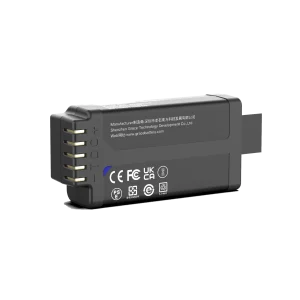
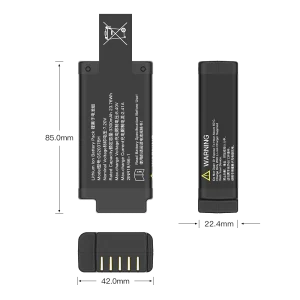
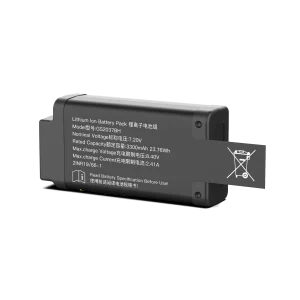
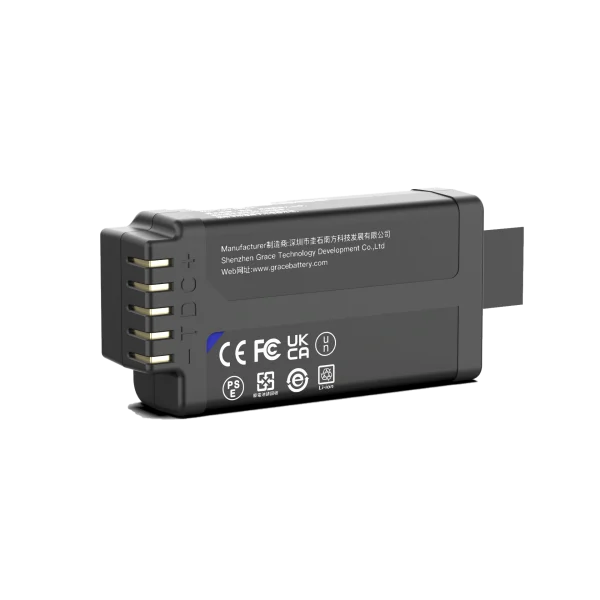
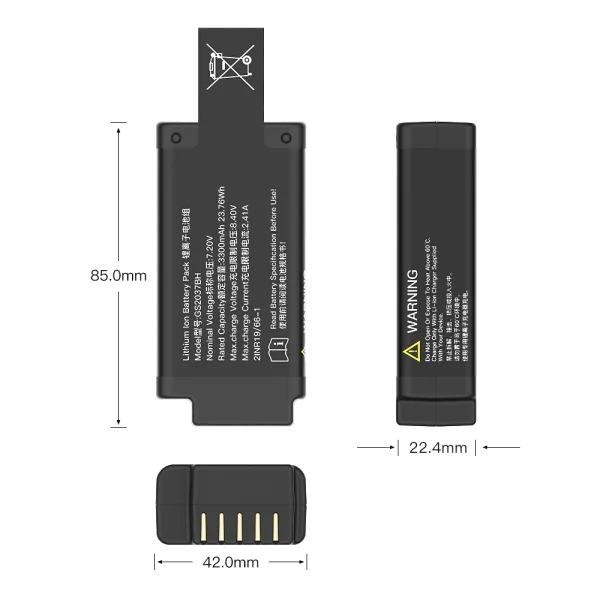
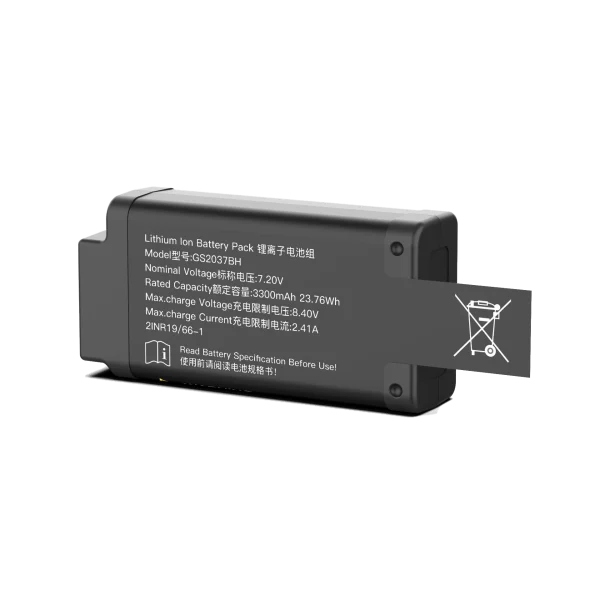
GS2037BH
7.2V/3450mAh/23.76Wh
Safety by Design: The BMS and Beyond
A lithium pack for a medical luminaire is never just cells and a fuse. The protection architecture has to work across four layers:
- Cell level — overcharge, over-discharge, overcurrent, short-circuit and temperature protection; mechanical safety features such as the vent, rupture disc and separator shutdown.
- Pack-level BMS — charge control, cell balancing, state-of-charge (SoC) and state-of-health (SOH) estimation, charge and discharge cutoff logic, and fault logging.
- Communications — a SMBus interface so the luminaire and hospital monitoring systems can read voltage, SoC, temperature and alarm flags. In our experience, maintenance teams value this more than almost any other feature: it turns a sealed black box into a device they can plan around.
- System level — fail-safe behaviour; thermal management with airflow, cell spacing and temperature sensing at the hottest points; insulation in line with medical electrical equipment requirements (basic insulation plus protective earth, or double insulation); and EMC compliance for the theatre environment, where electrosurgical and monitoring equipment operate nearby.
The single-fault concept is central. A backup battery is itself a point of failure unless it is designed so that a single fault — a failed FET, a stuck relay, a broken temperature sensor — cannot silently disable the backup function. Design reviews for medical packs always ask the same question: “If this component fails, what does the surgeon see?” The answer must never be darkness.
Certification and Testing: What the Pack Must Prove
The pack and its cells must demonstrate safety and reliability through certification and test evidence. Table 3 summarises the matrix that applies to a surgical light backup battery.
| Standard / regulation | Scope | Why it matters here |
| IEC 62133-2:2017 + A1:2021 | Safety of portable sealed lithium cells and batteries | Core cell- and pack-level safety tests (overcharge, short circuit, crush, thermal abuse); recognised as a consensus standard for medical devices |
| GB 31241-2022 | Safety technical specification for lithium cells and batteries used in portable electronic equipment (China) | Mandatory safety baseline for cells and batteries placed on the Chinese market; effective 2024-01-01 |
| UN 38.3 (UN Manual of Tests and Criteria) | Transport safety tests T1–T8 for lithium cells and batteries | Required for air, sea and road transport of the finished product |
| ISO 13485:2016 | Quality management system for medical devices | The manufacturing QMS that makes test evidence reproducible and traceable across production lots |
| GB 9706.1-2020 / IEC 60601-1 | Basic safety and essential performance of medical electrical equipment | Applies to the pack as a component of a medical electrical system — insulation, leakage current, temperature limits |
| IEC 60601-1-2:2014 + A1:2020 | EMC requirements and tests | Immunity and emissions in the theatre environment |
When we quote a medical programme, we deliver the evidence with the pack: UN 38.3 test summaries, IEC 62133-2 and GB 31241 reports, material declarations and traceable cell provenance back to the cell manufacturer’s batch records. If a supplier cannot produce this evidence, it will surface later — usually during a notified body audit or a customs hold.
Lessons from the Field
A few patterns repeat across installations, together with the design countermeasures that work:
- Float-charge ageing — packs that sit on continuous float charge degrade faster than cycle counts suggest. Countermeasure: charge management with periodic top-up and a standby SoC window (for example 50–80%).
- Deep-discharge damage — an unnoticed failed test or an unswitched load can take a pack below the safe voltage floor and permanently lose capacity. Countermeasure: low-voltage disconnect with hysteresis, plus a self-discharge monitoring routine.
- Contact resistance — in a warm luminaire environment, connector and busbar resistance drifts and the extra heat accelerates cell ageing. Countermeasure: torque-controlled busbars, plated contacts and thermal imaging during design validation.
- Temperature drift — cells near a hot LED driver age faster than the rest of the string and imbalance grows silently. Countermeasure: thermal simulation, cell-to-cell temperature mapping, and balancing hardware sized for real imbalance.
- Transport state of charge — shipping at high SoC raises transport risk and accelerates calendar ageing. Countermeasure: ship at 30–50% SoC and document it.
None of these are exotic. They are the ordinary failures of standby lithium systems — which is exactly why routine verification matters: a periodic capacity test and a BMS self-test in every maintenance cycle catch most problems long before the one night they are needed.
How to Qualify a Battery Supplier
Choosing a partner is as important as choosing a cell. We recommend structuring the qualification around hard evidence, not sales claims. Table 4 is the checklist we use.
| Dimension | What to ask for / check | Why it matters |
| Certification evidence | UN 38.3 test summaries; IEC 62133-2 / GB 31241 reports; ISO 13485 certificate | Verifiable proof of safety and quality management — not a promise |
| Cell provenance | Cell manufacturer, model, batch traceability, datasheet | Single-sourcing is a risk; you must know exactly what is inside |
| Design rigour | DFMEA, thermal analysis, protection architecture, single-fault analysis | Shows whether safety is engineered or improvised |
| Test data | Cycle- and calendar-life data at relevant temperatures; capacity-retention projections | The pack must be specified for a standby life of several years |
| Change control | Documented change notification for cell, BMS and components | Medical programmes cannot tolerate silent component swaps |
| Manufacturing control | Traceability, workmanship, incoming inspection, process controls | Consistency across production lots |
| Support and documentation | Design history file, user manual, maintenance recommendations | Needed for your own regulatory file and the hospital’s maintenance plan |
Closing Thoughts
A surgical light backup battery is a small part of the operating theatre, but it sits on a long chain of life-safety obligations. Engineer it like the safety-critical component it is: start from the applicable standards, size for real losses and end of life, choose the chemistry for the duty cycle, protect it with layered electronics and prove it with certification evidence. Then verify it in service — because the battery only counts as working if it works the one night it is needed.
Disclaimer: this article is provided for general technical information and is not regulatory advice. Requirements differ by jurisdiction and by product configuration; always confirm the current edition of the applicable standards and regulations with your notified body or regulatory specialist.
About the Author
Author is a senior lithium battery R&D engineer with 15 years of experience designing custom battery packs and BMS systems for medical devices.
References
[1] GB 50333-2013, Architectural technical code for hospital clean operating department. https://cssn.net.cn/cssn/productDetail/f89dae41ff5c37ad6fe4ef26d7433580
[2] WS/T 835-2024, Configuration standard for operating room medical equipment (National Health Commission, China). https://www.gov.cn/zhengce/zhengceku/202404/P020240429471798988270.pdf
[3] GB 9706.1-2020, Medical electrical equipment — Part 1: General requirements for basic safety and essential performance. https://std.samr.gov.cn/gb/search/gbDetailed?id=A327FCEA3046B9B7E05397BE0A0A8A97
[4] YY 9706.241-2020, Medical electrical equipment — Part 2-41: Particular requirements for surgical luminaires and luminaires for diagnosis. https://www.spc.org.cn/online/3e8ec6a1e458d033ac4b1b589b825259.html
[5] IEC 60601-1:2005+AMD1:2012+AMD2:2020, Medical electrical equipment — Part 1. https://webstore.iec.ch/preview/info_iec60601-1%7Bed3.2%7Den.pdf
[6] IEC 60601-2-41:2021, Medical electrical equipment — Part 2-41. https://webstore.iec.ch/publication/62677
[7] IEC 60601-1-2:2014+AMD1:2020, Medical electrical equipment — Part 1-2 (EMC). https://webstore.iec.ch/preview/info_iec60601-1-2%7Bed4.1%7Db.pdf
[8] IEC 62133-2:2017+AMD1:2021, Secondary cells and batteries — Part 2: Lithium systems. https://webstore.iec.ch/en/publication/32662
[9] GB 31241-2022, Safety technical specification for lithium ion cells and batteries used in portable electronic equipment. https://std.samr.gov.cn/gb/search/gbDetailed?id=F113142E3FF04B65E05397BE0A0A5AB9
[10] UN Manual of Tests and Criteria, Sub-section 38.3. https://www.prba.org/wp-content/uploads/Sub-section-38.3-UN-Manual-6th-Revised-Edition-with-corrections.pdf
[11] ISO 13485:2016, Medical devices — Quality management systems — Requirements for regulatory purposes. https://www.iso.org/standard/59752.html
[12] HTM 06-01:2017, Electrical services supply and distribution in healthcare premises (UK Department of Health and Social Care). https://www.elec-mate.com/guides/hospital-electrical-systems
[13] NFPA 99:2021, Health Care Facilities Code. https://www.bnibooks.com/products/nfpa-99-health-care-facilities-code
[14] 42 CFR 482.41, Condition of participation: Physical environment (US Centers for Medicare & Medicaid Services). https://www.federalregister.gov/select-citation/2013/12/27/42-CFR-482.41
[15] Brandon Medical iBEPU emergency power unit — public specification (NBS Source). https://source.thenbs.com/en/product/ibepu/fsix8uKejy2b2y1HPvwCWy