Engineering Deep-Dive: Powering Satcom Devices in Extreme Environments
By Senior R&D Engineer, TEFOO Battery Systems
1. Why the Battery Pack Is the Lifeline of Satellite Communications
Satellite communication (satcom) terminals operate where terrestrial networks do not — remote field operations, disaster response, maritime navigation, military deployments, and off-grid industrial monitoring. In every one of these scenarios, the rechargeable battery pack is not merely an accessory. It is the sole energy source that determines whether a terminal can transmit an SOS message when it matters most, hold standby for days in a backpack, or survive a winter night at 4,000 meters elevation.
As a lithium-ion battery engineer with over a decade of experience designing custom packs for industrial and ruggedized electronics, I have seen firsthand how the wrong battery choice can undermine even the most sophisticated satcom hardware. A terminal that shuts down mid-burst at -20°C, or loses 30% of its charge after a month in storage, fails its core mission. This article walks through the engineering decisions — from cell chemistry selection to BMS algorithm tuning to certification strategy — that define a reliable satellite terminal battery pack.
2. Four Core Engineering Challenges
2.1 Wide Temperature Operation: The -40°C Problem
Commercial consumer lithium-ion cells are rated for 0°C to 45°C discharge. Satellite terminals are routinely deployed in environments that stretch from Arctic winters to desert midday sun. A field-grade satcom battery must deliver usable capacity at -40°C and survive storage at +85°C.
At sub-zero temperatures, electrolyte viscosity rises sharply and lithium-ion diffusion kinetics slow down. Standard cells can see internal resistance triple or quadruple by -20°C, and available capacity can drop below 50% of rated. When a satellite transceiver demands a sudden 2–5 A pulse to transmit a burst, the voltage collapse from high internal resistance can trigger the terminal’s undervoltage protection and shut the device down mid-transmission. This is the single most common field failure mode we diagnose for satcom battery packs.
Solving this requires three layers: low-temperature electrolyte formulation at the cell level, a BMS that dynamically adjusts discharge current limits based on cell temperature, and thermal mechanical design that preserves residual heat during operation.
2.2 Pulse Discharge and Burst Transmission
Satcom transmission is not a continuous load. It is a series of short, high-current bursts. Iridium L-band transceivers, for example, draw peak currents of 2 A or more during time-slotted transmit windows. Higher-data-rate BGAN terminals and military satcom radios can demand 10 A or higher pulses for brief intervals.
A battery pack that looks fine on a steady 0.5C discharge test can fail catastrophically under pulsed load. The internal resistance — both ohmic and polarization — causes instantaneous voltage drops that may dip below the terminal’s minimum operating voltage even though the average voltage remains healthy. Engineering teams must specify packs by their pulse current capability (e.g., 5 A peak for 1 second, 20 A peak for 100 ms), not just by average C-rate.
2.3 Ultra-Low Self-Discharge and Long Standby
Reserve satellite messengers, emergency beacons, and IoT satellite trackers may sit unused for weeks or months before activation. A pack with high self-discharge or a power-hungry BMS may be nearly dead when the user needs it most.
Field-grade satcom packs target a self-discharge rate below 1% per month at room temperature. This is achieved through a combination of low-self-discharge cell chemistry selection and careful BMS quiescent current design. A BMS that draws 50 µA continuously will drain a 2000 mAh pack by roughly 6% per month just on its own — a non-trivial fraction when standby time is the product differentiator.
2.4 Weight, Volume, and Energy Density Trade-offs
Handheld satellite messengers must weigh less than 100 g total, meaning the battery contributes only 20–30 g to the bill of materials. Portable BGAN terminals target under 500 g battery weight for a full workday. Manpack satcom radios may allow 1–2 kg but demand the highest available energy density to maximize mission endurance.
These constraints drive cell format selection: small pouch cells for ultra-compact handhelds, 18650 cells for mid-range portables, and high-capacity 21700 cells for manpack configurations. The pack design must also account for the terminal’s mechanical envelope — custom form factors, connector placement, and mounting geometry are rarely off-the-shelf.
3. Cell Chemistry Selection for Satcom Packs
3.1 NMC / NCA Lithium-Ion: The Industry Default
Nickel Manganese Cobalt (NMC) and Nickel Cobalt Aluminum (NCA) chemistries dominate portable satcom battery packs. Their high energy density — typically 250–300 Wh/kg at the cell level — directly translates to longer runtime or lighter weight. Grade B or automotive-grade cells, rather than consumer-grade cells, are preferred for satcom applications because they offer tighter capacity tolerance, lower self-discharge, and better cycle life at temperature extremes.
For low-temperature operation, cell suppliers offer NMC variants with specialized electrolyte additives that maintain ion mobility down to -30°C or even -40°C. These cells typically sacrifice a small amount of room-temperature energy density in exchange for cold-weather performance — a trade-off that is almost always justified for field-deployed satcom equipment.
3.2 LFP: Safety-First for Fixed and Vehicle-Mounted Terminals
Lithium Iron Phosphate (LFP) chemistry offers superior thermal stability, longer cycle life (2,000–3,000 cycles vs. 500–1,000 for NMC), and better high-temperature tolerance. It is the preferred choice for fixed-site satcom installations, vehicle-mounted terminals, and marine applications where weight is less critical than safety and service life.
The trade-off is lower energy density (typically 120–160 Wh/kg) and significantly worse low-temperature performance. LFP cells can lose 60% or more of their capacity at -20°C unless they are specially formulated. For handheld or manpack satcom gear exposed to cold environments, NMC remains the better default.
3.3 Emerging Chemistries: Li-S and LTO
Lithium-Sulfur (Li-S) chemistry is gaining attention for military satcom applications due to its high theoretical energy density (up to 500 Wh/kg) and wide operating temperature range (-40°C to +70°C). Early-generation Li-S packs are already deployed in specialized tactical radio and satellite communication systems, though their higher cost and shorter cycle life currently limit mainstream adoption.
Lithium Titanate (LTO) chemistry, with its 10-minute fast-charge capability and exceptional low-temperature performance (-40°C discharge without significant capacity loss), is worth evaluating for rapid-recharge satcom use cases where downtime must be minimized. Its low nominal voltage (2.4 V per cell) means more cells in series to reach target pack voltage, and its energy density (~90 Wh/kg) remains a limitation for portable designs.
4. The BMS: Intelligent Management for Critical Applications
4.1 Voltage Monitoring and Cell Balancing
A satcom battery pack is typically configured as 2S to 4S (series) for handheld and portable terminals, up to 10S–14S for high-voltage manpack or vehicular systems. Regardless of series count, the Battery Management System (BMS) must monitor each cell with precision of ±10 mV or better. Voltage imbalance between cells in a series string directly reduces usable capacity — the weakest cell dictates when the pack shuts down.
Active balancing, which transfers charge from higher-voltage cells to lower-voltage cells at currents of 50–200 mA, is preferred over passive balancing for satcom packs. It recovers more usable capacity over the pack’s lifetime and prevents overcharge stress on individual cells during fast-charging scenarios.
4.2 Thermal Management Strategy
Temperature is the most influential variable in lithium-ion battery life and safety. A robust satcom BMS places NTC thermistors at multiple points — on the cell surface, near the protection IC, and on the connector interface — to track thermal gradients within the pack.
The thermal protection logic must be carefully tuned. Charging must be disabled below 0°C (lithium plating risk) and above 45°C (accelerated degradation). Discharge should be derated gradually at both temperature extremes rather than triggering abrupt cutoffs that could interrupt a critical transmission event. This graded protection philosophy is what separates a field-grade satcom pack from a consumer-grade battery.
4.3 Communication Protocols and Fuel Gauging
Modern satcom terminals require accurate state-of-charge (SOC) reporting and battery health telemetry. This is typically implemented via SMBus (System Management Bus) protocol at 100 kHz, or proprietary single-wire interfaces. A fuel gauge IC (such as TI bq series or similar) performs coulomb counting and voltage-based SOC estimation, reporting remaining capacity, run-time-to-empty, and cycle count to the host terminal.
For TEFOO custom satcom packs, we typically implement SMBus 1.1 compliance with gas gauge functionality, allowing the terminal operating system to display accurate battery percentage and estimate remaining talk-time — a feature users have come to expect even in ruggedized devices.
4.4 Pulse Discharge Protection Tuning
One of the most subtle BMS engineering challenges for satcom packs is setting the overcurrent protection threshold correctly. Set it too low, and the BMS falsely trips during normal satellite transmission bursts. Set it too high, and the pack is unprotected during a genuine fault.
The solution is a two-stage protection architecture: fast overcurrent cutoff (within milliseconds) for hard faults like short circuits, and a slower, time-delayed overcurrent window that allows short-duration transmit pulses but cuts off if high current persists beyond a safe duration. This requires iterative testing on the actual terminal hardware, not just bench-level characterization.
5. Environmental Reliability and Mechanical Design
5.1 Ingress Protection
Handheld satcom terminals typically require IP54 or IP55 protection (dust-protected, water-spray resistant), while manpack and marine-grade systems may target IP67 or even IP68. The battery pack is often the weakest link in the terminal’s sealing system. Gasket design, ultrasonic welding of the pack enclosure, and conformal coating of the PCBA are standard measures.
5.2 Vibration and Shock
Military and tactical satcom systems must meet vibration and shock specifications derived from standards such as MIL-STD-810 or equivalent GB/T 2423 series. Cylindrical cells must be secured with foam brackets, potting compound, or mechanical clamps to prevent cell-to-can rattling and terminal fatigue over thousands of vibration hours. Pouch cells require additional attention to pressure relief and swelling accommodation over the pack’s service life.
5.3 Humidity, Salt Fog, and Altitude
Maritime satcom installations face salt fog and high humidity (95% RH cycling). Tropical deployments combine high temperature with constant moisture. High-altitude operations expose the pack to low pressure, which can exacerbate cell venting if safety vents activate. A fully qualified satcom pack must pass these environmental tests as a complete assembly, not just at the cell level.
6. Certification and Compliance Framework
Bringing a satcom battery pack to market — especially for export to North America, Europe, or military customers — requires navigating multiple certification layers. Here is the framework we follow at TEFOO for every custom satcom pack program.
6.1 UN38.3: Mandatory for Global Shipping
UN38.3 (Section 38.3 of the UN Manual of Tests and Criteria) is the universal transport safety certification for lithium batteries. It comprises eight test procedures: altitude simulation, thermal cycling, vibration, shock, external short circuit, impact/crush, overcharge, and forced discharge. Without UN38.3 certification, lithium battery packs cannot be shipped by air, sea, or road — period. We treat UN38.3 as a minimum baseline, not an achievement.
6.2 IEC 62133: Product Safety Standard
IEC 62133 (Parts 1 and 2) specifies safety requirements for portable sealed secondary lithium cells and batteries. It covers continuous low-rate charging, forced internal short, free fall, and thermal abuse tests. For satcom terminals sold into EU and global markets, IEC 62133 compliance is typically required as part of the CE marking framework. Many customers also require UL 2054 (household and commercial batteries) or UL 1642 (single-cell) listings for North American channels.
6.3 System-Level Integration and EMC
The battery pack does not exist in isolation. It must integrate with the satcom terminal’s EMC compliance — the switching regulators in the BMS and the pulsed load currents from the transceiver can conduct or radiate interference. We work closely with terminal manufacturers during the design phase to define connector shielding, grounding strategy, and input filtering that supports the overall system EMC certification.
7. Typical Specification Reference: Three Common Satcom Form Factors
Table 1. Representative Battery Pack Specifications by Satcom Application Class
| Application Class | Reference Terminal | Nominal Voltage | Capacity | Energy | Operating Temp. | Weight |
| Handheld Satellite Messenger | Iridium GO! / inReach-class | 3.7 V | 2,000 mAh | ~7.4 Wh | -20°C to +60°C | ~85 g |
| Portable BGAN Terminal | Inmarsat Explorer 710-class | 10.95 V | 5,700 mAh | 63 Wh | -20°C to +55°C | ~439 g |
| Manpack Tactical Satcom | BB-2590/U compatible | 14.4 V | 28,000 mAh | 403 Wh | -40°C to +70°C | ~1.2 kg |
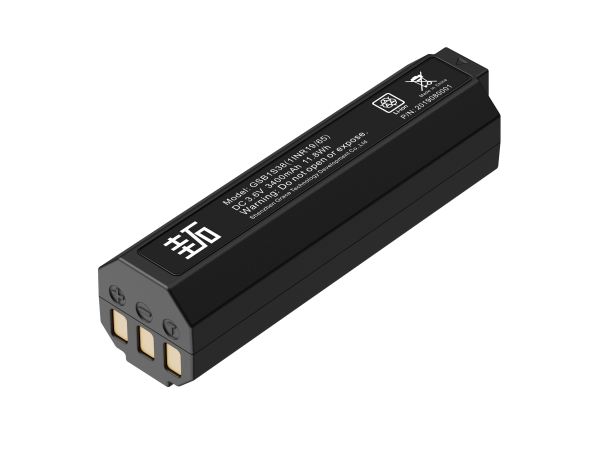
GSB1S38
3.6V/3450mAh/11.88Wh
These figures represent industry-typical configurations. Custom satcom battery packs vary widely based on terminal power budget, mission duration requirements, and environmental specifications. The table is provided as a reference baseline for system architects sizing their next-generation product.
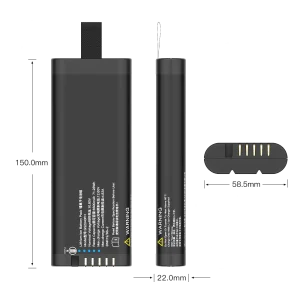
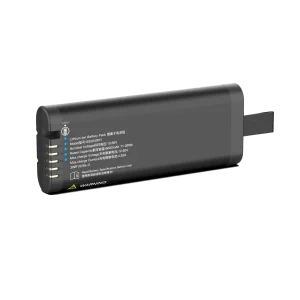
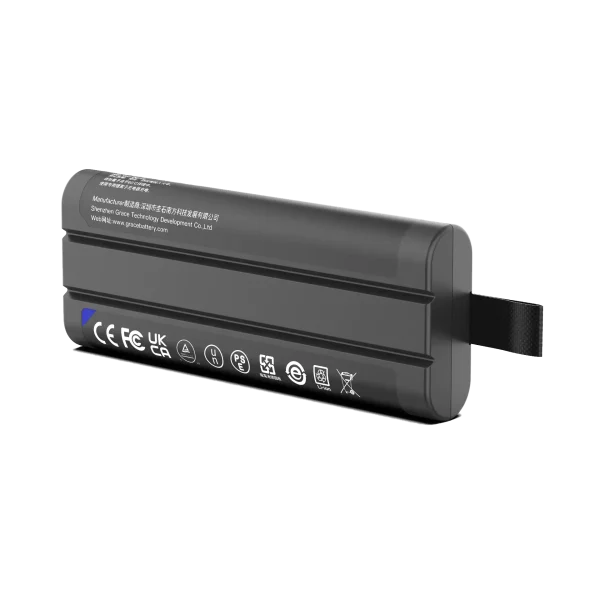
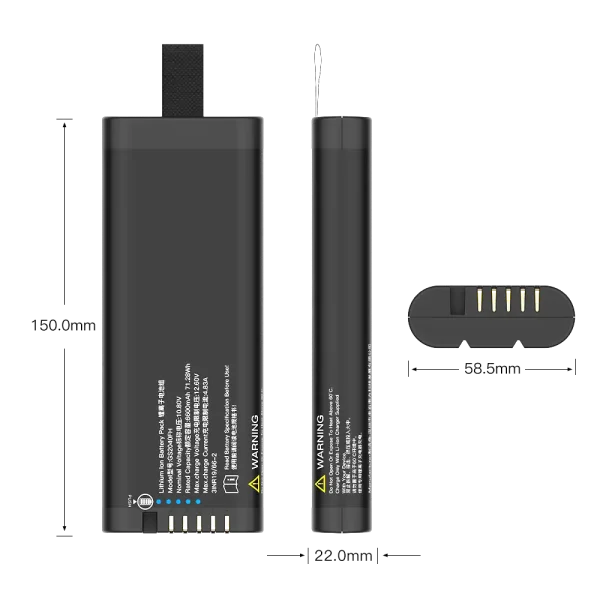
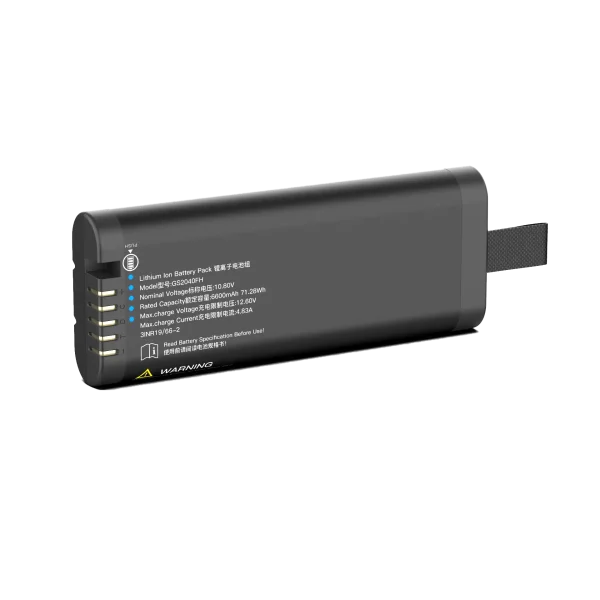
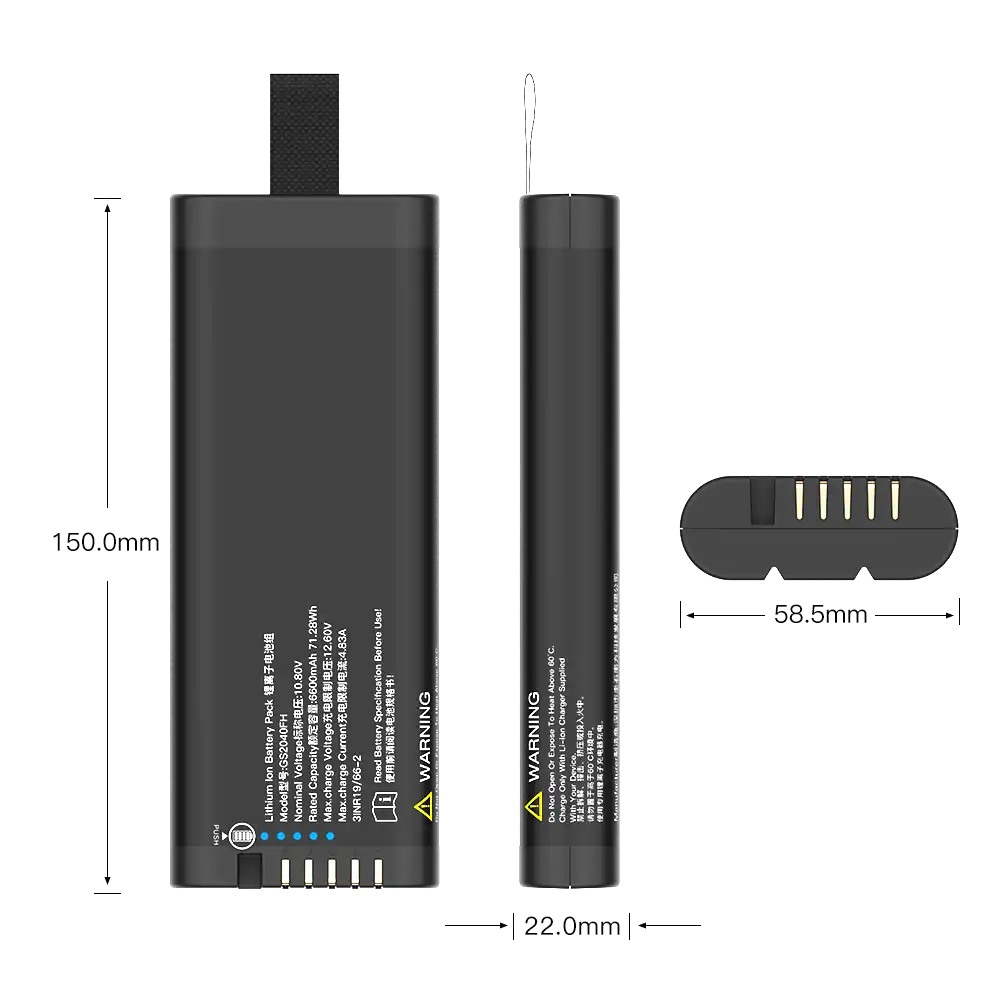
GS2040FH
10.8v/6900mAh/71.28h
8. OEM Custom Pack Design: What to Specify Upfront
For terminal manufacturers evaluating a custom satcom battery partner, the upfront requirements definition phase is the most important step. From our experience running dozens of custom pack programs, here is what should be specified before design work begins:
Electrical Requirements
Nominal voltage and capacity target, peak and continuous discharge current profiles, charge current limits, communication protocol (SMBus / I2C / analog), and fuel gauge requirements. Providing a full load profile (discharge current vs. time over a typical mission cycle) is far more useful than a single average wattage figure.
Mechanical Requirements
Envelope dimensions, weight budget, connector type and pinout, mounting method, and pack orientation within the terminal. Custom form factors are standard in satcom — off-the-shelf batteries rarely fit the mechanical design language of a purpose-built terminal.
Environmental and Certification Requirements
Operating and storage temperature ranges, ingress protection target, vibration and shock standards, altitude requirements, and the certification target list (UN38.3, IEC 62133, UL, CE, MIL-STD, etc.). Specifying these upfront prevents expensive redesign cycles later.
9. Conclusion: Power Reliability Is Mission Reliability
A satellite terminal’s radio, antenna, and software may be world-class, but if the battery pack fails at -30°C during a critical transmission, the entire system fails. Designing a satcom battery pack requires systems-level thinking — cell chemistry must match the environmental envelope, BMS algorithms must tolerate pulsed loads without nuisance tripping, and the mechanical pack must survive the same field conditions as the terminal itself.
At TEFOO, we have spent over a decade developing custom lithium-ion battery packs for industrial, medical, and ruggedized communications applications. Our engineering team brings cell-level expertise, BMS firmware experience, and full certification support to every OEM satcom battery program. If you are developing a next-generation satellite terminal and need a battery partner who understands the difference between a consumer cell and a mission-critical power source, we would welcome the conversation.
About the author: The TEFOO R&D team designs smart lithium-ion battery systems with integrated BMS, SMBus communication, and OEM customization for industrial, medical, and defense electronics worldwide.