Written by the Battery Engineering Team · TEFOO
October 2026 ·
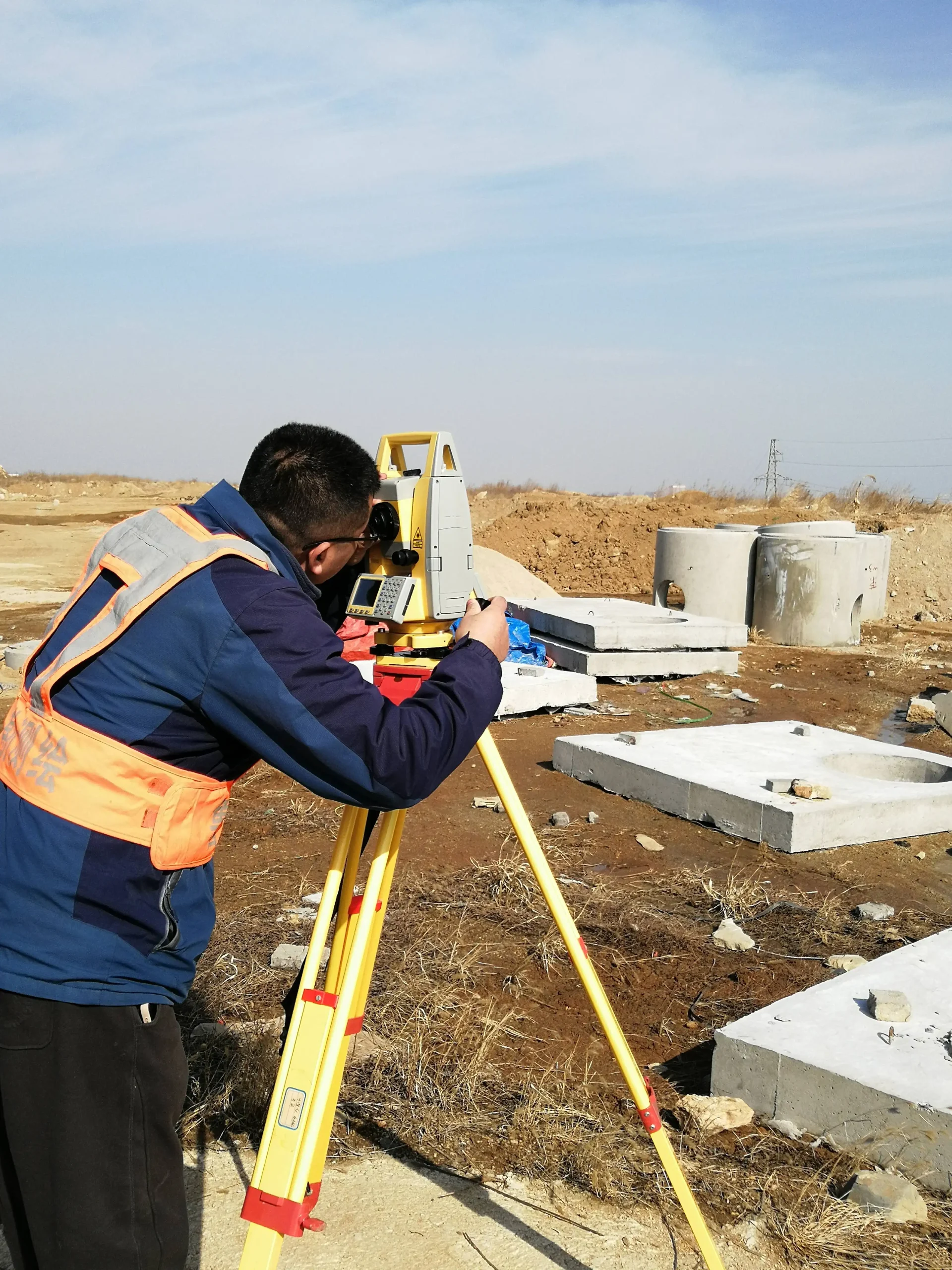
A mapping device lives or dies by its battery. Handheld SLAM and LiDAR scanners, GNSS RTK rovers and mobile mapping systems spend their working life outdoors — in rain, dust, cold and vibration — and the moment the pack fails, the survey crew stops. As a battery engineer who has taken packs from a working prototype to certified mass production, I have watched the same mistake repeat: a pack that performs beautifully on the bench becomes a field and compliance nightmare because the team treated “it works” as the finish line. This article walks through the disciplines that separate a prototype battery pack from a shippable, mass-produced one for mapping devices — and the hard-won lessons in between.
1. Define the Mission Profile First
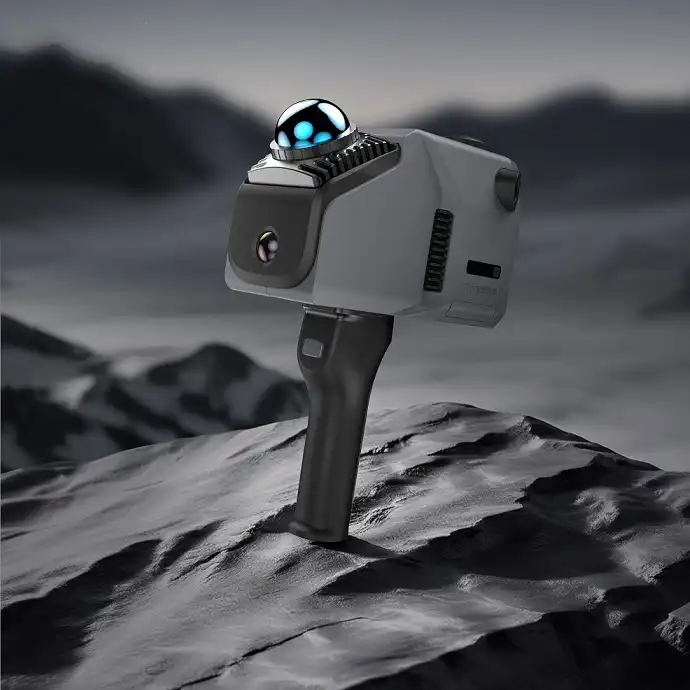
Before a single cell is chosen, the mission profile must be written down in numbers. Mapping devices are not phones. A handheld GNSS RTK scanner such as the CHCNAV RS10 runs below 30 W with a hot-swappable 24.48 Wh pack and accepts 9–20 V DC input (CHCNAV RS10 specifications, 2026). A GNSS rover draws only about 4 W on average, but its UHF radio pulls 2–3 A peaks at 7.4 V on transmit, and a terrestrial laser scanner can sustain 40–65 W for 20 minutes at a time (Horizon Power, 2026). South Surveying & Mapping builds its Visual-LiDAR RTK around a 7.4 V system with a 5,000 mAh inbuilt pack plus a 6,800 mAh hot-swappable handgrip — 87.32 Wh total — to deliver more than three hours of scanning and over 24 hours in GNSS rover mode (South Surveying & Mapping Instrument, 2025).
From these examples the requirements list writes itself: energy and runtime at the worst-case continuous load; C-rate headroom for radio and motor bursts; field hot-swap without rebooting the instrument; operation from −20 °C to 55 °C; ingress protection around IP54–IP65 per IEC 60529:2013 (IEC, 2013); resistance to drop, shock and random vibration (e.g., IEC 60068-2-64); months of shelf life on a single charge; charging from car and solar sources; digital telemetry to the host; and transport certification. Every requirement must carry a number and a test method. “Rugged enough” is not a specification.
2. Cell Selection and Qualification
Chemistry first. High-energy NMC remains the default for mapping packs because field runtime dominates. LiFePO4 buys cycle life and abuse tolerance at the cost of roughly 30–40% lower volumetric energy density — worth it only when safety, cycle count or thermal stability outweigh runtime. LTO is rarely justified unless charging in extreme cold is mandatory. Form factor matters too: cylindrical cells (18650/21700) are mechanically robust and easy to weld into a pack, while pouch cells pack more energy into tight spaces but demand rigid compression and more mechanical protection.
On energy, 2026 is an interesting moment. Commercial high-energy 21700 cells typically deliver around 4,800–5,000 mAh, while silicon-anode R&D cells have been reported at an average of 6,696 mAh with 319.9 Wh/kg (HPQ Silicon, 2026). For a field device that must work on the first try, however, qualification beats headline numbers: verify capacity, DCIR and self-discharge across the operating temperature range; run cycle tests at field temperatures; and confirm the safety certifications of the exact cell variant (UN 38.3, IEC 62133-2). Match cells tightly — the capacity and impedance spread inside the pack determines balance quality and pack life — and always qualify a second source before freezing the bill of materials.
3. Mechanical, Thermal and Electrical Architecture
The enclosure is part of the battery. Field packs need a sealed, keyed connector so the pack cannot be inserted wrongly or knocked loose; gaskets and strain relief sized to IP54–IP65 per IEC 60529:2013; screw-down cell retention instead of loose pressure; conformal coating on printed circuit board assemblies; and a deliberate trade-off between sealing and cell venting — a sealed box with nowhere for a vented cell to exhaust is a hazard.
Thermal design determines field performance. At −20 °C, usable capacity drops, and charging below 0 °C damages cells unless current is derated or the pack preheats itself. At the other end, the scanner’s own electronics and the pack share the same hot enclosure. Thermistors at several points, thermal pads to spread heat, and a cold-start strategy (preheat, charge-current derating, state-of-charge recalibration) are design inputs, not afterthoughts. Simulate before tooling.
Electrically, a hot-swap pack needs output capacitance and ideal-diode OR-ing so the instrument never sees a power gap; a proper fuse plus protection FETs; very low quiescent current (well under 100 µA) so the pack can sit on a shelf for months; and connectors rated for the burst currents, not just the average.
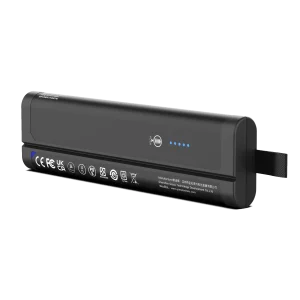
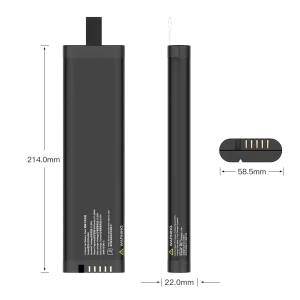
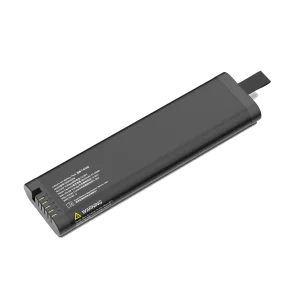
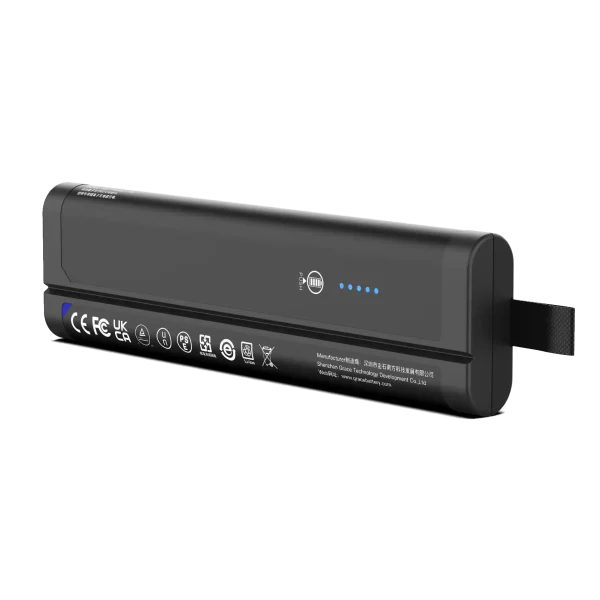
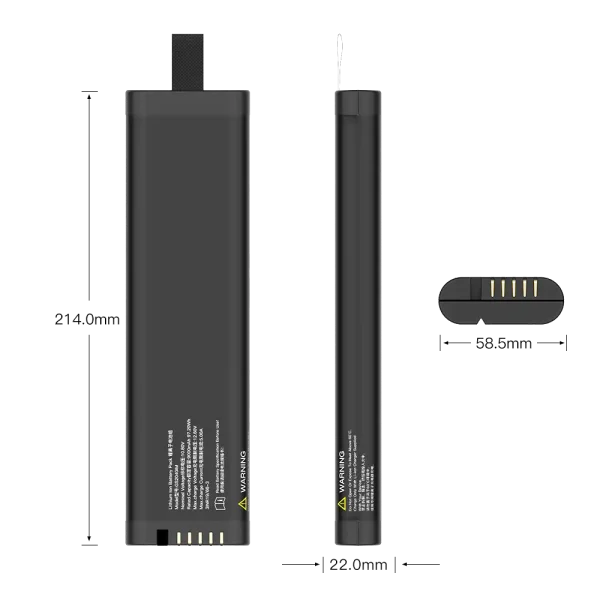
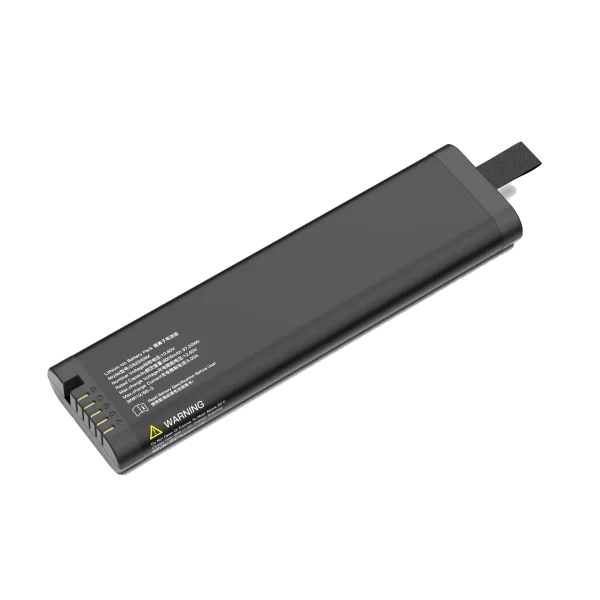
GS2040IM
10.8V/9300mAh/97.2Wh
4. BMS Design for Field Devices
The BMS is the pack’s operating system. The minimum set: over-voltage, under-voltage, over-current, short-circuit, over-temperature and under-temperature protection on every cell; passive balancing with a controlled window; state of charge from coulomb counting corrected against open-circuit voltage at rest; state-of-health logging; and a host interface — SMBus, I²C, UART or CAN — so the scanner can display runtime, temperature and health. Add a low-battery warning early enough for a field swap, and field-updatable firmware, because you will learn things about real usage only after launch.
5. From EVT to DVT: Test Like You Mean It
Prototype builds answer “does it work?”; engineering validation builds (EVT/DVT) answer “does it work in the real world?” Run a test matrix, not a test: capacity and DCIR across temperature; charge and discharge curves at the actual load profile; temperature cycling and humidity; drop, shock and random vibration per IEC 60068-2-64; IP ingress verification; an EMC pre-scan; charger interoperability; and hot-swap under full load.
One recurring lesson from our programs is cold start. A pack that validates perfectly at 25 °C can fail to power a scanner at −20 °C because the under-voltage hysteresis was tuned for room temperature, or because the first load pulse collapses the sagging voltage below the pack’s own threshold. We now run a cold-start sequence — storage at −20 °C followed by an immediate full-load ramp — on every prototype revision, and it has caught real problems on every program since.
6. Design for Manufacturing and Supply Chain
A design that cannot be built repeatedly at cost is a prototype, not a product. Design for manufacturing means: a controlled welding process window for cell tabs, where weld pull strength is proven rather than assumed; panelized PCBA with test points; fixtures and a functional tester that every single pack must pass; laser-marked unique IDs linking cells, BMS firmware and test data; and documents — drawings, DFMEA, control plan, incoming inspection — that a factory can execute without the engineer on site. Run quality management to a recognized standard; ISO 9001:2026, which succeeded ISO 9001:2015 in 2026, is the baseline for battery manufacturing quality systems (ISO, 2026).
Supply chain is the silent killer of programs. Dual-source the cell, confirm minimum order quantities and lead times, and lock the chemistry variants you qualified — a “better” cell swapped in during a shortage resets your certification and reliability work. Build margin for cell price and lead-time swings into the program plan.
7. Certification and Compliance – the Shipping Gate
You cannot ship lithium batteries without proving they are safe. UN 38.3 (UN Manual of Tests and Criteria, Revision 8, Amendment 1, 2025) requires the T1–T8 test series — altitude, thermal, vibration, shock, external short circuit, impact, overcharge and forced discharge — before the first air or sea shipment, plus the supporting test summary, MSDS and transport classification (Changhong New Energy, 2026). For portable sealed cells and packs, IEC 62133-2:2017 is the reference safety standard (IEC, 2017); for batteries in industrial equipment, IEC 62619:2022 applies (IEC, 2022). Regional rules — CE, RoHS and REACH in the EU, UL in North America — add their own layers.
Treat certification as a design input from day one. The cell must exist in a certifiable variant; the pack’s BMS, cell spacing and test fixtures must be built for the required tests; and transport labelling must be engineered into the product graphics. Retesting after any change to cell, BMS or enclosure is expensive and slow, so freeze what you certify.
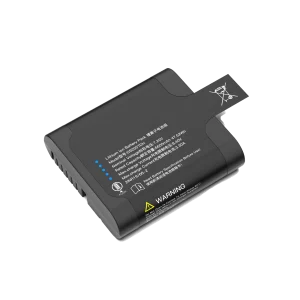
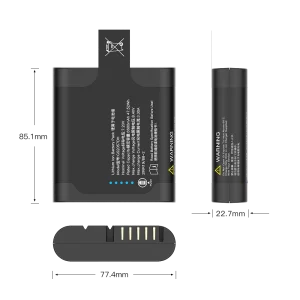
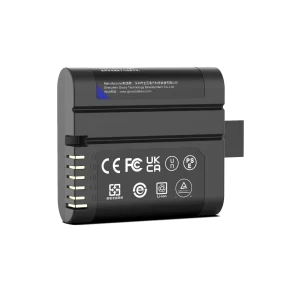
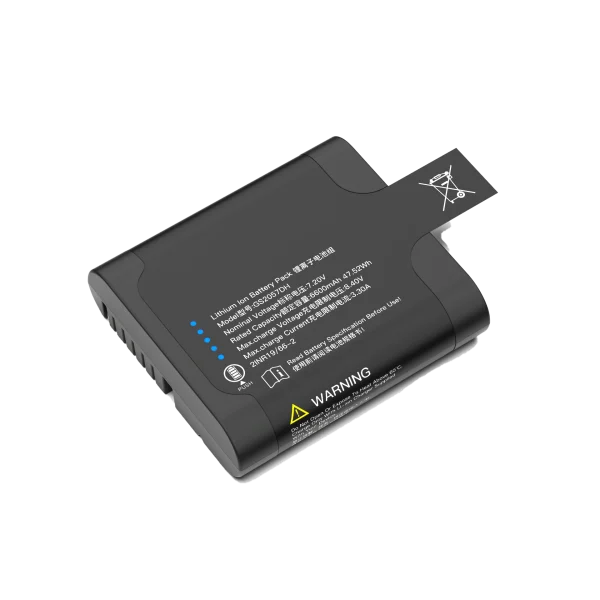
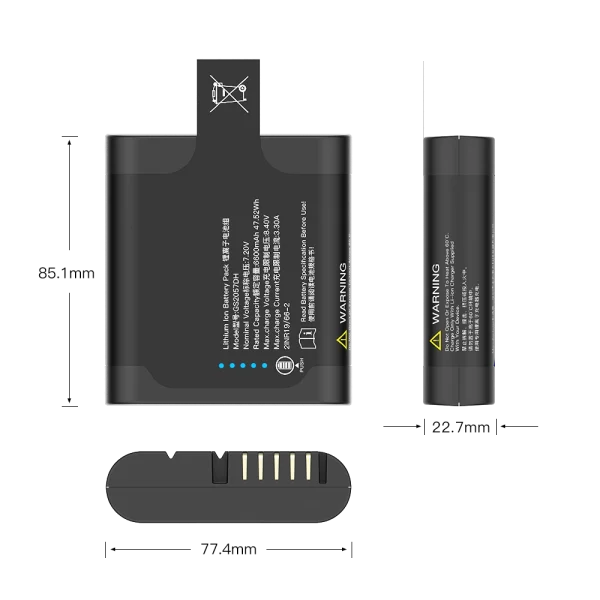
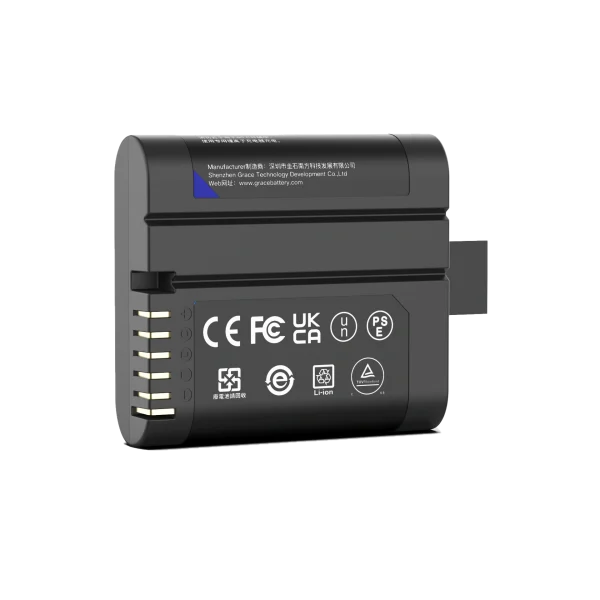
GS2057DH
7.2V/6900mAh/47.52Wh
8. Production Ramp and Beyond
Pilot production (PVT) exists to prove the process, not the design. Measure first-pass yield, run a 48-hour aging on every pack, verify calibration, and tear down sample units to check weld and assembly quality. Only then scale. In mass production, traceability is the product’s memory: any pack can be traced back to its cells, its BMS firmware build and its test record. After launch, track field data — capacity fade, temperature extremes, warranty returns — against the design assumptions; that feedback loop is what turns a good pack into a proven one. Table 1 summarizes the phase gates from prototype to mass production.
Table 1. Development phase gates from prototype to mass production
| Phase | Purpose | Key activities | Exit criteria |
| EVT — Engineering Validation | Prove the electrical and mechanical concept | Cell qualification; BMS firmware; prototype enclosure; thermal and cold-start tests | Design meets mission profile; major risks retired |
| DVT — Design Validation | Prove the design against the full specification | Tooled enclosure; full test matrix (environmental, mechanical, EMC); safety and abuse tests; certification pre-tests | All specification tests pass; certification ready |
| PVT — Production Validation | Prove the manufacturing process | Tooling and fixtures; first-pass yield; 48 h aging; traceability; operator documentation | Yield and quality targets met; process capable |
| MP — Mass Production | Ship reliably at volume | Statistical process control; batch release; field monitoring; warranty tracking | On-time quality and cost targets sustained |
Table 2. Standards governing mapping-device battery packs
| Standard | Scope | Why it matters for mapping packs |
| UN 38.3 (Rev. 8 Amd. 1, 2025) | Transport safety of lithium cells and batteries | Required before any air or sea shipment; T1–T8 test series |
| IEC 62133-2:2017 | Safety of portable sealed lithium cells and batteries | Reference safety standard for handheld and portable mapping packs |
| IEC 62619:2022 | Safety of lithium cells and batteries in industrial applications | Applies to industrial and field equipment battery systems |
| IEC 60529:2013 | Degrees of protection provided by enclosures (IP Code) | Defines the IP54–IP65 field-enclosure requirements |
| IEC 60068-2-64:2008+AMD1:2019 | Environmental testing — broadband random vibration | Proves pack survival under vehicle and field vibration |
| ISO 9001:2026 | Quality management systems — requirements | Baseline quality management system for battery manufacturing |
FAQ
How long does it take to go from prototype to mass production?
Realistic programs plan for several quarters from design freeze to first production shipments. Certification testing, cell supply lead time and tooling usually dominate the calendar, so start them as early as possible — ideally in parallel with the design work, not after it.
Can I just use an off-the-shelf power bank?
Power banks are optimized for cost and convenience, not for hot-swap under load, −20 °C operation, vibration, IP protection, host telemetry or transport certification. For a field instrument whose uptime is billable, the pack is worth engineering properly.
What certifications does an internationally shipped mapping pack need?
At minimum, UN 38.3 transport testing and IEC 62133-2 (portable) or IEC 62619 (industrial) safety testing, plus regional requirements such as CE and RoHS/REACH in the EU. Confirm the rules for each destination market with your certification partner.
How do you handle sub-zero field performance?
By design: chemistry selection, thermal insulation and preheat, charge-current derating below 0 °C, state-of-charge recalibration in the cold, and a cold-start test on every prototype revision.
What does hot-swapping require from the pack and the device?
The pack needs output capacitance and ideal-diode OR-ing so the output voltage never drops during the swap; the device needs a keyed connector, hot-swap-rated contacts and firmware that accepts a swap without reboot. Always test the swap under full load.
Conclusion
The distance from a prototype that works on the bench to a battery pack that ships by the thousand is a process, not a single step: mission profile, cell qualification, mechanical and thermal design, BMS, validation testing, manufacturing readiness, certification and a production ramp that treats every unit as traceable. Each discipline is cheap to do early and expensive to retrofit. That is why teams building mapping devices benefit from working with a battery manufacturer that owns the whole journey — from the first requirements workshop to field support after launch.
At TEFOO, our engineering team develops custom lithium battery packs with intelligent BMS (including SMBus communication) for medical and industrial equipment, and supports OEM/ODM programs from prototype to certified mass production. If you are taking a mapping device to market, talk to us early — the battery pack is a design partner, not an accessory. Contact our engineering team through the TEFOO website.
About the Author
The author is a senior battery R&D engineer at TEFOO , leading custom battery pack programs for medical and industrial equipment, with a focus on intelligent BMS, SMBus communication and OEM battery solutions. The engineering team has taken multiple packs from first prototype to certified mass production for field devices.
References
Third-party figures and device specifications cited in this article are provided for engineering illustration and were current at the time of writing; verify current values and requirements with the original sources and your certification partner before making design decisions.
CHCNAV. (2026). CHCNAV RS10 — Handheld SLAM + GNSS RTK 3D Scanner (product specifications).
Changhong New Energy. (2026). Lithium Battery Testing Standards 2026 — Global Compliance Guide (UN 38.3, Manual of Tests and Criteria Rev. 8 Amd. 1).
Fortune Business Insights. (2026). Lithium-ion Battery Market Size, Share & Future Trends, 2034.
Global Market Insights. (2026). LiDAR Market Size and Share, Forecasts Report 2026–2035.
GPS World. (2026). Market reports examine mid- and high-precision GNSS receiver market.
Horizon Power. (2026). Battery Solution for Construction Survey Equipment — An Engineer’s Field Guide.
HPQ Silicon. (2026). HPQ Silicon Reports 6,696 mAh GEN4 21700 Cell Performance Among the Highest Reported Globally.
IEC. (2013). IEC 60529 — Degrees of Protection Provided by Enclosures (IP Code), Edition 2.2.
IEC. (2019). IEC 60068-2-64:2008+AMD1:2019 — Environmental Testing, Part 2-64: Vibration, Broadband Random.
IEC. (2022). IEC 62619:2022 — Safety Requirements for Secondary Lithium Cells and Batteries, for Use in Industrial Applications.
ISO. (2026). ISO 9001:2026 — Quality Management Systems, Requirements (replacing ISO 9001:2015).
Mordor Intelligence. (2026). Lithium-ion Battery Market Size & Industry Report 2031.
South Surveying & Mapping Instrument. (2025). Visual-LiDAR RTK for All Scenarios (product specifications).