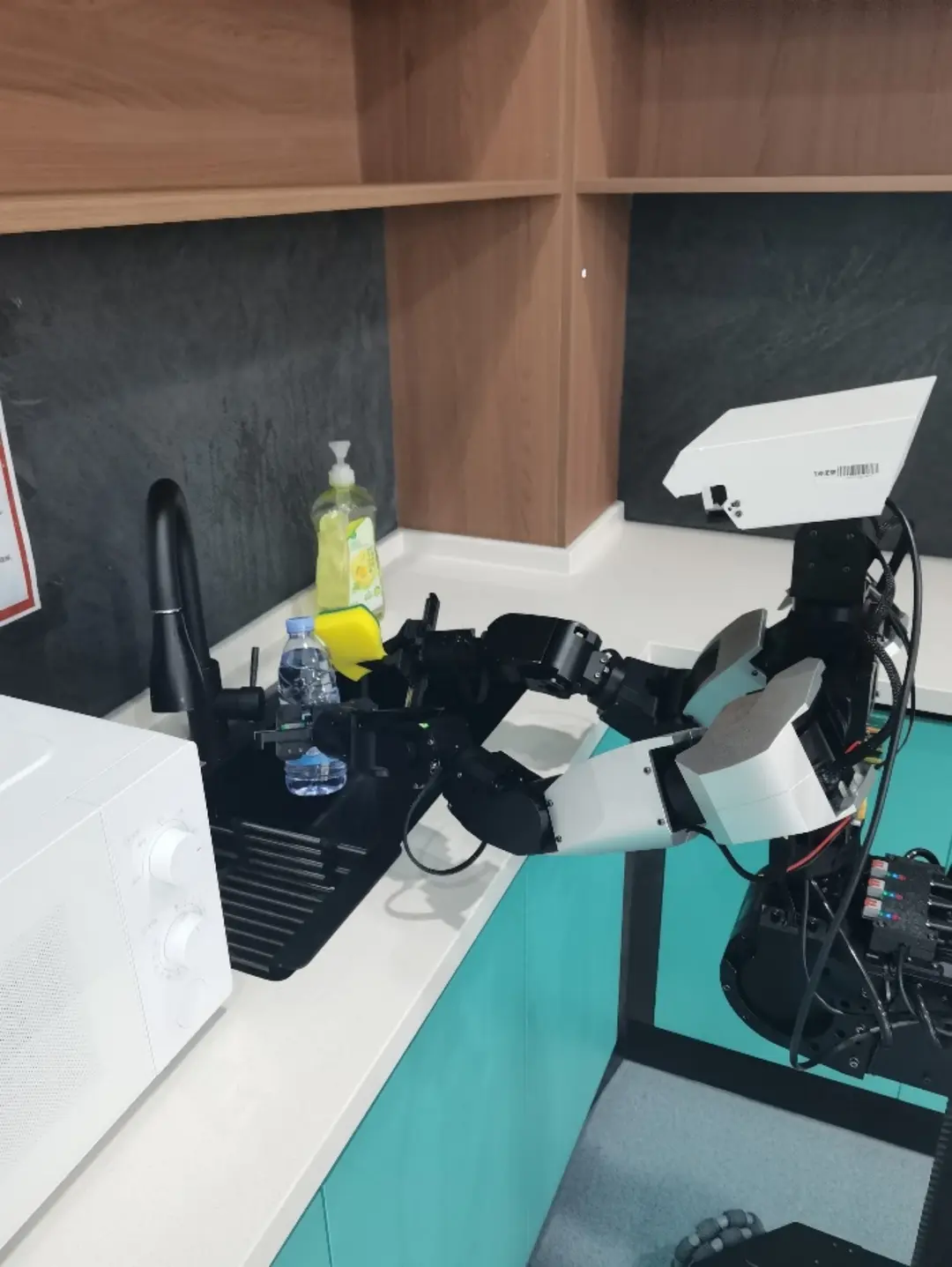
An R&D engineer’s practical guide to designing, selecting and certifying power for portable data acquisition systems and field data loggers
Introduction: your data is only as good as your battery
A portable data acquisition system is often the most expensive single item in a monitoring campaign, yet the component most likely to end it early is the one that costs the least: the battery. After more than a decade designing lithium packs for portable medical and industrial instrumentation — patient monitors, DAQ terminals, environmental loggers — I have debugged plenty of ‘system failures’ that turned out to be battery failures. A pack that sagged under a sensor burst. A BMS that shut everything down at 3°C. A ‘10,000 mAh’ power bank that delivered a third of its rated energy at -5°C. The electronics were fine. The power source was not.
This article is written for the engineers who specify, buy or build portable DAQ systems and data loggers. It covers what a portable DAQ battery must survive in the field, how to size and select the right chemistry, which safety standards apply in 2026, and when a custom-engineered pack is worth the money. It reflects the way our engineering team at [Company Name] actually reviews battery designs — because the questions below are the questions we ask before a pack goes into a product.
The timing matters. The global data logger market is valued at USD 9.19 billion in 2026 and is projected to reach USD 14.12 billion by 2031, a CAGR of 8.97% per Mordor Intelligence, while The Business Research Company puts 2026 at USD 9.58 billion. On the measurement side, Mordor Intelligence estimates the global data acquisition market at USD 3.53 billion in 2026, and Research and Markets sizes DAQ systems at USD 2.07 billion, heading to USD 2.45 billion by 2030. Every one of those systems ships with a battery — and a surprising number ship with the wrong one.
One terminology note before we go deeper: ‘portable DAQ battery’ and ‘data logger battery’ are used almost interchangeably in the industry, and the same rechargeable pack can legitimately serve both roles. They are not identical, though. A DAQ system and a data logger have different load profiles, and that difference drives every design decision in this article.
What is a portable DAQ battery — and how is it different from a data logger battery?
A portable DAQ battery is the power source for a data acquisition system operating away from mains power: multichannel sensing, conditioning, digitisation, local processing and, increasingly, wireless streaming. A data logger battery does a similar job for a much simpler device that wakes up on a schedule, takes a sample, stores it, and goes back to sleep. The engineering consequence is in the load profile, summarised in Table 1.
Table 1 — Load profiles: portable DAQ systems vs stand-alone data loggers
| Parameter | Portable DAQ system | Stand-alone data logger |
| Typical average current | Tens to hundreds of milliamps, up to several amps | Microamps to low milliamps |
| Load pattern | Continuous operation with sensor and radio bursts | Dormant, with scheduled wake-ups |
| Peak current events | 2–10 A for radios, actuators, displays | Milliamps, brief ADC or radio windows |
| Runtime target | 8–72 h per mission or shift | Days to years unattended |
| Typical environment | Lab bench, vehicle, field, airborne | Outdoor, cold chain, remote, buried |
| Typical cell chemistry | Rechargeable Li-ion (18650, 21700, pouch) | Primary LiSOCl2 or small Li-ion |
| Main design driver | Peak power and energy | Sleep current and self-discharge |
The consequence is simple: DAQ packs are power-limited, logger packs are energy-limited. A pack sized for a logger’s 3 mA average would be destroyed by a DAQ’s 5 W processing burst; conversely, a DAQ pack’s electronics overhead and self-consumption would drain a year-long logger in weeks. State your load profile — average, peak and duration — before anyone quotes you a capacity. That single number determines everything that follows.
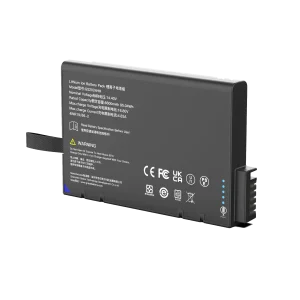
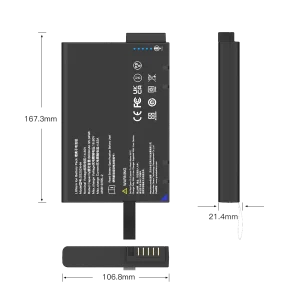
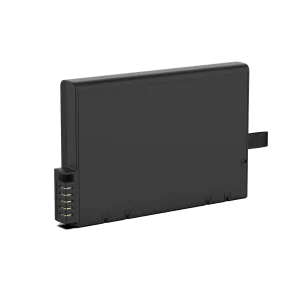
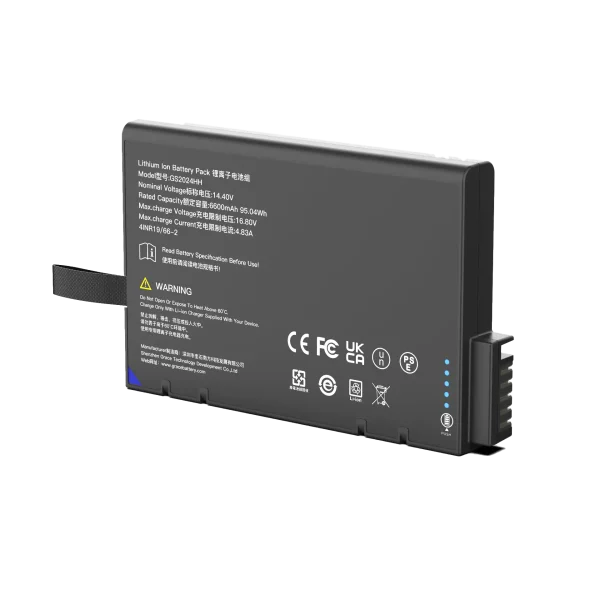
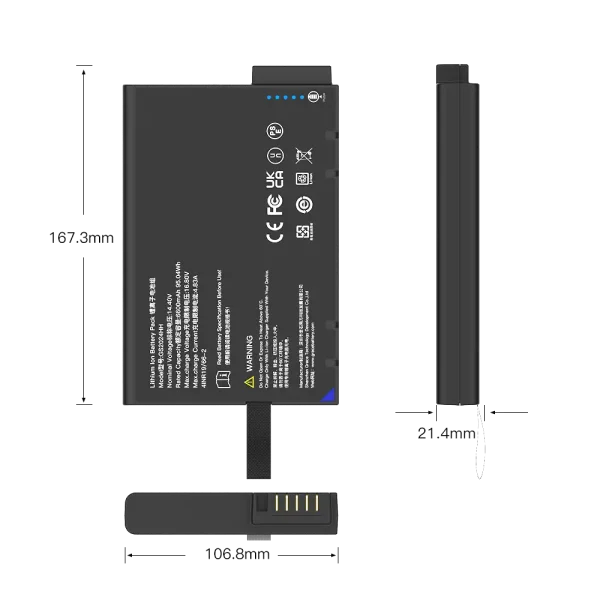
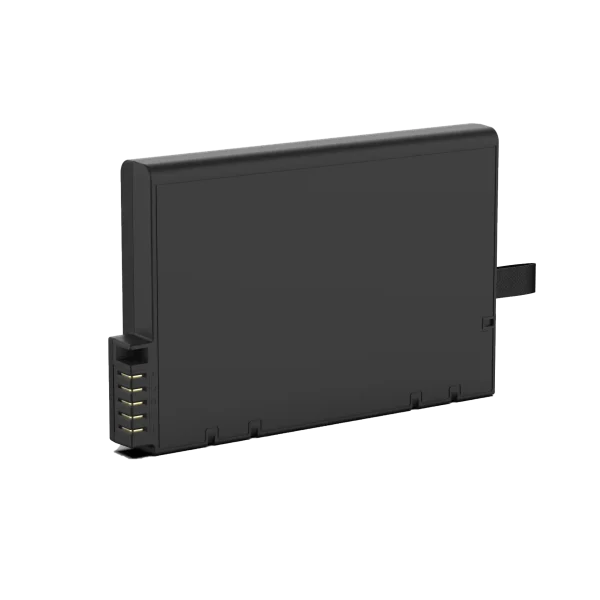
GS2024HH
14.4V/6900mAh/95.04Wh
Cell chemistry selection in 2026
Once the load profile is clear, the first decision is chemistry. For rechargeable portable DAQ applications, lithium-ion is the practical default. NMC (nickel-manganese-cobalt) 18650 and 21700 cylindrical cells deliver the best energy density and current capability for compact, high-power packs. LiFePO4 (LFP) trades some energy density for longer cycle life, wider safe operating margins and better abuse tolerance — attractive for long-life field packs and safety-critical instruments. Pouch LiPo wins when the form factor is the constraint, at the cost of shorter cycle life and the need to manage mechanical swelling. For long-life stand-alone loggers, primary lithium-thionyl chloride (LiSOCl2) remains the industry standard: essentially no self-discharge, no charger, no BMS overhead, and years of unattended operation. The ER-series cells used by most loggers — ER14505 (2,400 mAh), ER26500 (8,500–9,000 mAh) and ER34615 (19,000 mAh), all 3.6 V nominal — are the reason ‘fit it and forget it’ is possible, per the selection guides of PKCELL and Westinghouse Battery.
Table 2 — Cell chemistry comparison for DAQ and logger packs (typical values)
| Chemistry | Nominal voltage | Energy density | Cycle life | Cold behaviour | Best suited to |
| Li-ion NMC (18650 / 21700) | 3.6–3.7 V | High | 500–1,000 cycles | Discharge derated below 0°C; charging blocked near 0°C | DAQ packs, high current, rechargeable |
| LiFePO4 (LFP) | 3.2–3.3 V | Medium | 2,000–3,000+ cycles | More abuse tolerant; still no sub-0°C charging | Long-life field packs, safety-critical |
| LiPo (pouch) | 3.7 V | High | 300–600 cycles | Derated; swelling management needed | Slim custom form factors |
| LiSOCl2 (primary) | 3.6 V | Highest per volume | Single use | Excellent wide-temperature range | Years-long unattended loggers |
Cold is where field campaigns die, so it deserves a section of its own. Discharging lithium-ion below 0°C is permissible but derated: internal resistance rises, and usable capacity and peak power fall (reviewed in the low-temperature battery literature). Charging below 0°C is a different matter. At low temperature, lithium ions plate onto the graphite anode instead of intercalating, permanently damaging capacity and creating a safety risk (battery winter-performance guidance). A responsible BMS therefore blocks charging below a temperature threshold — typically around 0°C and configurable per design — or pre-heats the pack before accepting charge (BMS low-temperature charging protection strategies). If your deployment involves freezers, alpine winters or desert-to-night swings, ask for the pack’s low-temperature charge-protection behaviour and cold-capacity test data. A datasheet line saying ‘discharge: -20°C’ tells you nothing about what happens when the operator plugs in the charger at -5°C.
Sizing the pack: the math every engineer should do first
Runtime is not a datasheet property; it is arithmetic. The equation is simple: runtime = pack capacity × usable depth of discharge ÷ average load. For lithium-ion, plan on 80–90% usable capacity to protect cycle life and keep voltage rails within specification.
Take a modest four-channel DAQ drawing a continuous 5 W. On a 74 Wh pack (10 Ah at 7.4 V): 74 × 0.8 ÷ 5 ≈ 11.8 hours — under half a day. Step up to a 148 Wh pack (10 Ah at 14.8 V) and the same load runs for roughly 23.7 hours. That is why mission length, not datasheet capacity, should drive pack size.
Now take a logger averaging 20 mA. On a 10 Ah pack: 10,000 × 0.8 ÷ 20 = 400 hours, about 16.7 days. With a 19,000 mAh ER34615 at 90% usable, a 3 mA logger runs 17,100 ÷ 72 ≈ 237 days — seven-plus months between service visits. Same discipline, completely different answers.
Two rules of thumb I apply to every design: size for the peak, not the average — a 10-second radio burst at 2 A must not sag the pack below the system’s brown-out voltage; and add 20–30% margin for cold derating, cell ageing and end-of-life capacity. The cheapest place to fix an undersized battery is before it is built, not after a lost campaign.
Voltage is the other half of sizing. DAQ boards typically want 5 V (USB), 12 V or 24 V (industrial). A pack can be configured as 1S (3.6–4.2 V), 2S (7.2–8.4 V), 3S (10.8–12.6 V) or 6S (21.6–25.2 V), with the rail regulated down. Higher cell counts reduce current and wiring loss, but add balancing and BMS complexity; for handheld gear most DAQ packs are 1S–3S. Tell your battery engineer the load’s voltage window and brown-out level, and let them propose the cell count.
Inside a well-designed DAQ battery pack: what I check before I approve a design
A battery pack is not cells in shrink-wrap. These are the subsystems that decide whether a field campaign finishes or fails — and they are the difference between a commodity and an engineered product:
- Cell selection and traceability. A-grade cells from tier-1 manufacturers with full lot traceability, and matched capacity and internal resistance in multi-cell packs. If a vendor cannot show you cell provenance, walk away.
- A BMS with real protection. Overcurrent, short-circuit, over-voltage, under-voltage, over-temperature, cell balancing — and, for mission-critical gear, low-temperature charge blocking and a fuel gauge that reports state of charge rather than a green LED. Field loggers are built on exactly this kind of low-power discipline, as the design walkthrough of a battery-powered data logger illustrates.
- Smart battery communication. SMBus or I2C lets the DAQ firmware read live state of charge, current, temperature and cycle count, so the instrument warns the operator before shutdown instead of dying silently. This is standard on medical-grade packs and increasingly expected in industrial DAQ.
- Mechanical ruggedisation. Vibration, shock, humidity, IP-rated housings, strain-relieved connectors and potting where needed. Field equipment is dropped, rained on and left in hot vehicles.
- Connectors and swap strategy. Keyed, field-serviceable connectors; hot-swappable dual-battery bays for continuous missions; charging through USB-C or a sealed industrial connector.
- Certification and documentation. Every export pack needs a UN 38.3 test report and safety testing to IEC 62133-2 or IEC 62619; US sales typically require UL 2054; EU sales require CE and RoHS. The deliverable is the design file — schematics, BOM, thermal analysis, test reports and FMEA — not a sticker.
The 2026 certification roadmap
Standards are part of the engineering, not an afterthought. Table 3 shows what applies to a portable DAQ battery shipping in 2026.
Table 3 — Certification roadmap for portable DAQ batteries (2026)
| Standard | What it covers | Why it matters for your DAQ |
| UN 38.3 — UN Manual of Tests and Criteria, Section 38.3 | Transport safety: altitude, thermal, vibration, shock, external short circuit, impact, overcharge and forced-discharge tests (T1–T8) | Mandatory before air, sea, road or rail shipment; without a passing UN 38.3 test report the battery cannot legally ship |
| IEC 62133-2:2017 + AMD1:2021 | Safety of portable sealed lithium cells and the packs built from them | The baseline safety standard for portable rechargeable packs, referenced across EU and Asian markets |
| IEC 62619:2022 | Safety of lithium batteries for industrial applications | Applies as DAQ equipment crosses into industrial use; adds functional-safety requirements |
| UL 2054 (3rd edition) | Household and commercial batteries | Required by many US OEMs and for products entering US retail channels |
| CE marking / RoHS | EU market access (EMC, LVD, hazardous substances) | Mandatory for battery-containing equipment sold in the EU |
Off-the-shelf, OEM or custom-engineered? An honest vendor comparison
The question I hear most often from project managers is ‘can’t we just use a power bank?’ The honest answer is: sometimes yes, often no. Table 4 is the comparison I walk through with clients when they are choosing a sourcing route for a portable DAQ battery.
Table 4 — Sourcing comparison: consumer power bank vs standard OEM pack vs custom-engineered pack
| Decision factor | Consumer power bank | Standard OEM pack | Custom-engineered pack |
| Runtime predictability | Poor — capacity claims vary; no load-profile data | Good — datasheet-based | Best — validated against your exact load profile |
| Cold and rugged environments | Not designed for sub-0°C, shock or sealing | Basic temperature and IP ratings | Engineered and tested for your environment, incl. low-temperature charge cut-off |
| Protection and BMS transparency | Opaque; often no per-cell protection | Documented basic BMS | Full BMS specification, fuel gauge, optional SMBus telemetry |
| Certifications | Usually none | UN 38.3, IEC 62133-2 typically | Full package with test reports delivered |
| Form factor and connector | Fixed USB-A / USB-C | Standard sizes and connectors | Any shape, connector or mounting |
| Field charging and hot-swap | USB charging only | Standard charger | Mission-designed: dual-bay hot swap, solar or vehicle charging |
| Documentation | None | Limited | Complete engineering file: BOM, schematics, FMEA, test reports |
| Cost profile | Very low unit cost | Low to moderate | Higher upfront; lower total cost per successful deployment |
When is off-the-shelf good enough? Prototypes, indoor lab experiments, short demos and non-critical logging where losing an hour of data costs nothing. When does custom engineering pay for itself? Multi-day outdoor or cold-chain campaigns; regulated industries such as medical, pharma and utilities; equipment that must not reboot mid-measurement; deployments where a failed battery means repeating the entire study; and any product you plan to ship in volume, where the battery is a compliance and reputation asset rather than a commodity.
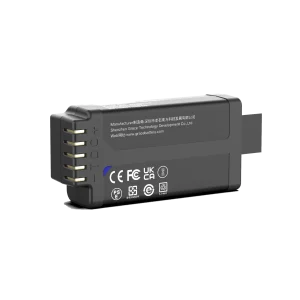
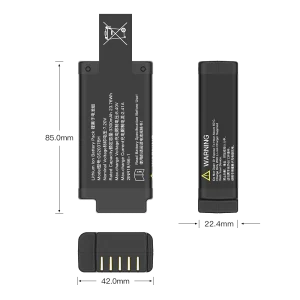
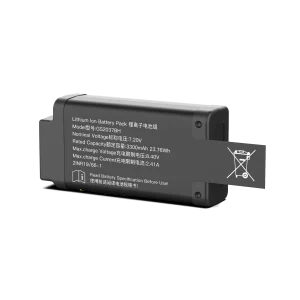
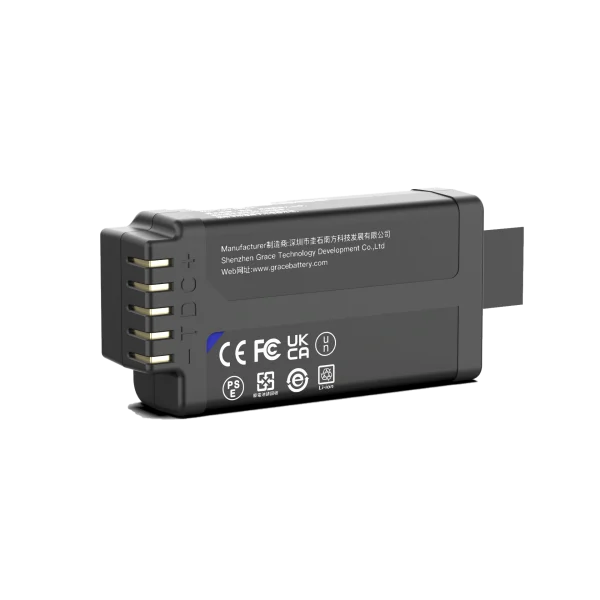
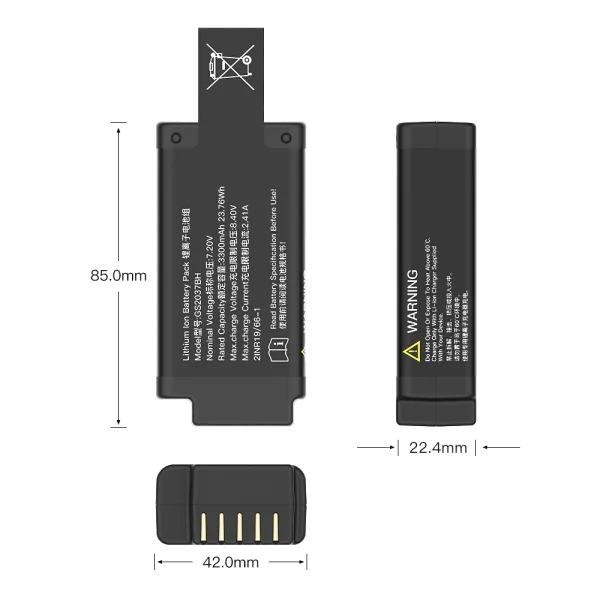
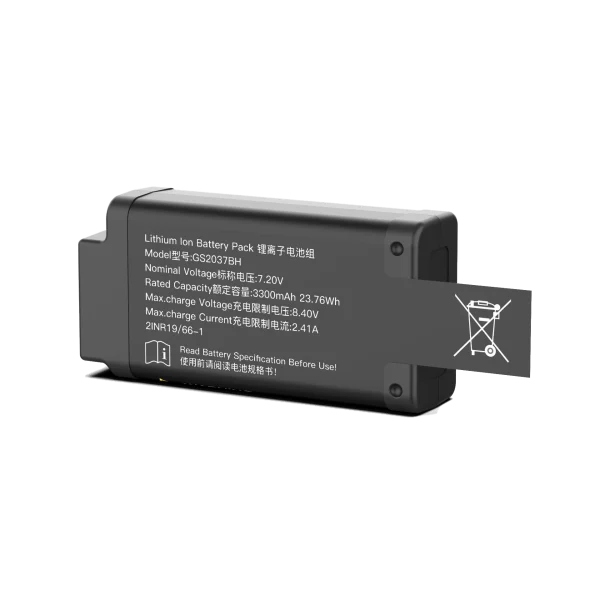
GS2037BH
7.2V/3450mAh/23.76Wh
At TEFOO, this is the work our engineering team does daily: custom rechargeable packs for medical and industrial portable equipment, built on smart BMS platforms with SMBus communication, certified to IEC 62133-2, IEC 62619 and UN 38.3, and delivered with a complete engineering file. What we advise every customer — whether or not they buy from us — is to never accept a pack from a supplier who cannot show you the cells, the BMS or the test reports. Those three documents separate an engineered battery from a gamble.
FAQ
How long will a portable DAQ battery last on a single charge?
There is no universal answer — runtime is load, not battery. Use runtime = capacity × usable DOD ÷ average current. A 10 Ah pack at a 20 mA average runs about 400 hours; a 74 Wh pack feeding a 5 W DAQ runs about 11.8 hours. Give your vendor the average and peak current and the mission duration; capacity follows from arithmetic, not opinion.
What battery is best for an outdoor data logger in freezing temperatures?
For rechargeable systems, use lithium-ion with low-temperature charge protection in the BMS and oversize capacity by 20–30% for cold derating. For multi-year unattended loggers, primary LiSOCl2 (ER-series) is the classic choice: very low self-discharge, wide temperature capability and no charger dependency.
Can I just use a power bank for my DAQ system?
For a lab demo, yes. For field campaigns, usually no. Power banks are not rated for cold, shock or sustained high load; most have undocumented protection circuits, and their USB output can brown out under a 2 A sensor or radio burst. A single lost deployment costs far more than the price difference of a proper pack.
What certifications does a portable battery need for international shipping and sale?
UN 38.3 for transport — mandatory, with the test report. IEC 62133-2 (portable) or IEC 62619 (industrial) for safety. UL 2054 for US channels. CE and RoHS for the EU. Ask for the reports, not a sticker; anyone can print a logo.
How do I size a battery for a 72-hour deployment?
Measure the real load profile first — average power and worst-case peak. Total energy = 72 h × average power ÷ usable DOD (0.8). Then add 20–30% for cold and ageing, and confirm the pack’s continuous and pulse current ratings cover your peaks.
What is a smart BMS and why should I care?
A smart BMS protects the pack — overcurrent, over- and under-voltage, temperature and low-temperature charge blocking — and talks to your DAQ over SMBus or I2C, reporting state of charge, current and health. It changes a ‘system died’ event into a ‘battery at 12%, plan a swap’ notice. For unattended deployments, that is the difference between data and no data.
Can the pack be customised — voltage, shape, connector, capacity?
Yes — that is the purpose of a custom pack. Configurations from 1S to 6S, any enclosure shape, keyed connectors, hot-swap dual bays, integrated heaters or solar charge input. Send the mechanical envelope and the load profile, and the design is scoped from there.
What should I ask a battery vendor before ordering?
A short checklist: Which cells, what grade, and is provenance documented? What BMS functions, and what is the test evidence? Do you hold UN 38.3 and IEC 62133-2 or IEC 62619 reports for this specific design? What is the cold-charge and cold-discharge behaviour, with data? What documentation do I receive — BOM, schematics, FMEA, test reports? And what is the warranty and field-failure procedure?
Summary
Three decisions separate a successful field campaign from a re-run. First, match the load profile: know your average and peak power before you buy anything. Second, match the chemistry: rechargeable Li-ion for DAQ work, primary LiSOCl2 for long-life loggers, LFP where cycle life is the constraint. Third, match the compliance: UN 38.3, IEC 62133-2 or IEC 62619, UL 2054 and CE/RoHS — with reports, not stickers.
A battery is a few percent of a DAQ system’s cost and 100% of its mobility. Spend the engineering attention where the failures actually happen.
References
- Mordor Intelligence — Data Logger Market — https://www.mordorintelligence.com/industry-reports/data-logger-market
- The Business Research Company — Data Logger Global Market Report 2026–2030 — https://www.thebusinessresearchcompany.com/report/data-logger-global-market-report
- Mordor Intelligence — Global Data Acquisition (DAQ) Market — https://www.mordorintelligence.com/industry-reports/global-data-acquisition-daq-market-industry
- Research and Markets — Data Acquisition (DAQ) System Market Report 2026 — https://www.researchandmarkets.com/reports/5767239/data-acquisition-daq-system-market-report
- IEC Webstore — IEC 62133-2:2017 + AMD1:2021 — https://webstore.iec.ch/en/publication/32662
- IEC Webstore — IEC 62619:2022 — https://webstore.iec.ch/en/publication/76174
- UL Standards — UL 2054, Standard for Household and Commercial Batteries — https://www.shopulstandards.com/ProductDetail.aspx?productId=UL2054_3_S_20211117
- UNECE — UN Manual of Tests and Criteria, Section 38.3 (UN 38.3), clarification note — https://unece.org/sites/default/files/2024-05/ST-SG-AC10-C3-2024-56E.pdf
- TÜV SÜD — UN/DOT 38.3 Transportation Testing — https://www.tuvsud.com/en-us/industries/mobility-and-automotive/automotive-and-oem/automotive-testing-solutions/battery-testing/un-dot-38-3
- Ryder Electronics — Why Does Your Lithium Battery Perform Poorly in Winter — https://www.ryderelectronics.com/news/why-does-your-lithium-battery-perform-poorly-i-85598871.html
- PMC — Research on Performance Constraints and Electrolyte Optimization Strategies for Lithium-Ion Batteries at Low Temperatures — https://pmc.ncbi.nlm.nih.gov/articles/PMC11912001/
- Large Battery — Low-Temperature Charging Protection for Lithium Battery Packs: BMS Control Strategies — https://www.large-battery.com/blog/low-temperature-charging-protection-bms-control-strategies/
- PKCELL — Industrial Data Logger Battery Guide: ER14505 vs ER26500 vs ER34615 — https://www.pkcellpower.com/news/industrial-data-logger-battery-guide-er14505-vs-er26500-vs-er34615/
- Westinghouse Battery — Lithium-Thionyl Chloride Cells — https://www.westinghousebattery.com/ukr/Specialty-Batteries/Lithium-Thionyl-Chloride.html
- IC Online — Battery-Powered Data Logger: Design Walkthrough and Field Test Results — https://www.ic-online.com/blog/post/r5f52318adfp-in-a-battery-powered-data-logger-design-walkthrough-and-field-test-results