
By TEFOO Battery Engineering Team | October 28, 2026
1. Introduction
Portable coordinate measuring machines (CMMs) have fundamentally transformed quality inspection workflows across aerospace, automotive, medical device manufacturing, and precision engineering. Unlike their fixed-floor counterparts, portable CMMs — including articulated arm systems, handheld probes, and laser scanners — are designed to travel to the workpiece, enabling on-machine inspection, shop-floor quality control, and field metrology audits.
As the metrology industry shifts from tethered, mains-powered systems to fully wireless operation, the lithium-ion battery pack has emerged as a critical sub-system that directly impacts measurement accuracy, operational uptime, and total cost of ownership. Drawing on over 15 years of engineering experience designing battery systems for industrial and medical precision equipment, this guide provides a deep technical analysis of the requirements, benchmarks, and best practices for portable CMM battery design and selection.
2. What Is a Portable CMM and Why Battery Matters
A coordinate measuring machine precisely measures the geometric characteristics of physical objects by sensing discrete points on the object surface. Portable CMM variants employ different sensing architectures: articulated arms use rotary encoders at each joint, handheld probes integrate optical or tactile sensors, and laser trackers rely on interferometric distance measurement.
What unites all these systems is their extreme sensitivity to power quality. The encoders, signal conditioners, and analog-to-digital converters (ADCs) inside a CMM operate at microvolt-level resolution — meaning even millivolt-level fluctuations in the power rail can translate directly into measurement uncertainty. This is why portable CMM battery design is not simply a matter of “how many mAh” — it is a precision power engineering challenge.
3. Core Technical Requirements for Portable CMM Batteries
3.1 Voltage Stability and Measurement Precision
The single most critical requirement for a CMM battery is output voltage stability. Precision encoders and sensor front-ends in a typical articulated arm CMM operate with 16-bit to 24-bit resolution, where a 10 mV supply ripple can induce measurable angular error at the probe tip. Engineering best practice calls for a battery management system (BMS) with voltage regulation accuracy of ±10 mV or better, combined with low-ESR output filtering to suppress high-frequency noise.
From our engineering experience at TEFOO, we have observed that poorly regulated battery packs can introduce up to 2–5 μm of measurement uncertainty at a 1.5 m arm radius — enough to push a precision inspection out of tolerance. This is why CMM battery design prioritizes noise performance ahead of raw energy density.
3.2 Energy Density and Runtime
Typical portable CMM applications demand 4 to 16 hours of continuous field operation on a single charge. Shop-floor inspection routines often involve back-to-back measurement cycles lasting entire shifts, while field metrology audits at remote manufacturing sites may require all-day autonomy.
High-energy-density lithium-ion cells (250–280 Wh/kg at the cell level) are the standard choice. Many modern systems adopt a dual-battery hot-swap architecture — two independent packs that can be swapped without powering down the instrument. This design eliminates downtime during battery changes and is particularly valued in production-line environments where measurement continuity is essential.
3.3 Intelligent BMS and SMBus Communication
A sophisticated battery management system is the intelligence layer between the cell chemistry and the host CMM. For precision metrology equipment, the BMS must deliver:
- State-of-charge (SOC) estimation accurate to ±1–2%, based on coulomb counting combined with voltage-based calibration
- Individual cell voltage monitoring at 1 mV resolution, enabling precise overcharge/over-discharge threshold setting
- SMBus v1.1 / I2C communication protocol, allowing the CMM host controller to read battery status, fuel gauge data, and fault codes in real time
- State-of-health (SOH) tracking through internal resistance measurement, predicting end-of-life before performance degradation affects measurement workflows
SMBus communication is particularly important in CMM applications: the host metrology software can display remaining runtime directly in the inspection interface, warn operators before a low-battery event, and log battery health as part of the instrument calibration record.
3.4 Environmental Adaptability
Portable CMMs operate in demanding industrial environments. The battery pack must withstand:
- Extended temperature ranges: -10 °C to 50 °C operating, with storage range extending from -20 °C to 60 °C
- Vibration and shock from transport between measurement stations and in-vehicle transport
- Humidity, dust, and coolant exposure on the shop floor, typically requiring IP54 or higher enclosure rating
Low-temperature performance is a known challenge for lithium-ion chemistry. At -10 °C, discharge capacity can drop by 30–40% compared to room temperature unless the pack incorporates thermal management or uses low-temperature-optimized cell chemistry.
3.5 Weight and Form Factor Constraints
Portable CMMs are carried or mounted on tripods throughout the workday, so every gram counts. A typical articulated arm CMM weighs 6–15 kg total, and the battery pack represents 8–15% of that mass. Designing a pack that delivers maximum energy within tight weight and dimensional envelopes requires careful cell selection, structural optimization, and thermal engineering.
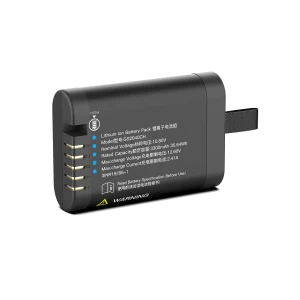
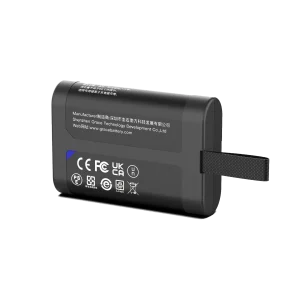
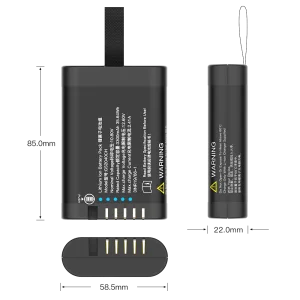
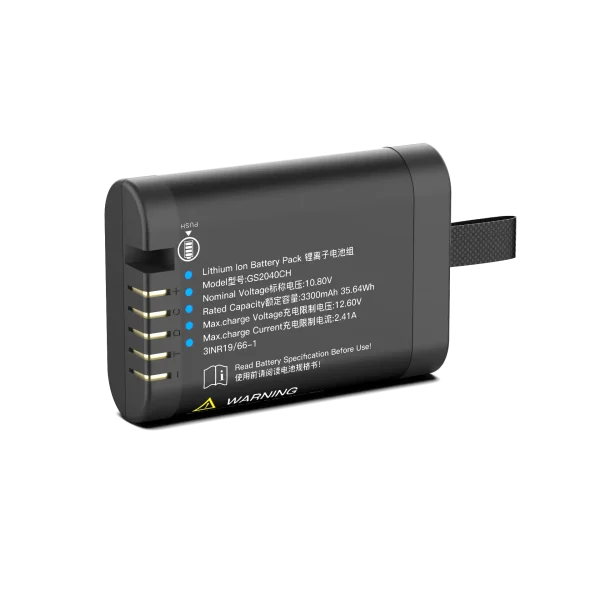
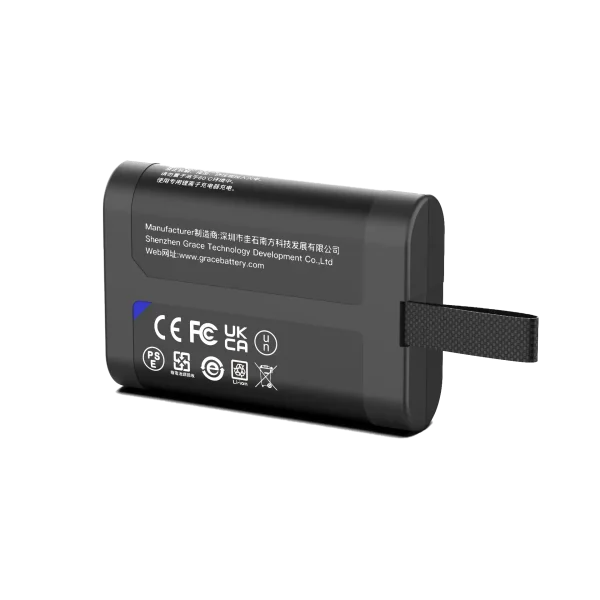
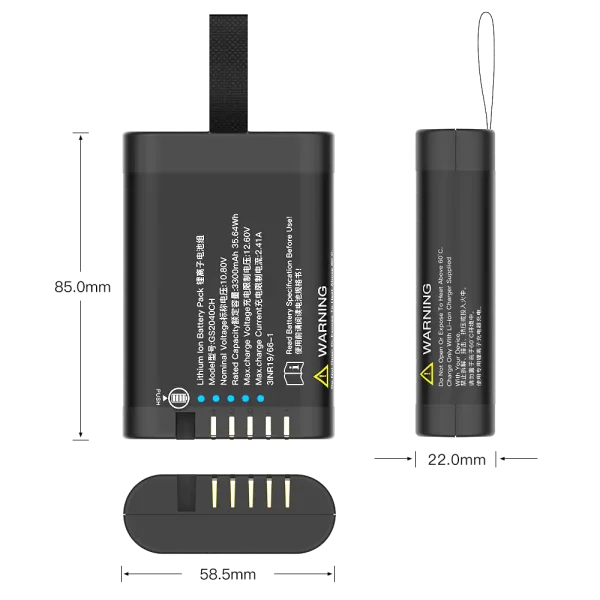
GS2040CH
10.8V/3450mAh/35.64Wh
4. Certification and Compliance Landscape
For portable CMM batteries deployed in global industrial markets, a layered certification framework is expected. Understanding the distinction between these standards is essential for both OEMs and end users:
4.1 IEC 62133-2: Portable Sealed Secondary Lithium Cells
IEC 62133-2 is the primary safety standard for portable lithium-ion cells and batteries, covering requirements for external short circuit, overcharge, overdischarge, free fall, impact, and thermal abuse. It is widely accepted as the baseline safety requirement for battery packs used in portable electronic and industrial equipment.
4.2 UN 38.3: Transport Safety
UN 38.3 (Section 38.3 of the UN Manual of Tests and Criteria) mandates a series of transport-related tests — including altitude simulation, thermal cycling, vibration, shock, external short circuit, impact, overcharge, and forced discharge. Every lithium cell and battery pack shipped commercially must pass UN 38.3, and test summaries must accompany shipping documentation.
4.3 CE Marking and (EU) 2023/1542 Battery Regulation
CE marking demonstrates conformity with applicable EU legislation, including the Low Voltage Directive and EMC Directive. More recently, the EU Battery Regulation (EU) 2023/1542, which entered into force in 2023, introduces new requirements for carbon footprint declaration, battery passporting, recycled content percentages, and end-of-life collection. OEMs serving the European market must plan for phased compliance through 2027–2030.
4.4 ISO 9001 and Quality System Certification
Beyond product-level certifications, the battery manufacturing facility itself should operate under a certified ISO 9001 quality management system. For medical-grade metrology applications, ISO 13485 may additionally be required if the CMM is used in regulated medical device manufacturing environments.
5. TEFOO Engineering Solutions for Portable Metrology
At TEFOO, we have spent over a decade developing intelligent lithium battery systems for precision medical and industrial equipment. Our approach to portable CMM battery design is built on four engineering pillars:
- Precision BMS Platform: Our BMS hardware achieves 1 mV cell voltage sampling accuracy and ±1% SOC estimation, with full SMBus v1.1 protocol support for host communication.
- Low-Noise Power Architecture: We implement multi-stage filtering and low-dropout regulation to keep output ripple below 5 mV peak-to-peak, protecting sensitive CMM sensor electronics.
- OEM Customization: From 3S 10.8 V compact packs to multi-cell high-capacity dual-battery systems, we work with CMM OEMs to develop application-specific battery form factors, connectors, and communication protocols.
- Industrial-Grade Quality: All TEFOO packs undergo UN 38.3 transport testing, IEC 62133 safety certification, and are manufactured under ISO 9001 certified processes, with medical-grade options available under ISO 13485.
6. Frequently Asked Questions
Q1: How long does a typical portable CMM battery last?
Typical runtime ranges from 4 hours on compact handheld probe systems to 16+ hours per pack on high-end articulated arm scanners, with dual-battery configurations extending total autonomy to 32 hours. Actual runtime depends on measurement frequency, wireless data transmission load, and ambient temperature.
Q2: Can I use third-party replacement batteries for my CMM?
While generic third-party packs may be physically compatible, we recommend OEM-specified or engineering-equivalent packs for precision metrology equipment. Voltage regulation accuracy, communication protocol compatibility, and certified safety performance are all factors that generic replacements often compromise. Using non-certified batteries may also void the CMM manufacturer’s warranty and introduce measurement uncertainty.
Q3: How does temperature affect CMM battery performance and measurement accuracy?
Lithium-ion battery capacity and voltage drop significantly at low temperatures — at -10 °C, available capacity can fall by 30–40%. Beyond the battery itself, CMM dimensional accuracy is temperature-sensitive: most precision CMMs are calibrated at 20 °C, and thermal expansion of both the instrument and the workpiece affects measurement results. For field metrology, allow the CMM and battery pack to acclimate to ambient temperature before taking critical measurements.
Q4: What is the expected cycle life of a CMM battery pack?
A well-engineered lithium-ion pack with a proper BMS typically delivers 500–800 charge-discharge cycles before dropping to 80% of original capacity. For a CMM used 3–4 times per week, this translates to 3–5 years of service life. Cycle life is heavily influenced by operating temperature and charge-discharge depth — shallow cycles and moderate temperatures extend pack life.
Q5: How should CMM batteries be stored for long periods?
For long-term storage (over 3 months), store the battery at 40–60% state of charge in a cool, dry environment at 15–25 °C. Avoid fully charging or fully discharging before storage, as both states accelerate capacity fade. Recharge to 50% every 6 months to prevent deep discharge that could trigger BMS lockout.
7. Conclusion and Future Trends
The portable CMM battery is far more than a convenient power source — it is a precision sub-system that directly shapes measurement quality, operational flexibility, and total cost of ownership. As metrology equipment continues to evolve toward fully wireless, AI-assisted inspection workflows, the battery pack will play an increasingly strategic role.
Looking ahead, we see three key trends: (1) higher energy density through advanced cell chemistry, extending runtime without weight penalty; (2) deeper system integration, where the battery BMS communicates bidirectionally with the metrology software for predictive maintenance and performance optimization; and (3) growing regulatory pressure under frameworks like EU 2023/1542, requiring OEMs to account for carbon footprint and circularity from the earliest design stages.
For CMM manufacturers and end users alike, investing in a properly engineered, certified, and application-optimized battery pack is not a cost center — it is a precision investment that protects measurement accuracy and maximizes the return on metrology equipment.