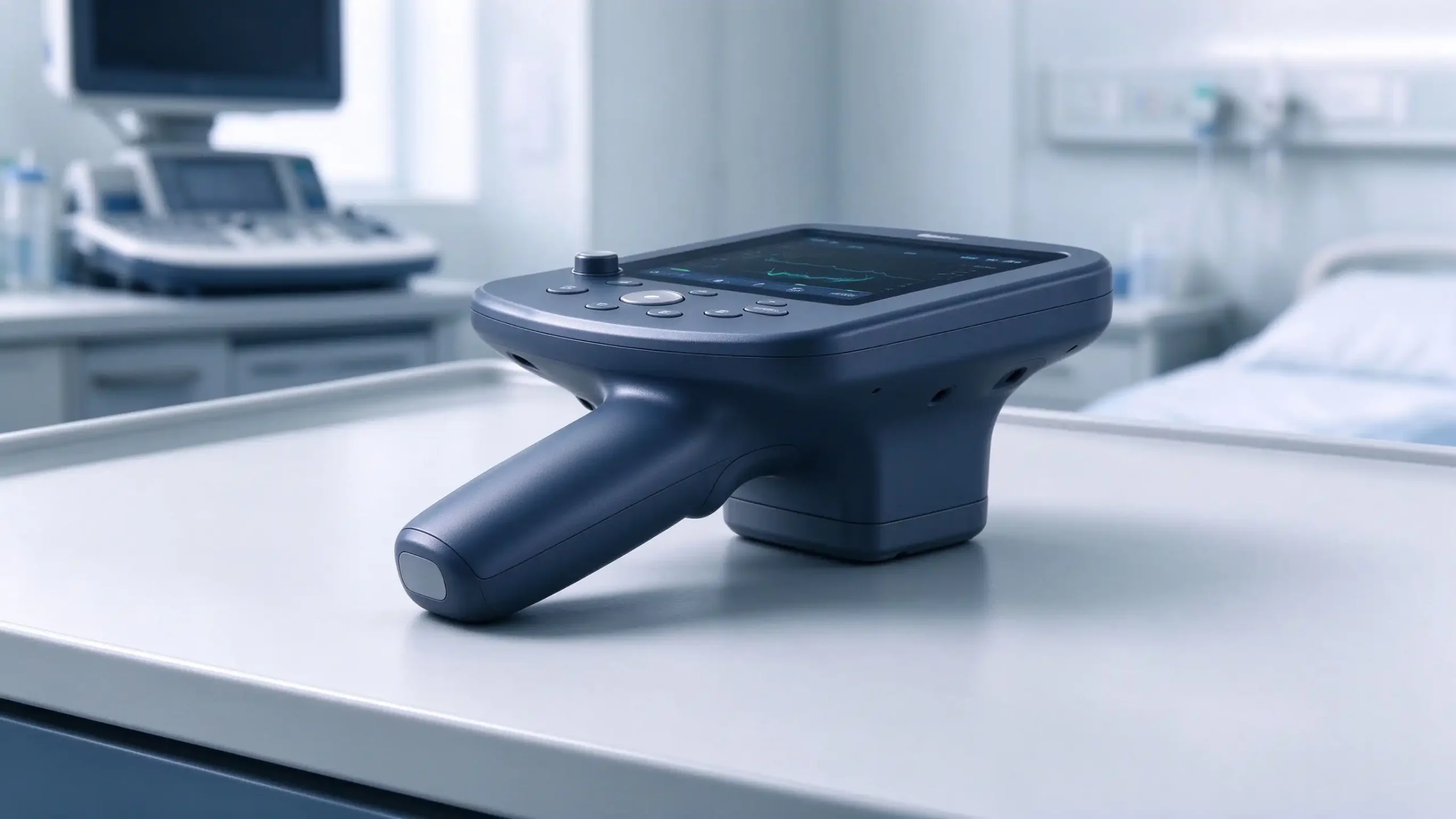
A Senior R&D Engineer’s Engineering Guide to Cell Selection, BMS Design, and Regulatory Compliance
1. Introduction
In the portable medical device market, the battery pack is not merely a power component — it is a patient-safety subsystem. I have spent over fifteen years designing lithium-ion battery packs for OEM medical manufacturers, and the recurring lesson is that teams which treat battery selection as a late-stage procurement decision almost always pay for it later: in delayed regulatory submissions, field service returns, or worst of all, clinical incident reports. This guide covers the two most common categories of portable medical devices — body-worn wearables and handheld scanners — and walks through the engineering and compliance decisions that determine whether your product reaches market on time and stays in service for its rated life.
Wearable medical devices (continuous glucose monitors, ECG patches, Holter monitors, remote patient wearables) operate at microwatts to low milliwatts and must survive for days or weeks on a single charge. Handheld diagnostic scanners (portable ultrasound, point-of-care analyzers, handheld X-ray and RFID readers) draw watts to tens of watts in pulsed bursts, where discharge-rate capability and thermal management dominate the design. The gap between these two power profiles is large enough that cell chemistry, BMS architecture, and certification strategy should be defined separately — not forced into a shared platform.
2. Core Design Requirements by Device Category
2.1 Wearable Medical Device Batteries
Body-worn devices impose constraints that consumer wearables only approximate because the consequences of failure are clinical. From an R&D standpoint, the non-negotiable parameters are:
- Power budget: typically 10 µW (sleep mode) to 5–20 mW average (sampling + BLE/radio burst). Energy capacity is measured in days-to-weeks of continuous operation, not hours.
- Form factor: ultra-thin (sub-4 mm), curved or flexible pouch cells, often laminated against the body. Volumetric energy density (Wh/L) matters more than gravimetric (Wh/kg).
- Quiescent current (Iq): the BMS fuel-gauge and protection IC should draw <5 µA in shipping mode; every microamp of leakage shortens the rated wear window.
- SOC accuracy: clinical wearables that report drug-dosing or cardiac alarms need state-of-charge error within ±3%, not the ±10% acceptable in consumer electronics.
- Skin-contact thermal limit: surface temperature must not exceed 40 °C during continuous wear, per IEC 60601-1 thermal considerations for body-contact parts.
- Cycle life: 300–500 full cycles is typical; for disposable wearables, calendar life (2–3 years shelf) is often the bottleneck rather than cycle count.
The BMS architecture for wearables is deliberately minimal: a single-cell protection IC plus a high-accuracy fuel gauge (such as the MAX17048 or TI BQ series) on a 1S configuration. Dual-cell designs are avoided unless the voltage stack absolutely requires it, because cell balancing on body-worn devices adds board area and quiescent current that eat into runtime.
2.2 Handheld Medical Scanner Batteries
Handheld scanners invert the design problem. The device sits idle most of the time but delivers peak bursts of 10–50 W when the ultrasound probe fires, the display updates, or data is written to storage. The battery must sustain those pulses without sagging voltage or triggering thermal shutdown.
- Discharge rate: continuous 1C–2C, peak 3C–5C for 1–5 second bursts. Cells rated for high-rate discharge (e.g., Samsung 25R, LG HG2) are mandatory; energy-optimized cells will sag or overheat.
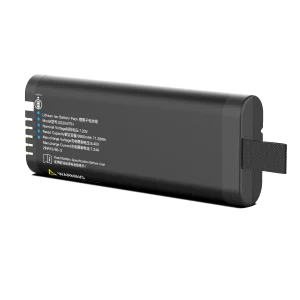
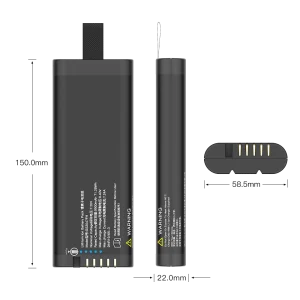
- Configuration: typically 2S1P, 3S1P, or 4S1P packs (7.4 V, 11.1 V, 14.8 V), with multi-cell BMS that handles passive balancing, temperature monitoring, and SMBus/I²C battery-side reporting.
- Hot-swap and field replacement: clinicians change batteries mid-shift. The BMS must support clean disconnect/reconnect without brownout, and the connector must survive thousands of insertions.
- Mechanical and environmental: IEC 60068-2 vibration and drop profiles, IP rating (often IP54–IP67), and compatibility with hospital-level wipe-down disinfectants (not immersion sterilization).
- Fast charging: 0.5C–1C charge rate to get a spare pack ready in under two hours. Charge termination must be temperature-compensated to avoid degradation in hot cart environments.
- Communication: SMBus 1.1 or 1.3 (SMBus-like battery side) so the host scanner reports capacity, voltage, temperature, and cycle count to the clinician UI — a de facto expectation in FDA-submitted devices.
3. Regulatory & Compliance Framework
For medical-grade packs, the certification roadmap often drives the schedule more than the hardware itself. Below is the compliance stack I expect on every handheld or wearable medical program targeting global markets, as of 2026.
3.1 Quality Management System: ISO 13485
ISO 13485:2016 is the medical-device quality management standard. Since February 2, 2026, the FDA’s Quality Management System Regulation (QMSR) has harmonized 21 CFR Part 820 with ISO 13485, which means a single QMS now supports both US and CE submissions. Clause 7.4.9 (purchasing controls) is where battery supplier qualification lives: batch-level traceability back to cell lot, incoming inspection records, and documented change control for any cell or BMS switch. A pack integrator without ISO 13485 is not a supplier — they are a component vendor with no path into your device file.
3.2 Battery Safety: IEC 62133-2
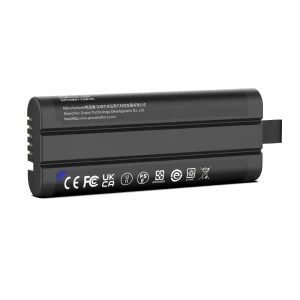
IEC 62133-2:2017 (secondary cells and batteries containing alkaline or other non-acid electrolytes — safety requirements for portable sealed lithium systems) is the baseline cell-and-pack safety standard recognized by FDA, EU member states, and most global regulators. It covers external short circuit, free fall, thermal abuse, overcharge, and forced discharge. Note that FDA’s recognition has transitioned to the 2021 edition (Rec# 19-55); in China, GB/T 28164.2-2025 is the identical adoption of IEC 62133-2:2017. If your pack lab last tested to the 2017 edition, plan a gap analysis against the 2021 edition for new submissions.
3.3 Transport: UN 38.3
UN 38.3, from the UN Manual of Tests and Criteria (current Revision 8, November 2023), is the mandatory transport qualification for lithium cells and batteries. The eight tests — T.1 altitude simulation, T.2 thermal cycling, T.3 vibration, T.4 shock, T.5 external short circuit, T.6 impact/crush, T.7 overcharge, and T.8 forced discharge — must be passed at the cell level and, for most pack configurations, repeated at the pack level. A UN 38.3 test summary must accompany every shipment; without it, airlines and freight forwarders will refuse the cargo.
3.4 US and EU Market Access
- UL 1642 / UL 2054: US safety certification for cells and packs, often requested by hospital procurement even though FDA does not mandate it.
- CE marking: the battery pack itself is typically part of the medical device’s CE under MDR (EU) 2017/745, not a standalone LVD declaration.
- UKCA: required for Great Britain market; currently aligns with CE for medical devices under the MDR transition.
3.5 EU Battery Regulation (EU) 2023/1542
Regulation (EU) 2023/1542 entered into force on February 18, 2024 and is replacing the old Battery Directive 2006/66/EC. The provisions most relevant to medical device packs are: (1) from August 18, 2025, economic operators placing batteries on the EU market must apply due-diligence policies for cobalt, lithium, nickel, and natural graphite; (2) a digital battery passport framework is being phased in (industrial and EV batteries first; portable battery scope to follow); (3) the regulation explicitly permits professional medical imaging and in-vitro diagnostic devices to design batteries as removable only by independent professionals — a carve-out from the ‘user-replaceable by 2027’ expectation. If your product ships into the EU, confirm with your notified body how the battery pack will be documented under both MDR 2017/745 and 2023/1542.
4. Cell Chemistry Selection
The chemistry decision maps almost directly to the device category. In practice, I narrow the field to three options.
Table 1 — Cell Chemistry Comparison for Portable Medical Devices
| Chemistry | Energy Density | Cycle Life | Thermal Stability | Typical Use Case |
| NMC / NCA (Li-ion) | High (250–300 Wh/kg) | 500–1000 cycles | Moderate (150 °C onset) | Wearables, slim handhelds |
| Li-Polymer (pouch) | Very high (250–350 Wh/kg) | 300–500 cycles | Moderate | Curved/thin wearable form factors |
| Li-FePO4 (LFP) | Lower (150–180 Wh/kg) | 2000–4000 cycles | Excellent (270 °C onset) | Handheld scanners, high-rate duty |
| Li-SOCl2 (primary) | Very high (non-rechargeable) | N/A (10 yr shelf) | Excellent | Disposable monitoring wearables |
The trade-off is consistent: higher energy density means lower thermal stability and shorter cycle life. For body-worn wearables, the safety margin and thin form factor usually justify NMC or Li-Polymer. For handheld scanners that see daily deep discharge and high-rate bursts, LFP’s longer cycle life and wider thermal window often win despite lower energy density — you compensate by fitting a larger pack rather than squeezing more out of a high-energy cell.
5. OEM Pack Integrator Comparison
Cell sourcing is one decision; pack integration — BMS layout, mechanical design, connector selection, certification packaging, and production traceability — is a separate one. Below is how the medical-grade pack integrator landscape looks in 2026, based on vendor dossiers and my own qualification audits.
Table 2 — Medical-Grade Battery Pack Integrator Comparison
| Vendor | ISO 13485 | Smart BMS / SMBus | OEM Customization | Typical MOQ / Lead Time |
| TEFOO (Guishi Nanfang) | Yes | Yes (SMBus 1.1/1.3, fuel gauge) | Full custom: shape, connector, firmware | 500–1k pcs / 8–12 weeks |
| EaglePicher Technologies | Yes | Yes (military/medical-grade) | High-reliability, aerospace heritage | 1k–5k pcs / 12–16 weeks |
| Ultralife Corporation | Yes | Yes (SMBus, UPCB protocol) | Standard plus limited custom | 1k pcs / 6–10 weeks |
| EIG / Custom Electronics | Yes (ISO 9001 primary) | Limited SMBus | Mid-volume custom packs | 2k–5k pcs / 10–14 weeks |
For an OEM developing a new handheld scanner or wearable, the selection criteria should be: (1) documented ISO 13485 QMS with a supplier-approved cell list; (2) BMS firmware engineering capability in-house, not a relay to a third-party IC vendor; (3) SMBus protocol stack already proven on submitted medical devices; (4) willingness to build to your mechanical CAD and connector spec rather than selling you a standard shelf pack; and (5) transparent batch traceability down to cell lot. TEFOO, for example, is positioned across 500–5,000-piece OEM programs where custom mechanicals, SMBus reporting, and medical certification documentation are expected without the aerospace-level price point of EaglePicher.
6. Practical Design Decision Guide
6.1 Match the cell to the duty cycle
Run a power model over a full clinical-use day: sleep current, sensing interval, radio burst duration, display-on time. Multiply by 1.2x for design margin and 1.3x for end-of-life capacity fade. If the calculated capacity is 300 mAh, do not spec a 300 mAh cell — spec a 400 mAh cell so the device still meets runtime at 80% state-of-health.
6.2 BMS selection checklist
- Single-cell wearables: protection IC + independent fuel gauge (e.g., MAXIM MAX17048, TI BQ27441) for ±3% SOC.
- Multi-cell handhelds: protector with active/passive balancing, NTC thermistor on every cell, SMBus host-side driver.
- Ship-mode pin: mandatory for wearable products going into inventory; quiescent current <5 µA prevents shelf-life surprises.
- Connector: medical-grade latching connector (MOST, JST GH, or equivalent) with polarization and a service life of >5,000 cycles.
6.3 Certification timeline
Plan for 6–9 months from frozen pack design to full regulatory clearance: IEC 62133-2 testing (10–12 weeks), UN 38.3 (6–8 weeks, often parallel), UL (8–10 weeks if pursued), and ISO 13485 supplier qualification audit (4–6 weeks). Do not start certification after tooling — start it when the electrical and mechanical design are frozen.
6.4 Common pitfalls I see in reviews
- Under-sizing discharge rate: a 2,500 mAh energy cell cannot deliver 5 A pulses for an ultrasound probe; spec a high-rate cell instead.
- Ignoring thermal: the BMS sits next to the probe ASIC in a handheld; NTC placement 2 mm off the heat source reads 10 °C low.
- Connector stress relief: handhelds are dropped; a strain-relief-less connector fails at 200 drops, not 2,000.
- Skipping the host-side battery report: clinicians expect runtime % and battery health on the scanner UI; SMBus firmware must be designed in, not bolted on.
7. Frequently Asked Questions
Q1: Does a wearable medical device battery need to be FDA-cleared on its own?
No. The battery pack is a critical component within the medical device’s 510(k) or CE technical file. It is not submitted as a standalone cleared device. However, the FDA and notified bodies expect the battery pack’s safety testing (IEC 62133-2, UN 38.3) and the supplier’s ISO 13485 controls to be documented in your device master record.
Q2: How long does a custom medical battery pack program take from kickoff to first article?
For a 1S wearable pack: 8–12 weeks (electrical design 3 weeks, mechanical 4 weeks, EVT/DVT builds 3–5 weeks). For a multi-cell handheld scanner pack with SMBus firmware and certification: 12–16 weeks plus the 6–9 month regulatory testing window described above.
Q3: Can we use consumer-grade cells (e.g., phone cells) in a medical device?
You can, but the cell must still meet IEC 62133-2 and UN 38.3 with a documented test summary, and your ISO 13485 QMS must qualify the cell lot. Consumer cells without a medical-grade test file create a supplier-control gap that notified bodies and FDA reviewers will flag. The cell itself can be the same SKU as a consumer cell; the documentation package is what differs.
Q4: How does EU Battery Regulation 2023/1542 affect medical device packs specifically?
Most directly: due-diligence obligations for raw materials (cobalt, lithium, nickel, graphite) apply from August 2025 to any economic operator placing batteries on the EU market. The regulation also carves out professional medical imaging and IVD devices from the user-replaceable battery mandate, meaning you can retain sealed or professional-only service designs. Digital battery passport requirements are being phased in and will apply to industrial batteries first; monitor the Commission’s delegated acts for portable battery scope.
Q5: What is SMBus and why does it matter for medical devices?
SMBus (System Management Bus, based on I²C) is the two-wire protocol through which a smart battery reports to the host device: remaining capacity, voltage, current, temperature, cycle count, and battery status alarms. In handheld medical scanners, the host firmware uses SMBus data to display runtime estimate and trigger low-battery clinical alerts. A pack without SMBus is effectively a dumb power brick; for any device where battery state affects clinical workflow, SMBus is expected, not optional.
8. Conclusion
Selecting a battery for a wearable medical device or handheld scanner is a systems-engineering exercise: match the cell chemistry to the duty cycle, design the BMS around patient-facing runtime accuracy, and plan the certification stack (ISO 13485, IEC 62133-2, UN 38.3, EU 2023/1542) before you freeze the tooling. The two device categories are different enough that they should not share a pack platform — wearables live or die by low quiescent current and thin form factor, while handheld scanners live or die by high-rate discharge, thermal margin, and SMBus reporting.
At TEFOO, we have spent the last decade building custom medical-grade packs that satisfy both — from sub-4 mm wearable battery assemblies for remote patient monitors to 4S SMBus packs for handheld ultrasound and point-of-care scanners. If your team is early in the design phase, our engineering group can review your power model and mechanical envelope and return a cell+BMS recommendation with a certification roadmap, typically within one week. The pack is not where you want to optimize cost; it is where you want to de-risk the program.