
Technical article by the TEFOO R&D team — senior lithium-battery engineers serving medical, industrial and precision-instrument OEMs.
Introduction
A surveyor’s day rarely ends at lunchtime. RTK base stations run for twelve hours or more on a remote control point, a robotic total station tracks a moving prism through a housing site, and a mobile LiDAR mapper scans a corridor while mounted on an ATV. In every one of these workflows, the instrument’s performance is not limited by its GNSS receiver, its angular resolution or its point-cloud density — it is limited by the battery.
The land surveying instrument market continued to expand through 2025–2026, with GNSS systems accounting for roughly 34.3% of product revenue and construction-related applications driving about 42.6% of demand; total stations and theodolites still represent around 30.9% of installed hardware. Every one of these devices is field-powered, and every one of them faces the same engineering question: how do you deliver a full working day of reliable runtime without making the pack heavier, bulkier, or less safe?
This article, written from a lithium-battery R&D perspective, explains what an all-day battery pack for field surveying actually requires, compares the three sourcing routes available to instrument OEMs, and describes how a custom OEM pack — built around a smart BMS and a defined SMBus interface — removes the runtime, compatibility and compliance risks that generic replacements leave on the table.
1. Why All-Day Power Is the Hidden Bottleneck
Field downtime is expensive. A GNSS rover that dies at 4 p.m. does not merely lose two hours of work; it forces a return trip to a vehicle, a transport of data back to the office, and a second mobilisation the next day — costs that, on a remote pipeline or corridor survey, can dwarf the price of the instrument itself.
Three structural trends have made the power problem worse rather than better:
- Higher compute and sensing load. Modern data collectors run Android-based field software, streaming GNSS correction streams, recording photos, and exporting in real time. A 3D LiDAR scanner may log hundreds of thousands of points per second while driving servos.
- Longer duty cycles. UAV-based mapping, permanent RTK base stations and structural monitoring rigs run for shifts of 10–14 hours, sometimes unattended.
- Wider environmental envelope. Survey crews work from sub-zero winter construction sites in Northern Europe and North America to 50 °C summer pavement in the Middle East and Australian outback.
A consumer-grade lithium pack selected on labelled mAh alone will not survive these conditions. The label is a laboratory number measured at 25 °C under a 0.2 C discharge; the field reality is −10 °C to +55 °C, pulse loads from motorised total stations, and a fuel gauge that the instrument firmware expects to talk to over a digital bus.
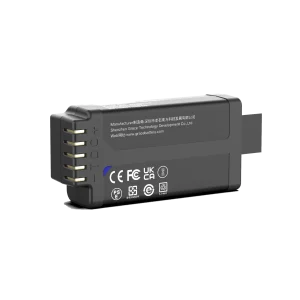
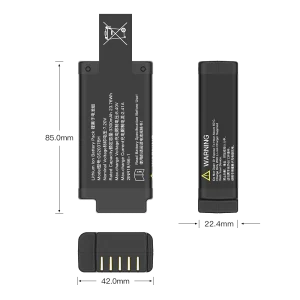
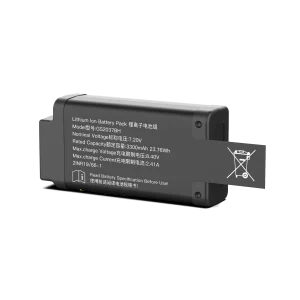
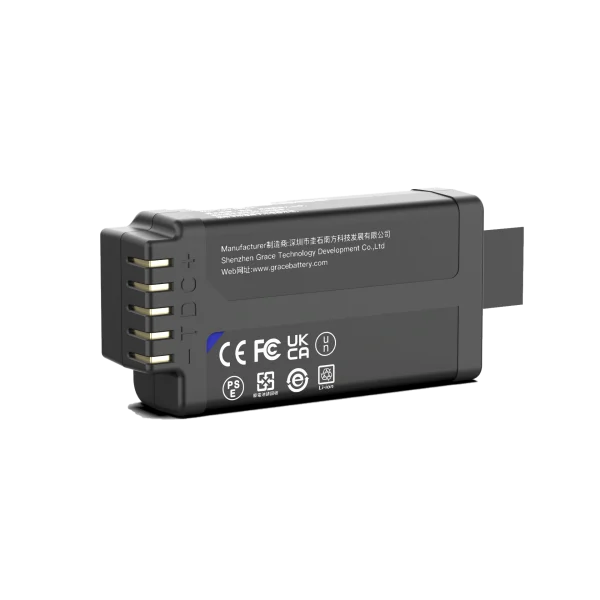
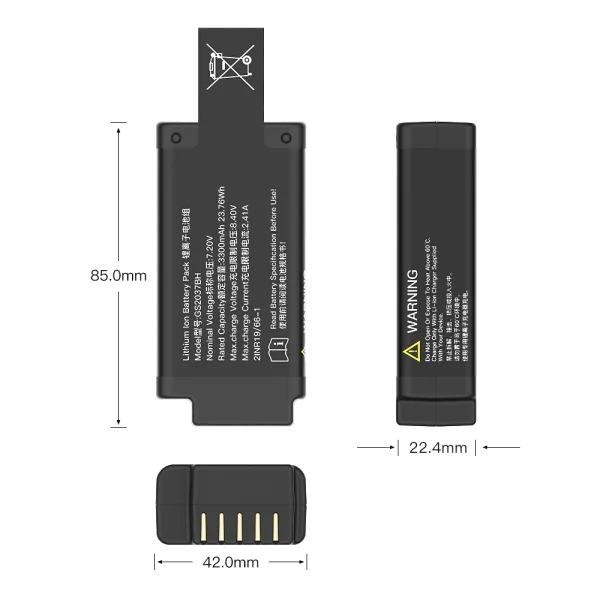
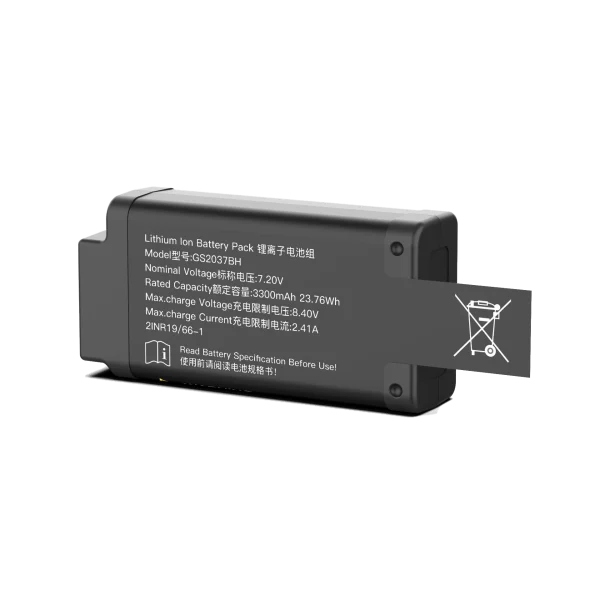
GS2037BH
7.2V/3450mAh/23.76Wh
2. The Power Profile of Modern Surveying Instruments
Before specifying a pack, an engineer must map the load. Different surveying instruments draw power in characteristically different ways:
- GNSS RTK rovers and base stations: low average current (0.5–1.5 A at nominal voltage) but long runtime targets (10–16 h), with background receivers running continuously.
- Robotic motorised total stations: low idle current, but short, high-current pulses (2–4 A) when the servo drives the telescope to locate a prism.
- Terrestrial / mobile LiDAR scanners: steady medium load (2–5 A) sustained over multi-hour scans, with cooling fans adding intermittent draw.
- Field data collectors and controllers: 1–2 A, with screen brightness and cellular modem spikes.
- UAV mapping payloads and docking stations: high-energy bursts between flights, often requiring a pack that can both deliver high peak current and accept a fast recharge between sorties.
These profiles cannot be served by a single generic cell configuration. A pack designed for a steady 1 A GNSS load will deliver a very different cycle life when it is subjected to the motor pulses of a robotic total station; a pack optimised for high-rate drone bursts will waste energy density if it sits behind a receiver drawing 500 mA. This is the core engineering reason to move from a one-size-fits-all replacement to a custom pack matched to the instrument’s duty cycle.
3. Seven Technical Requirements of a Field-Grade Battery Pack
3.1 Real-world energy density, not just labelled capacity
A 7.4 V 5,000 mAh pack and a 7.4 V 5,000 mAh pack are not equivalent. The useful energy depends on cell chemistry, the discharge cut-off voltage enforced by the BMS, and the temperature at which the instrument is actually used. A field-grade design specifies cells with a proven low-temperature discharge curve, and quotes capacity at the actual operating temperature rather than only at the 25 °C laboratory value.
3.2 Wide operating temperature range
Li-ion cells lose available capacity and internal resistance rises sharply below 0 °C, while accelerated ageing and safety risks appear above 45 °C. A credible surveying pack is specified for −20 °C to +60 °C discharge (with derating clearly communicated to the OEM), and a charging window of 0 °C to +45 °C enforced by the BMS to prevent lithium plating.
3.3 Smart BMS with digital fuel gauging
A basic protection board only disconnects on over-voltage, under-voltage, over-current and short circuit. A surveying instrument needs more: it needs to report state-of-charge accurately to the host firmware, estimate remaining runtime, and log cell imbalance. An SMBus (System Management Bus) compliant gas gauge — following the Smart Battery System protocol — lets the instrument display a true percentage and remaining minutes rather than a guessed bar.
3.4 Low self-discharge and long shelf life
Field equipment may sit in a vehicle or a store for weeks between projects. A high-quality Li-ion pack should self-discharge at less than 3% per month, and the BMS should include a shipping / storage mode that disconnects the fuel gauge so the pack arrives at the crew with usable charge.
3.5 Mechanical ruggedness and environmental sealing
Survey packs are dropped, rained on, exposed to dust and carried on backpacks and carbon-fibre poles. A production pack should specify impact resistance to the instrument’s enclosure IP rating, a flame-retardant UL94 V-0 housing, potting or conformal coating for the PCB where required, and secured cell retention against vibration.
3.6 Fast charging and controlled hot-swap behaviour
Crews often charge between sites. A smart pack supports a defined charge profile (typically 0.5 C–1 C) without forcing the user to wait overnight, and — where the instrument supports it — allows a second pack to be swapped without losing the survey session.
3.7 Certification and regulatory readiness
This is the item that most often catches OEMs late. A pack sold into the EU must comply with Regulation (EU) 2023/1542, which from 18 August 2026 requires rechargeable portable batteries to carry capacity labelling and, from 18 February 2027, a QR code linking to battery information. Safety-wise, the pack should be built to IEC 62133-2 (safety of portable sealed rechargeable lithium cells), pass UN 38.3 for transport, and carry CE and UKCA marking. For OEMs that also sell into adjacent medical or industrial markets, an ISO 13485-aligned production line and ISO 9001 / ISO 14001 management systems remove a second audit burden.
4. Custom vs. Off-the-Shelf: A Side-by-Side Comparison
Surveying instrument OEMs and larger rental fleets typically source packs from one of three routes. The table below summarises the engineering and commercial trade-offs.
| Dimension | Off-the-shelf consumer pack | Generic aftermarket replacement | TEFOO custom OEM pack |
| Form factor & fit | Generic dimensions; may not match enclosure or contacts | Reverse-engineered to a popular model; fit varies by supplier | Engineered to the OEM’s enclosure drawings, connector and contact position |
| Capacity matching | Label-only; no load-profile optimisation | Usually matched to one popular SKU | Matched to instrument duty cycle (GNSS steady vs. servo pulse vs. LiDAR continuous) |
| BMS intelligence | Basic protection only; no fuel gauge | Protection + analog NTC; limited SoC reporting | Smart BMS with accurate SoC, cell balancing, fault logging and low-power shipping mode |
| Host communication | None; voltage-only | Usually one-wire or proprietary analog | SMBus / SBS-compliant fuel gauge, customised to host firmware |
| Temperature range | 0–45 °C typical; derating undocumented | −10 to +50 °C, often unvalidated | −20 to +60 °C discharge with documented derating, 0–45 °C charge window |
| Certification | Random; often missing IEC 62133 / UN 38.3 | Certificate on file but sample may differ from shipped lot | IEC 62133-2, UN 38.3, CE, UKCA; ISO 9001 / 14001 and ISO 13485-aligned line |
| EU 2023/1542 readiness | Not addressed | Labelling added late; QR code not planned | Capacity label and 2027 QR/battery-data design built into the product from the start |
| Cycle life | 300–500 cycles, unguaranteed | 500 cycles typical | 800+ cycles at 80% DOD, specified and tested to application profile |
| Supply chain | Commodity; supplier changes weekly | Single-source; lead time variable | Stable BOM, NPI support, volume pricing, traceable lot records |
Table 1. Comparison of sourcing routes for surveying instrument battery packs.
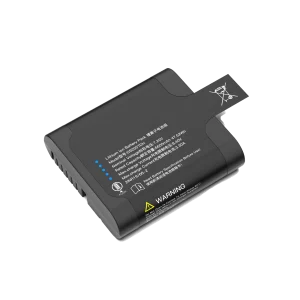
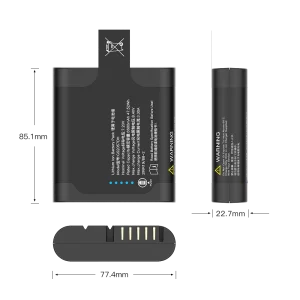
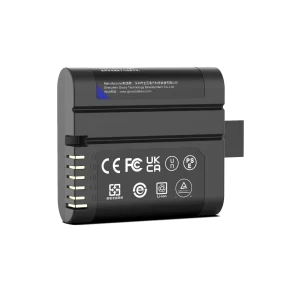
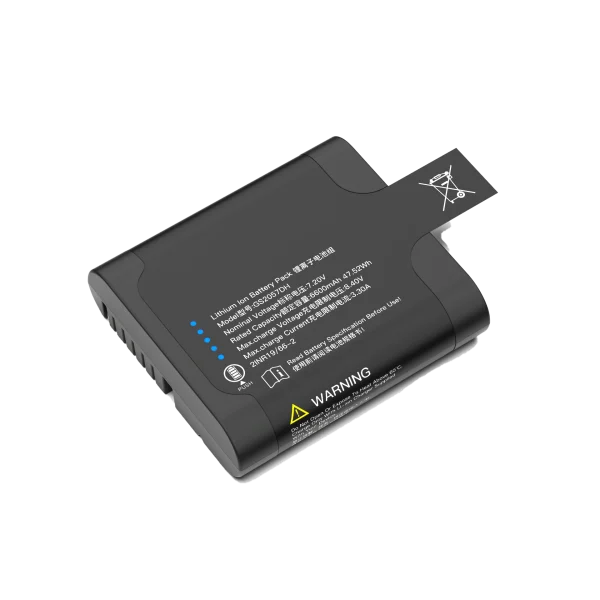
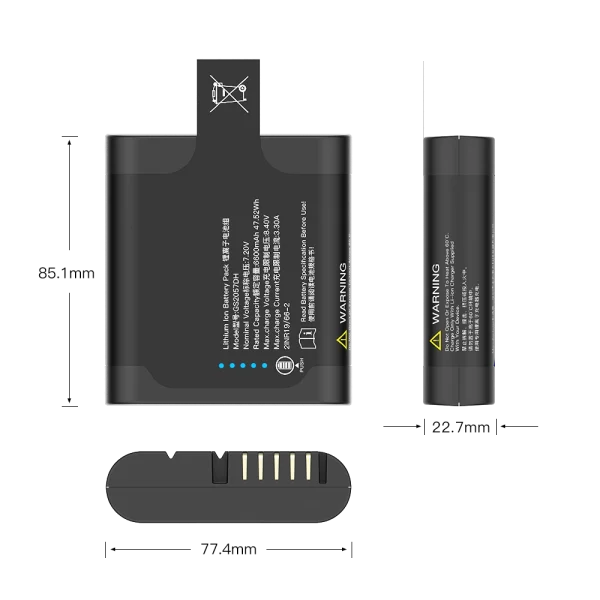
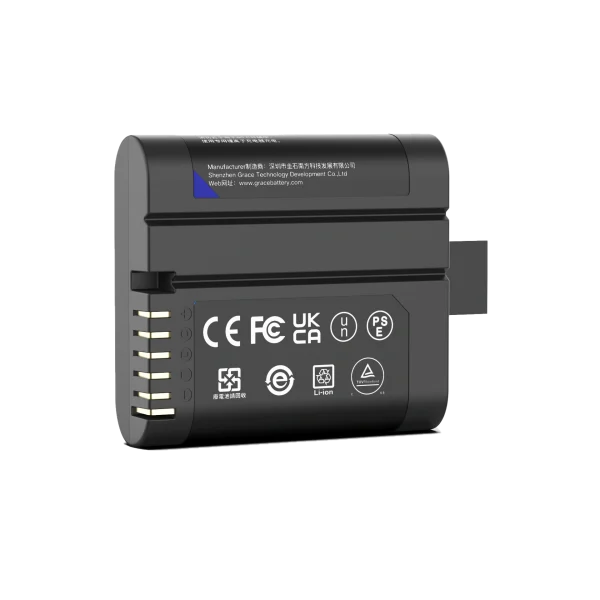
GS2057DH
7.2V/6900mAh/47.52Wh
5. How TEFOO Designs a Custom Pack for Surveying Instruments
At TEFOO, a custom pack project starts not with a cell but with the instrument. The R&D team works from the OEM’s mechanical drawings, host communication specification and intended operating environment, and then designs the pack around four engineering pillars:
- Chemistry and cell selection. We select grade-A cells matched to the instrument’s duty cycle — high-energy cells for long-duration GNSS rovers, high-rate cells for motorised total stations and UAV payloads.
- Smart BMS with SMBus. Our packs integrate a programmable fuel gauge that reports accurate state-of-charge, remaining run time, cycle count and cell voltage history to the host over SMBus, matching the instrument’s existing SBS driver.
- Wide-temperature rugged design. The pack is qualified across the surveying operating envelope, with BMS-enforced charging thresholds, a flame-retardant enclosure and vibration-tested cell retention.
- Compliance by design. Every custom pack is built on an ISO 9001:2015 and ISO 14001:2015 managed line, with production controls aligned to ISO 13485 for adjacent medical and precision-instrument customers; each pack is tested to IEC 62133-2 and UN 38.3, marked CE and UKCA, and designed to carry the EU 2023/1542 capacity and QR-code labelling obligations as they phase in through 2026–2027.
For an OEM, the practical outcome is simple: one validated part number that fits the enclosure, talks to the firmware, survives the field, and is audit-ready for every market the instrument ships into — rather than a stack of uncertified replacements that crews swap in the parking lot.
6. Frequently Asked Questions
Q: Can I use a consumer USB power bank to extend my total station or GNSS rover runtime?
A: It works occasionally, but it is not a production solution. Most surveying instruments expect a defined SMBus or proprietary fuel-gauge interface, a specific cut-off voltage, and a protected connector. A power bank delivers raw 5 V (or 12 V) through an unmanaged cable, which can lead to inaccurate state-of-charge display, unexpected shut-downs at voltage sags, and no warranty coverage. For occasional emergency use it is acceptable; for a production fleet, a proper OEM or custom pack is the only defensible choice.
Q: What does “real” capacity mean versus the mAh printed on the pack?
A: Printed capacity is typically measured at 25 °C at a 0.2 C discharge to the cell cut-off. In the field, at −10 °C or under a pulse load, usable capacity can be 20–40% lower. A reputable supplier will quote capacity at the intended operating temperature and load profile, and will show you the discharge curves rather than only the headline number.
Q: Why does SMBus matter more than a simple fuel-gauge chip?
A: SMBus is a defined two-wire protocol (based on I2C) that lets the host instrument read state-of-charge, remaining capacity, voltage, current, temperature, cycle count and battery status in a standard format. Without it, the host can only guess state-of-charge from voltage, which is inaccurate on a flat lithium discharge curve. With SMBus, the crew sees a true percentage and remaining-minutes estimate, which is what actually enables confident all-day planning.
Q: Do surveying instrument packs really fall under EU 2023/1542?
A: Yes. Rechargeable packs built into or sold with portable surveying equipment are classified as portable batteries under the regulation. From 18 August 2026, they must carry capacity labelling; from 18 February 2027, a QR code linking to battery information is required. OEMs should ensure their pack supplier already designs for these obligations, because relabelling existing stock after the deadline is not compliant.
Q: What is the typical lead time for a custom OEM battery pack?
A: For a straightforward pack built on a proven BMS platform and standard cells, NPI sampling is typically 3–5 weeks, with production ramp-up 4–6 weeks after design freeze. Projects requiring new tooling, custom communication firmware, or full certification testing run longer; an experienced supplier will give you a phase-by-phase timeline rather than a single optimistic number.
Q: How many charge cycles should I expect from a field-grade surveying pack?
A: At 80% depth of discharge and room temperature, a quality Li-ion pack should deliver 500–800 cycles before falling to 80% of initial capacity. In cold-field use or high-rate servo loads, expect the lower end. Cycle life is an engineering specification, not a guarantee on the cell datasheet — the BMS, cell matching and charge algorithm all determine whether you see the promised number.
7. Conclusion
An all-day battery for field surveying is not a bigger mAh sticker. It is an engineered system: cells matched to the instrument’s duty cycle, a smart BMS that reports honestly over SMBus, a wide-temperature and rugged mechanical design, and a compliance posture that already accounts for EU 2023/1542 labelling and data requirements through 2026–2027.
For surveying instrument OEMs, the choice is not really between cheap and expensive — it is between a pack that is validated as part of the product, and a part that crews fight in the field. A custom OEM pack from a supplier that designs the BMS, owns the certification file, and stands behind cycle life removes that risk, and turns the battery from the weakest link in the survey workflow into the part the crew trusts before every long day on site.
If you are developing a new GNSS rover, robotic total station, mobile LiDAR mapper or UAV payload and need a custom battery pack engineered for the field — with SMBus fuel gauging, wide-temperature operation and full IEC 62133-2 / UN 38.3 / CE / UKCA / EU 2023/1542 readiness — the TEFOO engineering team can support your NPI from the first load profile review to mass production.