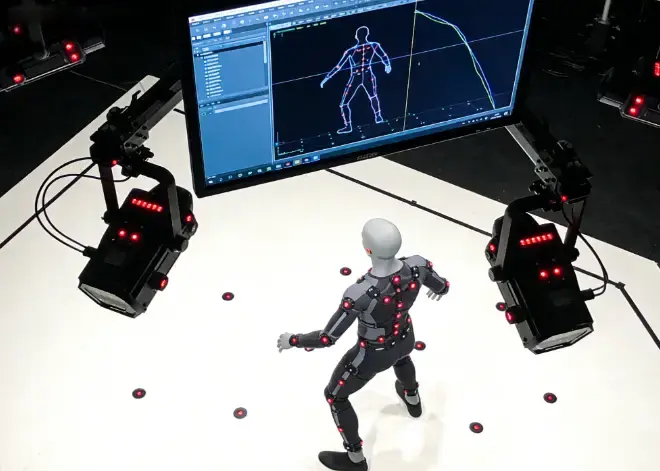
Sizing, specifying and sourcing reliable power for inertial suits, VR trackers, gloves and optical mocap hardware
1. Introduction: What a Motion Capture Battery (and Mocap Battery Pack) Actually Is
A motion capture battery is the rechargeable lithium cell or assembled pack that powers any device in a motion capture (mocap) system: the IMU sensor node on a suit, the VR full-body tracker, the finger glove, the hub, or the active optical marker. A mocap battery pack is the assembled, certified unit — cells plus protection circuit, optional fuel gauge, connector and enclosure — that a studio or OEM specifies as a replaceable or hot-swappable power module. The two terms are often used interchangeably, but they describe different engineering objects: a single tracker cell versus a certified pack architecture for a suit, hub or rig.
The market pressure behind this question is real. The global 3D motion capture market was valued at USD 340.6 million in 2025, projected at USD 387.2 million in 2026 and about USD 1,025.4 million by 2034, a CAGR of 12.90% (Fortune Business Insights, 2026). On a broader definition, the motion capture system market was USD 486.2 million in 2025 and an estimated USD 547.5 million in 2026, with a 12.6% CAGR to 2035 (Emergen Research, 2026). Growth comes from virtual production, VR/AR and VRChat full-body tracking, game animation, VTubing, sports science, biomechanics research, robotics teleoperation and live performance. As systems move from cabled studios to wireless body-worn hardware, every node carries a battery, and that motion capture battery decides runtime, weight, charging logistics, safety compliance and total cost of ownership.
After more than a decade designing custom lithium packs with smart Battery Management Systems (BMS) for medical and industrial OEM equipment, I can say from experience that when a mocap session fails mid-take, the cause is rarely the IMU or the camera. It is almost always the power system: a tracker that went flat, a pack that was not charged, a voltage that sagged during a radio burst, or a shipment held at customs because the lithium battery paperwork was incomplete. This guide explains, from the engineer who builds the battery, how to size, specify and source a dependable motion capture battery and mocap battery pack. It is an engineering selection framework, not a ranking of commercial brands.
2. Where the Battery Sits in a Mocap System: Load Profiles
Before choosing a cell, understand the load. Different mocap architectures put very different demands on the motion capture battery, and a pack optimized for one can fail in another.
2.1 Inertial (IMU) suit sensor nodes — the largest battery population
An inertial mocap suit carries 6 to 24 wireless sensor nodes depending on tier: Sony mocopi uses six sensors, Rebocap uses fifteen, and Xsens Awinda carries seventeen plus an optional prop sensor. Each node combines an IMU, a microcontroller and a radio, and the load is continuous: the system streams during a take with no sleep mode. The radio sits beside the antenna and the IMU, so current spikes, grounding and electromagnetic compatibility (EMC) are part of the motion capture battery design, not an afterthought.
2.2 Hub-level external mocap battery pack and hot-swap
A hub consolidates power and data for the whole suit, which is where a larger, certified mocap battery pack earns its place. The Movella Xsens Link illustrates the architecture: an external hot-swappable battery pack rated 7–8 hours plus an internal backup of 3–4 hours, so recording continues without interruption when the external pack is exchanged (Movella, 2026). This is the classic split between a small per-node cell and a system-level hot-swap pack.
2.3 VR full-body trackers
VR full-body tracking adds 3 to 8+ body-worn trackers. HTC VIVE publishes up to 7 hours for the VIVE Ultimate Tracker (about 2.2 hours to charge with Qualcomm Quick Charge 3.0, 3.2 hours with a 5 V/1 A supply; USB-C and pogo pins) and up to 7.5 hours for VIVE Tracker 3.0, which it states is 75% longer than the 2018 model (HTC VIVE, 2026). Weight and charge time on these small hard-worn devices directly affect studio turnaround between sessions.
2.4 Gloves and hand capture
Finger capture adds a row of micro sensors per hand, powered from a small swappable power module. Rokoko Smartgloves states a capture ratio of 1 hour per 1,000 mAh of power, with users switching between batteries for day-long sessions (Rokoko, 2026). Energy budgets here are tighter than on the body suit.
2.5 Optical systems still need batteries
Optical systems remain the professional standard for film, animation and biomechanics. Passive reflective markers need no power, but active markers and wireless do: the Vicon Pulsar active marker runs about 9 hours at 100% brightness, recharges in about 2 hours at 1 A over Micro USB, and weighs 50 g (Vicon, 2026); the OptiTrack Active Puck uses a 1,200 mAh lithium-polymer cell for roughly 10 hours nominal at 5 V micro USB (OptiTrack documentation, 2024). Outdoor and field capture prefers inertial suits precisely because they are portable and self-powered.
Table 1. Published battery benchmarks across representative mocap products (vendor-published figures; runtime varies with settings)
| System / product | Battery as shipped | Published runtime | Charging |
| Movella Xsens Link (inertial suit hub) | External hot-swappable pack + internal backup | External 7–8 h; internal 3–4 h; continuous with hot-swap | USB-C PD; pack charging station |
| Xsens MVN Awinda (17 wireless sensors) | Integrated cells per sensor | 12 h (orders after Oct 1, 2024) | Docking / charging stations |
| Rokoko Smartsuit Pro II | User-supplied 5 V/3 A USB-A power bank; battery not included | 10,000 mAh bank ≈ 6+ h continuous capture | USB-A output to suit |
| Rokoko Smartgloves | Swappable small power module | 1 h capture per 1,000 mAh | USB |
| Noitom Perception Neuron 3 | Small per-sensor cells in a Type-C charging case | Charge 1 h → 3.5 h capture; case charges all sensors | USB Type-C case (6 sensors per dock) |
| Sony mocopi | Six built-in Li-ion sensors | ≈10 h; ≈1.5 h charge | USB-C charging case |
| Rebocap 15-point inertial suit | 3.7 V / 300 mAh per tracker; tracker <19 g | Vendor-claimed extended runtime; shared charging box | Charging box for all 15 trackers |
| Knoxlabs MOXI S100 | Li-polymer 2,000 mAh transponder | 4+ h | USB |
| HTC VIVE Ultimate Tracker | Built-in cell | Up to 7 h; QC3.0 ≈2.2 h, 5 V/1 A ≈3.2 h | USB-C / pogo pins |
| HTC VIVE Tracker 3.0 | Built-in cell | 7.5 h (75% longer than 2018 model) | USB |
| Vicon Pulsar active marker | Built-in cell | 9 h at 100% brightness; 2 h charge @1 A | Micro USB |
| OptiTrack Active Puck | 1,200 mAh LiPo | ≈10 h nominal | 5 V micro USB; ≈3 h |
Sources: Movella Xsens Link specifications; Movella Awinda; Rokoko Smartsuit Pro II and Smartgloves; Noitom PN3 Pro; Sony mocopi specifications; Rebocap; Knoxlabs MOXI S100; HTC VIVE; Vicon Pulsar; OptiTrack documentation. See Appendix C.
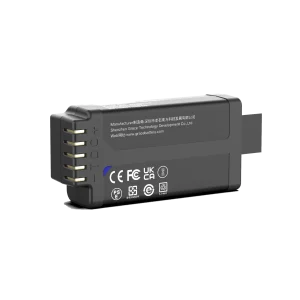
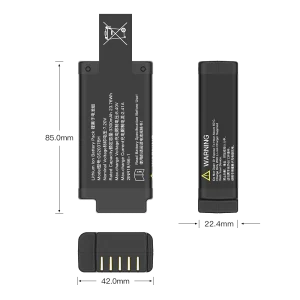
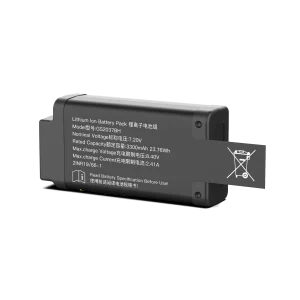
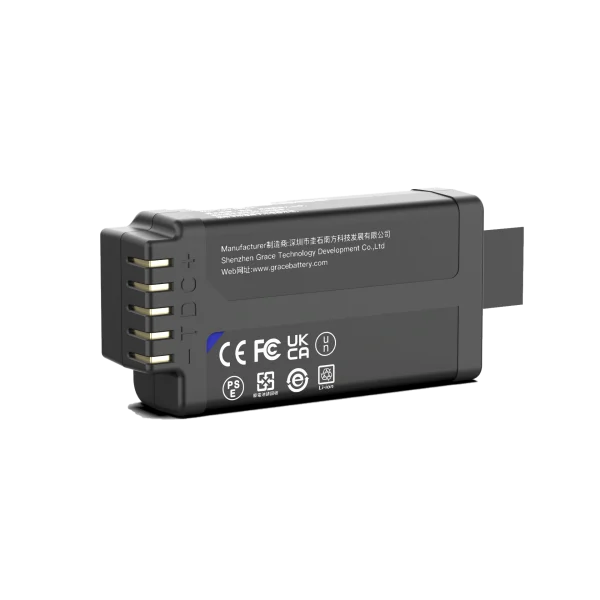
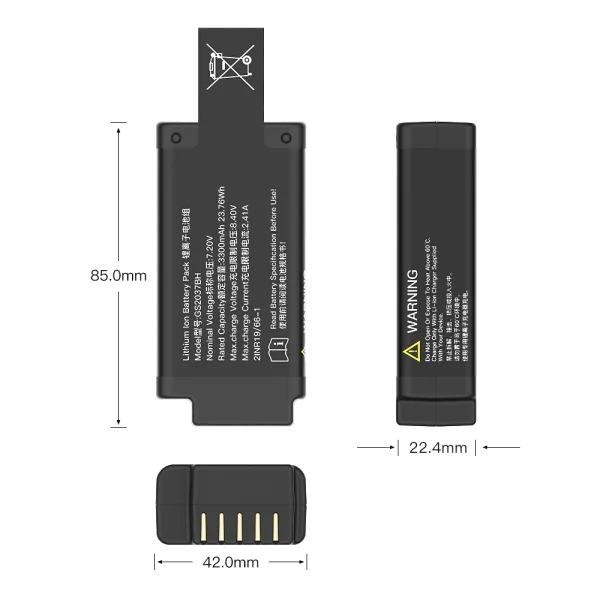
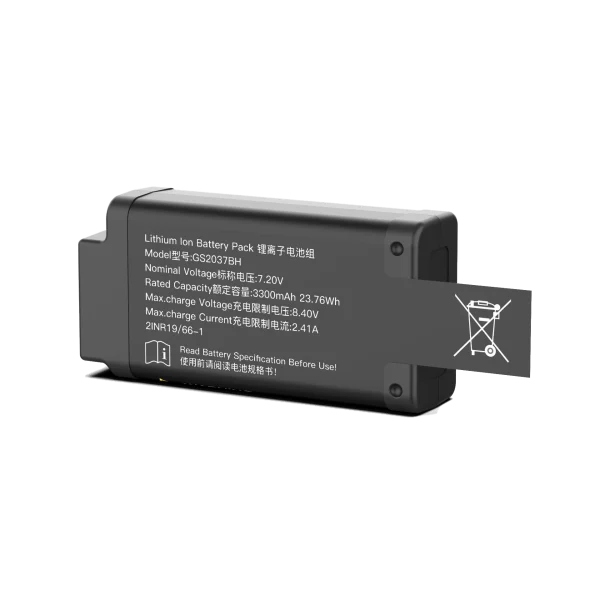
GS2037BH
7.2V/3450mAh/23.76Wh
3. The Eight-Point Specification Checklist for a Mocap Battery Pack
Based on the load profiles above, this is the checklist I use when an OEM asks for a motion capture battery or a custom mocap battery pack:
- Voltage and capacity. A single 3.6–3.7 V nominal cell is common for body-worn nodes. Define capacity as runtime × average load current, plus at least 20% margin for radio burst current, aging and cold.
- Weight and form factor. Keep the node including cell in the sub-20 g class where possible (Rebocap specifies <19 g per tracker). Thin pouch cells follow curved body surfaces best.
- Runtime target. Decide the minimum continuous capture window: a full studio day (8–12 h) or per-take operation with hot-swap (4–8 h per pack).
- Charge time and logistics. Multi-bay docks and charging cases (PN3 case, Awinda stations, mocopi case) plus USB-C PD or Quick Charge turn five minutes between takes into a real plan.
- Hot-swap and redundant power. An internal backup cell or hub buffer lets you exchange packs without stopping capture, as on the Xsens Link.
- Safety and transport compliance. Design to IEC 62133-2:2017+AMD1:2021 for product safety and UN 38.3 for transport, plus UL, CE or PSE as required by target markets.
- Environmental range. Studios run warm; outdoor and sports capture runs cold and humid. Specify wide-temperature cells (roughly −20 to +60 °C operating) and sweat/moisture protection.
- Telemetry and BMS. Require a smart battery interface (SMBus) reporting state of charge, state of health, temperature and cycle count — this turns a battery failure from a surprise into a scheduled event.
4. Cell and Pack Technology Choices
4.1 Chemistry and format
Published 2026 industry data gives a practical energy-density map by cell format (MOTAWILL, 2026; Mottcell, 2026). Actual values depend on grade, manufacturer and test condition; treat the ranges below as typical published industry bands.
Table 2. Cell format vs. typical gravimetric energy density (2026 published industry ranges)
| Cell format | Typical Wh/kg band | Fit for motion capture |
| Cylindrical (18650 / 21700) | ≈210–270 | Rigid; good for hub-level packs, poor body fit |
| Prismatic | ≈200–260 | Good capacity, rigid shape, limited curved fit |
| Pouch (LiPo) | ≈220–300 | Best for thin, curved, custom wearable shapes |
| Pack-level NMC (typical) | ≈170–255 | Mainstream high-energy packs |
| Pack-level LFP | ≈126–190 | Longer cycle life and safer, but heavier; niche use |
For body-worn motion capture batteries, pouch LiPo cells dominate because of shape freedom and low weight. Solid-state cells remain largely pilot or premium stage in 2026; design on a cell that exists today rather than a roadmap promise.
4.2 Why a smart BMS with SMBus matters
A protection-only circuit is not enough. A smart battery interface based on the SMBus protocol reports real-time state of charge, state of health, temperature, cycle count and charge control. On a 15–24 node suit, per-node health telemetry is the difference between the battery died and a pack reporting fourteen minutes remaining, so the swap can be scheduled. This is exactly the capability an engineering-led pack maker such as TEFOO builds into its SMBus smart-BMS platform for medical and industrial OEMs, and the same engineering discipline transfers directly to motion capture hardware.
4.3 Thermal, mechanical and EMC design
Body contact adds heat and sweat; capture involves drops and repeated plugging. Specify potting or encapsulation for ingress protection, a connector rated for thousands of cycles, drop and crush margins in the mechanical design, and charging current limits that respect cell temperature. Grounding and shielding must be designed together with the 2.4 GHz radio to avoid noise injection into the IMU data stream.
5. Manufacturer Comparison: Choosing the Right Battery Partner
5.1 Three supply models
When you compare motion capture battery suppliers, you are usually comparing three business models, not three products:
Table 3. Battery supply models compared
| Supply model | What you get | Strengths | Watch-outs |
| Cell manufacturer | High-quality cells only | Chemistry and process mastery | You own pack design, BMS, certification and logistics |
| Pack assembler / trader | Standard packs at low cost | Price and stock | Thin BMS/firmware depth; certificates often not transferable to you |
| Engineering-led custom partner | Cell + BMS + structure integration, custom firmware, certifications, NPI support | One accountable vendor; full traceability; joint design iteration | Higher non-recurring engineering cost; partner depth must be verified |
The differentiation question is not whether a vendor can assemble a pack, but who owns the BMS firmware, who owns the certificates, and who stands behind the field failures.
5.2 Six acceptance criteria for a motion capture battery supplier
- BMS and firmware depth. Can the vendor write SMBus firmware, custom charge profiles and telemetry, or only fit a protection IC?
- Certification ownership. Are IEC 62133-2, UN 38.3, UL, CE and PSE test reports issued in your name, not just the vendor’s?
- Customization depth. Shape, connector, firmware, charging profile and wide-temperature cells — all changeable per project.
- Traceability and quality. Full traceability from cell batch to finished pack, with incoming, in-process and outgoing inspection data.
- NPI and engineering support. Sample turnaround, validation data and fast iteration during development.
- Supply reliability. Long-term cell sourcing commitments and documented capacity for volume.
5.3 What an engineering-led partner adds
This is where TEFOO fits. We do not sell generic off-the-shelf packs; we design power systems with the customer’s team. Our SMBus smart-BMS platform, standard battery platforms combined with flexible customization (structure, connectors and BMS firmware), wide-temperature designs, full traceability and OEM experience in medical and industrial equipment are the same capabilities a motion capture OEM needs when reliability is part of the product promise. Ask any candidate partner: show me your SMBus firmware, your test reports and your traceability system — the answers separate a battery supplier from a battery engineering partner.
6. Frequently Asked Questions
Q1. What is the difference between a motion capture battery and a mocap battery pack?
A motion capture battery is the generic term for any cell powering a mocap device — a tracker, glove, hub or active marker. A mocap battery pack is the certified assembled unit (cells + BMS + connector + optional enclosure) specified as a replaceable or hot-swappable module. The cell is a component; the pack is a certified subsystem.
Q2. How long does a mocap battery last on a charge?
Published benchmarks span 4 to 12 hours: MOXI S100 4+ h; Rokoko Smartsuit Pro II about 6+ h from a 10,000 mAh bank; VIVE Ultimate Tracker up to 7 h; VIVE Tracker 3.0 7.5 h; Xsens Link external 7–8 h; Sony mocopi about 10 h; Xsens Awinda 12 h; Vicon Pulsar about 9 h. Target 8–12 h for a full studio day, or design hot-swap so each pack only covers one take.
Q3. Can I power a mocap suit with a standard power bank?
Only if the system specifies it. Rokoko’s Smartsuit Pro II is designed for a 5 V/3 A USB-A power bank and warns that more than 5 V can damage the hardware; never exceed the host’s voltage and current limits.
Q4. Can you hot-swap a mocap battery pack?
Yes on systems designed for it: the Xsens Link supports hot-swapping the external pack while an internal 3–4 h backup keeps recording alive. Hot-swap requires a backup buffer and a BMS that maintains rail voltage during the exchange — it cannot be added to a plain pack after the fact.
Q5. What certifications does a motion capture battery need?
At minimum IEC 62133-2:2017+AMD1:2021 (portable sealed lithium safety) and UN 38.3 (transport testing with the required test summary). For target markets add UL (North America), CE under Regulation (EU) 2023/1542 plus RoHS (EU/UK) and PSE (Japan), usually via the IECEE CB scheme. Radio-containing hosts separately follow FCC Part 15 (US) or the RED/EMC standards (EU).
Q6. Why do some suits ship without the battery?
Air transport of lithium batteries is restricted under UN 38.3 and IATA rules, and some vendors ship the device without the cell to avoid customs holds (Rokoko ships the Smartsuit Pro II without a power bank). This is why a mocap battery supply chain needs documented transport compliance before volume orders.
Q7. Off-the-shelf or custom mocap battery pack?
Off-the-shelf works for prototypes and low-volume runs. Once you need a specific form factor, per-node telemetry, certification in your name or production traceability, a custom engineering-led pack is the lower-risk path.
Q8. Does temperature matter for outdoor motion capture?
Yes. Cold raises internal resistance and cuts usable capacity; heat accelerates aging. Specify wide-temperature cells (roughly −20 to +60 °C) and a BMS that throttles charge outside the safe window.
Q9. How do I estimate the capacity for my motion capture system?
Measure or estimate average load current per node, multiply by required runtime, add 20% margin, then account for radio burst peaks and low-temperature derating. Capacity is arithmetic from a measured current profile, not a guess from rated mAh.
Q10. What should I ask an OEM battery pack manufacturer before quoting?
Request the SMBus firmware sample, IEC 62133-2 and UN 38.3 reports (check whose name they are issued in), cell sourcing and traceability records, sample lead time, and the target-market certifications they can support. Provide the measured current profile, runtime, weight limit, environment and destination markets at the RFQ.
7. Summary: The Practical Selection Checklist
The right motion capture battery is small, light, safe, certified and instrumented. The right mocap battery pack architecture keeps a whole suit or studio running through a working day with predictable charging and hot-swap. Before you buy or specify:
- Define nodes, runtime and load current first; capacity is arithmetic, not guesswork.
- Budget weight and form factor against a real benchmark (sub-20 g per node class).
- Require a smart BMS with SMBus telemetry — a protection IC alone is not enough.
- Demand IEC 62133-2 and UN 38.3 compliance with reports issued in your name.
- Choose an engineering-led partner who owns firmware, certificates and traceability.
- Prototype, validate over the real duty cycle, then scale.
If you are designing a motion capture product and the battery is currently an afterthought, treat it as a subsystem. Talk to an engineer who designs batteries for a living — that is what TEFOO is here for.
References and Sources
[1] Fortune Business Insights, 3D Motion Capture Market Size, Share & Global Report (2026). https://www.fortunebusinessinsights.com/3d-motion-capturing-system-market-104827
[2] Emergen Research, Motion Capture System Market Size, Share & Trends (2026). https://www.emergenresearch.com/industry-report/motion-capture-system-market
[3] Movella, Next-Generation Xsens Link specifications (external 7–8 h, internal 3–4 h, hot-swap, USB-C PD). https://www.movella.com/motion-capture/xsens-link-specifications
[4] Movella Shop, Next-Generation Xsens Link (4 h internal + 8 h external hot-swappable). https://shop.movella.com/health-sports/products/next-generation-xsens-link
[5] Movella, Xsens Awinda (12 h, 17 sensors, charging stations). https://www.movella.com/products/motion-capture/xsens-mvn-awinda
[6] Rokoko, Smartsuit Pro II (5 V/3 A USB-A power bank; 10,000 mAh ≈6+ h; battery not included). https://www.rokoko.com/products/smartsuit-pro
[7] Rokoko Support, Best power banks for Smartsuit Pro II. https://support.rokoko.com/hc/en-us/articles/4561524515345
[8] Rokoko, Smartgloves (1 h capture per 1,000 mAh, swappable). https://www.rokoko.com/products/smartgloves
[9] Noitom, Perception Neuron 3 Pro (Type-C charging case; charge 1 h → 3.5 h capture). https://www.noitom.com.cn/mobile/perception-neuron-3-pro.html
[10] Sony Singapore, mocopi specifications (six Li-ion sensors, ≈10 h, ≈1.5 h charge, USB-C case). http://www.sony.com.sg/microsite/mocopi/specifications.html
[11] Rebocap, 15-point inertial motion capture (3.7 V/300 mAh per tracker, <19 g, shared charging box). https://rebocap.com/
[12] Knoxlabs, MOXI S100 mocap suit (Li-polymer 2,000 mAh, 4+ h). https://www.knoxlabs.com/products/moxi-s100-mocap-suit
[13] HTC VIVE, VIVE Ultimate Tracker (up to 7 h; QC3.0 ≈2.2 h; USB-C/pogo). https://www.vive.com/eu/accessory/vive-ultimate-tracker/
[14] HTC VIVE, VIVE Tracker (3.0) (7.5 h, 75% longer than 2018). https://www.vive.com/us/accessory/tracker3/
[15] Vicon, Pulsar active marker (9 h at 100% brightness, 2 h @1 A, Micro USB, 50 g). https://www.vicon.com/hardware/devices/pulsar/
[16] OptiTrack documentation, Active Puck (1,200 mAh LiPo, ≈10 h, 5 V micro USB). https://docs.optitrack.com/
[17] IEC 62133-2:2017+AMD1:2021 CSV, Secondary lithium systems — safety requirements for portable sealed cells and batteries. https://webstore.iec.ch/en/publication/70017
[18] EUR-Lex, Regulation (EU) 2023/1542 concerning batteries and waste batteries (consolidated 2024-07-18). https://eur-lex.europa.eu/legal-content/EN/TXT/HTML/?uri=CELEX:02023R1542-20240718
[19] IATA, Lithium batteries guidance and shipping regulations (UN 38.3 test summary). https://www.iata.org/lithiumbatteries
[20] MOTAWILL, Pouch vs Prismatic Battery: The 2026 Engineering Guide (format energy-density ranges). https://www.motawill.com/pouch-vs-prismatic-battery/[21] Mottcell, Cylindrical vs Prismatic vs Pouch: Battery Format Guide (2026). https://www.mottcell.net/Which-Battery-Format-Keeps-Your-Project-Safe-and-Profitable.html