
By the TEFOO Medical Battery R&D Team |
1. Introduction
Portable medical devices have moved from the ICU corner to the front lines of pre-hospital care, emergency medical services (EMS), field hospitals, and point-of-care diagnostics. Among the most power-hungry and safety-critical of these devices are portable ventilators and portable ultrasound systems. Both rely on high-voltage lithium-ion battery packs — and the 14.8V four-series (4S) configuration has emerged as the industry standard for mid-tier portable ventilators, while portable ultrasound machines span a wider voltage range from 7.4V to 14.8V depending on system power.
As a battery engineer who has designed packs for Class II medical devices under IEC 60601-1, I want to walk OEM design teams through the engineering decisions behind a 14.8V ventilator battery pack and the parallel design considerations for a portable ultrasound machine battery. This guide covers cell selection, BMS architecture, communication protocols, regulatory compliance in 2026, and how to evaluate battery suppliers — not with marketing claims, but with engineering criteria you can verify.
Market context: The medical device segment accounts for approximately 7.3% of the global rechargeable battery market, valued at around USD 9.4 billion in 2026 and growing at an estimated 11.2% CAGR, driven by point-of-care diagnostics, EMS transport, and home respiratory care (source: Dataintelo, Global Rechargeable Battery Market Research Report, 2026). Within battery management ICs, medical device applications represented about USD 393 million, or 5.13% of the total BMS IC market in 2026 (source: PW Consulting / P Market Research, Worldwide Li-ion Battery Management ICs Market 2026), reflecting the depth of intelligent power electronics required in this segment.
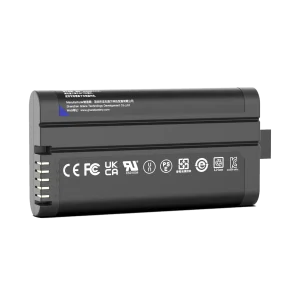
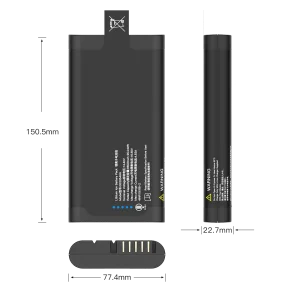
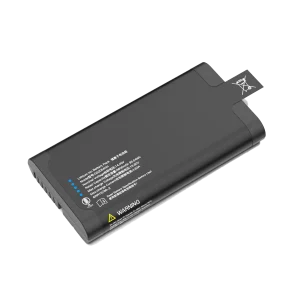
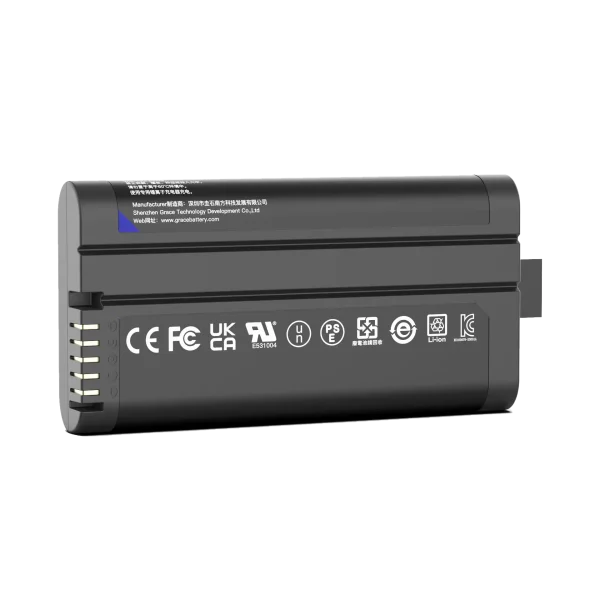
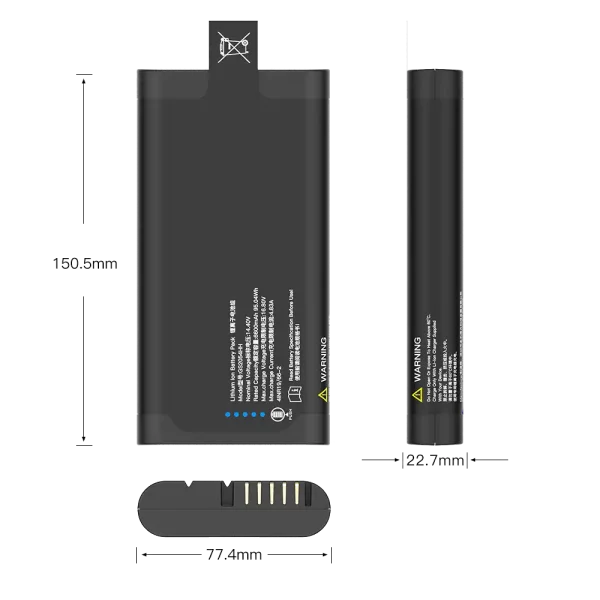
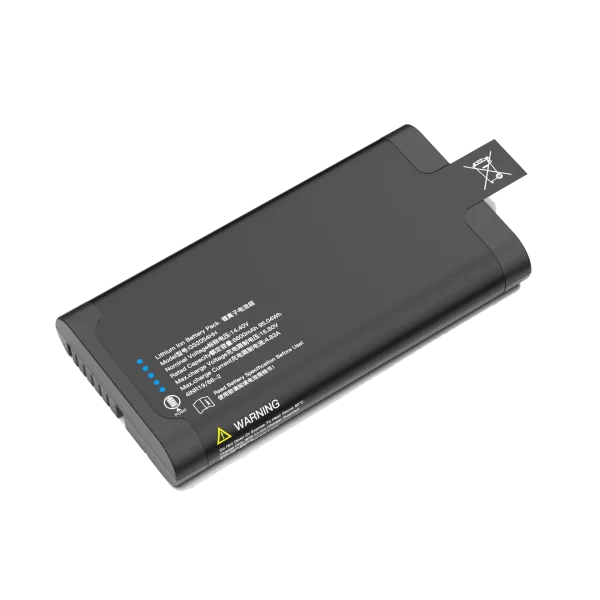
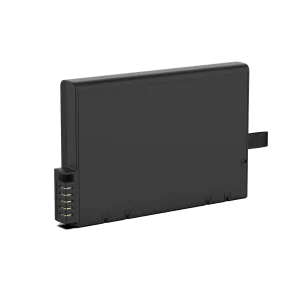
GS2054HH
14.4V/6900mAh/95.04Wh
2. The 14.8V Architecture: Why 4S?
A 14.8V nominal battery pack is, by definition, four lithium-ion cells connected in series (4S). Each cell has a nominal voltage of 3.6V or 3.7V, giving a nominal pack voltage of 14.4V–14.8V. Fully charged, the pack reaches 16.8V (4.2V per cell); fully discharged, it cuts off around 12.0V (3.0V per cell). This voltage window is a sweet spot for portable medical equipment because it balances motor drive efficiency, component availability, and safety margins.
2.1 Why Not 11.1V (3S) or 22.2V (6S)?
A 3S (11.1V) pack cannot deliver enough sustained current through a small-gauge internal harness for a ventilator blower motor at peak pressure support, and ultrasound beamforming power stages often require a 12V rail with headroom. A 6S (22.2V) pack raises the per-pack energy but pushes the system into higher-voltage DC-DC conversion losses and increases the creepage and clearance distances required under IEC 60601-1. The 4S 14.8V platform therefore became the dominant configuration for devices drawing 40–150W continuously — exactly the power envelope of most transport ventilators and mid-tier portable ultrasound scanners.
2.2 Cell Format: 18650 vs. Prismatic vs. Pouch
For 14.8V ventilator packs, the 18650 cylindrical cell remains the dominant format. It offers mature supply chains (Samsung SDI, LG Energy Solution, Murata/Sony, MOLICEL), proven abuse testing data, and mechanical robustness that matters in EMS environments. Portable ultrasound packs, where weight and thinness are paramount, increasingly use high-energy-density pouch cells or prismatic cells, accepting a slightly more complex pack design in exchange for 15–25% lower volumetric energy penalty.
3. Portable Ventilator Battery Pack: Engineering Requirements
A ventilator is a life-support device. Its battery cannot simply be a larger version of a laptop battery. The design requirements fall into five categories.
3.1 High Discharge Current and Peak Load
A portable turbine ventilator drives a blower that must deliver consistent tidal volume across a wide range of lung compliances. During pressure-support breaths and in spontaneous-mode triggering, the blower current can spike to 8–15A for short durations. A 14.8V 5.8Ah pack (e.g., the Mindray LI24I007h used on SV300/SV350 ventilators) is typically built around 18650 cells rated for 10A continuous discharge, with the BMS MOSFETs sized for a 20–30A peak rating. Pack weight for this class is typically 580–650 g.
3.2 Hot-Swap and Dual-Battery Redundancy
ICU and transport ventilators frequently support two battery bays. The BMS must support hot-swap: removing a depleted pack while the second pack continues to power the device, and inserting a fresh pack without a voltage glitch. This requires a pack-side ideal diode or OR-ing controller on the power path, plus a handshake protocol over SMBus or a dedicated detect pin. For a design team, this is one of the most common integration pitfalls — testing hot-swap only on the bench and discovering at clinical trial that the ventilator reboots under load.
3.3 Smart BMS and Fuel Gauge
Modern medical ventilator packs use a gas-gauge IC such as the TI bq series or Analog Devices MAX17320 family, communicating over SMBus (System Management Bus) v1.1 or I2C. The pack reports state-of-charge (SoC), remaining capacity, run-time-to-empty, cycle count, cell temperatures, and battery serial number to the ventilator’s main controller. This is not optional: clinicians depend on an accurate battery indicator before moving a patient to MRI or during an ambulance transfer. Coulomb-counting gauges with impedance tracking (such as TI Impedance Track) are preferred over voltage-only fuel gauges for medical applications because SoC accuracy of ±3% is expected.
3.4 Safety and Protection
A medical-grade 14.8V pack must integrate the following protection functions on the BMS analog front-end (AFE): over-charge detection per cell (4.25V typical), over-discharge per cell (2.5–3.0V), over-current on discharge (two thresholds with delay), short-circuit detection (hardware, <500 µs), and cell-temperature monitoring with NTC thermistors. The pack enclosure must meet the device’s IEC 60601-1 enclosure rating, and the battery itself must pass IEC 62133-2 (secondary lithium cells and batteries for portable applications) as a component safety standard.
Table 1. Typical 14.8V Portable Ventilator Battery Pack Specifications
| Parameter | Typical Value | Engineering Note |
| Nominal Voltage | 14.8V (4S) | 4 × 3.7V cells; charge voltage 16.8V |
| Nominal Capacity | 5.8Ah – 7.2Ah | 2P or 3P configuration of 18650 cells |
| Energy | 85 – 106 Wh | Under 100 Wh qualifies for simplified air transport rules |
| Continuous Discharge | 5 – 10A | Blower motor average; peak 15–20A |
| Cycle Life | ≥ 500 cycles to 80% | At 0.5C/0.5C, 25°C, per IEC 61960 |
| Communication | SMBus v1.1 / I2C | Fuel gauge with impedance tracking |
| Operating Temperature | 0°C to 45°C (discharge) | Charging limited to 0–40°C per most medical specs |
| Pack Weight | 580 – 650 g | Including enclosure and connector |
| Key Certifications | IEC 60601-1, IEC 62133-2, UN38.3, UL 2054 | CE / UKCA / CB scheme for global market access |
4. Portable Ultrasound Machine Battery: Design Considerations
Portable ultrasound machines — including handheld wands, tablet-based systems, and cart-lite trolleys — draw a different load profile than ventilators. The ultrasound front-end (pulse generator, transmit beamformer, receiver channels, and display) is a pulsed, mixed-signal load, not a continuous motor load. This changes the battery design priorities.
4.1 Energy Density and Runtime
Most portable ultrasound systems target 2–8 hours of continuous scanning on a single charge, depending on imaging mode (B-mode, Doppler, color flow). A typical portable cart ultrasound uses a 14.8V 4S2P or 4S3S pack in the 4.4Ah–6.6Ah range; handheld and tablet wands often drop to 7.4V (2S) or 11.1V (3S) pouch packs because their power budget is under 25W. The design priority shifts from high-discharge current to high volumetric energy density — hence the preference for pouch cells with 250–280 Wh/L energy density.
4.2 Voltage Stability During Pulsed Loads
Ultrasound pulser circuits draw short, high-current bursts (several amps for microseconds) that can cause rail droop if the battery pack’s internal impedance is too high. The pack designer must specify cells with low ESR (equivalent series resistance) — typically sub-30 mΩ for 18650 cells — and place bulk capacitance (low-ESR electrolytic or polymer tantalum) close to the system input. A pack that tests fine under a resistive load may cause image artifacts under real beamforming load.
4.3 Thermal and EMC Considerations
Ultrasound B-mode image quality is sensitive to noise. The BMS switching regulator and fuel-gauge clocking must not couple conducted or radiated noise into the receiver chain. This means careful layout of the pack PCB, shielded flex connections, and selection of BMS ICs with spread-spectrum or low-noise charging topologies. The final device must still meet IEC 60601-1-2 (EMC) but the pack designer should not assume the system integrator will solve every coupling problem.
Table 2. Typical Portable Ultrasound Battery Pack Specifications by Device Class
| Parameter | Handheld / Wand | Tablet / Cart-Lite | Transport Cart |
| Nominal Voltage | 7.4V (2S) – 11.1V (3S) | 14.8V (4S) | 14.8V (4S) – 22.2V (6S) |
| Typical Capacity | 1.5Ah – 3.0Ah | 4.4Ah – 5.2Ah | 5.2Ah – 7.8Ah |
| Cell Format | Pouch / Polymer | Pouch or 18650 | 18650 cylindrical |
| Continuous Power | 8 – 25 W | 40 – 80 W | 80 – 150 W |
| Runtime (B-mode) | 2 – 4 hours | 3 – 5 hours | 4 – 8 hours |
| Communication | I2C / HDQ | SMBus / I2C | SMBus / CAN optionally |
| Weight Target | 150 – 300 g | 450 – 600 g | 600 – 900 g |
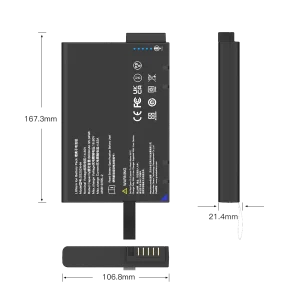
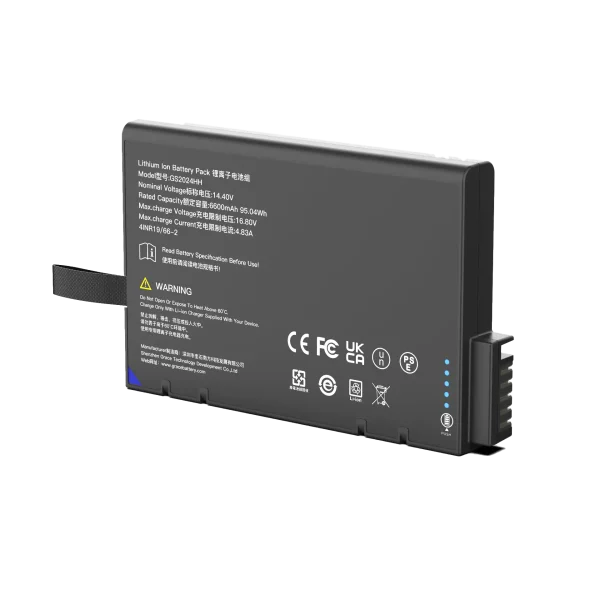
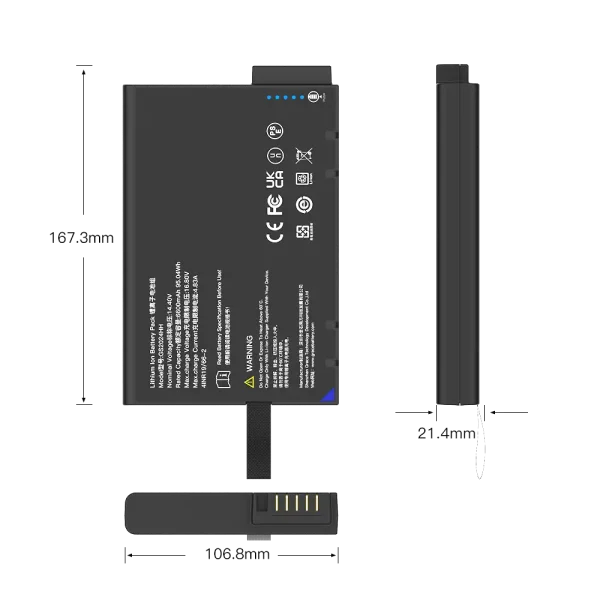
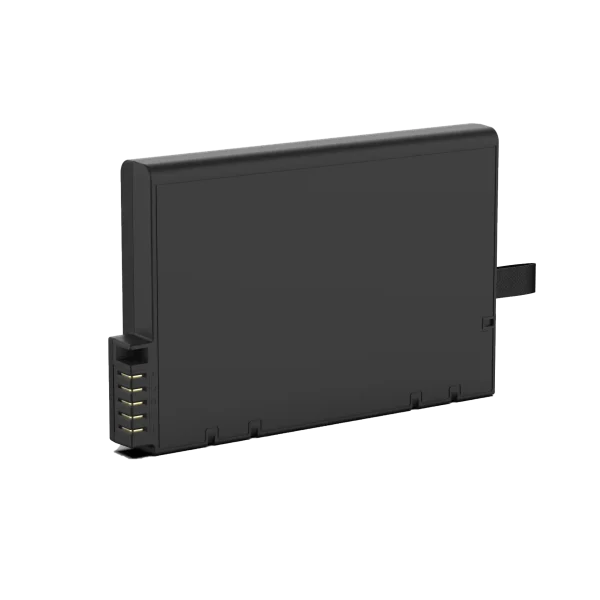
GS2024HH
14.4V/6900mAh/95.04Wh
5. Regulatory and Certification Landscape in 2026
For any medical battery pack shipped to global markets in 2026, the certification landscape has tightened considerably. Here is what design teams should be tracking.
5.1 IEC 60601-1 and the A13:2024 Amendment
The consolidated IEC/EN 60601-1:2006+A1+A12+A2+A13:2024 now includes explicit clauses for battery-powered and internally powered medical equipment. The pack is treated as a safety-critical component: the device manufacturer must evaluate the battery under the standard’s hazard-based risk management file (ISO 14971), and the battery supplier should provide a technical construction file, test reports, and a documented change-control process. Thermal runaway propagation, even in a single-cell fault, must be assessed for its effect on patient safety.
5.2 IEC 62133-2 and UL 62133
IEC 62133-2:2017 (secondary lithium cells and batteries) is the component-level safety standard almost universally invoked in the IEC 60601-1 risk file. UL 62133 is the North American adoption. For a pack to carry the CB Scheme certificate, both the cells and the completed pack should be tested — not just the cells. A common OEM mistake is certifying only the cells and assuming the pack is covered.
5.3 EU Battery Regulation 2023/1542
Regulation (EU) 2023/1542 entered into force on 18 February 2024 and is phasing in obligations through 2027 and beyond. For portable medical device batteries, two provisions are especially relevant in 2026:
- Removability and replaceability: The EU has adopted delegated acts granting derogations for professional medical imaging and radiotherapy devices (under MDR 2017/745) and in-vitro diagnostic devices (under IVDR 2017/746), allowing batteries to be replaced only by independent professionals rather than end-users. This reflects the safety-critical nature of sealed medical enclosures.
- Battery Digital Product Passport (DPP): Starting February 2027, specified battery categories will require a digital product passport carrying composition, carbon footprint, supply chain due diligence, and end-of-life information. Medical battery OEMs should begin DPP-ready data collection in 2026 — cell chemistry, supplier chain, and recycling information must already be traceable.
5.4 Certification Checklist
Table 3. Certification and Compliance Checklist for a 2026 Medical Battery Pack
| Standard / Requirement | Scope | Typical Apply Date |
| IEC 60601-1 (+A13:2024) | Medical electrical equipment safety | Current, for CE marking under MDR |
| IEC 60601-1-2 | EMC for medical electrical equipment | Current |
| IEC 62133-2 / UL 62133 | Portable sealed secondary lithium cells | Component-level, CB Scheme |
| UN 38.3 | Transport safety of lithium batteries | Mandatory for air/sea transport |
| UL 2054 / UL 60950-1 | North American component safety | For US market access |
| CE / UKCA marking | EU / UK regulatory marking | Current |
| ISO 13485 | Quality management system for medical devices | Manufacturer QMS |
| EU 2023/1542 | EU Battery Regulation (sustainability, DPP) | Phasing in through 2027 |
| ISO 9001 / ISO 14001 | Quality and environmental management | Supplier-level baseline |
6. Evaluating Battery Suppliers: What OEMs Should Compare
When selecting a custom medical battery pack partner, OEM design teams should compare suppliers on verifiable engineering and quality criteria rather than price-per-Wh. Based on our own supplier audits and 15+ years of pack development experience, the following dimensions separate capable medical battery partners from commodity cell assemblers.
Table 4. Supplier Evaluation Framework for Medical Battery Packs
| Evaluation Dimension | Tier-1 Component Supplier | Specialized Medical Pack OEM | Commodity Assembler |
| Primary business model | Sells standardized off-the-shelf packs | Designs and builds custom OEM packs | Assembles cells to generic reference designs |
| BMS / firmware ownership | Often third-party or closed | In-house BMS firmware and fuel-gauge tuning | Off-the-shelf BMS board, no customization |
| Communication protocols | Limited to SMBus basic data | SMBus, I2C, CAN, UART; custom SBDATA profiles | Voltage-only or basic HDQ |
| IEC 60601-1 support | Provides cell datasheets only | Full technical file, risk-file support, change control | Minimal documentation beyond datasheet |
| ISO 13485 QMS | Not always held at pack level | Held at pack manufacturing level | Typically ISO 9001 only |
| Custom enclosure / mechanical | No mechanical customization | Co-designed enclosure, connectors, thermal interface | Generic plastic housing |
| Regulatory file transfer | Cumbersome, NDA-heavy | Full file transfer to OEM at NPI | No regulatory file |
| Typical MOQ / NRE | High MOQ, low NRE | Moderate MOQ, engineering NRE | Low MOQ, no engineering support |
6.1 Why Custom OEM Packs Are Preferred for Ventilators and Ultrasound
A portable ventilator or ultrasound machine is itself a regulated medical device under MDR or FDA 510(k). The battery pack is a safety-critical subsystem, and the device manufacturer bears ultimate responsibility for its performance in the risk file. A supplier that can deliver a custom pack — with tuned fuel-gauge algorithms, integrated SMBus communication, a co-designed enclosure, and a transferable technical file — reduces regulatory risk and time-to-market compared with forcing a generic off-the-shelf pack into a mechanical and electrical enclosure it was not designed for.
6.2 TEFOO’s Position as a Medical Battery OEM Partner
At TEFOO, we specialize in custom lithium-ion battery packs for medical and industrial portable devices. Our medical product line includes 14.8V (4S) and 11.1V (3S) packs for ventilators, patient monitors, infusion pumps, portable ultrasound systems, and point-of-care diagnostic devices. Key differentiators include:
- In-house smart BMS design with SMBus/I2C communication and impedance-tracking fuel gauges, typically achieving ±3% SoC accuracy.
- ISO 13485-certified quality management system, alongside ISO 9001 and ISO 14001.
- Full certification support: IEC 62133-2, UN38.3, CE, UKCA, and UL reports, with technical files prepared for OEM submission under IEC 60601-1.
- Cell-agnostic design: we work with Samsung SDI, LG, Murata, MOLICEL, and other tier-1 cells to match the right chemistry and format to each device’s power envelope.
- EU 2023/1542 readiness: supply-chain traceability and DPP data preparation already underway for 2027 compliance.
For an OEM evaluating a 14.8V ventilator pack or a portable ultrasound battery, we recommend starting the dialogue with a complete device power budget — continuous watts, peak watts, voltage window, runtime target, and enclosure volume. That single document drives every downstream engineering decision, from cell format to BMS selection to certification path.
7. Frequently Asked Questions
Q1: Why is 14.8V the standard voltage for portable ventilator batteries?
A 14.8V pack is a 4S configuration of 3.6V–3.7V lithium-ion cells. It delivers enough voltage and current for a turbine ventilator blower at a reasonable harness loss, while staying below the higher-voltage clearance requirements that a 6S (22.2V) pack would trigger under IEC 60601-1. Most transport ventilators from Mindray, Dräger, Hamilton, and Medtronic use this 4S platform.
Q2: Can I use a consumer-grade 18650 cell in a medical ventilator pack?
No. Consumer cells lack the controlled discharge and safety-consistent manufacturing required for medical certification. Medical packs must use cells certified to IEC 62133-2 (and ideally UL 1642), from manufacturers with batch traceability. The cell supplier must also provide a controlled datasheet, failure-mode documentation, and a no-approval-change guarantee, all of which consumer cell channels do not offer.
Q3: What SMBus information should the battery pack report to the ventilator or ultrasound?
At minimum: temperature, voltage, current, state-of-charge, remaining capacity, run-time-to-empty, cycle count, battery status alarm bits, and serial number. A properly implemented Smart Battery Data (SBData) profile allows the host device to display an accurate fuel gauge, estimate remaining procedure time, and log battery health for service — all of which clinicians expect on modern portable medical devices.
Q4: How does EU Regulation 2023/1542 affect my 2026–2027 medical device launch?
Two immediate effects: first, medical imaging and IVD devices are covered by a derogation allowing professional-only battery replacement, so you are not required to design a user-removable battery. Second, the Battery Digital Product Passport begins in February 2027, requiring accessible data on cell composition, carbon footprint, supply chain, and recycling. Start collecting this data from your battery supplier in 2026 to avoid a launch delay.
Q5: What is the typical cycle life expectation for a medical ventilator battery?
Under IEC 61960 testing at 0.5C charge / 0.5C discharge at 25°C, a well-designed 4S2P medical pack should deliver 500 cycles to 80% capacity. In clinical practice, ventilator packs are often replaced on a 2–3 year service schedule regardless of cycle count, because BMS fuel-gauge calibration and safety margin degrade over time. Specify cycle life as a rated number, not as a warranty period.
Q6: Should a portable ultrasound battery use a smart BMS or a simple protection board?
For any device shipping as a regulated medical product, use a smart BMS with fuel gauge and communication. A simple protection board will meet over-charge and short-circuit requirements but cannot provide accurate remaining-runtime data, which is both a clinical workflow expectation and increasingly a regulatory expectation under IEC 60601-1 risk management.
8. Conclusion
The 14.8V portable ventilator battery pack and the portable ultrasound machine battery are more than commodity power sources — they are safety-critical subsystems designed under strict medical electrical safety standards. The 4S 14.8V architecture has become the default for transport ventilators because it balances motor drive efficiency, conversion losses, and clearance requirements, while ultrasound packs span a wider voltage range optimized for energy density and low-impedance pulsed loads.
For OEM teams in 2026, the engineering bar has risen: smart BMS with SMBus fuel gauges is expected, ISO 13485 at the pack level is increasingly a procurement requirement, and the EU Battery Regulation 2023/1542 — including the 2027 Digital Product Passport — is reshaping how suppliers trace cell chemistry and supply chain. Selecting a battery partner that can own the BMS firmware, support the regulatory file, and design the pack to the device’s actual power budget will determine both clinical reliability and time-to-market.
If you are specifying a new 14.8V ventilator pack or a portable ultrasound battery, the most valuable first step is a complete power-budget document. Bring that to the table, and every subsequent engineering decision — cell selection, pack architecture, certification path, and cost — becomes far more predictable.
About the Author and TEFOO
This article was written by the R&D engineering team at TEFOO, a custom lithium-ion battery pack manufacturer specializing in medical device and industrial portable power solutions. With ISO 13485 (Certificate No. [TEFOO-ISO13485-XXXX]), ISO 9001, and ISO 14001 certifications, TEFOO designs and manufactures smart BMS battery packs with SMBus communication, supporting OEM customers worldwide in ventilators, ultrasound systems, patient monitors, infusion pumps, and portable diagnostic equipment. For custom pack inquiries, contact our medical battery engineering team through the TEFOO website.
9. References and Further Reading
[1] IEC 60601-1:2006+A1+A12+A2+A13:2024, “Medical electrical equipment — Part 1: General requirements for basic safety and essential performance.” International Electrotechnical Commission.
[2] IEC 62133-2:2017, “Secondary cells and batteries containing alkaline or other non-acid electrolytes — Safety requirements for portable sealed secondary lithium cells.” International Electrotechnical Commission.
[3] IEC 61960:2017, “Secondary cells and batteries containing alkaline or other non-acid electrolytes — Secondary lithium cells and batteries for portable applications.” International Electrotechnical Commission.
[4] UN 38.3, “United Nations Manual of Tests and Criteria, Subsection 38.3 — Lithium metal and lithium ion batteries.” United Nations Economic and Social Council.
[5] Regulation (EU) 2023/1542 of the European Parliament and of the Council of 12 July 2023 concerning batteries and waste batteries. Official Journal of the European Union.
[6] European Commission, “Commission Notice: Guidelines on the removability and replaceability of portable batteries under Regulation (EU) 2023/1542,” 2026.
[7] European Commission, “Guidance to support preparations for the Digital Batteries Passport,” August 2026.
[8] Dataintelo, “Global Rechargeable Battery Market Research Report 2034,” 2026 — medical device segment share and CAGR.
[9] PW Consulting / P Market Research, “Worldwide Li-ion Battery Management ICs Market Research 2026,” June 2026 — medical device BMS IC segment.
[10] Texas Instruments, bq29330 / bq40Z series datasheets: 2-Series to 4-Series Li-ion Battery Protection AFE and Impedance Track Fuel Gauge.
[11] Analog Devices, MAX17320 Datasheet: 3-Series to 6-Series Cell Pack-Side Fuel Gauge with Security, I2C/SMBus.
[12] Mindray Medical International, LI24I007h / LI241002A Li-ion Battery Pack Datasheet for SV300/SV350 Series Ventilators.
Disclaimer
This article is intended for engineering, procurement, and regulatory professionals working on portable medical device power systems. It is not clinical advice, and it does not replace the device manufacturer’s own risk management file under ISO 14971 or compliance review against current IEC, ISO, UN, and regional regulatory requirements. Specifications cited are typical industry values as of the publication date; design engineers must verify all parameters against the specific device application and latest standard revisions.