
By TEFOO Battery · Lithium Battery R&D Engineer
1. Introduction: Why a DAQ Device Deserves an Engineered Battery
Portable data acquisition (DAQ) devices have become the quiet workhorses of modern field engineering. They sit on transmission towers, inside rotating-machinery cabinets, on test benches and in remote environmental monitoring stations, collecting voltage, current, vibration, temperature and strain data that engineers later turn into decisions. What most users never see is that every one of those readings depends on a power source that has to be as disciplined as the measurement itself.
In my work as a lithium battery R&D engineer, I have watched the same mistake repeat across industries: a DAQ device is designed around its sensors and communication link, and the battery is treated as an afterthought — a generic cell holder or a consumer power bank bolted to the enclosure. The result is predictable: runtime estimates that fail in the cold, voltage sag that resets an ADC mid-recording, unexpected shutdown during a critical measurement window, and field batteries swapped “early” because nobody trusts the remaining-charge indicator.
This article explains how an engineered DAQ battery pack differs from a commodity power pack, and why a smart battery using the SMBus protocol and the Smart Battery System (SBS) model is the practical answer for data acquisition. Whether you are designing a portable logger, a wireless sensor node or a benchtop instrument that must keep measuring when the mains disappears, the load profile, the cell chemistry, the protection scheme and the fuel-gauging intelligence should be specified together — not bolted on afterwards.
2. The DAQ Load Profile Is Not a Constant Load
2.1 Average Current vs. Peak Current
The first mistake in battery sizing is designing around average current alone. A DAQ device rarely draws a steady current. Typical duty cycles include sensor-excitation pulses, ADC conversion bursts and wireless transmission bursts (LoRa, Wi-Fi, BLE or cellular) that can pull tens of times the average current for tens to hundreds of milliseconds. An environmental logger, for example, may average 30–50 mA while its radio burst draws 2–3 A for a fraction of a second — a peak-to-average ratio of fifty to one or more.
Peak current matters because lithium cells have internal resistance (DCIR) that rises at low temperature and as the pack ages. Under a high pulse the terminal voltage sags; if it sags below the dropout voltage of the downstream LDO or DC-DC converter, the ADC can brown out mid-sample, corrupting the measurement or losing the recording altogether. A properly engineered DAQ battery pack must therefore be characterised for both average energy (capacity) and peak power (impedance), at the coldest operating temperature the deployment will see.
2.2 Low-Noise Power: The Battery Is Part of the Measurement Path
The second mistake is forgetting that, in a DAQ system, the battery is part of the measurement path. Switching regulators inject ripple onto the supply rail, and ground bounce from return currents can couple directly into high-resolution ADC inputs. In one instrument we audited, a 24-bit acquisition channel was limited to roughly 16 effective bits purely by power-supply noise; the battery cabling and converter layout — not the converter itself — were the dominant contributors. Power-architecture decisions, such as an LDO for the analog rail, separated ground planes, shielded and twisted battery wiring and a clean return path, matter as much as the chemistry.
2.3 Temperature and Long Unattended Deployment
Field DAQ devices live where consumer electronics do not: inside unheated cabinets at -20 °C, on rooftops above +60 °C, and inside enclosures that bake in the sun. Lithium chemistry is temperature-sensitive: capacity falls and impedance rises as the pack cools, and calendar aging accelerates with heat. The same pack that reports 100 % state of charge at 25 °C may deliver only a fraction of its rated energy at -20 °C. Self-discharge, protection-circuit quiescent current and long storage periods between deployments must all be included in the energy budget, or the “reliable” runtime promised on the datasheet will not survive the first winter.
3. Cell Chemistry and Pack Architecture Selection
3.1 Chemistry Comparison
There is no single best chemistry for every DAQ application; the right choice is the one that matches the load profile, temperature range, cycle requirements and cost envelope. Table 1 summarises the trade-offs we evaluate when a customer brings a new acquisition project to us.
Table 1. Trade-offs between common lithium chemistries for DAQ battery packs.
| Chemistry | Energy density | Cycle life | Pulse capability | Low-temperature | Typical DAQ use |
| NMC / NCA | High | Moderate | Good (quality cells) | Deteriorates below 0 °C | High-energy loggers |
| LiFePO4 (LFP) | Moderate | Long (2,000+) | Good, flat voltage | Better thermal stability | Outdoor long-life deployments |
| LTO | Lower | Very long (10,000+) | Excellent, low impedance | Wide temperature window | High-rate, cold environments |
| Li-Polymer | High, flexible | Moderate | Good | Similar to NMC | Compact enclosures |
3.2 Voltage, Capacity and Pulse Sizing
Pack voltage should match the DAQ rail with the fewest conversion stages. A 3.7 V nominal LiPo or single 18650 cell feeds 3.3 V logic[10] through a small boost or LDO, while a 7.4 V (2S) or 11.1 V (3S) pack suits higher-rail instruments directly. Li-ion and Li-Poly cells are the usual choice for wireless DAQ[9] because of their higher voltage per cell and energy density.
Capacity sizing starts from an energy budget: average current multiplied by the required runtime, then derated for cell aging, temperature, depth-of-discharge limits, self-discharge and the protection circuit’s own quiescent draw. A pack that must deliver 500 mA average for 30 days at -10 °C needs a far larger nameplate capacity than the raw arithmetic suggests once all derating factors are applied. Pulse capability is verified separately against the cell datasheet’s DCIR and the manufacturer’s published pulse-current limits at the coldest temperature.
3.3 Protection, Mechanical and Connector Design
A DAQ pack is a safety device as much as an energy store. The BMS must provide overvoltage, undervoltage, overcurrent, short-circuit and over-temperature protection, with a secondary protection path (a second protector IC or fuse) for single-point-fault robustness. Multi-cell packs require balancing to keep the string healthy over hundreds of cycles. Mechanically, the pack must survive the field: locking connectors with gold-plated contacts for vibration environments, IP-rated enclosures, thermistor placement against the cells, and strain relief on the output cable. These details — not the chemistry — are usually what separate a pack that lasts three years from one that fails after three months.
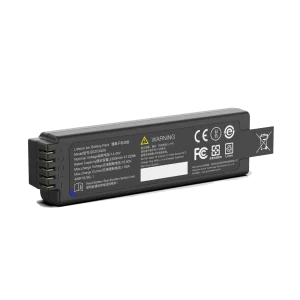
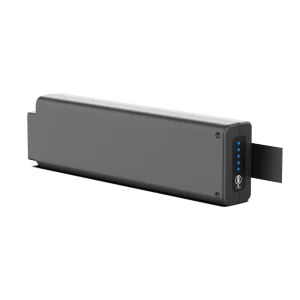
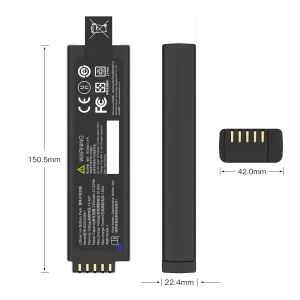
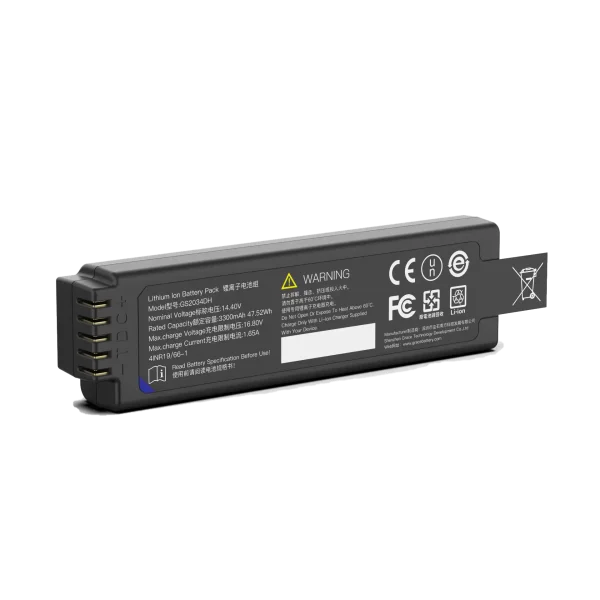
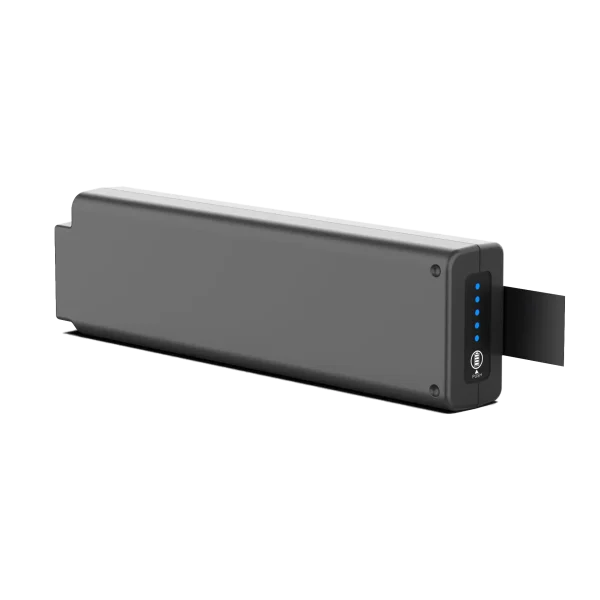
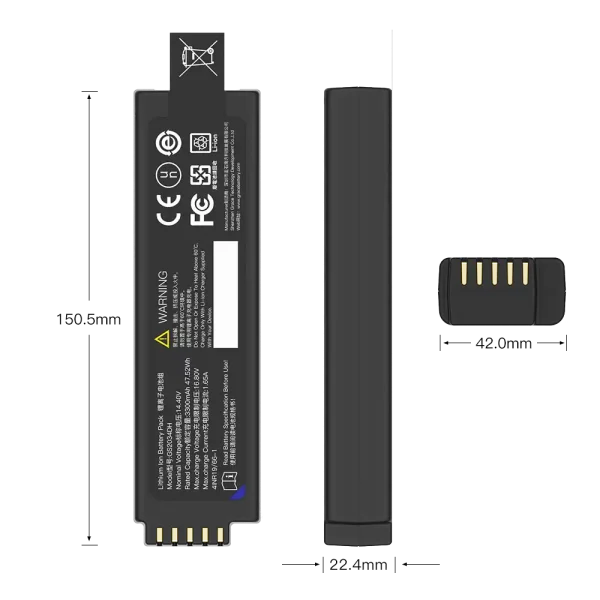
GS2034DH
14.4V/3450mAh/47.52Wh
4. Why a Smart Battery with SMBus Is the DAQ Game Changer
4.1 The Smart Battery System (SBS) Model
A smart battery is a battery pack with an integrated fuel-gauge IC and a communication interface. In the Smart Battery System (SBS) model[2] defined by the Smart Battery System Implementers Forum (SBS-IF), the battery, the charger and the host communicate over a two-wire System Management Bus (SMBus), exchanging a standardised set of data defined in the Smart Battery Data (SBData) specifications[1].
The data available over SMBus includes voltage, current, temperature, remaining capacity, full-charge capacity, state of charge, run time to empty, cycle count and state of health. Gas-gauge ICs that communicate over SMBus have been available for two decades — the bq2040 family from Texas Instruments, for example, reports remaining capacity, remaining time and chemistry data over the bus[6] — and modern fuel gauges add packet error checking (PEC) and higher SMBus speeds for reliable field communication.
4.2 Fuel Gauging: How the Pack Knows What It Has Left
Fuel gauging is the hard part. A simple voltage-based “fuel gauge” fails under the dynamic loads of a DAQ device because the open-circuit voltage is masked by internal-resistance voltage drops. Accurate gauges combine coulomb counting (integrating current in and out) with voltage and temperature modelling. Texas Instruments’ Compensated End-of-Discharge Voltage (CEDV)[8] algorithm, and dynamic-load modelling such as Dynamic Z-Track[7], continuously learn the cell’s impedance and aging behaviour, keeping the reported state of charge accurate to a few percent even under pulsed loads. The gauge also learns the pack’s aging curve and can report when the pack has drifted outside its calibrated window.
4.3 What SMBus Data Means for a DAQ Deployment
For a data acquisition system, this intelligence transforms the battery from a liability into an instrument:
- Predictable runtime. Run-time-to-empty and state-of-charge data let the host scheduler plan maintenance windows and alert operators before a measurement window is lost — instead of the pack dying silently mid-recording.
- Health telemetry. Cycle count, state of health and temperature history enable predictive replacement: packs are swapped on condition, not on guesswork, which matters for fleets of loggers in the field.
- Condition monitoring. Voltage, current and temperature read over the same two-wire bus can be logged alongside sensor data, giving the engineer an audit trail of the power conditions that shaped every measurement.
- Multi-pack and hot-swap management. Systems that run on dual packs can read both, sequence them, and hand over without interrupting acquisition.
In one of our field deployments, a remote vibration logger on a highway bridge reported its remaining runtime over the same wireless link that carried the measurement data. The operator swapped the pack during a scheduled maintenance visit — not during a storm — because the battery told us the day beforehand that it had twelve hours left. That is the difference a smart battery makes.
5. Lessons from the Field
After a decade of engineering lithium packs for measurement and monitoring equipment, a few lessons recur in nearly every project:
- Noise is a layout problem, not just a battery problem. The first revision of a portable strain recorder picked up switching noise through unshielded battery wiring. Re-routing the harness, adding an LDO for the analog rail and separating the ground planes recovered more than eight bits of effective resolution without changing the chemistry.
- Cold changes everything. In a winter deployment, a nominally full pack delivered roughly two-thirds of its rated energy at -20 °C. The fix was a combination of chemistry selection, enclosure insulation and a software derating curve — not a bigger battery alone.
- Gauges drift after long storage. Packs stored at full charge for months showed optimistic state-of-charge readings until the gauge was refreshed with a golden-image calibration and an end-of-service update. Every DAQ pack we ship now ships with a documented refresh procedure.
- Connectors fail before cells do. Fretting corrosion on low-cost connectors produced intermittent contact-resistance spikes that appeared in the data as ADC glitches. Locking connectors with gold-plated contacts and strain relief eliminated that class of failure.
- Compliance is part of engineering. Engineers routinely discover transport-testing requirements on the day the first production units are booked for air freight. Certification timing, packaging and documentation must be in the project plan from day one, not discovered at the warehouse door.
6. Safety, Compliance and Transport: Non-Negotiables
Lithium batteries are dangerous goods, and a DAQ pack is no exception. For portable sealed lithium cells and battery packs, IEC 62133-2:2017 is the internationally recognised safety standard[3], covering tests for expected use and reasonably foreseeable misuse. For transport, the UN Manual of Tests and Criteria Section 38.3 (UN38.3) requires eight tests[4] — altitude simulation, thermal cycling, vibration, shock, external short circuit, impact/crush, overcharge and forced discharge — before lithium batteries may be shipped by air, sea or road. In North America, UL 2054 covers household and commercial batteries[5] and is commonly required for battery-powered products sold into that market.
Three points are worth emphasising. First, certification is configuration-specific: change the cell vendor, the cell model or the pack topology and the report must be re-validated. Second, UN38.3 tests the cell or battery, not the host device, so a DAQ enclosure does not exempt the pack. Third, for medical or industrial customers, battery compliance documentation is often part of their supplier audit — missing paperwork can block an order as surely as a failed test.
7. DAQ Battery Pack Selection Checklist
When we evaluate a battery pack for a data acquisition product, we work through the checklist in Table 2 with the system engineer before any cell is chosen.
Table 2. DAQ battery pack selection checklist.
| Selection criterion | What to verify | Why it matters |
| 1. Load profile | Peak and average current, pulse duration, duty cycle | Determines voltage sag and true runtime |
| 2. Voltage window | Compatibility with the DAQ rail and cutoff behaviour | Prevents brownout and data loss |
| 3. Capacity and runtime | Energy budget with derating for temperature, aging and DoD | Defines the deployment interval |
| 4. Temperature range | Operating and storage range; DCIR at low temperature | Cold-weather performance is a design input |
| 5. Smart battery data | Required SBData commands; fuel-gauge accuracy target | Runtime and health telemetry for fleet management |
| 6. Protection | OVP / UVP / OCP / OTP / short circuit, plus secondary protection | Safety and single-point-fault robustness |
| 7. Mechanical design | Connector type, vibration rating, IP rating, mounting | Field ruggedness determines service life |
| 8. Compliance | IEC 62133-2, UN38.3, UL 2054 as required by target market | Transport and market access |
| 9. Lifecycle | Cycle life, SOH reporting, replacement logistics | Total cost of ownership across the fleet |
| 10. Supplier qualification | ISO 9001, test reports, documentation quality | Trust, traceability and audit readiness |
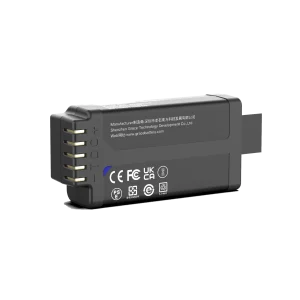
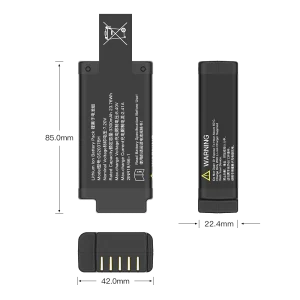
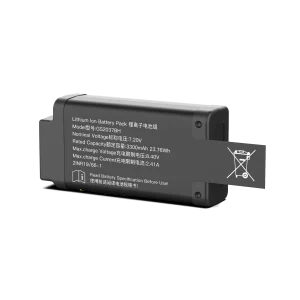
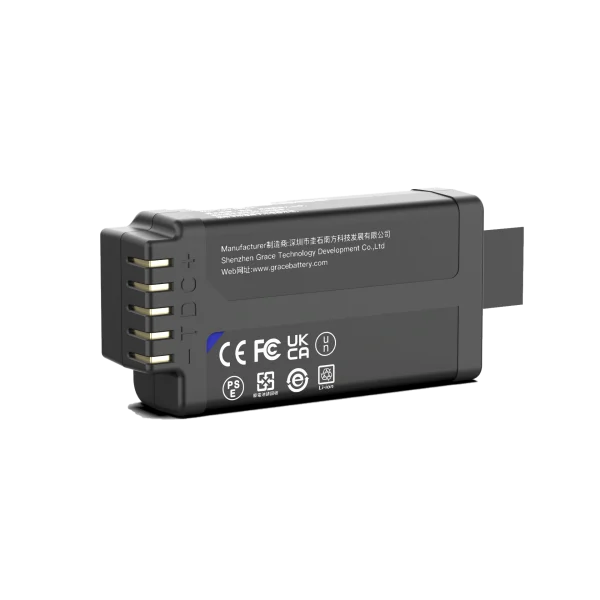
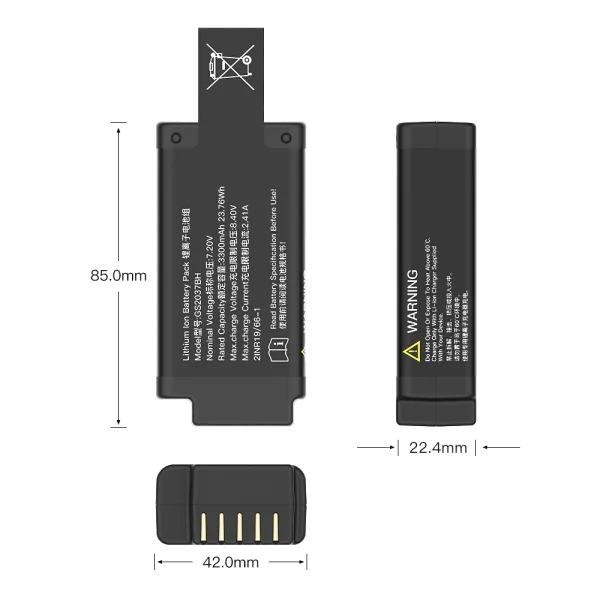
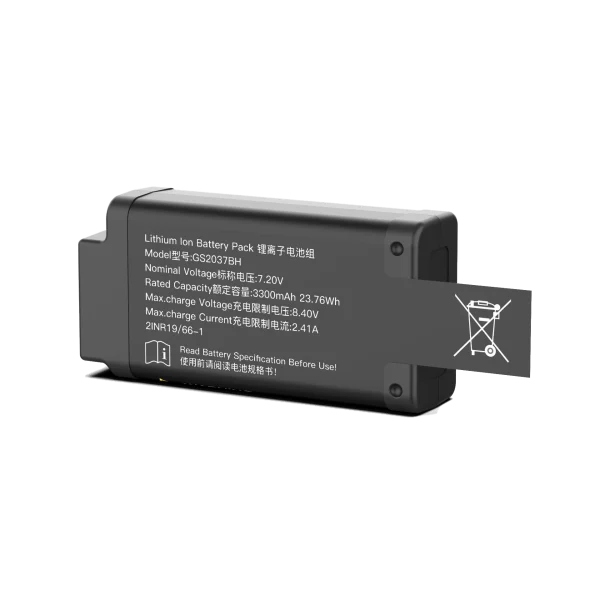
GS2037BH
7.2V/3450mAh/23.76Wh
8. Conclusion
A DAQ device is only as reliable as the measurement it keeps, and the measurement is only as reliable as the power behind it. Treating the battery as a commodity accessory is the fastest way to lose data in the field; treating it as a subsystem — specified from the load profile, engineered around the chemistry and protection, and instrumented with smart battery SMBus intelligence — is what turns a battery pack into a dependable part of the acquisition chain.
Start with the load profile, choose the chemistry and topology against real temperature and pulse data, demand certified safety and transport compliance, and let the SMBus data tell you what the pack knows. Done that way, the battery stops being a point of failure and becomes a source of operational certainty — and in data acquisition, certainty is the entire point.
References
- Smart Battery System Implementers Forum. Smart Battery Data Specification, Revision 1.1. https://sbs-forum.org/specs/sbdat110.pdf
- Smart Battery System Implementers Forum. Smart Battery Data Specification. https://sbs-forum.org/specs/sbdata10_a.pdf
- IEC 62133-2:2017, Secondary cells and batteries containing alkaline or other non-acid electrolytes — Safety requirements for portable sealed secondary cells, and for batteries made from them, for use in portable applications — Part 2: Lithium systems. https://webstore.iec.ch/publication/32662
- United Nations. UN Manual of Tests and Criteria, Section 38.3 (UN38.3), Eighth revised edition. https://www.intertek.com/contentassets/94860d488ad944408c1fd557a33eb8f6/faq—un-383-eighth-ed-top-10.pdf
- UL Solutions. UL 2054, Standard for Safety: Household and Commercial Batteries. https://www.element.com/resources/articles/lithium-ion-battery-certification
- Texas Instruments. bq2040 Gas Gauge IC with SMBus Interface (datasheet). https://www.ti.com/lit/ds/symlink/bq2040.pdf
- Texas Instruments. BQ41Z50 Battery Management Unit (datasheet). https://www.ti.com/document-viewer/lit/html/SLUSFB5A/GUID-4A7898BB-50E9-4025-88B8-C51033B382AA
- Texas Instruments. BQ78350 Battery Monitor and Secondary Protector (datasheet). https://www.ti.com/document-viewer/BQ78350/datasheet/detailed_description
- National Instruments. Selecting a Battery for CompactDAQ Devices. https://www.ni.com/en/support/documentation/supplemental/08/selecting-a-battery-for-compactdaq-devices.html
- MADV-DAQ: Multi-channel Arduino-based differential voltage data acquisition system for remote strain measurement applications. https://pmc.ncbi.nlm.nih.gov/articles/PMC9515601/