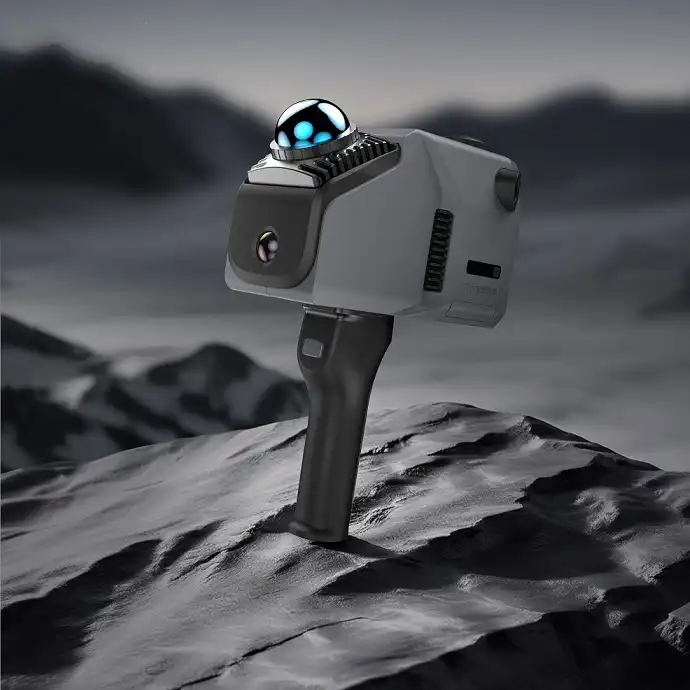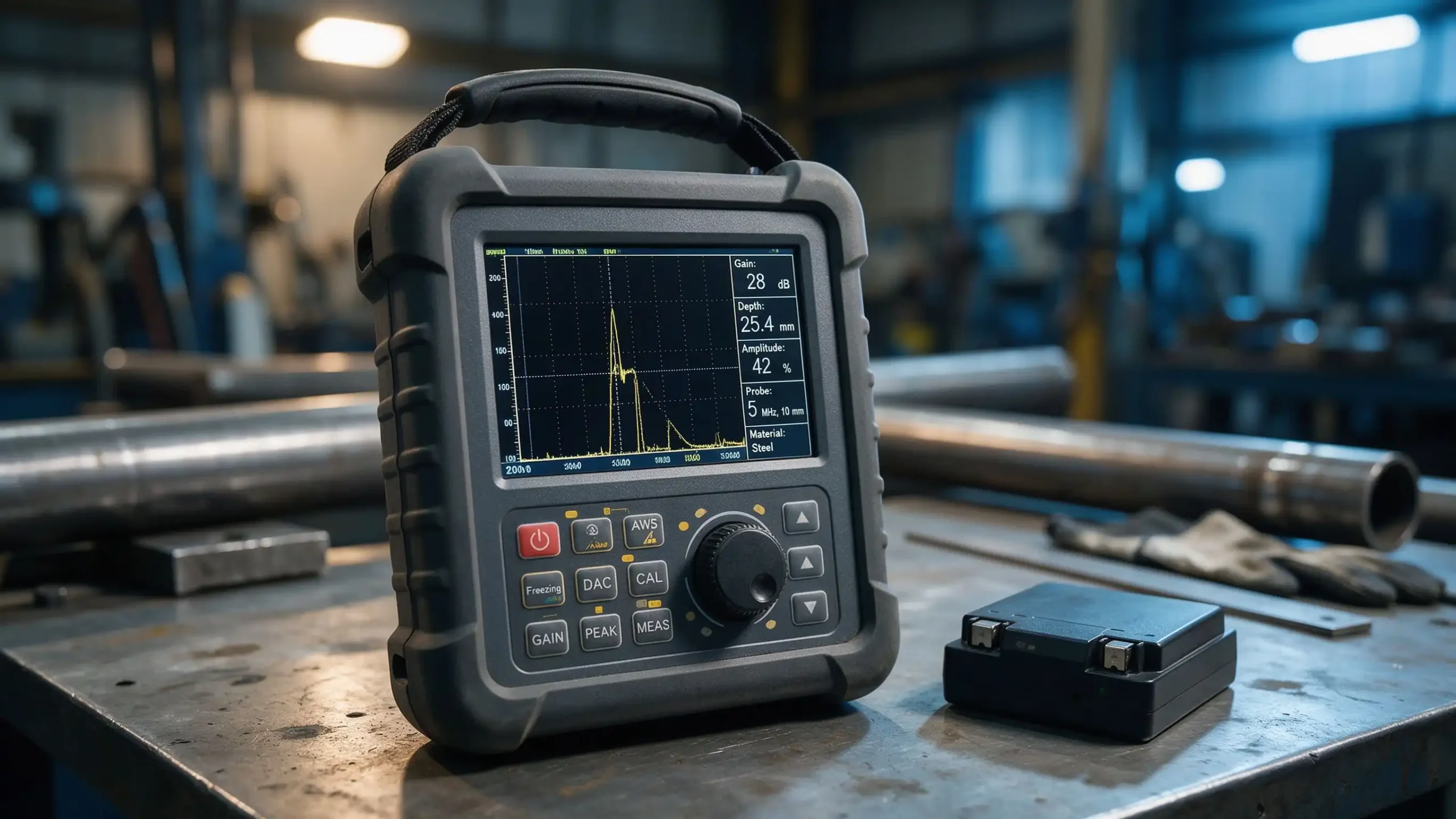
In the world of non-destructive testing (NDT), a battery is not a convenience — it is the instrument. When a certified inspector is on a refinery floor, on a rail inspection carriage, or inside a pressure vessel, the pack in their ultrasonic flaw detector, XRF analyzer, or eddy current probe determines whether the shift is productive or the weld report gets delayed. After years of engineering lithium-ion packs for portable NDT instruments, I have learned that off-the-shelf laptop batteries almost never survive this duty cycle. NDT battery packs are a specialized product: they must endure wide temperatures, repeated drops, continuous vibration, and the professional user’s non-negotiable demand for honest state-of-charge readouts.
This guide walks through what a purpose-built NDT rechargeable battery pack actually needs, from cell chemistry selection to BMS architecture, certification, and the field failures I see again and again.
1. The NDT Equipment Landscape and Its Power Draw Profiles
NDT is not one application — it is a family of inspection methods, each with a different electrical load profile. A battery engineer who treats them the same will end up with a pack that is either too heavy, too weak, or both.
1.1 Ultrasonic Testing (UT) and Phased Array (PAUT)
Digital ultrasonic flaw detectors and phased-array units are the most power-hungry of the handheld NDT family. They drive high-voltage pulser circuits, multi-channel analog front ends, color TFT displays, and on-board storage simultaneously. Production units such as the Evident OmniScan X4 use two hot-swappable 87 Wh Li-ion packs to deliver a minimum of five hours of operation under ISO 18563 standard setup conditions. Compact UT units, such as the Modsonic Arjun 10, ship with a 7.4 V 5 Ah (37 Wh) pack rated for roughly ten hours of continuous use while keeping the whole instrument under 800 g.
For the pack designer, the critical challenge is the pulsed nature of the load: the pulser draws short, high-current bursts that cause voltage sags if the internal impedance is too high. High-power cells with low ESR (equivalent series resistance), and a carefully routed pack main path, are mandatory.
1.2 Digital Radiography (DR / CR Detectors)
Flat-panel DR detectors and computed-radiography (CR) readers sit in a different envelope. Standby current is low, but during image readout the panel and readout electronics draw a sharp burst, and the display link (Wi-Fi or wired) adds its own peak. These packs are usually 11.1 V or 14.8 V, 4S configurations, sized for a full inspection day rather than a few hours.
1.3 Eddy Current Testing (ECT)
Eddy current instruments are the low-power benchmark. A pocket ECT unit such as the Olympus/Nortec PockET weighs only 321 g and is specified for up to twelve hours of battery life. Here the design priority is low quiescent current, a compact form factor, and a fuel gauge that remains accurate at very low average currents — a condition that defeats simple coulomb-counting algorithms.
1.4 Magnetic Particle (MT) and XRF Analyzers
Portable magnetizing units (yokes, prods, coils) draw high short-duration currents and often use sealed lead-acid or high-rate Li-ion packs. Handheld XRF analyzers, by contrast, are thermally sensitive — the detector tube requires stable temperature, and the battery must deliver consistent voltage through a full shift without thermal runaway risk. Field XRF units commonly specify IP54–IP55 ingress and MIL-STD-810G 1.22 m drop survival.
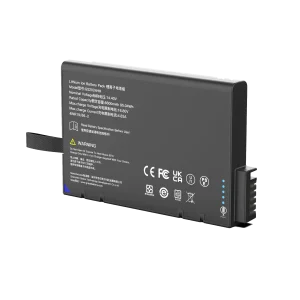
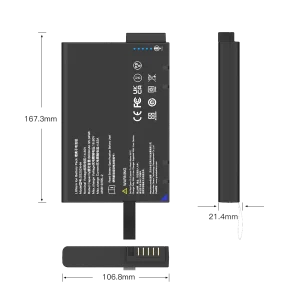
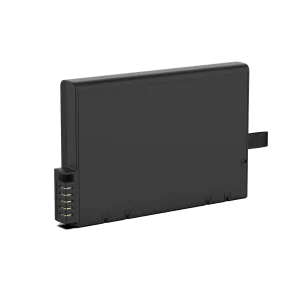
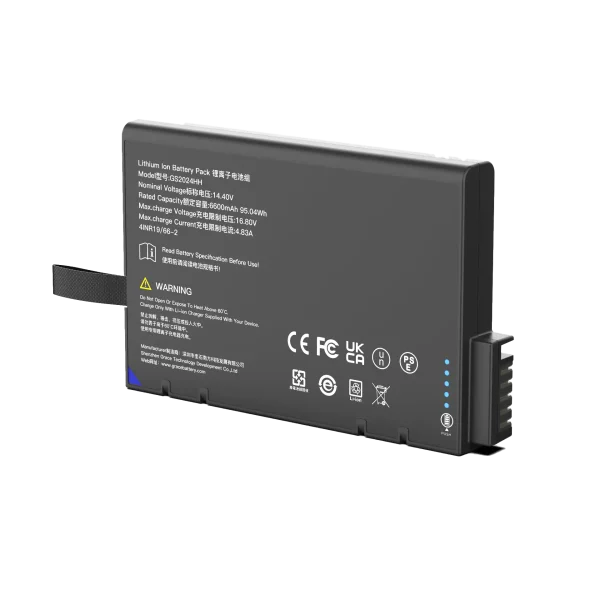
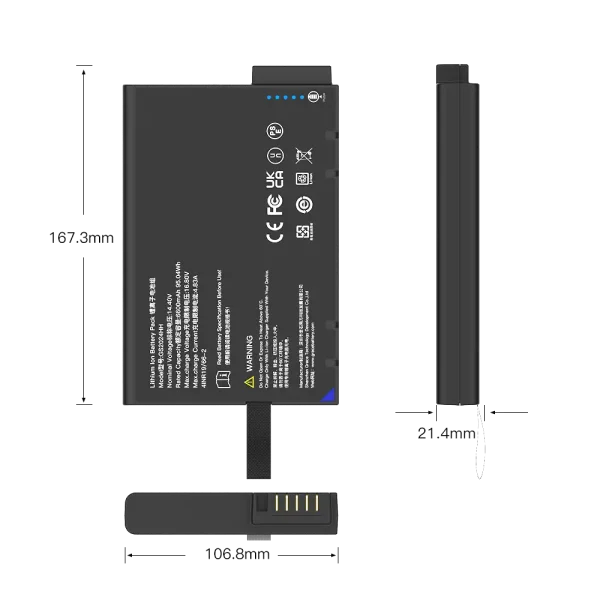
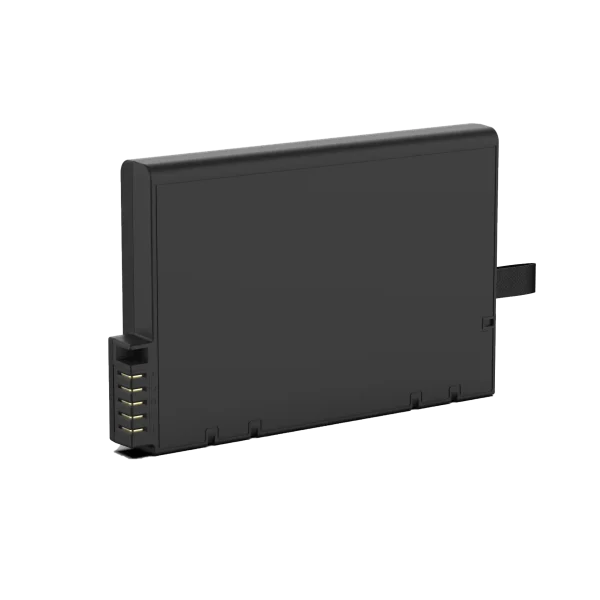
GS2024HH
14.4V/6900mAh/95.04Wh
2. Five Engineering Challenges on Every NDT Pack
2.1 Wide-Temperature Operation
NDT inspectors work in places that no consumer product warranty covers: outdoor pipe racks in winter (–10 °C to –20 °C), boiler interiors in summer (+50 °C), and coastal fog. A standard Li-ion pack derated to 0 °C charging and 60 °C storage will be flagged as failed on day one. Practical NDT packs specify an operating discharge range of –20 °C to +55 °C, with charging limited to 0 °C to +45 °C unless low-temperature-charge cells are used. The BMS must disable charging below 0 °C — that is not a nicety, it is a lithium-plating safety requirement.
2.2 Vibration, Shock and Drop
UN38.3 already mandates T3 vibration (a 7 Hz–200 Hz sine sweep over three axes) and T4 shock (150 G half-sine for small cells, 50 G for larger ones). Field use is harsher. A pack that passes UN38.3 on a bench can still fail after six months of being clipped to a technician’s tool belt on rough terrain. In practice we reinforce cell retention with high-compression foam, spot-welded nickel straps (not spring contacts for high-current paths), and over-molded or gasketed enclosures that meet IP54 or better.
2.3 Runtime, Hot-Swap and Weight
Inspectors will not accept a lunch-break charge. The design target is a full shift — typically 6–10 hours — and, on higher-end units, a second pack that can be swapped without powering down. Hot-swap requires the pack to present a stable voltage during contact bounce and the host to handle the brief gap cleanly. Weight matters too: every 100 g in the pack is felt after four hours of holding a probe.
2.4 Ingress and Contamination
Dust, hydraulic oil, salt spray, and occasional washdown are the norm. The pack enclosure should carry at least IP54, with IP65 where the instrument itself is rated for it. Connectors must be gasketed, and the BMS board conformal-coated. A sealed pack that breathes through a membrane vent (ePTFE) is preferred over a hermetically sealed one, because pressure cycling during altitude or temperature changes will otherwise push gaskets out.
2.5 Safety in Potentially Hazardous Areas
NDT is routinely performed in refineries, tank farms, and paint booths where an explosive atmosphere may exist. If the instrument is to be used in a Zone 2 / Class I Division 2 area, the pack must be designed with intrinsic-safety awareness: limited fault energy, careful fuse sizing, and coordination with the host’s ATEX/IECEx certification. This is not something you add at the end of the project; it constrains cell choice, fuse ratings, and connector geometry from day one.
3. Cell Chemistry: NMC vs LiFePO4 for NDT
Two chemistries dominate portable industrial packs today, and the choice is almost never obvious from the spec sheet alone.
- NMC (nickel-manganese-cobalt): Higher energy density (typically 240–260 Wh/kg in 18650/21700 cells), lighter weight, and better low-temperature discharge. Preferred for handheld units where every gram counts — UT flaw detectors, XRF analyzers, pocket ECT units.
- LiFePO4 (LFP): Lower energy density (~160 Wh/kg), but flatter discharge curve, longer cycle life (2000–4000 cycles to 80% capacity), and intrinsically safer thermal behavior. Preferred for heavier cart-mounted NDT systems, fixed installments, and packs that will see hard continuous duty or elevated temperatures.
My rule of thumb: if the inspector carries the instrument all shift, choose high-grade NMC and manage safety through a well-tuned BMS and enclosure. If the instrument lives on a cart, in a vehicle, or in a hot environment, LFP will age better and cause fewer warranty failures.
4. BMS and Fuel Gauge: Why a 5% SOC Error Costs Real Inspections
A fuel gauge that lies is worse than none at all. I have been on customer calls where an inspector trusted a 30% remaining readout, stepped into a vessel, and the instrument shut down mid-scan — because the real state of charge was 8%. On a phased-array system, that ruins a weld scan and may require re-accessing a confined space.
For NDT packs we specify gauges based on impedance-track technology (for example, the Texas Instruments bq series), which continuously learns cell resistance and open-circuit voltage rather than relying on coulomb counting alone. Communication to the host instrument is typically SMBus (System Management Bus), HDQ, or a custom UART protocol agreed with the OEM. The BMS should also provide:
- Hardware and software protection against overcharge, over-discharge, over-current, short circuit, and cell-level temperature faults.
- Passive or active cell balancing appropriate to the series count (usually 2S to 4S for portable NDT packs).
- Authentication (SHA-256 or similar) where the OEM wants to block third-party packs and protect the service revenue model.
- A protected discharge path that survives reverse insertion and contact bounce during hot-swap.
Typical NDT Pack Configurations at a Glance
| NDT Method | Typical Voltage | Capacity Range | Target Runtime | Dominant Chemistry |
| UT / PAUT Flaw Detector | 7.4 V – 14.8 V | 3 Ah – 6 Ah | 5 – 10 h | NMC (18650/21700) |
| DR Flat-Panel Detector | 11.1 V – 14.8 V | 4 Ah – 8 Ah | 6 – 8 h | NMC |
| Pocket Eddy Current | 3.7 V – 7.4 V | 1.5 Ah – 3 Ah | 10 – 12 h | NMC / Li-polymer |
| XRF Analyzer | 7.4 V – 11.1 V | 2.5 Ah – 5 Ah | 6 – 10 h | High-grade NMC |
| MT Magnetizing Yoke | 12 V – 24 V | 5 Ah – 10 Ah | High-rate bursts | LFP or high-rate NMC |
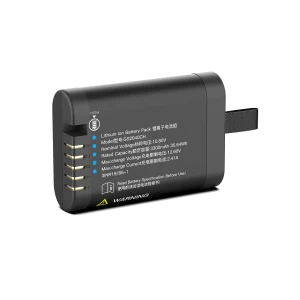
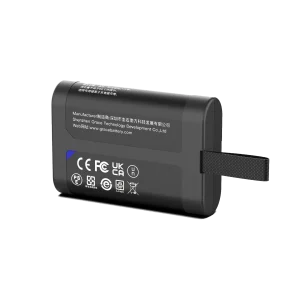
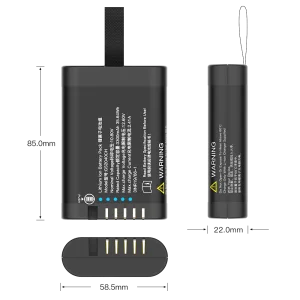
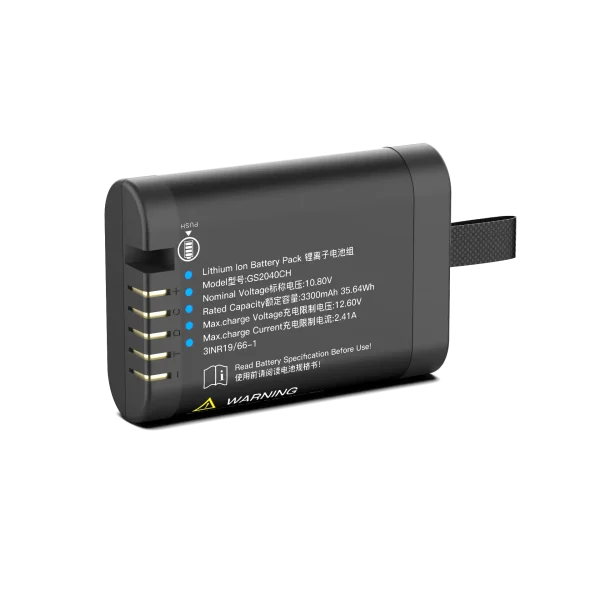
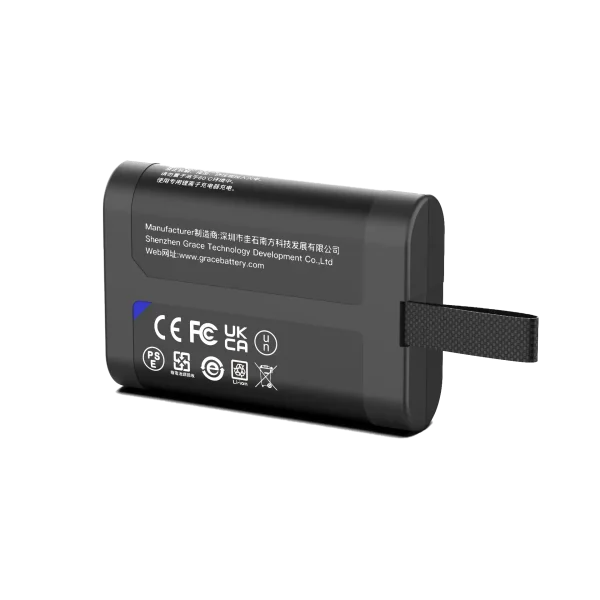
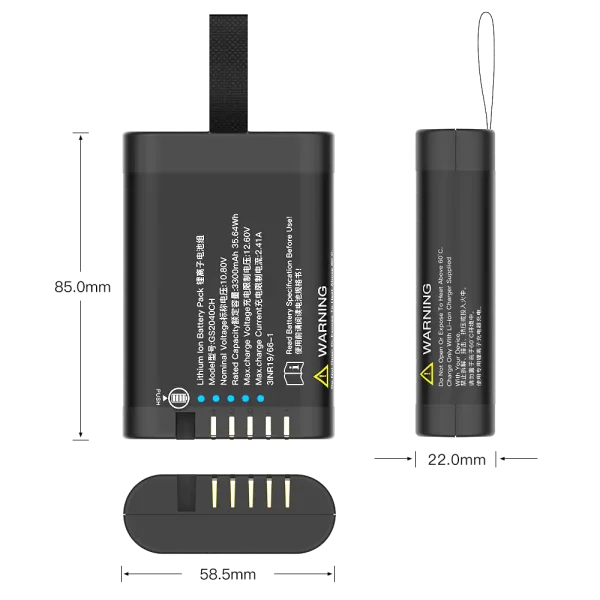
GS2040CH
10.8V/3450mAh/35.64Wh
5. Compliance and Certification Roadmap
A pack that passes bench tests but cannot be shipped across borders is not a product. For an NDT instrument sold globally, the baseline set of certifications includes:
- UN38.3 — transportation safety (T1 altitude, T2 thermal, T3 vibration, T4 shock, T5 short circuit, T6 impact, T7 overcharge, T8 forced discharge). Required by IATA, ICAO, and most national transport regulators before the pack can be shipped by air, sea, or road.
- IEC 62133-1 / 62133-2 — safety requirements for sealed secondary lithium cells and batteries used in portable applications. This is the harmonized safety standard behind CE marking in the EU and is increasingly referenced by OEM procurement specifications.
- Regional marks as required: UL 2054 / UL 62368-1 for North America, KC for Korea, PSE for Japan, BIS for India, RCM for Australia. Each adds test cost and lead time, so map the target markets before tooling the enclosure.
- Where the NDT instrument itself carries an IECEx / ATEX declaration, the pack must be assessed as part of that equipment’s certification — not as a standalone component.
6. Three Field Mistakes That Come Back to Haunt OEMs
6.1 Specifying a Consumer-Grade Cell
Consumer 18650 cells are cheap, but their cycle life is rated for a light-duty laptop duty cycle (1 C charge, 0.5 C discharge, 25 °C). NDT packs see irregular temperatures, partial discharges, and high peak currents. Within 18–24 months the consumer cells show 20% capacity loss while industrial-grade cells are still above 80%. The warranty math is brutal.
6.2 Skipping Cell Matching
When cells in a series string are not sorted by capacity, impedance, and OCV at the start, the weakest cell dictates the pack’s runtime. A 4S2P pack built from unsorted cells can deliver 15% less usable capacity than one built from properly matched grades. Sorting cost is tiny compared with a field failure.
6.3 Ignoring the Host-Side Power Budget
The pack is only half the system. The host instrument’s DC-DC efficiency, charge path, and fuel-gauge communication must be designed together. We have seen OEMs design a perfect 14.8 V pack, only to discover their instrument’s charge IC cannot handle the charge curve at low temperature, or their SMBus implementation does not match the gauge’s data format. Co-design early, validate on a bench power supply before tooling, and run a full day-cycle emulation before production release.
7. Conclusion
A reliable NDT instrument battery pack is the product of constrained engineering: high energy density in a rugged enclosure, an honest fuel gauge, protection electronics tuned to the real load, and a certification roadmap that matches where the instrument will actually be sold. Whether you are designing a new ultrasonic flaw detector, upgrading an XRF line, or replacing an aging NiMH pack, treat the battery as a co-developed subsystem — not as a commodity line item. The inspectors in the field will thank you, and your service department will see fewer pack returns.
If you are evaluating a custom NDT battery pack partner, ask them directly: which cells do they specify, how do they sort them, what fuel-gauge IC do they use, and can they show you UN38.3 and IEC 62133 test reports from an accredited lab. The answers will tell you more than any datasheet.