An Engineer’s Guide to Designing, Qualifying and Selecting Batteries for Mission-Critical Rugged Computing
By Author, Senior Lithium Battery R&D Engineer — TEFOO
1. Introduction
Rugged laptops, rugged tablets and rugged handheld computers are built for environments where ordinary consumer electronics give up: armored vehicle dashboards, oil rigs and refineries, first-responder scenes, warehouse floors, field-service vans, and work sites that swing between sub-zero nights and desert heat. The battery is the subsystem that decides whether the device stays alive — and in the field programs I have led, the battery is also the component most likely to fail first.
A rugged battery is not a consumer cell wrapped in a tougher plastic shell. It is a co-engineered system: a chemistry chosen for the temperature profile, a mechanical structure that survives shock and vibration, a thermal design that manages heat in both directions, an electronic brain that protects the cells and talks to the host, and a qualification program that proves all of it. This article walks through each layer — cell chemistry, mechanics, thermal, electronics, standards and testing — and closes with a practical specification checklist for OEMs. It reflects engineering practice and publicly available standards; final designs must always be validated against qualified test data and the regulations that apply to your target markets.
2. What “Rugged” Means for a Battery
“Rugged” is only meaningful when it is tied to a test profile. The most widely referenced framework is the U.S. Department of Defense standard MIL-STD-810H, which defines laboratory test methods for environmental stresses such as high and low temperature (Methods 501.7 and 502.7), temperature shock (503.7), vibration (514.8) and mechanical shock (516.8) [1][2]. Major OEMs publish the profiles they qualify against: Acer, for example, tests devices from -32 °C to 49 °C for extended periods [3], and Lenovo reports MIL-SPEC testing spanning 12 methods and 20 procedures, including humidity from 91 to 98 percent [4].
For a battery, the environmental profile matters more than for most other components, for three reasons. First, cell electrochemistry is strongly temperature-dependent: capacity, impedance and charge acceptance all move sharply outside a narrow window. Second, a battery stores energy, so mechanical abuse that a consumer pack shrugs off can, in an edge case, lead to internal shorts and thermal events. Third, the battery is a wear item: cycle and calendar aging degrade it even when the device itself is mechanically sound.
In practice I distinguish three grades. A ruggedized design adds mechanical margin to a standard design. A rugged design is built and tested against a defined environmental profile such as MIL-STD-810H. A mission-critical design adds redundancy, hot-swap capability and fleet telemetry. Knowing which grade your program needs is the first decision — it drives chemistry, cost and certification scope.
3. Cell Chemistry Selection
Chemistry selection is the single highest-leverage decision in a rugged battery program. There is no one “rugged” chemistry; there is a trade-off between energy density, cycle life, operating temperature, safety and cost.
3.1 NMC and NCA: energy first
Mainstream nickel manganese cobalt (NMC) and nickel cobalt aluminum (NCA) cells deliver the highest energy density and are the default for slim, high-capacity packs. Their weakness is the cold. Below roughly 0 °C, electrolyte viscosity rises, lithium-ion diffusivity in the electrodes falls, and interphase kinetics slow; charging in the cold risks lithium plating, which permanently consumes capacity and creates a safety hazard [5]. Below about -20 °C, standard cells lose a large share of usable capacity and discharge power.
3.2 LFP: stability and safety
Lithium iron phosphate (LFP) trades some energy density for stability: a thermal-runaway onset commonly reported around 270 °C [7], long cycle life, and better tolerance of elevated temperature. Standard LFP cells are still limited in deep cold, but wide-temperature variants extend operation further below freezing. LFP is attractive when safety margins and cycle life matter more than runtime per gram.
3.3 LTO: the extreme-environment specialist
Lithium titanate oxide (LTO) is the chemistry for genuinely extreme environments. LTO cells can charge and discharge at -40 °C without external heating, retain more than 80 percent of rated capacity at -20 °C and more than 60 percent at -40 °C, and deliver cycle lives beyond 10,000 cycles at 100 percent depth of discharge [6]. The price is low energy density — roughly one-third to one-half of NMC — so packs are larger and heavier.
Table 1 summarizes typical characteristics. The figures are representative values compiled from the cited industry sources, not datasheet guarantees; always verify against the cell manufacturer’s specification and your own qualification data.
Table 1 — Typical trade-offs of common chemistries for rugged battery packs (representative values; verify with cell datasheets)
| Chemistry | Relative energy density | Cycle life (100% DoD) | Cold performance | Thermal-runaway onset | Typical fit |
| NMC / NCA | High (≈250–270 Wh/kg at cell level) | 500–1,000+ cycles | Discharge usable to ≈ -20 °C; charge limited above 0 °C [5] | Lower; design-dependent | High-capacity rugged laptops and tablets |
| LFP | Medium (≈150–180 Wh/kg) | 2,000–4,000+ cycles | Standard cells limited; wide-temperature variants extend below -20 °C [6][7] | ≈270 °C (reported) [7] | Safety-critical and hot-environment devices |
| LTO | Low (≈70–100 Wh/kg) | 10,000+ cycles [6] | Charge and discharge at -40 °C; >80% at -20 °C [6] | Very high | Arctic operations, long-life field units |
Selection guidance: if runtime and size dominate and the environment is moderate, NMC/NCA with a BMS that blocks cold charging is the pragmatic choice. If safety and cycle life dominate, choose LFP. If the device must operate and charge in deep cold, or needs a decade-scale cycle life, LTO is the proven answer — or an NMC pack with an integrated heater, discussed next.
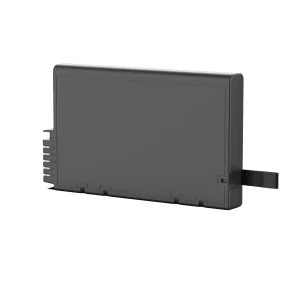
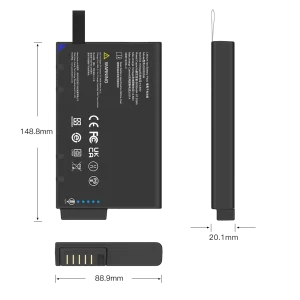
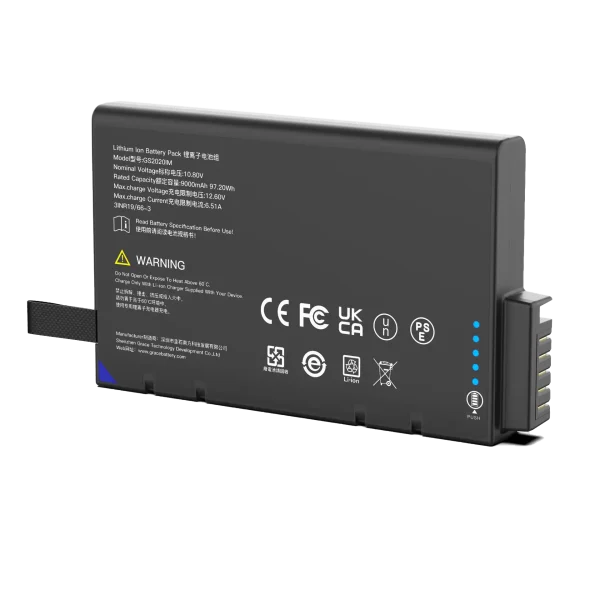
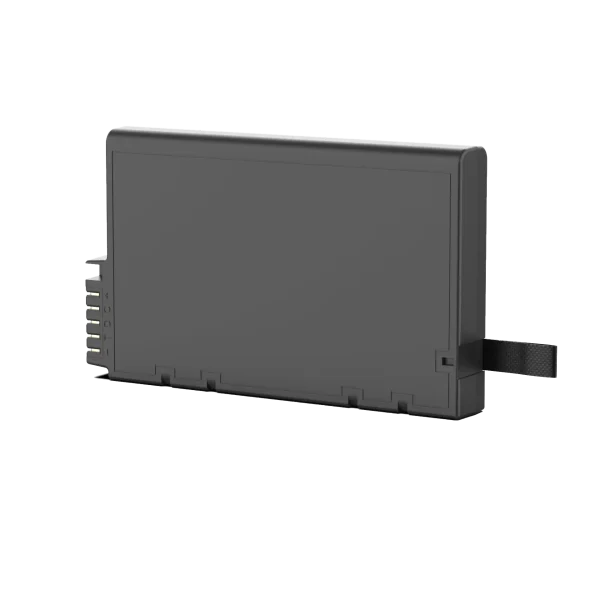
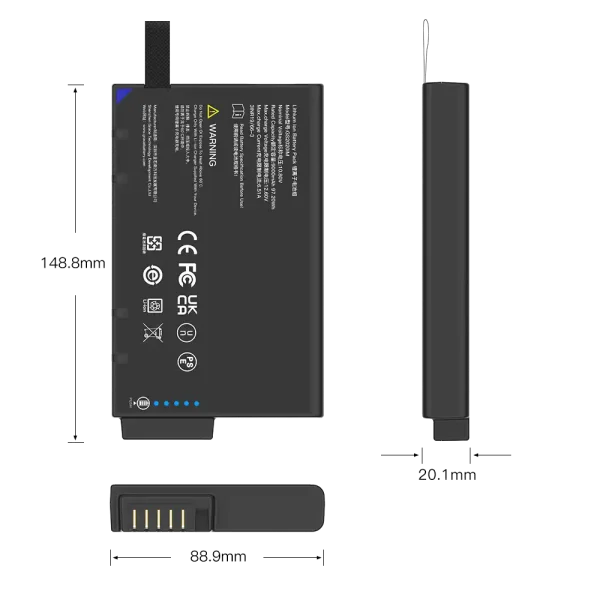
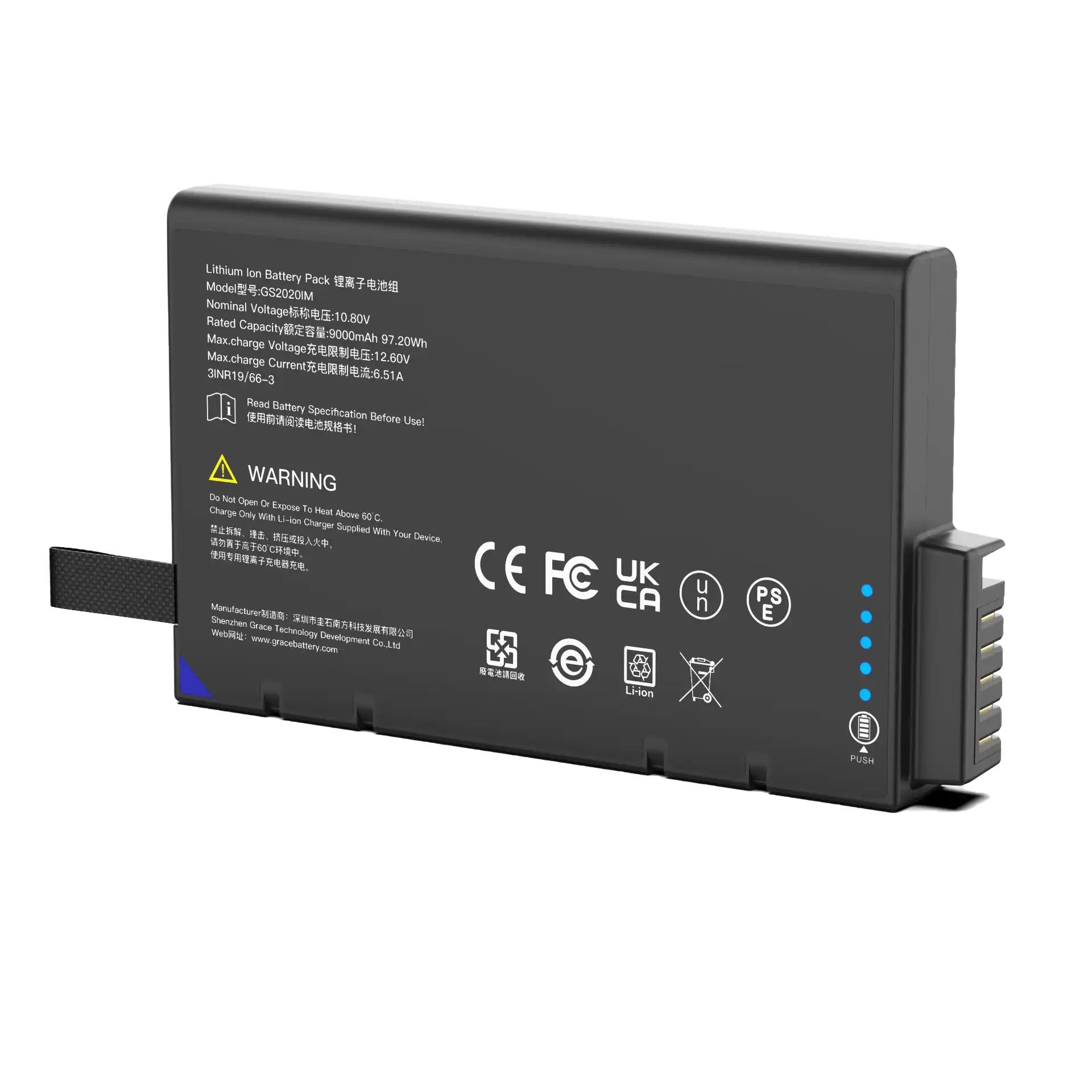
GS2020IM
10.8V/9300mAh/97.2Wh
4. Mechanical and Structural Design
The mechanical design turns a chemistry choice into a pack that survives the field. Cell format matters first. Cylindrical cells (18650/21700) are inherently robust under vibration and can be welded into rigid blocks; pouch cells offer packaging flexibility but need rigid support and controlled compression, and their tabs are vulnerable to fatigue. For high-vibration platforms I prefer cylindrical or prismatic cells with welded busbars over free-floating pouch tabs.
Encapsulation and strain relief are where vibration failures are won or lost. Selective potting around tab welds and connectors damps vibration and prevents tab fatigue; full potting trades away serviceability and thermal paths. Foam liners and mounting compliance absorb shock inside the device bay. Connectors should be locking, keyed and strain-relieved, with insertion-cycle ratings specified in the thousands for field-swappable packs. In our failure analysis, the two most common field root causes are connector fretting and cell-tab weld fatigue — both preventable at design stage.
Sealing determines ingress protection. Ingress protection (IP) ratings are defined by IEC 60529: IP67 means dust-tight and protected against temporary immersion in water up to 1 m for 30 minutes, while IP68 extends immersion to a depth and duration defined by the manufacturer [20][21]. Rugged tablets in the field, such as Samsung’s Galaxy Tab Active series, ship with IP68-rated enclosures [19]. A battery compartment must preserve that seal while remaining serviceable — a classic tension between protection and maintainability that deserves dedicated design effort, not an afterthought.
5. Thermal Management in Extreme Environments
5.1 The cold side
Charging a lithium-ion battery below 0 °C risks lithium plating, which permanently reduces capacity and creates a safety hazard [5]. The BMS must therefore block or derate charging below the chemistry’s safe threshold, and tell the host why. For devices that must charge in the field in winter, the practical options are: an integrated heater (PTC film or self-heating element) with a heat-then-charge sequence; a well-insulated enclosure that keeps the pack warm between uses; or an LTO chemistry that accepts cold charging natively [6]. Cold discharge also deserves attention — voltage sag and capacity loss at low temperature must be reflected in cut-off thresholds and gauge calibration (Section 6).
5.2 The hot side
High-rate discharge inside a sealed pack generates heat that cannot escape easily. Above roughly 45 °C, charge current must be derated, and cell temperature should be sensed at multiple points, not one. Thermal-runaway containment — ceramic or glass-fiber barriers between cells, flame-retardant enclosure plastics, pressure vents, and cell-level protection such as per-cell fuses and current-interrupt devices — is the last line of defense and is a core requirement of pack-level safety standards [8][9]. In a sealed rugged pack, that containment must survive the same shock and vibration as everything else.
5.3 Altitude and sealed packs
Sealed enclosures must handle pressure differentials during air transport and at altitude without stressing the case or breaking the IP seal. Venting strategies that relieve internal pressure must remain compatible with dust and water protection — a design detail that shows up repeatedly in altitude and rapid-decompression test failures [1].
6. Electronics: Protection, BMS and Smart Battery Communication
6.1 Protection hierarchy
Protection is layered. At cell level: fuses, current-interrupt devices, and separator shutdown. At pack level: a protection IC driving MOSFET cutoff for overvoltage, undervoltage, overcurrent, short circuit and over-/under-temperature. At system level: secondary protection such as a second IC or thermal fuse so a single point of failure cannot defeat the design [9][10]. In rugged packs, protection thresholds must be tuned for cold-weather impedance rise — a threshold set for 25 °C can cause nuisance shutdowns at -20 °C.
6.2 Balancing and gas gauging
Series strings need cell balancing; passive balancing is the norm, and tight cell capacity matching at assembly is what keeps early imbalance in check. Mission-critical run-time estimates need learning gauges that track impedance and state-of-health — Impedance Track-based gauges are a common example [17]. Gauge accuracy at low temperature requires calibration data collected at cold, not extrapolated from 25 °C curves.
6.3 Smart battery over SMBus
The Smart Battery System (SBS) is the industry architecture for intelligent packs: smart battery, smart charger and smart selector communicate over the System Management Bus (SMBus) using Smart Battery Data (SBD) commands such as RemainingCapacity() and AverageCurrent() [13][14][16]. The battery keeps charge/discharge intelligence in the pack and exposes remaining capacity, temperature, cycle count and chemistry to the host; a smart selector arbitrates between two packs, which is what makes hot-swap practical [15]. For rugged devices, SBS-level packs are not a luxury — they deliver the accurate run-time, hot-swap and telemetry that mission users depend on.
6.4 Pack memory and authentication
On-board EEPROM holds the serial number, manufacture date, cycle count, temperature history and learned capacity — the data trail that makes warranty claims and field-return analysis possible. Hash-based authentication (for example SHA-1 on the TI BQ20Z70 gas gauge [17]) blocks counterfeit packs, which matters in safety-critical fleets. My experience from field-return analysis: without the EEPROM log, a “dead battery” claim is guesswork; with it, we find the real cause — cold charging, connector damage or genuine cell aging.
7. Standards, Certification and Compliance
A rugged pack usually has to satisfy several independent sets of requirements at the same time.
Environmental qualification. MIL-STD-810H methods define the temperature, shock, vibration and humidity profiles the pack must survive; qualified test reports from a recognized laboratory are the evidence [1][2].
Ingress protection. IEC 60529 IP codes define dust and water resistance claims such as IP67 and IP68 [20][21].
Transport safety. UN 38.3, the battery tests in the UN Manual of Tests and Criteria, requires a defined series of tests — altitude simulation, thermal cycling, vibration, shock, external short circuit, impact, overcharge and forced discharge — for lithium batteries shipped internationally by air, sea or road [11][12].
Product safety. IEC 62133-2 covers the safety of portable sealed secondary lithium cells and packs, including mechanical abuse tests such as crush [8]. UL 1642 covers lithium cells [9], and UL 2054 covers household and commercial batteries, frequently required for North American markets [10].
Regional requirements — CE marking, RoHS/REACH and battery-specific regulations — apply depending on target markets; verify current versions with your compliance partner at program kickoff, not at ship date.
Table 2 — Key standards for rugged battery packs
| Standard | Scope | Why it matters for rugged packs |
| MIL-STD-810H [1][2] | Environmental test methods: temperature, shock, vibration, humidity, altitude | Defines the environmental profile the pack must survive; test reports are the qualification evidence |
| IEC 60529 [20][21] | Ingress protection (IP) codes | Basis for dust/water resistance claims such as IP67 and IP68 |
| UN 38.3 [11][12] | Transport safety tests for lithium batteries | Mandatory for international shipping by air, sea or road |
| IEC 62133-2 [8] | Safety of portable sealed secondary lithium cells and packs | Product safety including mechanical abuse such as crush |
| UL 1642 [9] | Lithium cell safety | Common cell-level safety requirement, especially for North America |
| UL 2054 [10] | Household and commercial battery safety | Common pack-level safety requirement for North American markets |
Build the certification matrix at kickoff. UN 38.3 and cell/pack safety data come from the cell supplier and your pack house; environmental qualification is program-specific; keep every test report traceable to the exact configuration it was run on.
8. Reliability Testing and Qualification
Qualification is where “rugged” is actually proven. The core blocks are: temperature (thermal shock with rapid transitions, thermal cycling, storage extremes, cold start); mechanical (random vibration such as the 5–500 Hz profiles of MIL-STD-810H Method 514.8 [2], shock and drop to the height defined by the device’s ruggedness specification, connector durability cycling); humidity and condensation, including high-humidity exposure in the 91–98 percent range [4]; and environment-specific tests such as salt fog for marine and coastal deployments, sand and dust, and low-pressure altitude exposure [1].
Aging is the part programs most often under-scope. Cycle life to a defined retention target (for example 80 percent after the specified number of cycles) and calendar aging at elevated temperature should be tested up front, then correlated with field data. The deliverables that matter: test reports, PPAP-style documentation, the UN 38.3 test summary, safety data sheets, a DFMEA, and a clear statement of what each test did and did not cover.
One lesson from my own programs: the tests that catch real problems are thermal shock and vibration applied to the assembled pack with the connector mated — not to the bare cell. Test the interface, not just the component.
9. Designing for the Field
Mission users do not have the luxury of shutting down to swap batteries. Dual-battery designs let operators swap without powering down — Getac’s rugged tablets, for example, support hot-swappable dual-battery configurations with standard and high-capacity packs [18], with SBS selectors arbitrating between them [15]. If your program allows it, make the battery a field-replaceable unit (FRU): define replacement intervals, connector torque, and the tooling field technicians carry.
Fleet and asset telemetry rides on the same SMBus data stream: state of health, cycle count and temperature history read out over the bus enable predictive maintenance instead of reactive failures. Cold logistics deserve the same rigor as cold operation — storage and transport below the cell’s storage limit degrades packs before they ever reach the field, and air carriage adds UN 38.3 packaging and watt-hour rules [12].
10. Selection Guide for OEMs
The checklist in Table 3 is the specification you should hand a battery partner before they quote anything. Ambiguity in any one row usually comes back as a field failure or a warranty dispute.
Table 3 — OEM specification checklist for a rugged battery program
| Area | Key parameters to define |
| Electrical | Nominal voltage; capacity in Wh; continuous and peak discharge current; charge profile (CC-CV, current, voltage) and temperature limits |
| Environmental | Operating and storage temperature range; IP rating; MIL-STD-810H methods to qualify; humidity, salt fog, sand/dust and altitude exposure |
| Life and warranty | Target cycle life; calendar life; capacity retention at end of life; warranty terms and field-return process |
| Intelligence | SMBus/SBS compliance level; data fields required (state of health, cycle count, temperature history); gauge accuracy at low temperature; authentication; host firmware interface |
| Compliance | UN 38.3; IEC 62133-2; UL 1642/2054; regional marks; who owns each test report |
| Mechanical and labeling | Form factor; connectors; mounting; sealing; serviceability; safety vents; watt-hour and regulatory labels; branding and color |
| Supply chain | Cell source and dual sourcing; cell end-of-life and obsolescence plan; MOQ, lead time, country of origin |
Questions worth asking any supplier: How do you verify cold-charge blocking? Can you show thermal-runaway containment evidence for the sealed pack, not just the cell? What is your gauge accuracy at -20 °C? Who owns the UN 38.3 report — and is it current for this exact configuration? Suppliers that cannot answer with documents, not anecdotes, are not ready for a rugged program.
11. What’s Next in Rugged Battery Technology
A few trends will shape rugged batteries over the next few years. Silicon anodes will push energy density higher, with swelling management becoming a pack-design challenge. Semi-solid and solid-state electrolytes promise better low-temperature behavior and reduced flammability; they are still maturing for mass production, but safety-critical rugged segments will be early adopters once field reliability is proven. Temperature-aware fast charging will shorten recharge cycles without sacrificing cycle life. And battery-health analytics on the SMBus data stream will turn fleet telemetry into predictive maintenance. As with everything in this article: validate before you specify.
12. FAQ
Q: Which chemistry is best if the device must operate at -30 °C? A: LTO charges and discharges at -40 °C with more than 60 percent capacity retained [6]; alternatively, a heater-assisted NMC pack. Standard LFP and NMC cells will not meet that cold target.
Q: Can rugged battery packs be shipped by air? A: Yes, if the pack is UN 38.3 qualified and packaged per transport regulations, subject to the watt-hour limits that apply to air carriage [11][12].
Q: How long should a rugged battery last in service? A: It depends on cycle and calendar aging. Define capacity-retention and warranty targets with your partner up front; a field-replaceable pack keeps aging manageable over the device’s service life.
Q: IP67 or IP68 for the battery compartment? A: IP67 is dust-tight with temporary immersion to 1 m for 30 minutes; IP68 extends immersion to a manufacturer-defined depth and duration [20][21]. Choose based on the device’s immersion specification — and remember the battery door must maintain the rating after hundreds of swaps.
Q: Why do rugged devices use “smart” batteries? A: SMBus/SBS packs report remaining capacity, temperature, cycle count and health to the host, enable hot-swap arbitration between packs, and feed fleet telemetry [13][14][15][16].
13. Conclusion
A rugged battery is engineered, not assembled. Define the environmental profile first, select chemistry against it, design mechanics and thermal to match, put a smart BMS on top, and prove everything with a traceable qualification program. Then work with a battery partner that can show test evidence rather than datasheets alone — one that treats the pack as a co-engineered subsystem of your device. That is the difference between a battery that survives the field and a battery that fails it.
14. About the Author
Author is a Senior Lithium Battery R&D Engineer at TEFOO, leading rugged and industrial battery programs from cell selection and pack design through certification and field support, with 10+ years in the lithium battery industry.
15. References
[1] Sangster Engineering, “MIL-STD-810 Environmental Testing Requirements” (MIL-STD-810H methods 501.7/502.7/514.8/516.8). https://www.sangstereng.com/post/mil-std-810-environmental-testing-requirements
[2] ASUS, “MIL-STD-810H Test Report” (ExpertBook B5 OLED, methods 501.7 and 514.8 parameters). https://dlcdnwebimgs.asus.com/files/media/a554f1a4-c5d3-4d3b-92f9-f9e9d545abf6/ExpertBook%20B5%20OLED_B5602CVA_B5602CVN_Military%20grade%20report_810H.pdf
[3] Acer, “Military Grade Reliability” (-32 °C to 49 °C temperature testing). https://www.acer.com/ph-en/military-standards
[4] Lenovo, “ThinkPad Laptops — Durability & Reliability Tested” (12 methods, 20 procedures, 91–98% relative humidity). https://www.lenovo.com/ph/en/thinkpad-milspec
[5] MDPI Materials 15(22):8166, “Lithium-Ion Batteries under Low-Temperature Environment: Challenges and Prospects” (2022). https://www.mdpi.com/1996-1944/15/22/8166
[6] JYH Technology, “Extreme Temperatures and Wide Temperature Battery Lifespan” (LTO cold performance and cycle life). https://www.jyh-battery.com/extreme-temperatures-and-wide-temperature-battery-lifespan.html
[7] VTC Power, “Wide Temperature Lithium Batteries: The Ultimate Buyer’s Guide for Extreme Climates” (LFP thermal-runaway onset). https://vtcbatt.com/wide-temperature-lithium-batteries-the-ultimate-buyers-guide-for-extreme-climates/
[8] IEEE Xplore, “The Use of UL 1642 Impact Testing for Li-ion Pouch Cells” (IEC 62133-2 crush test discussion). https://xplorestaging.ieee.org/ielx7/6287639/8600701/08924629.pdf?arnumber=8924629
[9] UL Solutions, “Lithium-Ion Batteries” (UL 1642 scope for secondary lithium cells). https://code-authorities.ul.com/wp-content/uploads/sites/40/2015/02/New_Science_SE_Journal_Issue_2.pdf
[10] NTSB, “UN Lithium Battery Transport Tests & UL Battery Safety Standards — Status Update” (UL 2054 scope). https://www.ntsb.gov/news/events/Documents/2013_Lithium_Batteries_FRM-Panel2a-Florence.pdf
[11] UL Solutions, “UN/DOT 38.3 — UN Manual of Tests and Criteria, lithium batteries” (test scope and transport application). https://www.ul.com/services/ev-battery-testing-compliance-regulatory-requirements-and-standards
[12] Element Materials Technology, “Lithium-Ion Battery Certification Guide” (UN 38.3 transport applicability). https://www.element.com/resources/articles/lithium-ion-battery-certification
[13] SBS-IF, “Smart Battery Data Specification”, Revision 1.1 (RemainingCapacity(), AverageCurrent()). https://sbs-forum.org/specs/sbdata10.pdf
[14] SBS-IF, “Smart Battery Charger Specification”, Revision 1.1. https://sbs-forum.org/specs/sbc110.pdf
[15] SBS-IF, “Smart Battery Selector Specification”, Revision 1.1 (dual-battery arbitration). https://sbs-forum.org/specs/sbsel110.pdf
[16] PMBus.org, “PMBus Ancestry” (SMBus physical layer and Smart Battery Data command language). https://pmbus.org/about-pmbus/pmbus-ancestory/
[17] Texas Instruments, “BQ20Z70-V160” (SMBus gas gauge, Impedance Track algorithm, SHA-1 authentication). https://www.ti.com/product/BQ20Z70-V160
[18] Getac, “Getac G140: Rugged AI Tablet for Field Operations” (hot-swappable dual-battery configuration). https://www.getac.com/us/blog/getac-g140-rugged-ai-tablet/
[19] Samsung Newsroom, “Galaxy XCover7 Pro and Galaxy Tab Active5 Pro” (IP68-rated rugged devices). https://news.samsung.com/ca/samsung-introduces-galaxy-xcover7-pro-and-galaxy-tab-active5-pro-ruggedized-devices-for-frontline-excellence
[20] RS Components, “IP Ratings Guide” (IP67 definition: dust-tight, 1 m / 30 min immersion). https://au.rs-online.com/web/content/discovery/ideas-and-advice/ip-ratings
[21] Beckhoff EP8309-1022 manual, page 80 (IEC 60529 IP code definitions). https://www.manualslib.com/manual/3472860/Beckhoff-Ep8309-1022.html?page=80